
Video works by Jarrett Key & Kameron Neal at (Im)Posibilidades: Performance Art for Video Exhibition at Ogden Contemporary Arts. Image courtesy of Tristan Sadler.
Video art has been around for a long time. Performance art even longer. The exhibition (Im)posibilidades, at Ogden Contemporary Arts, is at the center of the Venn diagram of the two. And it’s an interesting place to be.
Performance art is in person, live, and ephemeral. Not theatre, but sharing many of theatre’s best qualities. It’s not narrative—usually—but it tells stories, sparks conversation and questions everything.
Video art is, well, on video or film or digital media. It is recorded and can be “collected” by museums or individuals. Not all video art involves performance. It involves many forms and variations and can be as multi-media as any exhibition involving multiple media. It hasn’t always won the hearts of museum and gallery visitors, but its nascent forms in the 1970s had a much closer tie to performance art of the time than much of what was produced in the 1980s and 1990s. But since the early 2000s, video art has met much higher critical success and has expanded and opened up to many variables, not the least of which is advancement in technology.
All that is to say, the concept of this exhibition of performance art for video is fully ensconced in that center of the Venn diagram. We aren’t seeing these performances live, but the human bodies of the artists and their participants are the work, more than the digital video on which they’re presented. There are some effects that have been added, but the performance itself is ultimately what we’re here to see.
Beyond the focus on a medium, the conceptual scope of this exhibition is to “dismantle stereotypical gender roles and expose the environmental and cultural harm caused by rapid gentrification and the overarching forces of capitalism.” Video art has always been strongest at exposing ideas. Its ability to change minds is a topic for a much larger discussion. But what the curators have presented in this exhibition are works by 14 artists who actively look at issues and bring experiences to audiences who may not have the ability to see those issues despite our unending access to news and information. They pull from that behemoth of global information and take topics that are both familiar and unfamiliar and shed new light on them. Their light, that is, their personal light that may be a shared light with us.

Visitors watch José Villalobos’ El Peso del Río / The Weight of the River (2021), a performance video dedicated to the artist’s mother. Image courtesy of Tristan Sadler.
“El Peso del Río/The Weight of the River” (2021) by José Villalobos is a perfect example. Villalobos dedicates the work to his mother, “a resilient courageous woman who fought the violent currents of the river and the pressing heat of the desert.” The artist’s personal connection with the subject matter ensures the performance carries authenticity and directness. It also makes watching his video performance particularly impactful. As he meanders across the sandy soil near the Rio Grande River, filling the plexiglass box over his head with water from gallon jugs, we can feel the fear and the trauma he’s experiencing. When he breaks the box with a rock, we flinch. When he takes on the ropes to pull tires, we feel the heaviness that is both physical and emotional.
These images could be portrayed in a painting or sculpture, or even a series of photographs, and still present the idea of what it means to enter this country for so many people. But would we feel it in the same way? Would we see it in the same way? Certainly, this is a hot-button issue right now and one that elicits strong opinions, but perhaps this is where performance art—in person or recorded as in this exhibition—has the power to express infinitely complex subjects in a way that we 21st-century, digitally-driven people can grasp more deeply.
The same could be said for Javier Ocampo’s “Utopia” (2019). As he chases—literally—the word “Utopia” in circles around the sculpture of Justice in front of the Palace of Justice in the artist’s hometown of Morelos, Mexico, we feel like we’re seeing a heavy-handed lesson about the futility of the pursuit of justice at first. But watching the artist’s perseverance builds an emotional platform for our empathy. We don’t see it as out of reach, but, rather, just within our grasp and, more importantly, worthy of continued pursuit. Again, this could have been presented in another medium, but seeing the performance and understanding the artist’s personal connection to the place and the subject (as the label mentions, he’s a “gay, brown, lower-middle-class man living on the fringes in Mexico”) makes it real for us. It seems the image has more potential to stay in our mind, playing back on a loop in the way it plays in the gallery.

Still from Javier Ocampo “Utopia” (2019).

A visitor watches Beth Krensky’s “Make Me a Sancutary,” while Naomi Rincón Gallardo’s “Eclipse” plays in the background. Image courtesy of Tristan Sadler.
In an upstairs gallery, artists expand these themes of struggle and resilience. Beth Krensky carries a portable tent across the barren edges of the Great Salt Lake in search of sanctuary; María Eugenia Chellet reimagines Catholic iconography to embody mourning and hardship during the Covid-19 pandemic; Leo Marz reframes history with green-screen dancers in front of Mexico City’s Museo Jumex; and Naomi Rincón Gallardo’s “Eclipse,” steeped in Mesoamerican mythology, envisions cosmic catastrophe and looming extinctions. The upstairs portions of the show are tighter and a bit harder to step back from, yet they still draw viewers into an immersive encounter with each work.
Larger-scale in video art is always more immersive. You can’t get away from 10 to 15-foot-high images or life-size people in a video shown at average standing height. Cannupa Hanska Luger’s “Midéegaadi: Water Bison, Light Bison, Fire Bison” (2022) from the series Future Ancestral Technologies, is the largest projection in the exhibition. And the size does matter. The figures tower over us, in a good way, grabbing our full attention and captivating our eyes with active images of the artist dancing in buffalo regalia made of repurposed materials, superimposed over images of the Great Plains of North Dakota. The three projections come in at different times and change throughout the looped video. But the dance continues at pace even during the changes. The regalia is bold and visually powerful. It’s impossible not to watch the entire two and a half minutes and then want to stay and watch again.
And the ability to keep watching the performance is another thing that sets video art like this apart from live performance art. The ephemeral nature of performance art has a particular impact, but one reserved for those in attendance. Many performance art pieces have been photographed and filmed, preserving them for posterity. But the recorded images of those works are not the art; they are documentation. What the artists of (Im)posibilidades present is the possibility to watch and re-watch, in the gallery, their performance, perhaps bringing new insights or exposing new details as we loop along with the video. In a TikTok world of fast visual consumption, the chance to spend time with a performance and take in all it has to offer is a pretty special opportunity.

Cannupa Hanska Luger’s “Midéegaadi: Water Bison, Light Bison, Fire Bison,” (2022), fills a gallery wall with three larger-than-life projections of the artist in buffalo regalia. Image courtesy of Tristan Sadler.
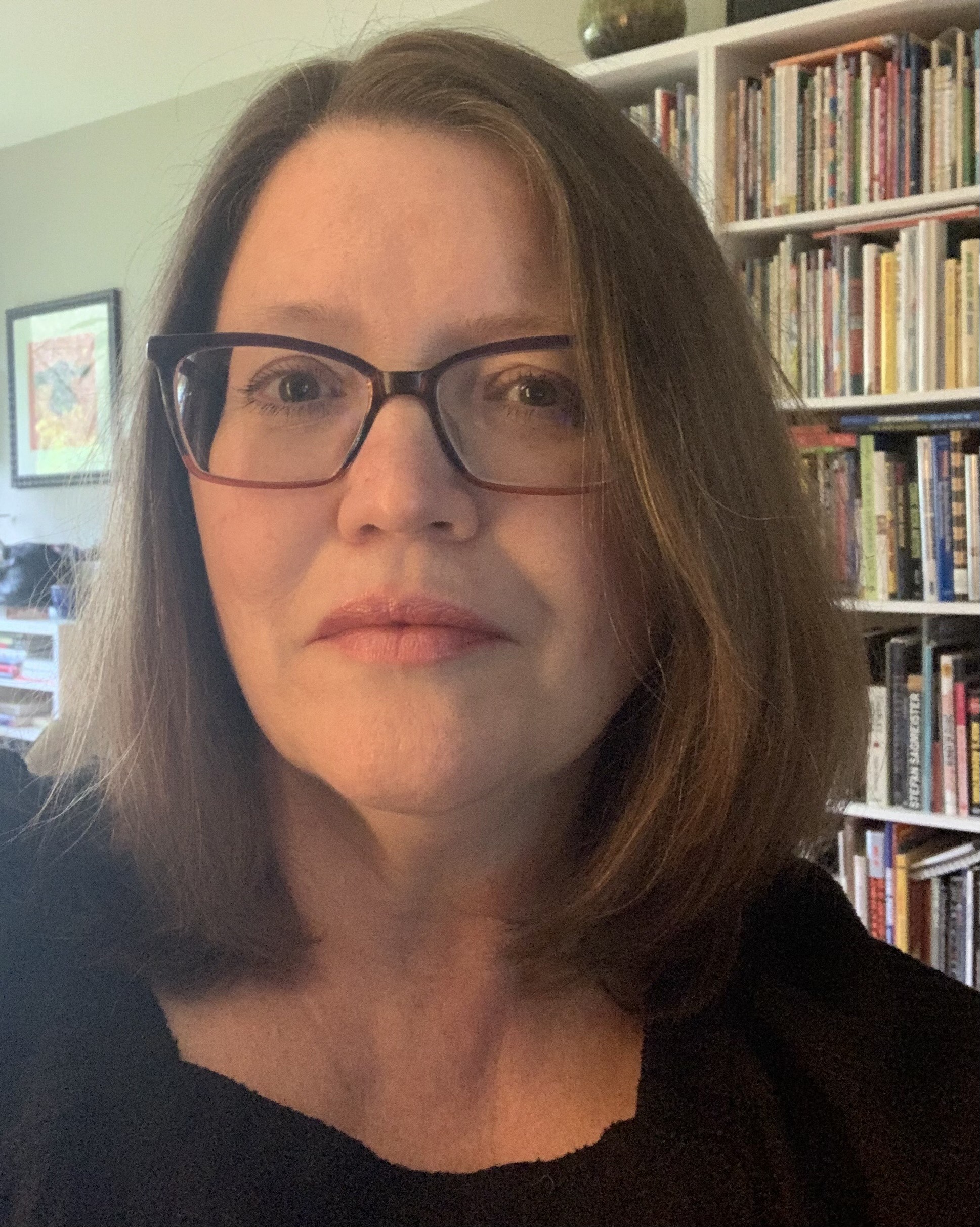
Gina Cavallo has been a curator, registrar, and executive director in museums for over 35 years. She spent many years as an art critic for publications in Phoenix. She began her career at the Phoenix Art Museum and the Heard Museum, was a founding curator at the Scottsdale Museum of Contemporary Art, spent two terms managing exhibitions at the Virginia Museum of Fine Arts, and was the Executive Director at the Mission Inn Foundation & Museum in Riverside, California. Her current role is Director of Development for Taproot Theatre Company in Seattle where she also serves as the curator of the Kendall Center Exhibition Series. She moved to Orem in 2024 with her husband, a theatre faculty member at UVU.
Categories: Exhibition Reviews | Visual Arts