
At Alpine Art and Frame, Matthew Hassing’s aspen composition leads into a viewing bay with works by Jodi Steen and Sarah Ashley Peterson.
A Perspective of Nature, now on view at Alpine Art & Frame in Salt Lake City, brings together four artists—Sarah Ashley Peterson, Laura Hope Mason, Jodi Steen, and Matthew Hassing—whose works channel the restorative power of the natural world into the places we live and gather. At a time when the world can feel heavy, these paintings offer an antidote: light, air, and color drawn from quiet horizons and open skies. Each artist approaches the landscape as a source of energy to translate, moments of stillness, renewal, and joy distilled into form. The result is a show that feels both lively and cohesive, a reminder that what grounds us outdoors can also elevate the mood indoors.
“We wanted to bring together artists who each approach the landscape in different ways,” says Susan Bonosconi, Gallery Director at Alpine Art & Frame. “I challenged the artists to find peace and solace in nature, to notice those moments of calm while hiking, standing before a lake, or watching the light change, and bring that feeling back into the home. It’s in times like these we need that uplifting energy.” With a professional background in interior design and over a decade at Alpine Art, Bonosconi approaches curation much like design itself—creating balance, warmth, and harmony.
For A Perspective of Nature, she invited the artists to take on that challenge, resulting in a collection that moves gracefully between quiet contemplation and vivid expression. Peterson, Mason, Steen, and Hassing developed the show over six months, each finding a different way to translate what they value most in nature into technically refined, visually resonant designs.

Laura Hope Mason, “Salinity 4,” acrylic, 24×12 in.
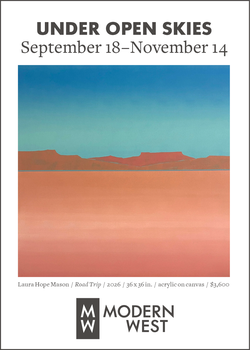
Mason’s paintings describe quiet planes of earth and sky, where light and color become the real subject. Works like “Toasty” and “Evanescence” explore subtle shifts of tone across long, open plains near the Great Salt Lake and the Bonneville Salt Flats. Her gradations move from dusty peach to soft mauve, with mountain silhouettes anchoring the horizons. The effect is calm but charged. In “Powder” and “Morning Glow,” she leans into cooler spectrums of blue and violet, coaxing the shimmer of light on air without tipping into pastel.
Hope Mason’s showstopper, “Salinity 4,” hits you with instant Bowie-era cool. Half pink, half blue, the painting is divided by a lightning-shaped white line—a divide cutting through the Great Salt Lake. It feels both geographic and glamorous in a modern minimalist way, a real feature of Utah turned into a piece of pop iconography. The composition has that magazine-cover starkness and cool—the kind of image that feels both effortless and iconic. The palette channels David Hockney, one of my favorite painters, with that bright precision and cinematic flatness that turns simplicity into style. I can imagine taking it home, meditating in front of it each morning, coffee cup in hand: a Great Salt Lake altar to light, design, and discipline. Hope Mason’s composition captures the lake’s otherworldly clarity, where color feels both natural and invented, and where beauty hovers just on the edge of abstraction.
Across the gallery, Bonosconi has placed Mason’s work in quiet dialogue with Peterson’s, pairing their horizons and transitions of tone. Where Hope Mason’s expanses invite reflection, Peterson turns those same elemental gradients into the foundation for something more architectural. Peterson’s paintings share that attentiveness to light but shift the focus toward structure and pattern. In “Slow Fade,” the mountains dissolve into shadow, with a precise stripe of orange working like a design element and echoing the sunset peaks above it. The piece balances cool restraint with quiet drama, its geometry giving weight. “Still Here” carries that sensibility forward: a carmine red bush set against electric-blue peaks, the contrast vibrating with just enough tension to feel deliberate, almost engineered.

Sarah Ashley Peterson, “Slow Fade,” acylic, 12x 12 in.
An intricate work, “Northern Blues,” takes that design impulse to its peak. Squares and triangles tessellate into a patchwork of blues and ochres, their edges softened by delicate brushwork that recalls porcelain pattern or textile weave. Every part of the painting is paint, yet the shifting treatment of each shape—matte against gloss, shadow against plane—creates the illusion of depth and material variation. The result is less a depiction of a place than a meditation on how pattern itself can hold emotion.
If Peterson’s work builds structure from light, Hassing builds rhythm from natural forms. His paintings balance the decorative and the organic, somewhere between William Morris’s Arts & Crafts revival and a contemporary sense of meditative design. They speak in patterns rather than brushstrokes, transforming flowers, leaves, and pods into a visual cadence that feels quietly deliberate. In “The Brimming World,” oil and acrylic unite in a repeated pattern of green pods and white moths drifting across a muted visual field. The outline is calming, the repetition hypnotic—nature refined into symbol.
“Aspen View” continues that conversation with a subtle geometry of aspen leaves rendered in light greens and yellows over a warm taupe ground. Hassing’s balance of order and looseness makes his work deeply livable; it’s easy to imagine his paintings transforming the atmosphere of a space without demanding attention.

Jodi Steen, “Desert Sunset,” acrylic, 48×48 in.
Steen’s pieces bring the exhibition to a more conceptual register, reducing landscape to rhythm and hue. In her work, the horizon isn’t drawn but implied—bands and fields of color that pulse between serenity and surprise. “Desert Sunset” radiates warmth through layers of yellow, brown, and muted green, while “Ice Circles” captures the frozen shimmer of a winter pond in pale blues and grays.
Her most playful painting, “Pie,” leans into strawberry and lilac tones offset by a touch of yellow—sweet, buoyant, and full of light. Steen’s color fields are deceptively simple: at first purely decorative, but with repeated viewing they start to breathe, like music with long rests between notes. Placed beside Hope Mason’s “Morning Glow,” the pairing becomes almost synesthetic—a quiet duet in violet and rose.
Together, these four artists offer a layered meditation on how we see, translate, and live with the natural world. A Perspective of Nature is about the human impulse to bring that landscape home—to surround ourselves with reminders of balance, renewal, and beauty. Bonosconi’s curatorial eye unites these visions into a harmonious interior of their own, where color, pattern, and atmosphere speak across seasons.

A row of horizon-based landscape abstractions in “A Perspective of Nature” at Alpine Art & Frame, featuring works by Sarah Ashley Peterson and Laura Hope Mason.
A Perspective of Nature, Alpine Art & Frame, Salt Lake City, through Nov. 19.
Related posts:

Hannah McBeth studied art history, classics, and Mediterranean archaeology before getting a Master’s at Cambridge University. She enjoys writing, hiking, and traveling to far-off places. Follow her on Twitter @hannahmcbee.
Categories: Exhibition Reviews | Visual Arts