
Holly Rios at Finch Lane Gallery during the installation of Perspectives of Women in Print, where her recent works explore gendered imagery and cultural patterning. Image by Steve Coray.
Holly Rios began her training at Western Colorado University, studying printmaking and English, until—as she puts it—she “did the art-school thing and dropped out to learn about real life.” The time away didn’t pull her from art so much as widen the lens: work, people, desire, power, and the unspoken ways women are taught to see themselves all became part of her material vocabulary. When she returned to finish her BFA, she did so with a steadier sense of direction, one that carried her into the MFA program at the University of Utah. There, working primarily in copper-plate etching and screenprinting, she found a medium whose slowness and repetition suited the questions she wanted to ask. Its structure gave her room to merge text with image, pare her palette to essentials, and build a language for the subjects that now anchor her practice: domesticity, gender construction, inequity, maternal relationships, and the uncanny moment when a familiar image turns suddenly strange.
At Harrington Art Studio, where she’s currently showing with Marissa Albrecht, Rios’s largest work hangs on the south wall—a cluster of collages nested within a silhouette, fragments of type drifting through a centerfold-like composition alongside drawings of cropped bodies. The gallery itself, tucked into an industrial stretch of Midvale, encourages slow looking: a quiet, attentive gaze that suits the intimacy of her subject matter. “Fed it to the VCR”—a charcoal drawing of a washboard-flat female torso placed inside an old-fashioned television—seems to hum faintly with static memory. The tightly cropped frame reads like both a film still and a broadcast interruption. At the opening, she moves through the space with a calm attentiveness, listening more than she speaks; she says the way viewers read her work feeds back into how she makes it. As we talk, she traces how early we learn to measure ourselves against others, or against images that start instructing us long before we know how to question the terms.

Holly Rios, “Fed it to the VCR,” 2024, graphite, 26×40 in.

“90 Minute Permissions,” which Holly Rios exhibited at Artists of Utah’s 35×35 exhibit, used cropped film stills to scrutinize portrayals of gender roles in horror films. Image by Shawn Rossiter.
Rios’s work balances material curiosity with psychological weight. Though her themes—objectification, desire, self-image—can sound heavy, her approach is playful and grounded in humor. She navigates the tension between text and image, beauty and critique, seduction and unease, often by starting with found materials and pulling fragments of language or form into new contexts.
By isolating and rearranging familiar imagery, she creates space for viewers to recognize the cultural patterns shaping their sense of self—patterns they may not even realize they’ve absorbed. “A lot of us have a kind of mental block on certain content,” says Rios. “Some people don’t even realize how media impacts their sense of self… and some people are so aware of it that they don’t realize how much power media representation still has.” What interests her is the moment before critique, when a viewer catches themselves in a pattern they didn’t know they were following. “It’s hard to make progress in representation,” she says, “without first re-assessing what patterns we are even disrupting or expanding.”
From that conversation, it becomes easier to see how pieces like “Redacted Form I,” showing the black silhouette of a woman on her hands and knees on a couch, or “Redacted Form II,” where a tie drapes across the void where a woman’s neck and shoulders would be, operate as both visual riddles and emotional triggers. The works are elegant but unsettling—logos drained of seduction until only the power dynamics remain.
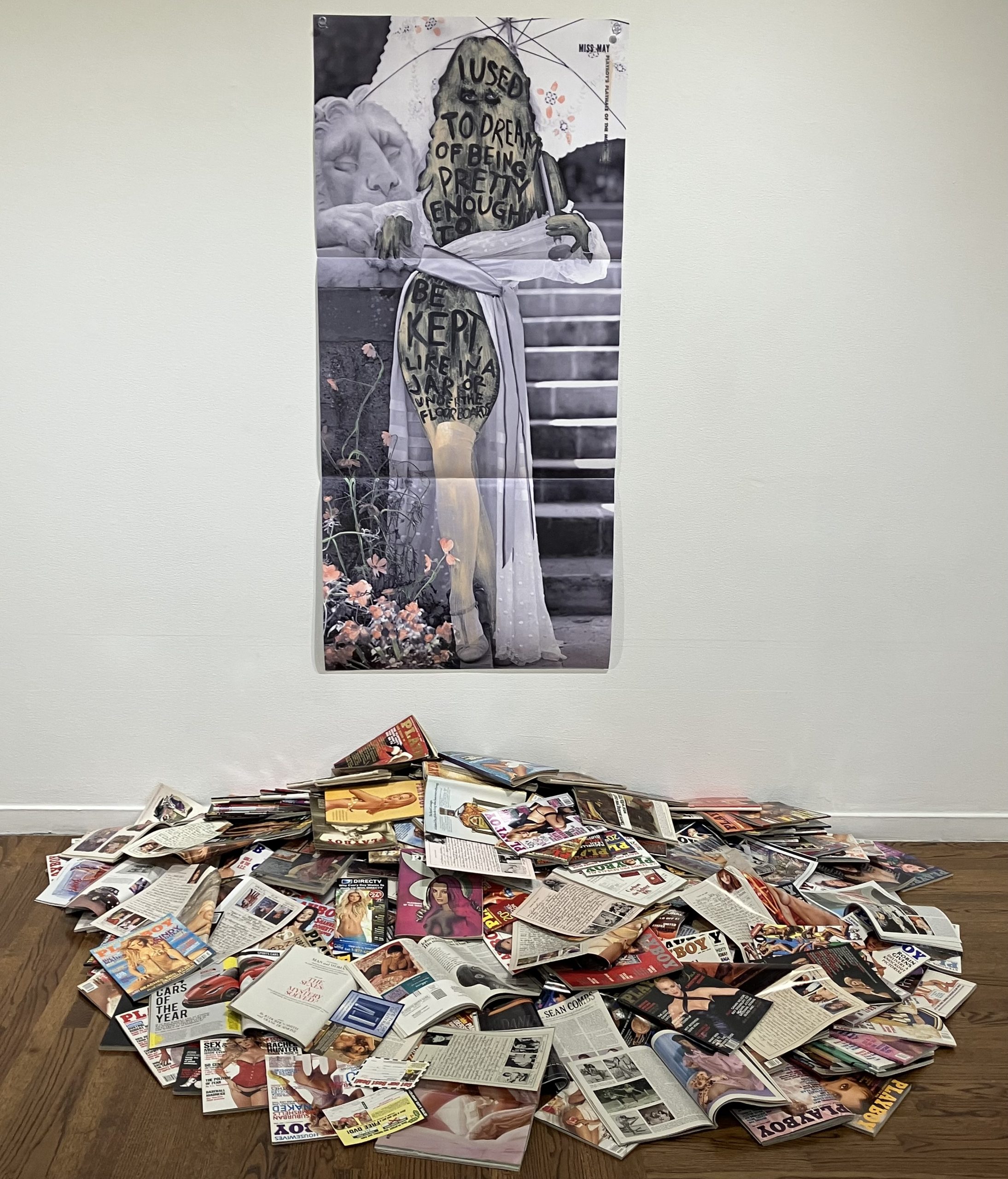
Installation view of Holly Rios’ UMOCA exhibit, April 2025.
She gathers fragments—vintage magazine pages, scraps of text, half-erased images—and arranges them like evidence in an ongoing investigation. The result feels archaeological: an excavation of how culture has instructed generations of women to pose, smile, perform, and disappear.
Her artist-in-residence exhibition at UMOCA this spring made that investigation explicit. Transforming a collection of vintage Playboy magazines, she erased, defaced, and recontextualized their once-celebrated images. Geoff Wichert described the show as one that “asks us to look closely at our national soul,” and Rios’s method—treating each page as both artifact and accusation—exposed the power dynamics embedded within the glossy fantasies.
The subject is personal for Rios. She remembers one memory, from high school, when a group of guys took her over to a friend’s apartment. The walls were covered with Playboy cutouts salvaged from a garbage can. She recalls not knowing how she was supposed to feel or whether she should pretend it didn’t bother her. “I thought being a cool girl meant not letting it bother me,” she says. The moment stayed with her, mundane but formative. It started her thinking about the culture around sexuality and representation, which eventually led her to study feminist literature in college and, after dropping out of art school at 20, to take a job at a sex shop next to Shotgun Willie’s in Denver. She laughs about it now—it’s almost a female art-student rite of passage, she says—but that experience gave her a firsthand view of how people navigate desire, embarrassment, and performance.
Rios approaches these subjects with sex positivity, but she’s also clear-eyed about the realities behind the imagery. “There were some gross moments on the ground,” she says of her time in the sex shop. “It deepened and changed my opinions.” Her mixed-media work “RIP, Roe” leans into that complexity. The centerfold is transformed into a long rectangular meditation on loss and control, a female figure draped in beads almost entirely whitewashed with gesso except for her vivid eyes. Clipped magazine words float around her like marginalia—mapping, fiction, bodily, reality. The tension between her direct gaze and her obscured body draws a line between the performative stare of porn stars and the composed remove of 19th-century portraiture.

nstallation view of Perspectives of Women in Print at Finch Lane Gallery, featuring works by Holly Rios and Utah printmakers examining identity, process, and representation. Image by Shawn Rossiter.
-

- Holly Rios, “Internal Data Set,” 2025, collograph, 14×30 in., at Finch Lane Gallery
-

- Holly Rios, “RIP, Roe,” at Harrington Art Studio
Across her work, Rios threads empathy through critique. She avoids moralizing, preferring to sit with the discomfort of looking. The torn edges, erased words, and smudged graphite remind viewers that each piece is less a statement than a question about what we see and why.
Alongside her studio practice, Rios has been stepping into curation. Later this month, she’ll open a co-curated exhibition at Finch Lane Gallery. Perspectives of Women in Print, organized with Carlissa Whells, features Rios and other Utah printmakers—including Kait Lennon and Holland Larsen—exploring how process and identity overlap. It asks what happens when printmaking’s rules become tools for breaking form, and how repetition shapes what we recognize as beautiful, believable, or true.
Across both projects, Rios moves between making and framing—between the private rigor of the press bed and the shared space of conversation.

Rios in her studio. Image by Steve Coray.
For her, making art is a way of deciphering what society has already written on the body—slipping beneath the sheer volume of images we consume and turning something seen every day into a question worth revisiting. “It can be difficult to break through the sheer volume of media that we are exposed to,” says Rios. “I’m interested in the foundation that built certain visual vernacular.” Even something as specific as Playboy, she says, created “a visual language that seeped out into popular culture,” one that continues to shape how people see and are seen, often without realizing it.
Perspectives of Women in Print, Finch Lane Gallery, Salt Lake City, November 17 – December 26. Opening Reception & Salt Lake Gallery Stroll, Friday, Nov. 21, 6–9 p.m.
Holly Rios: The Sum of Her Parts, Harrington Art Studio, Midvale, through Dec. 3.

Hannah McBeth studied art history, classics, and Mediterranean archaeology before getting a Master’s at Cambridge University. She enjoys writing, hiking, and traveling to far-off places. Follow her on Twitter @hannahmcbee.
Categories: Artist Profiles | Visual Arts




Saw the printmaking show at Finch Lane last night and loved it! Love the strong printmaking community we have here in Utah that is making such beautiful, important work.