Actor and co-director Tamara Howell considers the weight of Sugar’s words in Tiny Beautiful Things.
In February 2012, when Cheryl Strayed revealed herself as the writer of Dear Sugar, the wildly popular anonymous internet advice column, her coming out was detailed in a New Yorker interview.
This was on the cusp of the publication of Strayed’s memoir, Wild: From Lost to Found on the Pacific Crest Trail, about a solo hike that helped the inexperienced hiker find peace after the trauma of her mother’s death. “I needed to carry the weight that I couldn’t bear,” Strayed told me in a 2012 interview, referencing the monstrous backpack she shouldered. “That’s what Wild is about. It’s about how we bear what we cannot bear.”
In July 2012, Strayed followed the success of her memoir with a best-selling collection of columns, Tiny Beautiful Things: Advice on Love and Life from Dear Sugar. Strayed’s memoir became a bestseller, and then a film starring Reese Witherspoon. A few years later, in 2016, Nia Vardalos, of My Big Fat Greek Wedding fame, adapted Strayed’s columns into a stage show (co-conceived with Marshall Heyman and Thomas Kail), with Vardalos starring as Sugar.
In short, Strayed’s voice as Dear Sugar became a literary phenomenon, remaking the advice column for the internet era. With frankness and vulnerability, Strayed responded to letter writers by offering beautiful gems of personal essays.
Utah theatergoers don’t need to know that history to appreciate Dear Sugar’s wisdom. Actor Tamara Howell embodies the advice columnist in PYGmalion Theatre’s Tiny Beautiful Things, playing through Nov. 22 at the Rose Wagner Performing Arts Center’s Black Box Theatre.
Howell co-directed the show, along with her daughter and regular collaborator, Madison Howell, and Fran Pruyn, PYGmalion artistic director. She’s joined on stage by actors Stephanie Howell, Ali Lente, and Matthew Ivan Bennett as letter writers.
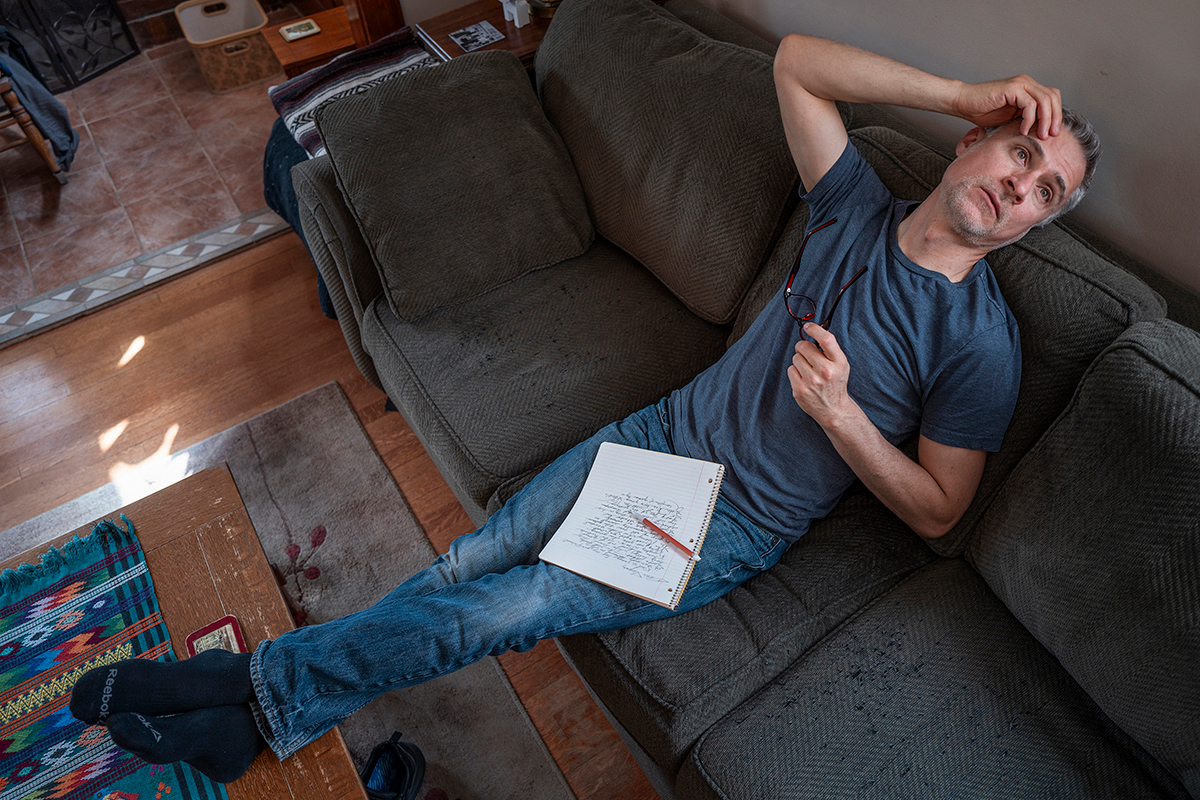
Matthew Ivan Bennett plays a letter-writer in Tiny Beautiful Things.
The script is drawn from responses to letter writers asking for advice, so you might envision actors dressed in black, perched on stools, reading letters. Instead, Tamara Howell and her co-director forged a more dramatic path. They created a show filled with movement, drawing upon blocking suggested by the cast. It’s a style of theatermaking that might seem untraditional—or maybe, very, very traditional, rooted in the collaborative theatrical traditions of Shakespeare’s time, Howell says.
Some of the letter writers ask bizarre questions. Some are gritty. All of the questions, and Sugar’s answers, are transparent and sincere. “Sugar has led a complicated life, as we all do,” Pruyn says.
I interviewed Tamara Howell on the morning of her first Tiny Beautiful Things performance, on a break from her day job as a middle school drama teacher shepherding a massive 120-student cast rehearsing Wizard of Oz, assisted by a 30-student tech crew.
During the day, Howell is thinking about minions and flying monkeys. At night, she’s dramatizing the moment Sugar remembers the last word her mother said before she died. Or offering crystalized advice for 20-somethings: Be about ten times more generous than you believe yourself capable of being. This interview has been condensed and edited for clarity.
What are the pleasures, and complications, of taking on a role like Sugar—dramatizing an advice columnist who writes letters—which translates to a script of monologues and fewer direct dialogues with fellow characters?
Cheryl Strayed is a wonderful writer. She is so literary, but it’s not how people talk, so it’s very hard to serve the literary nature of the words. They’re just beautiful, which makes it really hard to memorize. And if somebody goes up [on a line] or gets lost, there’s nothing you can do to save them, you can’t improv. You just have to watch and squirm.
To make it sound conversational has been the complicated part. The weirdest thing about theater is you work and work and work, you spend hours and hours and hours, and then on the day of your first performance, you turn around and try to make it sound like you’re saying it for the first time.
How do you act in the main role and co-direct the play–with your daughter, Madison Howell, and with Fran Pruyn, the artistic director of Pygmalion Theatre Company?
Maddiey and I have worked together a bunch. She helps me with my shows. She’s a theater teacher also, at Cottonwood High School, with her husband [Adam Wilkins].
Being in it, there’s no way to completely stand out and watch, so Maddiey’s role is to help me see what may work or what may not work. In the room, it has been 100 percent collaborative. Everybody has been responsible for the process and product.
Could you say more about the multiple layers of collaboration in this project.
In Tiny Beautiful Things, each letter and response could kind of stand on its own. It would be an easy default to make it very episodic and, I think, less interesting.
Maddiey added movement pieces in-between to help tell the story, to make it visually and emotionally interesting. This play was a collaboration from the get-go, and then every one of the letter writers, the three other actors, were collaborators. I was so fortunate to get the [cast] that I did, with directing, writing and movement backgrounds. As a director, I would be a fool not to leverage that.
As an actor, when did you feel like the script changed from a clever format—letters to and from Dear Sugar—to a real story about real life?
One of our basic concepts in directing the show draws on some of the last lines: ‘Your stories spilled into mine, and I spilled mine back into you. Sugar is not just me. We created something together. We are all Sugar.’ We created it together. The letter writers and Sugar become kind of the same person, and by the end it becomes not an us and them, it becomes all of us.
Do you have a favorite scene you look forward to playing?
I love the one where she talks about the yard sale and the little boys [one boy steals a camera case and Sugar asks him why]. The other actors play the little boys and they’ve come up with such fun stuff. I also love the scene with the troubled teenagers – to see our cast transform themselves from letter writers to thirteen year-old girls.
What should theatergoers know before they walk into Tiny Beautiful Things?
There are some hard things to listen to. Cheryl Strayed is talking about her own traumas and the letter writers are talking about their own traumas. [We learn] that if you get to the beautiful things, they come about because of the hard things. It’s interesting because being involved in this show—it forces you to think about those things about your own life.
What line from the play do you hope might resonate with the audience?
There are so many about healing and forgiveness. There are so many, but one of them is: ‘I don’t think the path to wholeness is walking backwards up the trail.’
Tiny Beautiful Things, PYGmalion Productions, Rose Wagner Performing Arts Center, Black Box Theatre, Salt Lake City, through Nov. 22. Thursday, Friday at 7:30 p.m.; Saturday at 4 p.m. and Sunday at 2 p.m. Tickets: $15-$22.50 at 801-355-ARTS or saltlakecountyarts.org.
DID YOU ENJOY THIS ARTICLE?
Help make more like it possible.
VENMO us a donation at artistsofutah

Or use PayPal to MAKE A DONATION.
15 Bytes is published by Artists of Utah, a 501 (c) 3 tax-exempt nonprofit.

Ellen Fagg Weist, a former arts and theater reporter, promotes Utah culture as the public information officer for the Utah Department of Cultural & Community Engagement. She is the editor of a collection of fiction,“The Way We Live: Stories by Utah Women.”
Categories: Theater