
Though encaustic has been around for more than two millenia, it seems only in recent years that its capabilities have caught the eyes of a growing number of artists and patrons. Now that it has taken root it seems –as you’ll find if you visit galleries and museums this month — to be popping up all over. The interested viewer will find a dazzling array of work in the medium this month at Park City’s Kimball Art Center, which hosts two curated shows: one, a show of artists from across the country exploiting the textile quality of the medium, and the other, FUSE, a selection of work by local artists. To explore the medium I visited three local artists who will be showing at the Kimball. Jeff Juhlin, Gia Whitlock and Nancy Vorm invited me into their studios and showed me their processes, which varied slightly or significantly from each other.
The basics
It doesn’t take long to see the appeal of encaustic. Using melted beeswax and pigment, the medium lends itself to experimentation and a seemingly infinite variety of outcomes – from detailed, smoothly finished representational subjects to abstract, highly textured pieces.
The most basic materials include the following:
- An electric griddle or similarly temperature-controlled heating element with a large flat surface.
- Small metal containers that sit on the griddle for melting the pigment and medium.
- Another, perhaps larger, pot for keeping the encaustic medium (a combination of beeswax and Damar resin) melted and ready to use.
- Bristle brushes.
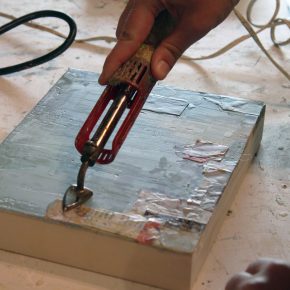
- A heat gun for heating each layer of paint and wax before the next layer is applied.
- Various tools for creating texture, images, or other design elements.
- A hard support for the work, which could be paper, wood panel, or canvas covered panel.
The basic materials and process are just the starting point. Artists can and do follow their own tangents to create their personal styles.

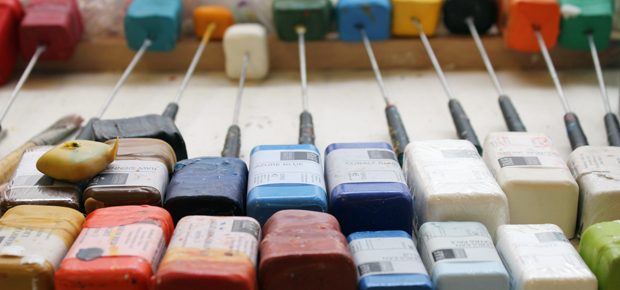
Pans of pigments and beeswax in Jeff Juhlin’s studio
Jeff Juhlin
Jeff Juhlin is perhaps one of the first Utah artists to work with encaustic. He has a national reputation in the medium and this month is part of the Kimball’s Encaustic with a Textile Sensibility; Salt Lake’s A Gallery has just hung a solo show of his work; and he helped curate the FUSE exhibit at the Kimball.
Juhlin’s spacious studio west of The Gateway was almost ready for a creative workday when I showed up early one morning. Small metal pots of paint and encaustic medium were heating on several electric griddles.|0| A larger electric fondue pot held melted medium. Various tools for scraping, scoring, and pattern-making were nearby. And several works-in-progress hung on the wall. The obligatory exhaust fan over the work area was ready to suck out any toxic vapors, though if the heat under the paints and medium is kept to less than 200 degrees, toxicity is not really an issue.
There are as many ways to start a painting as there are artists. Juhlin usually works directly on a cradled panel. Some artists coat the panel with a white gesso made especially for encaustic. He shows me a work just begun that so far has some oil paint and mulberry paper adhered with wax in a geometric design. This forms the basic design/map onto which he will build many layers of paint and medium.
Each successive layer is an opportunity for special effects that enhance the design, while creating depth and interest. For example, Juhlin may add other collage paper, photos, or digital transfers at any time. He may scrape into a layer, leaving a relief pattern, rub India ink or oil sticks into crevices, or adhere wood strips or other objects to build up the surface texture.
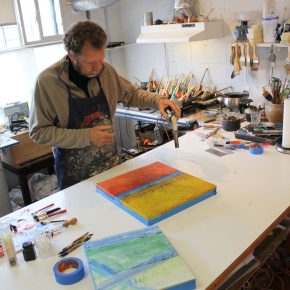
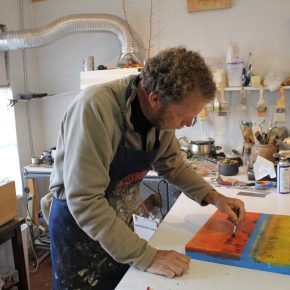
Before adding a new layer, the artist heats the existing layer using a heat gun.|1| If the underlying wax medium isn’t warm the new layer won’t adhere properly. In any layer, the artist might use oil paint |2| or ink to paint an image or to add color to an area. When finished (which could be eight or more layers), the artist may buff the surface to a shine.
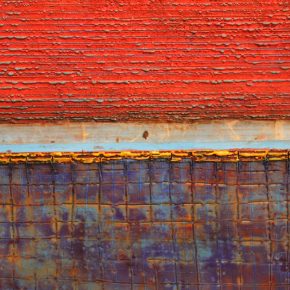
Juhlin first began working in encaustic after a workshop in California ten years ago. Since then, his abstract encaustic work has evolved and changed with each successive experiment with new tools and materials. Today his work often includes mulberry paper for its organic fibers, geometric patterns and lines, scraped, taped, or made with ink, and lots of rough texture that reveal bits of the underpainting on the surface of the panel.|3|
 Gia Whitlock
Gia Whitlock,|4| who exhibits regularly at Salt Lake’s 15th Street Gallery and Alpine Art, is one of the artists that has been curated into Kimball’s FUSE show. Like Juhlin, Whitlock works on cradled panels and her work is abstract and highly textured.|5| Her current series uses the landscapes and city skylines as inspiration for her design. She also finds inspiration and a way to start a piece by leafing through her big accordion file of collected papers, postage stamps. After adhering bits of paper in the shapes of buildings and skyscrapers along the bottom of the panel, she then builds the layers of wax medium and paint.|6|
Whitlock works in a detached garage/studio behind her home in the Sugarhouse area.|7| In warm weather, she leaves the door open for maximum ventilation, but she also has a heater for winter and an exhaust fan. When I visit, she points to the vat of medium that she has just mixed with a 4:1 ratio of beeswax and Damar resin, which she buys in granular form because it’s less expensive than the pre-mixed blocks. Like Juhlin, she orders blocks of paint made by R&F Paints. The block contains pigment combined with encaustic medium and melts easily when heated on the griddle. Colors may be mixed just like any other paint.
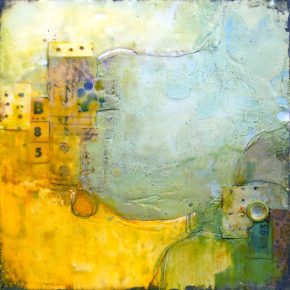
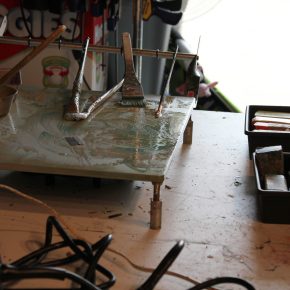
A 2002 graduate of Westminster College, Whitlock worked first as a graphic designer, then began painting in acrylic and oils in 2005. Since switching to encaustic more than a year ago her art business has taken off. “I like this the best because it lets me have all these quirks. It dries fast. It has great texture. I think I’m stuck here.”
 Nancy Vorm
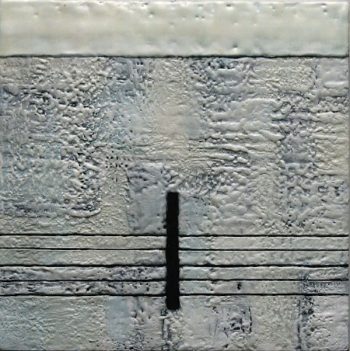
Nancy Vorm, another artist in the FUSE show, has a much different approach for her current body of encaustic work. Instead of panel supports, she works on BFK papers made for printing. Taking inspiration from the “rust belt” part of Indiana where she grew up, she uses vinegar to wet the paper and activate the rust, and makes a rusty print from rusted metal plates and other objects. She controls, somewhat, the lightness or darkness of the print by varying the amount of time the paper is in contact with the rusted object. “I love the randomness of it, because that’s how rust is,” she says.
Once printed, she coats the paper with beeswax, painting it on with a brush and then scraping off the excess with a plastic card. The beeswax has a little resin in it, which gives the coated paper a shine. For one piece that will be displayed at the Kimball show she connected her rectangular prints at the corners with little wires in an assemblage of seven rows and eight columns. These will be displayed in front of a window to show off the beautiful translucence of the wax-coated paper.
Vorm has been working with encaustic for three years. It was a natural transition from her highly textured acrylic work and her background as a textile artist. As a student at the University of Utah, she got a brief introduction to encaustic, but it was after graduation that she enrolled in a workshop and got hooked.
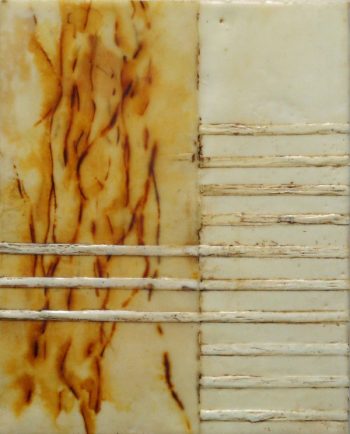
How archival is a painting made with wax, which could melt? I wonder. Each artist told me that encaustic is actually more vulnerable to cold, which could make it crack. The melting point would be about 160 degrees, far hotter than usual display conditions. Juhlin points out that the wax-covered edges of his panels are somewhat vulnerable to nicks and chips, but, knocking on one of his pieces, he notes, “The surface is really quite hard and durable.”
Between the two exhibits at Kimball Art Center and the Juhlin show at A Gallery, art lovers will feast on encaustic this month, getting a taste of the many ways this versatile medium can serve the creative imagination.
DID YOU ENJOY THIS ARTICLE?
Help make more like it possible.
VENMO us a donation at artistsofutah

Or use PayPal to MAKE A DONATION.
15 Bytes is published by Artists of Utah, a 501 (c) 3 tax-exempt nonprofit.

UTAH’S ART MAGAZINE SINCE 2001, 15 Bytes is published by Artists of Utah, a 501 (c) 3 non-profit organization headquartered in Salt Lake City, Utah.
Categories: Process Points | Visual Arts









Nancy Vorm is not only really talented but one of the nicest people you will ever meet. Thanks for giving her some exposure here.