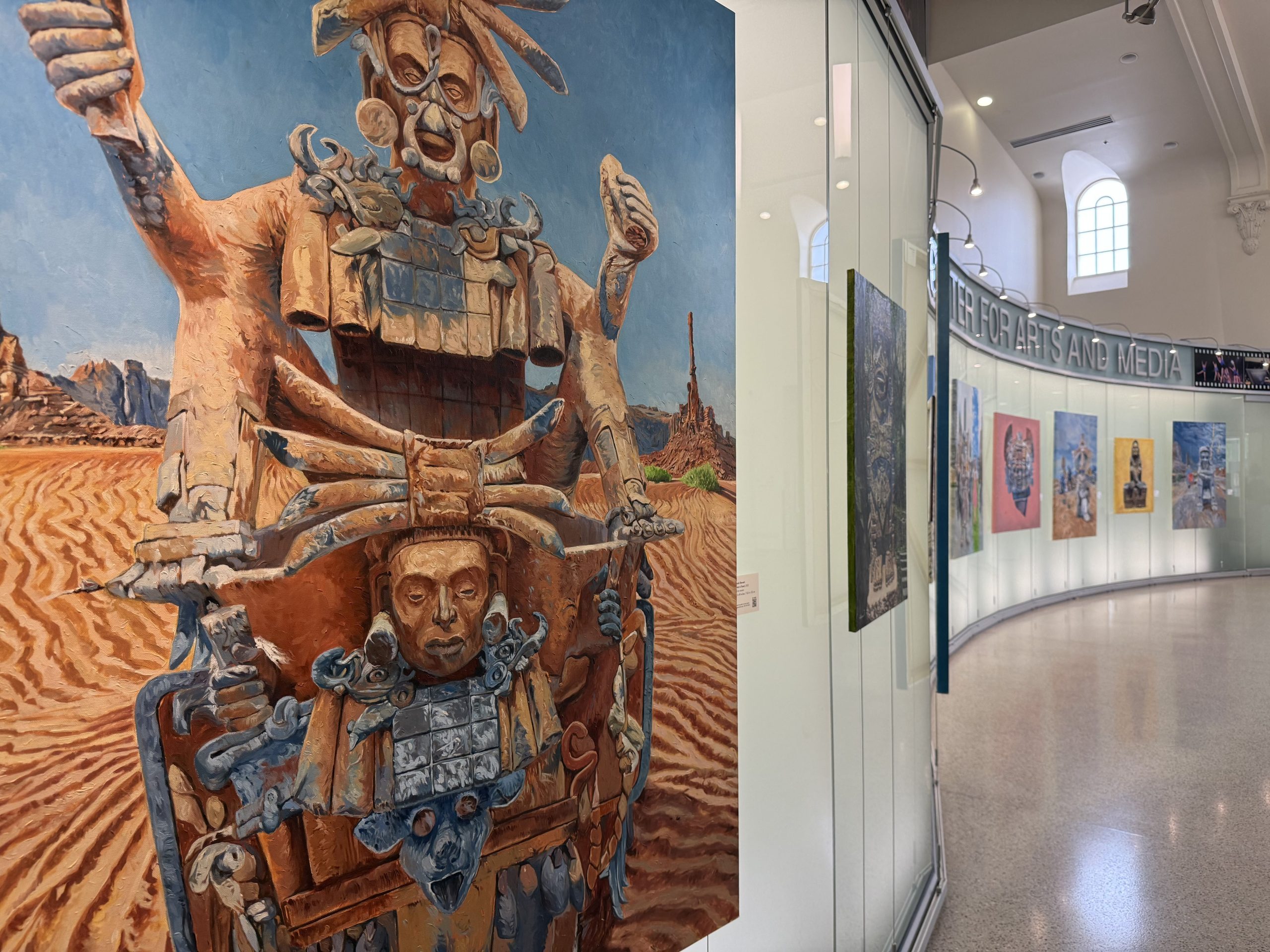
Installation view of Echoes of the Human Condition, featuring paintings by Arash Shoveiri at Salt Lake Community College’s South City Campus. Photo by Shawn Rossiter.
The founding editor of 15 Bytes, Shawn Rossiter, put his cards on the table, so to speak, when he titled the umbrella organization “Artists of Utah” and not Art of Utah. His focus was then, and 25 years later still is, on the community of our artmakers. Among several recent examples, his introduction to the Iranian painter Arash Shoveiri and his family story reveals in detail how this citizen of a nation the United States would soon come to be at war with has largely transferred his allegiance to America, and in particular to Utah. Any American who feels this nation has exhausted itself and is now irreparably damaged might want to spend a few minutes in the company of Shoveiri, or those like him, whose enthusiasm for what these United States have to offer its pilgrims, no matter where they may be from, can still inspire those who encounter it.
Several of15 Bytes’ writers, and some of their readers, have taken turns expressing appreciation of Shoveiri’s unique and original approach to such elements of painting as composition, setting, pose, and expression—areas in which his originality recalls that of Édouard Manet, one of the early Modernists who reshaped painting at the end of the 19th century. Expressed opinions demonstrate a warm welcome to his manner of bringing references to actual places and events together with imaginative images that bring these scenes to life. What none of us has sought to unpack in depth, however, is the contrast between the living, worldwide settings and the stone effigies that often occupy them. While such singular features as the explosion of the airship Hindenburg or Arches National Park’s star attraction, Delicate Arch, are presented as they appear to us in historical accounts or in person, the iconic sculptures that occupy central parts demonstrate something very different—something that their creators could not have imagined, nor could audiences prior to such Modernist innovations as Surrealism and cinematic tropes that bring them to life.
Among other things, this counterintuitive animation involves their color schemes and eyewear, which shows up as anything from goggles to virtual reality headsets. No amount of effort by an artist can completely control how the viewer interprets what is seen on the canvas, and so, given that these are still images, it’s up to the viewer to decide if these possible protagonists, or more likely witnesses, have come to life as living minerals—like the Golem, the clay figure brought so in the 16th century, according to mythical tale, by Rabbi Judah Loew ben Bezalel (such accounts occur frequently in stories told around the world, but not until the turn of the 20th century would they be represented in visual art). Or, in another way of seeing them, might they constitute a rupture of the continuity of time that allowed pre-Christian religious art in some parallel universe to partake of options that for us came hundreds of years later?
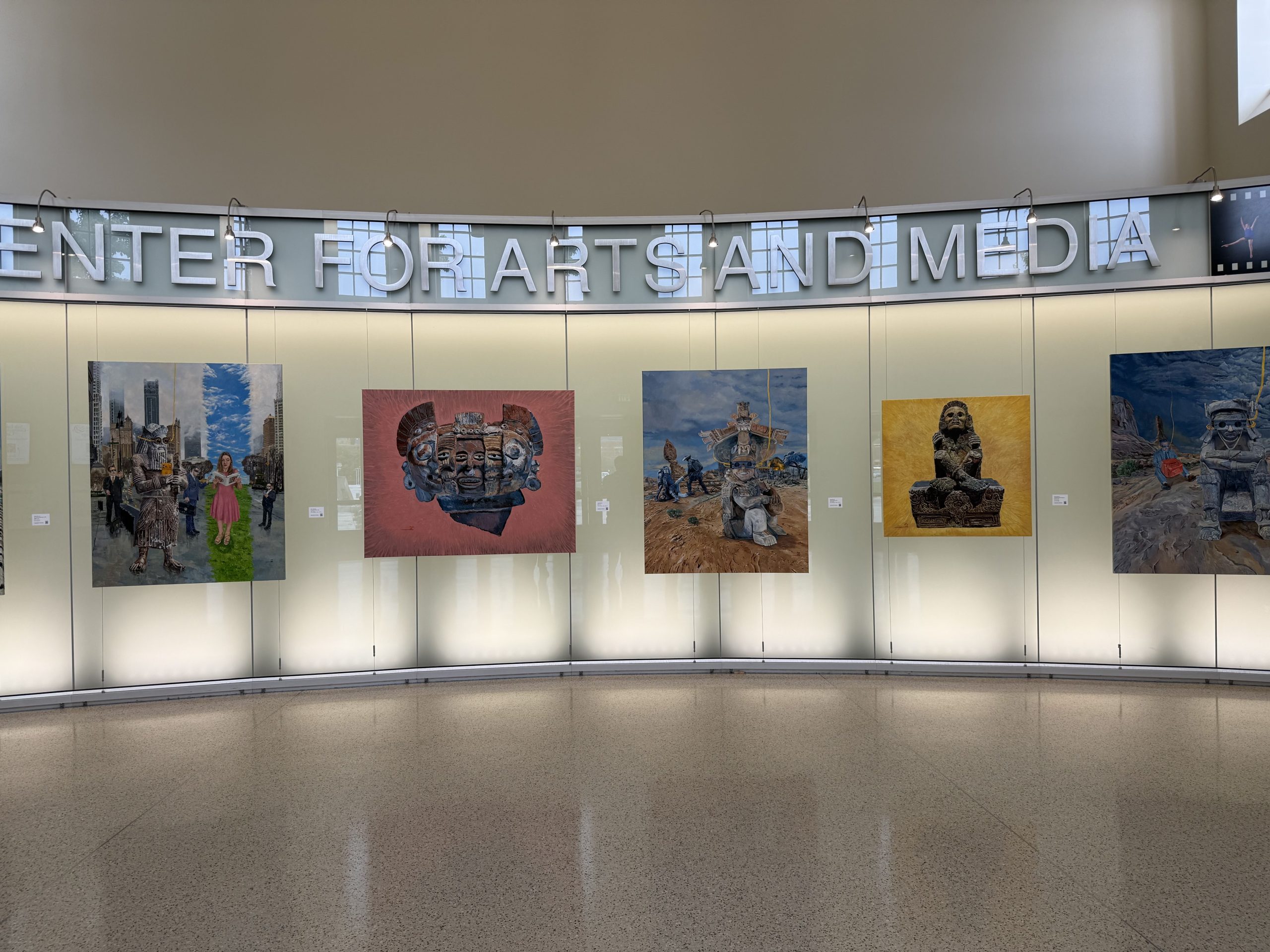
Installation view of Echoes of the Human Condition, featuring paintings by Arash Shoveiri at Salt Lake Community College’s South City Campus. Photo by Shawn Rossiter.
If such questions seem excessively academic, it must be said that only when asking them did it occur to this audience member to question the role of such stone figures in these paintings. Are they indeed witnesses to the violence and desolation that surrounds them? Fellow sufferers? Or do they represent the antagonists responsible for the bleak and barren places we see them in? Might they not be the industrialists whose greedy pursuit of profit has made this world—our world—so inhospitable to its rightful denizens? Considering the conclusions drawn by, for example, the first Europeans to arrive in Central and South America, such a domineering and suffocating image is none too extreme. Consider the statue of the Aztec creation goddess Coatlicue, which was dug up by the Franciscan padres in Mexico. This figure, with her fanged mouth, belt of skulls, and skirt of intertwined snakes was so terrifying that they immediately threw it back in the hole and reburied it. But their accounts ignore the primary question: why had the culture that made and presumably worshipped her chosen finally to bury her?
Echoes of the Human Condition, Arash Shoveiri’s latest exhibition on the LED Exhibition Wall of the SLCC’s South Campus, includes most of the work he has shown in Utah and some works not seen before, including a provocative image of his wife and one work-in-progress he has generously chosen to show in its incomplete state. This should give his admirers a chance to become even better acquainted, while for those who have missed his work thus far it offers a solid foundation by which to get to know him; and those who have so far resisted his virtues now have a chance to see a larger body of work that has a lot to reflect on concerning what they should see is our moment in history. So far, Arash Shoveiri has no plans to retreat, and we might all gain from taking him seriously.
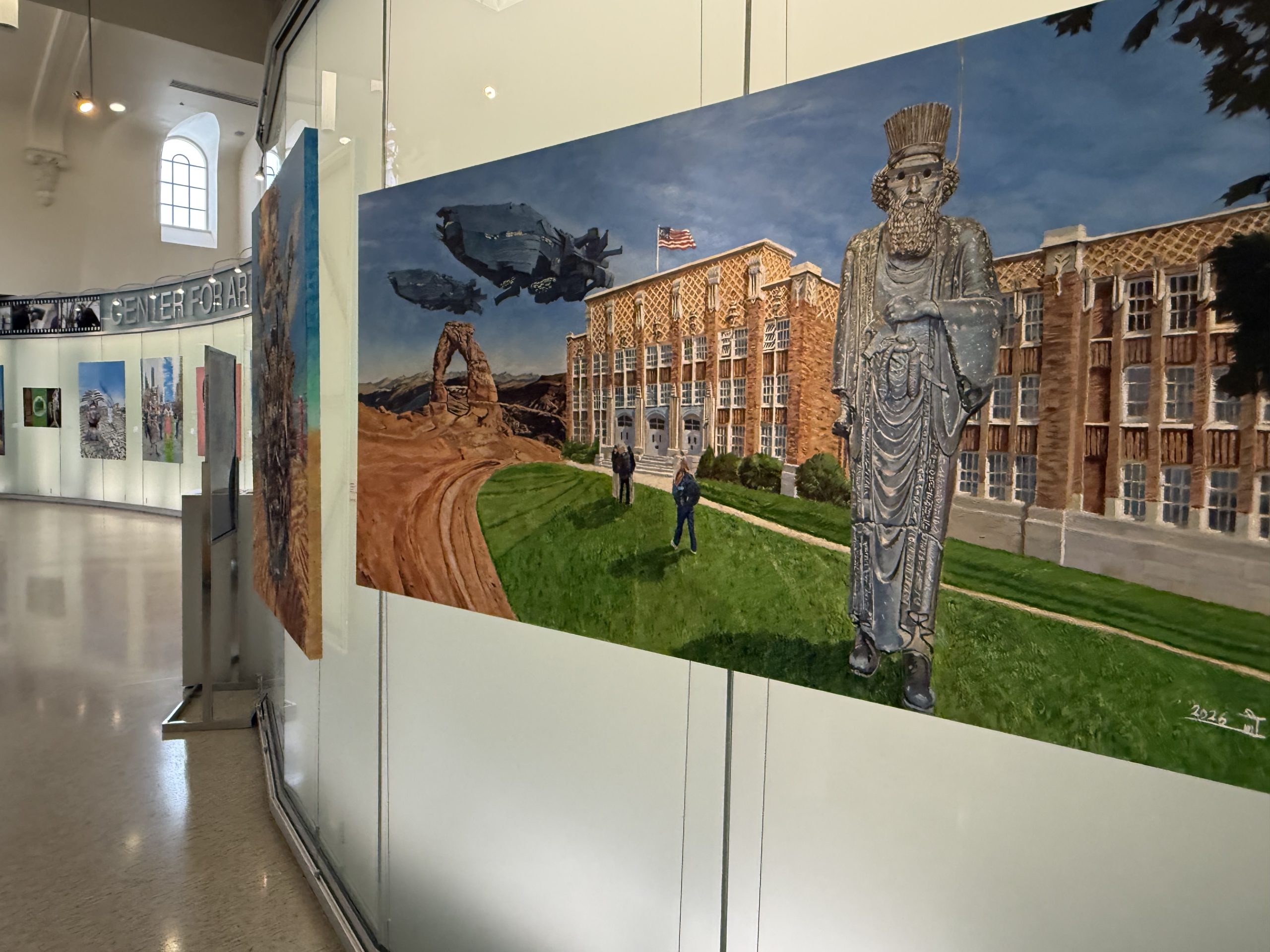
Detail and installation view of Echoes of the Human Condition. Photo by Shawn Rossiter.

Categories: Exhibition Reviews | Visual Arts