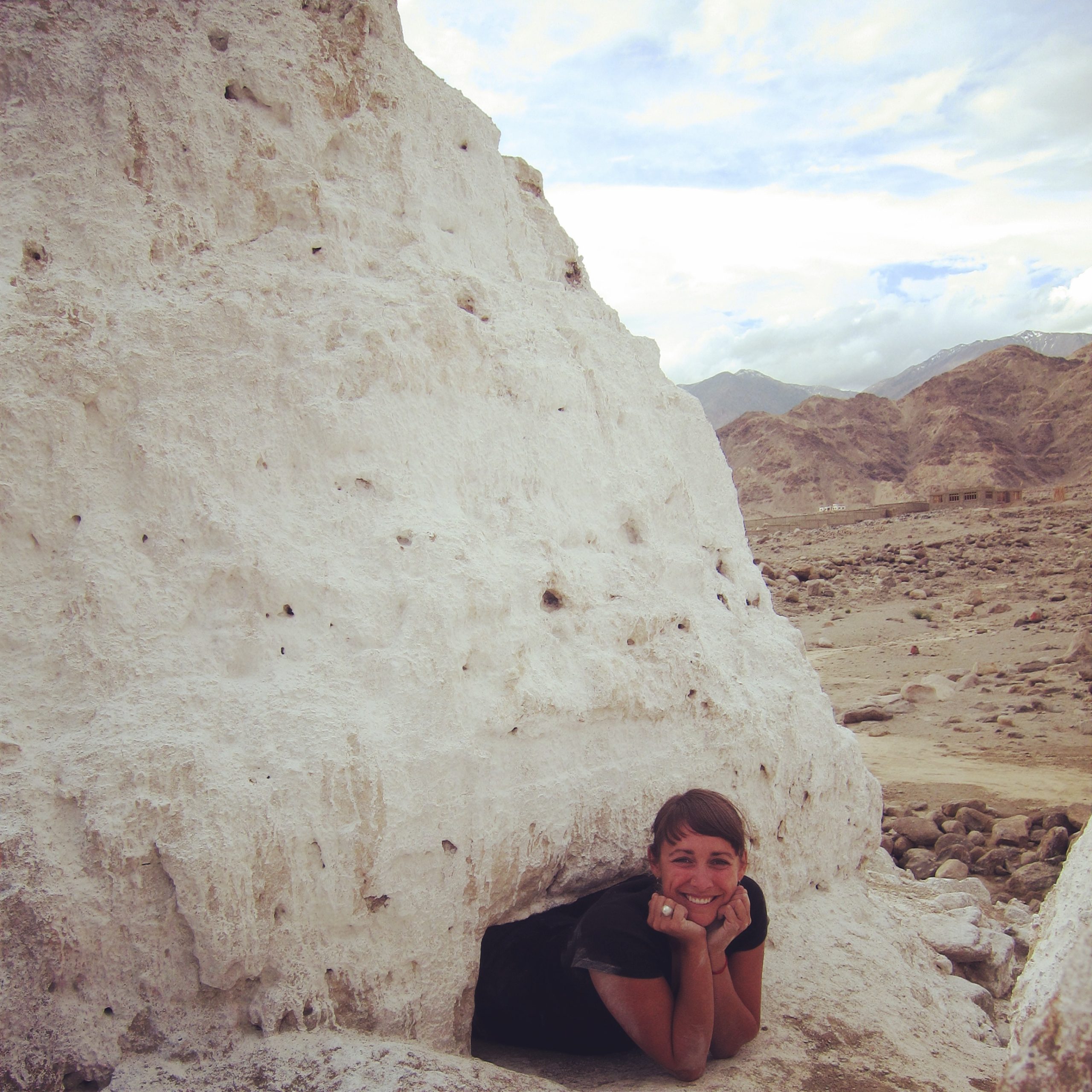
Becky Bloom doing field work in a stupa.
By the time Becky Bloom landed in Utah, she had already worked at New York’s Rubin Museum of Art, studied at Yale and Michigan State, and spent summers conducting research in the western Himalayas. Museums were the career she had been building toward for years. She had no idea there was one in Cedar City.
Now she’s leading it.
Bloom was finishing up a one-year fellowship at the Smithsonian’s National Museum of Asian Art, working on a Buddhist art exhibition, when her husband moved to southern Utah to guide in Zion. Bloom decided “Utah is a much nicer place to write my dissertation than Michigan in the winter.” COVID hit, she stayed. The couple had a child. Then she met Jessica Kinsey, the director of the Southern Utah Museum of Art. “I was like ‘Wait, there’s a museum here?’ And a position kind of fell in my lap. Jessica had found the money to hire a curator and I just happened to be down the road.” After several years as curator and a year as interim director, Bloom is now its executive director.
“I always knew that my career path would be in museums,” she says. “But I was never one who wanted to work at The Met; I’ve always wanted to balance lifestyle and cost of living and that kind of thing. And an academic museum is a good bridge for me, from academia to museums.”
The Southern Utah Museum of Art is ten years old this year, but what Bloom discovered after arriving in Cedar City is that the connection between art and the wider community did not begin with SUMA’s opening. It is tied to a much longer history of support for the arts in southern Utah. In 1929, Mary Bastow founded the art department at what was then called Branch Normal School, now Southern Utah University. “What a bad ass, right? In a tiny sheepherding community,” Bloom says. “Now it’s this big art department focused on filmmaking, art, and design…I think a lot about carrying that torch,” Bloom says. “I don’t take that responsibility for granted, building trust with our local community and the campus.”
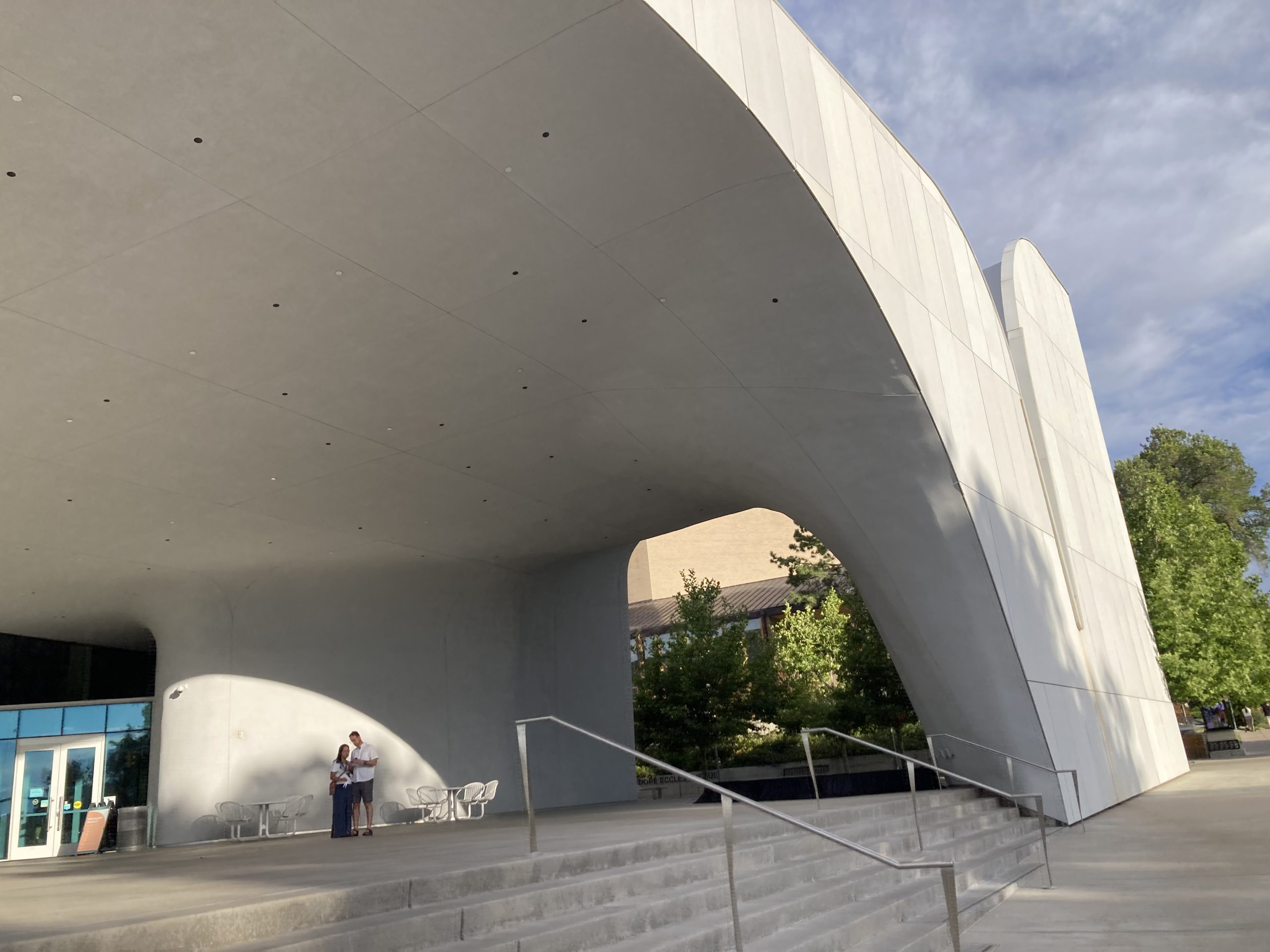
The Southern Utah Museum of Art on the campus of Southern Utah University in Cedar City celebrated its 10-year anniversary this summer.
That history became particularly vivid when Bloom began researching a Maynard Dixon painting in SUMA’s collection. “Before coming here, I didn’t even know who Maynard Dixon was. I found that Cedar City had an annual art exhibit starting in 1940 that was funded by New Deal community arts funding through the WPA. That is how the museum ended up with regionally well-known artists who were invited to sell their work in the show. Art for All was the title of the exhibit. It was all about bringing art to everyday folks in rural Utah.”
Jessica Kinsey, SUMA’s first director, left in the summer 2025 to join the University of Oklahoma faculty, and Bloom was named interim director beginning August 1. Then Bloom won the permanent position following a national search and became executive director effective July 1, 2026. Her new role draws on a career spent thinking not only about what museums show, but how and why they show it, who gets to tell the stories behind the objects and what relationship a museum should have with the communities it serves.
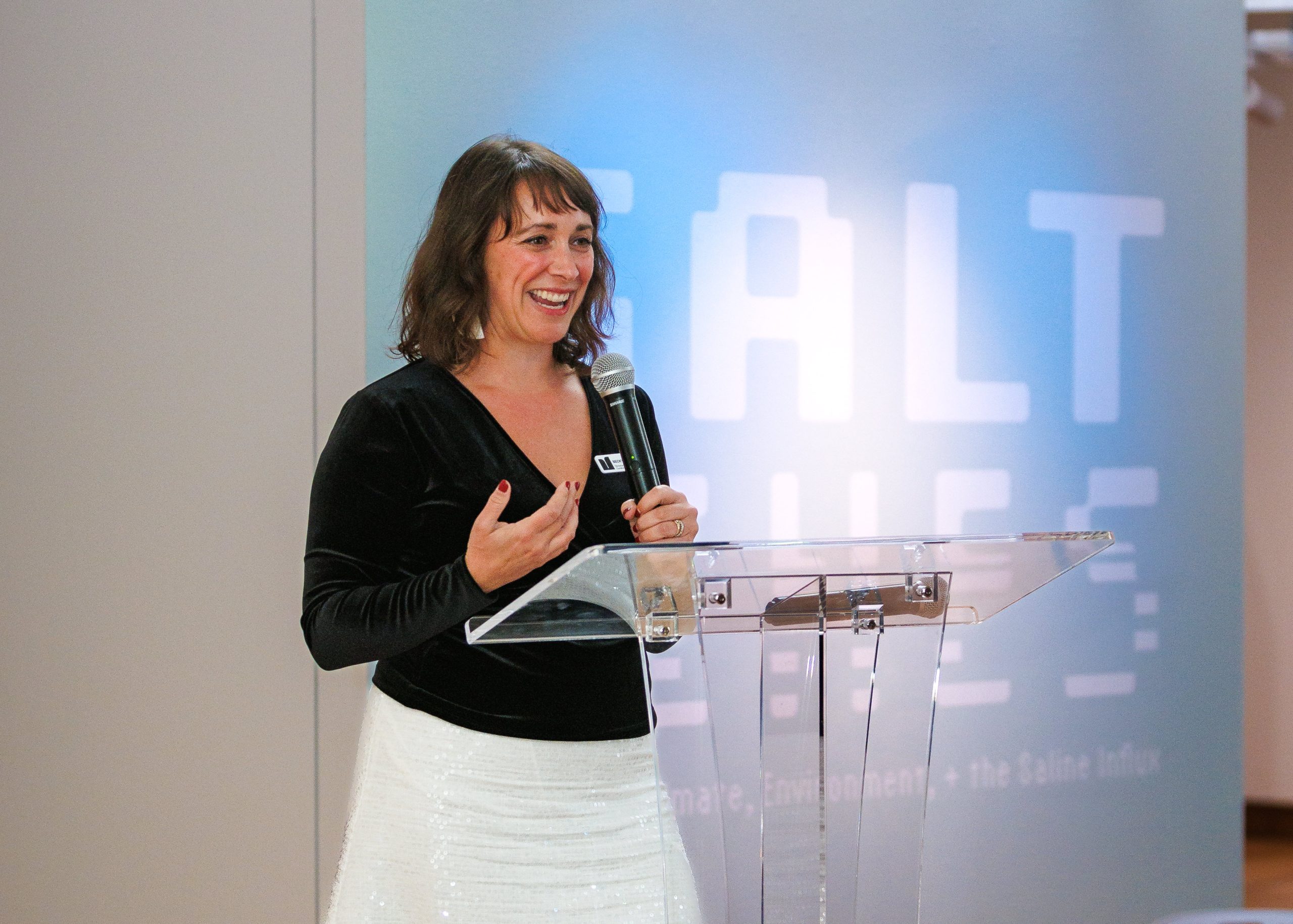
Photo by Russell Gearhart for Southern Utah Museum of Art (@gearhartphoto) – Becky Bloom, director of curatorial affairs, speaks at the opening reception for “Salt Lines: Exploring Climate, Environment, and the Saline Influx”, a fall 2024 exhibit at the Southern Utah Museum of Art on October 18, 2024.
Art has been a part of her life since childhood in New Jersey. Her mother took her into New York City and introduced her to museums. “We always visited museums. We’d be in Barbados and my mom would find a historic home to tour. So, art, and museums in particular, were always a central part of my life.” When she went to Middlebury College in Vermont she planned on studying anthropology in India, but a trip to Thailand sparked a passion for Southeast Asian studies.
A religious studies class was also pivotal. “I took a religious studies class that changed my life. I ended up majoring in art history and religion because they’re obviously inextricably connected whether you’re talking about European traditions or Buddhist traditions. I also realized my interest in anthropology was its focus on how to understand humans. Religion is the lens that is the most revealing of that and the most interesting to me.” She wrote an undergraduate thesis on a Himalayan goddess and her representation in the Kathmandu Valley of Nepal.
After graduating from Middlebury, Bloom began an internship at the Rubin Museum of Art in New York City, where she worked for two years and ended up as an assistant curator. There she received professional training in managing and interpreting collections while also getting a front-row seat to the growing discussions around decolonization in museums and universities. With a new perspective on collecting and showing the work of non-Western cultures, she decided graduate school would be her next step.
“My [then] boyfriend was like, ‘Why are you leaving the job you’re going to be trying to get when you get out of graduate school?’ and I was like, ‘valid point.’ But I wanted to be able to do well what I saw these other scholars and curators that I was working with do—develop exciting and new exhibitions.”
She earned a master’s in Asian religions at Yale’s Divinity School, then forged on to PhD work at Michigan State University. “I also did a museum studies certificate at Michigan, which was awesome because it was interdepartmental so there were students from across different departments. They are the NAGPRA [Native American Graves Protection and Repatriation Act] HQ for the upper Midwest so I learned a lot about Native American collections, about the history of collecting, about working with collections from an era when archaeology was ‘finders keepers.’ There was a lot of focus on decolonization practices which has made me more aware of that within my area of study—specifically Tibetan Himalayan.”
Graduate school also satisfied her passion for onsite and in-person research. “During the idyllic years of graduate study,” she says wistfully, “I spent every summer in the western Himalayas doing research, visiting so many temples, and I worked at a monastic museum teaching best practices to monks who have a collection, the way churches have collections of objects, about display, about security, about exhibition strategies using a model from sustainable exhibition development including hands-on methods, stakeholder involvement, and indigenous knowledge.”
Decolonization and repatriation in the area of collecting are two important lessons she carried from that work. “All of that led me to be thinking through how to resolve the fraught history of collecting. It’s been a passionate side project for me. Maybe that’s why it took me 10 years to get through graduate school. Well, there was COVID, but also, I have all these side quests.”
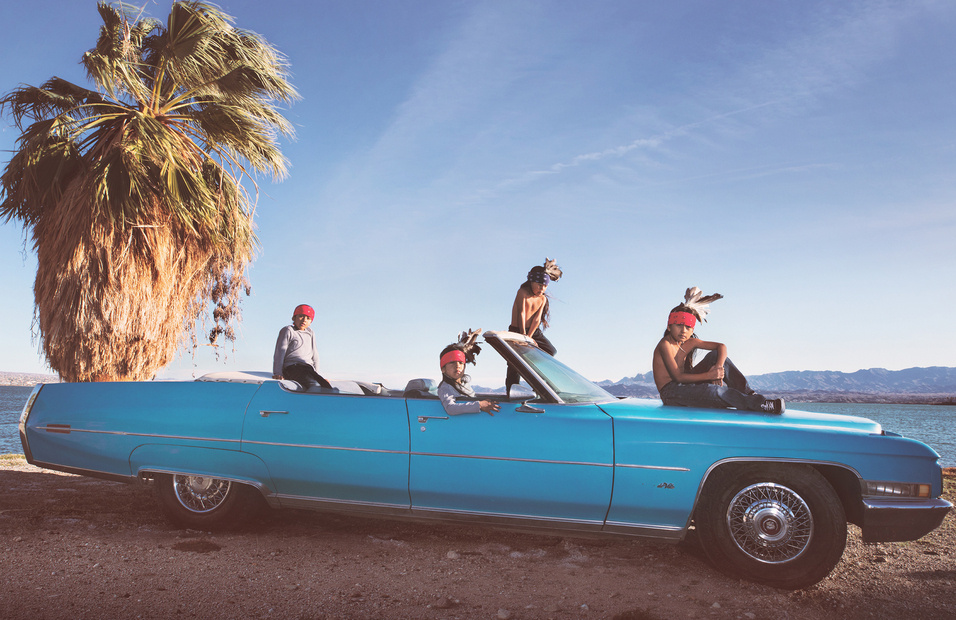
Tooveep (The Land) is at the Southern Utah Museum of Art through March 6, 2027.
At SUMA, those “side quests” have converged. One of the last things Bloom had done at the Rubin Museum was an exhibition of contemporary Tibetan art, an experience she finds herself thinking about in her work with contemporary artists in Utah. “I think about that a lot in connection to what I’m doing now. I get to work with some exceptional artists who are really stoked to talk to students and community members.”
She has been trying to engage more with contemporary artists, both for what they bring to the museum and for what they can offer students. “It is really exciting to work with living artists and I think it’s good to show the students that there are working artists and what they’re doing. It’s also a model of how contemporary artists are addressing history in terms of traditional mediums. For example, the artists in our [new] show Tooveep (The Land) and how these artists are reinterpreting traditional methods into their own work that tells stories about identity, displacement, resilience, in relation to things like the land. Also, what does it look like in Utah? Topics that feel relevant and urgent like the Great Salt Lake.”
Her interests go beyond Cedar City. “We’re trying to build more partnerships and build cross-promotional events with other Utah museums. We are always looking for ways to bolster each other. We also collaborate with other academic museums like the University of New Mexico and the Tang Museum in upstate New York. We’re co-organizing a fall 2028 environmental show with them. We have a connection with the University of Denver now too. We’re exploring ideas like cost sharing and traveling some shows. It’s about building on a network to support each other to make our dreams more feasible.”
“I love the collaborative nature of museum work,” she says. “My work is always better with other people’s input. I’m learning how to step into the leadership role, but I also crave other people’s input. … Especially when we’re talking about de-colonization issues where we let the community drive the work. I have learned from community leaders how to build longer-term, reciprocal relationships.”
Bloom may not have known there was an art museum in Cedar City when she arrived, but in SUMA she seems to have found the kind of museum she had been preparing for all along: one where scholarship and contemporary art intersect, where the university meets the wider community, and where the work of the museum is as much about relationships as objects. “Museums encourage people to step outside their own world view, their own experience,” she says. “At an academic museum, the mandate is being a mirror of our campus toward our campus and then outward toward our surrounding community.”
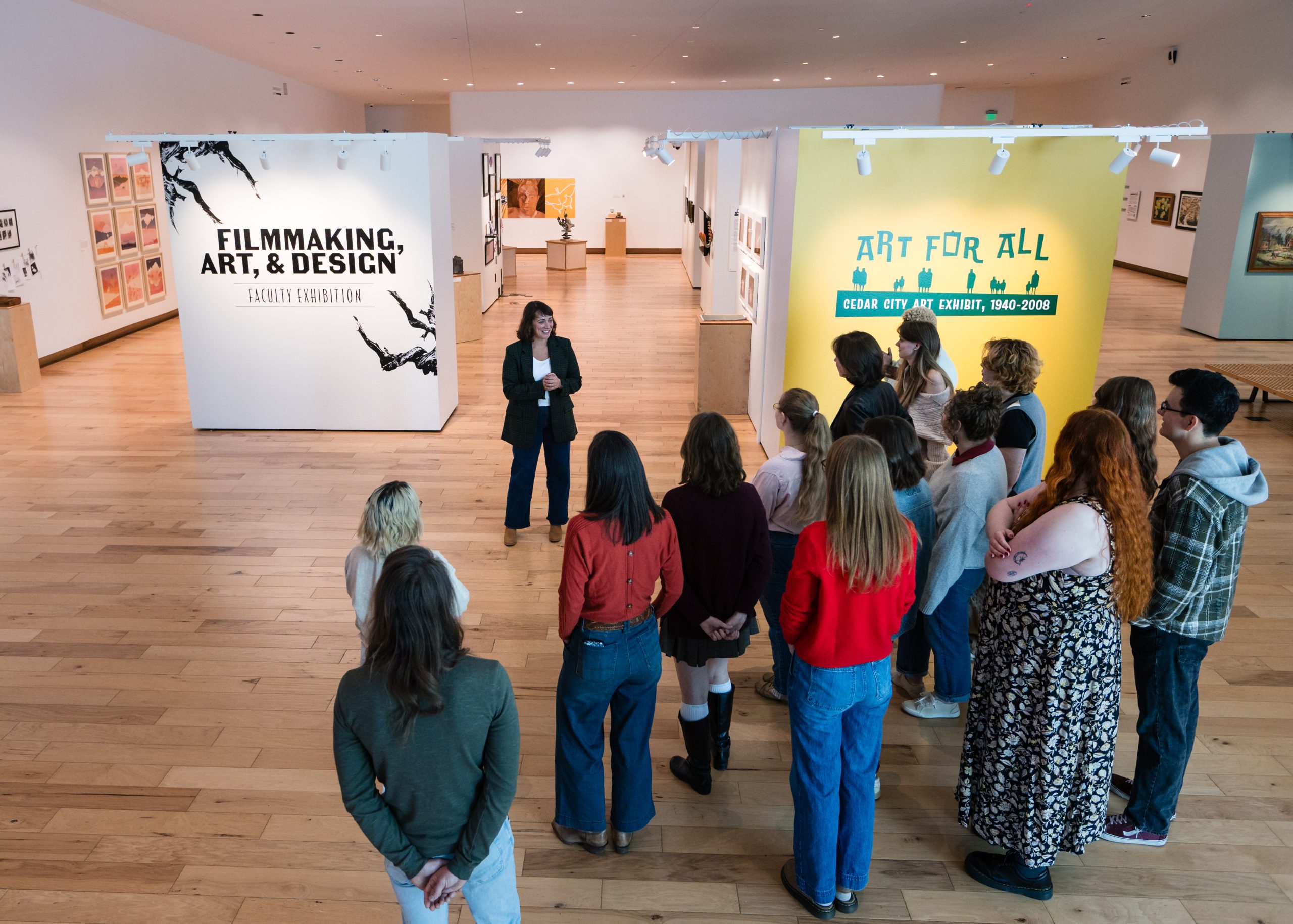
Photo by Russell Gearhart / @gearhartphoto – Fall 2025 exhibitions at the Southern Utah Museum of Art on Oct. 17, 2025.
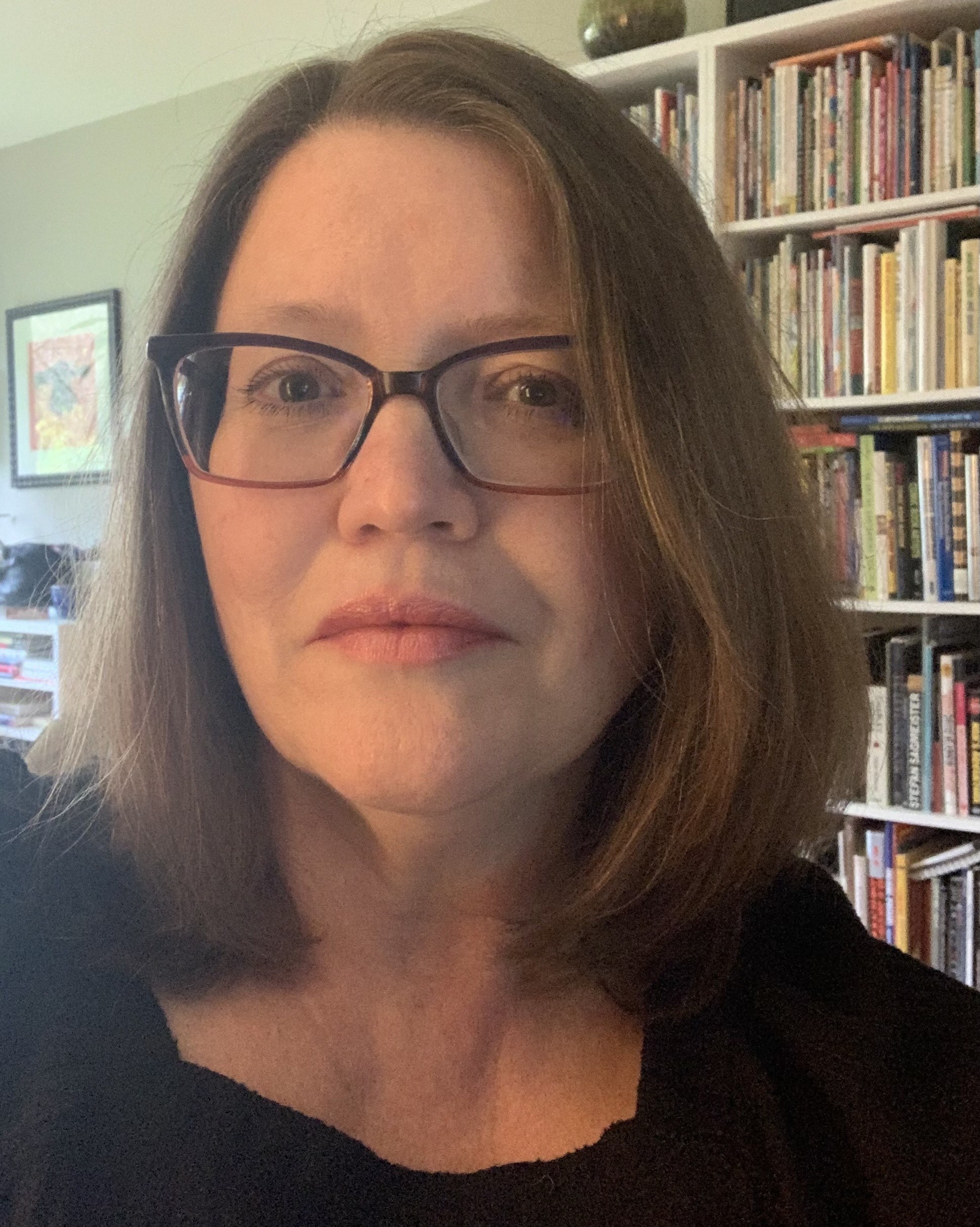
Gina Cavallo has been a curator, registrar, and executive director in museums for over 35 years. She spent many years as an art critic for publications in Phoenix. She began her career at the Phoenix Art Museum and the Heard Museum, was a founding curator at the Scottsdale Museum of Contemporary Art, spent two terms managing exhibitions at the Virginia Museum of Fine Arts, and was the Executive Director at the Mission Inn Foundation & Museum in Riverside, California. Her current role is Director of Development for Taproot Theatre Company in Seattle where she also serves as the curator of the Kendall Center Exhibition Series. She moved to Orem in 2024 with her husband, a theatre faculty member at UVU.
Categories: Art Professional Spotlight | Visual Arts