
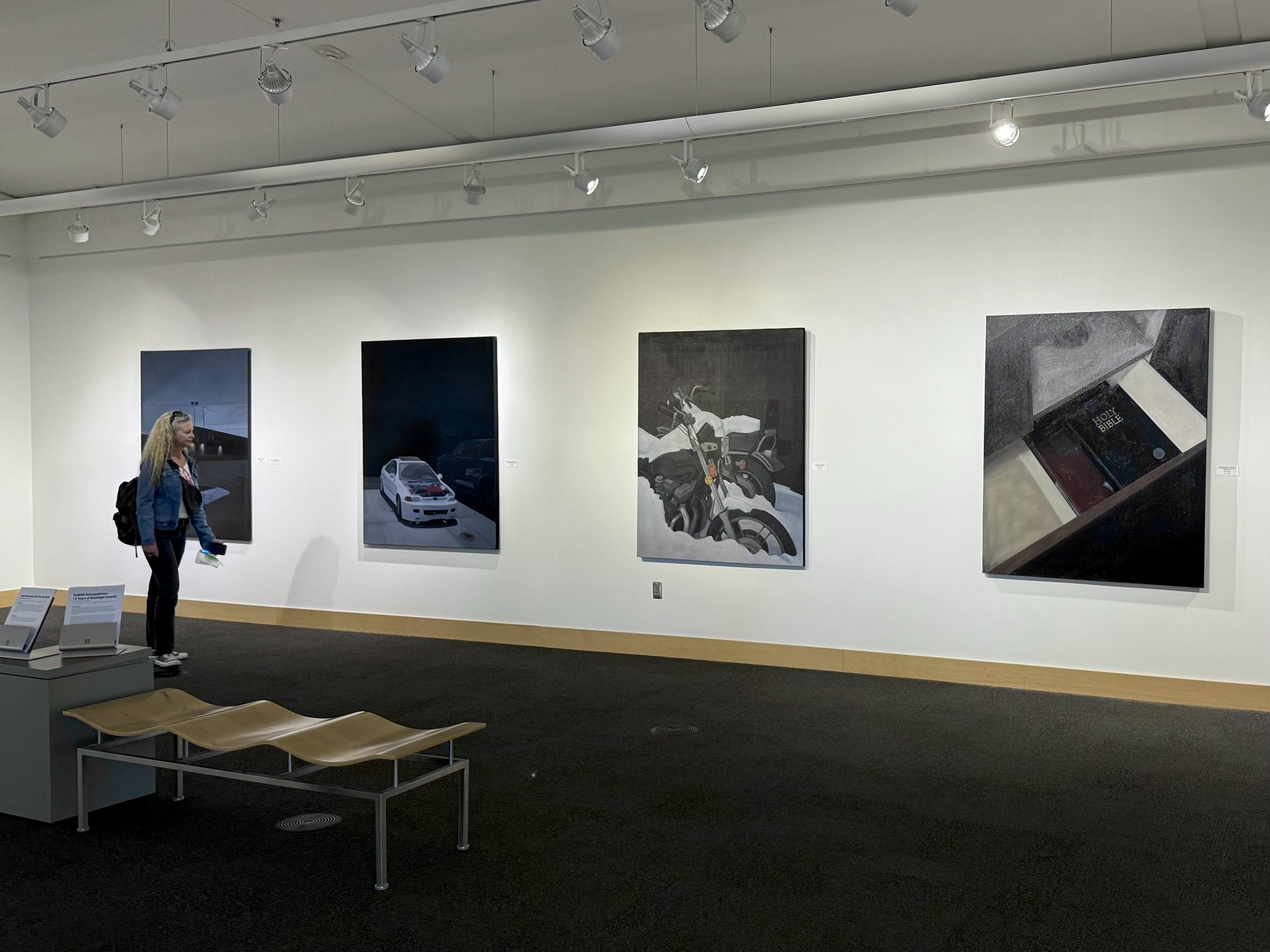
Hunter Bailey’s I Don’t Know God, but I Fear His Wrath is at The Gallery at Library Square in Salt Lake City, through Sept. 11.
A charcoal-grey smog sweeps across an American highway, the acrid tang of exhaust fumes so strong they snake into the cabin through the front windshield. A motorcycle, indefinitely rendered useless under a layer of cold plastic, leather, and steel. A single, perpetually parked car. The moment between calling to something or someone for help and retreating to silence.
This is the experience Bailey offers throughout I Don’t Know God, but I Fear His Wrath, an exhibition of oil paintings varying in scale and composition. Calling on the bleak muses of Western Gothic nihilism and a Hopper-esque visual sensibility, the University of Utah grad (BFA, 2024) creates a distinctly cold imagining of an American landscape. Bailey’s practice draws from an archive of crowd-sourced images, photography, and vignettes of life on the American highway, transforming imagery of the West into something more intimate and reflective.
I Don’t Know God reflects the anxieties of a younger generation, who, if ever called upon to jump-start a car or change a flat tire, might find themselves looking to one another with quiet uncertainty. “Material culture from the ‘90s and early 2000s [marks] the end of an era,” Bailey writes in his artist statement. We drift further from a time when people could rely on themselves.” Bailey’s effigies of mechanical obsolescence mirror a very real and very pressing human anxiety: that of knowing one’s own powerlessness.
The Gallery at Library Square accommodates more than a dozen of Bailey’s paintings, each of which cuts across the white gallery walls with lustrous swaths of dark pigment. Across several works, the audience inhabits a point-of-view shot; they exist behind the eyes of a phantom mechanic stumbling upon his next re-commissioning project. In these pieces, the audience encounters a recurring figure in Bailey’s portfolio: the abandoned vehicle. Where wreckage might ordinarily signify complete ruin, the automotive portraits in I Don’t Know God feel unexpectedly intimate. There is something memorial about the way Bailey poses his mechanical subjects. At three-quarter turns, their open hoods akin to toothy smiles, they recall the carefully composed solemnity of Victorian post-mortem portraiture. This effect is echoed in large-scale paintings “We Wind Our Clocks” and “We Wait for Midnight or the Carnival” and “Heavy Rain on Paper Wings.”
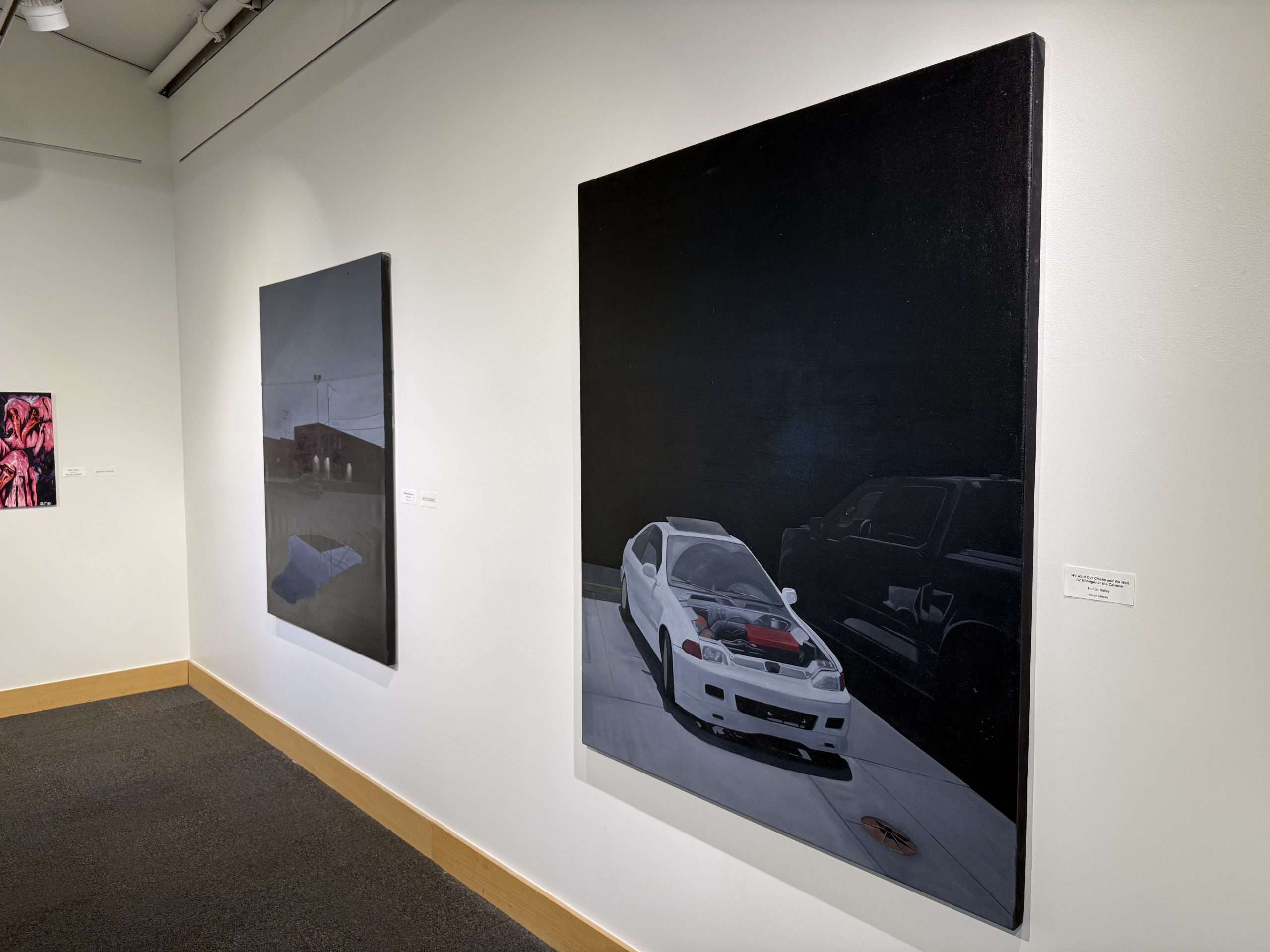
Hunter Bailey, “Nothing Lasts Forever” and “We Wind Our Clocks and We Wait for Midnight or the Carnival”
-
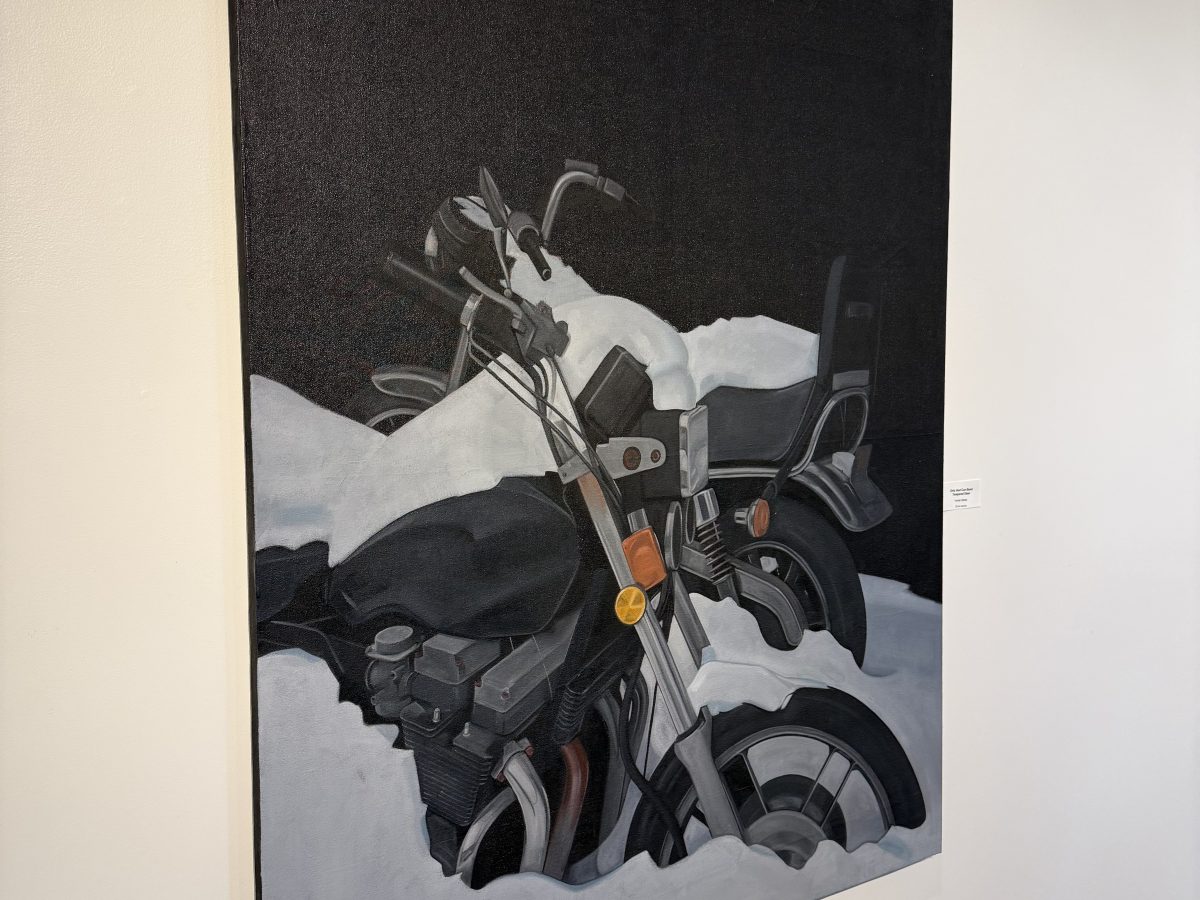
- Hunter Bailey, “Only God Can Bend Tempered Steel,” oil on canvas
-
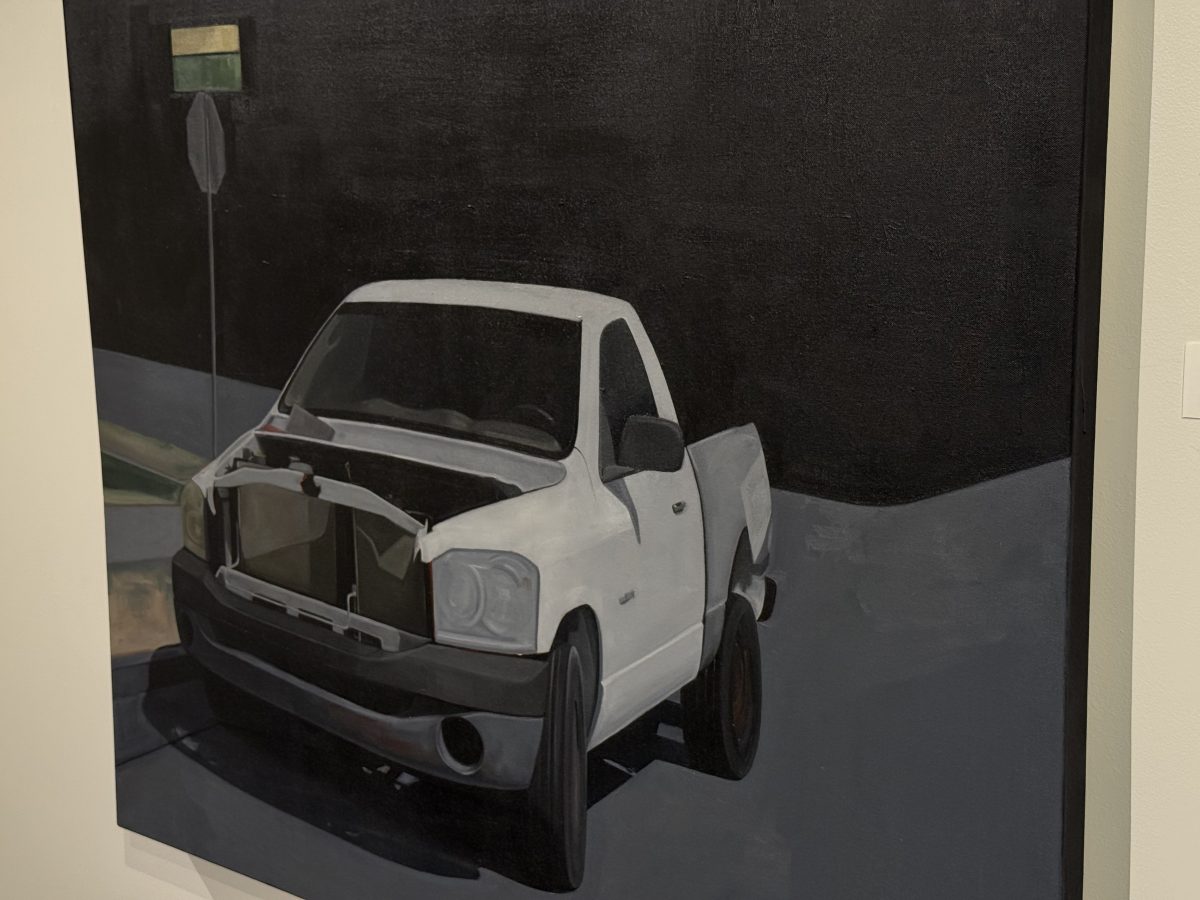
- Hunter Bailey, “Heavy Rain on Paper Wings,” oil on canvas
In “The Holy Bible and a Phonebook in a Hotel Drawer in Spokane, Washington,” the viewer becomes a traveler, peering into a nightstand illuminated by a diegetic bedside lamp. Another small-scale work illustrates an ambiguous moment in time where the sweep of headlights reveals an immutable decree painted on the back of a semi-truck: “JESUS CHRIST OUR SAVIOR.” Here, the artist suggests a fracture in the sense of united religiosity across the roadways of America.
In “Faith Don’t Fail Me Now,” a small-scale painting on wood, fear takes the form of a gray cloud looming over the horizon. Suspended in time, the viewer may hallucinate this cloud as a source of fire threatening the painted landscape, the sure promise of a storm, or as the tapering funnel of a tornado. Whatever the cloud becomes, all possibilities converge upon the same sense of unease. Drawing from the same sensations of disquiet, “Some Haystacks Don’t Even Have Any Needle” communicates exhaustion and futility. A faded yellow excavator sits in a field, positioned away from the audience. Its posture is supplicant, a mechanical arm extending toward its unseen workload. In both title and visual language, the painting presents labor unmet with any reward.
A most resonant quality of I Don’t Know God is its interrogation of the cyclical relationship between product and consumption. In three instances, smoothed particleboard substrates reinforce a conceptual counterpoint to Bailey’s narrative of abandoned consumer objects, standing in direct contrast to the decommissioned vehicles and technical objects in the rest of his work. (Lean closer, the raw edges of these particleboards are left exposed).
-
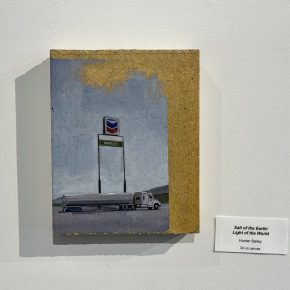
- “Salt of the Earth, Light of the World”
-
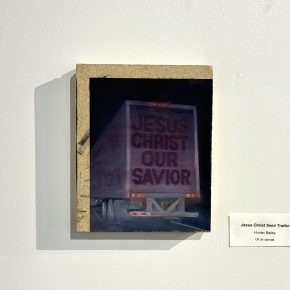
- “Jesus Christ Semi Trailer”
-
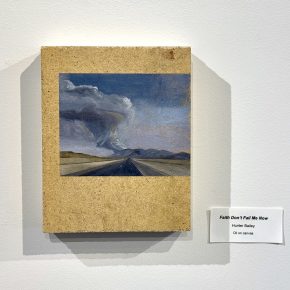
- “Faith Don’t Fail Me Now”
Together, these works position the audience within a physical and psychological perspective of a solitary traveler through a dystopia equal parts reverent and nihilistic. A balance is drawn between stable viewership and becoming lost in a placeless environment. Bailey makes accessible a glimpse into a place and time made inescapable by way of obsolete machinery, and unavoidable in its psychological paralysis.
After an encounter with Bailey’s works, a truth emerges: the paintings are less about the broken machine, and perhaps more about people seeing themselves reflected in obsolescence. There is something hopeful hidden here, something to suggest that the culture of discard can be remedied. The work itself is an antidote: there is a possibility of renewal and transformation under the hood. Bailey’s works conjure an extended universe of cars that may never again drive over asphalt, of leather that will never be warmed by the seat of a person, and of chapels as empty and abandoned as parking lots at dusk. Of a prayer yet unanswered, of a machine yet unfixed. Of God, cars, and other abandoned things.
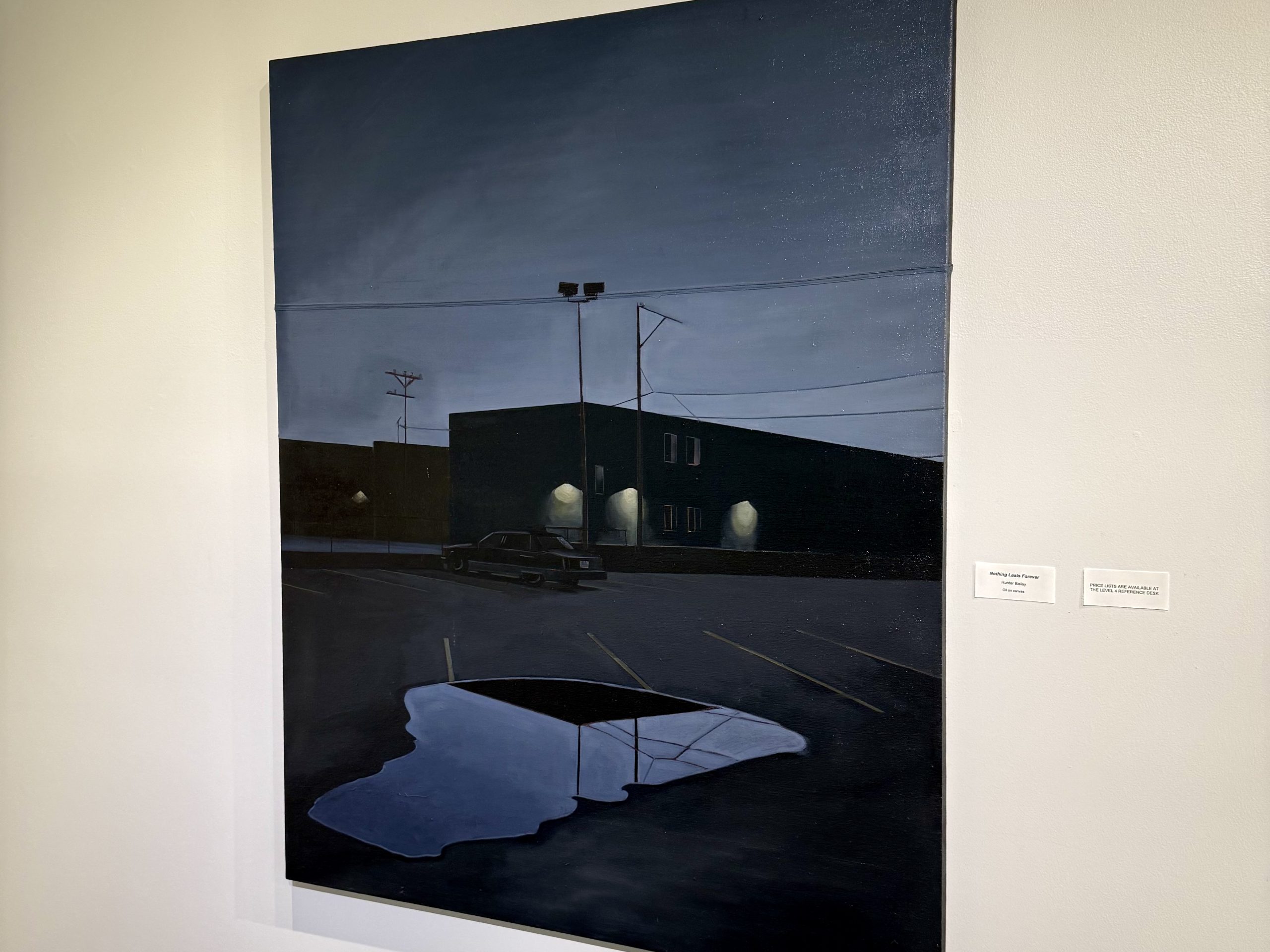
Hunter Bailey, “Nothing Lasts Forever,” oil on canvas
I Don’t Know God, but I Fear His Wrath, The Gallery at Library Square, Salt Lake City Public Library, through Sep. 11.

Anna McIllece is a writer and visual artist from central Alaska who lives and works in Salt Lake County, Utah. She holds a BFA in Fine Art from Brigham Young University and approaches art through both studio work and critical inquiry, investigating outsider art, the ancient and cosmic, human ritual, and folk tradition. Forever drawn to the unsettling, she examines how folklore persists and reemerges within contemporary life.
Categories: Exhibition Reviews | Visual Arts






I learned so much from this critique. Helps me with art appreciation and the backstories of these paintings.