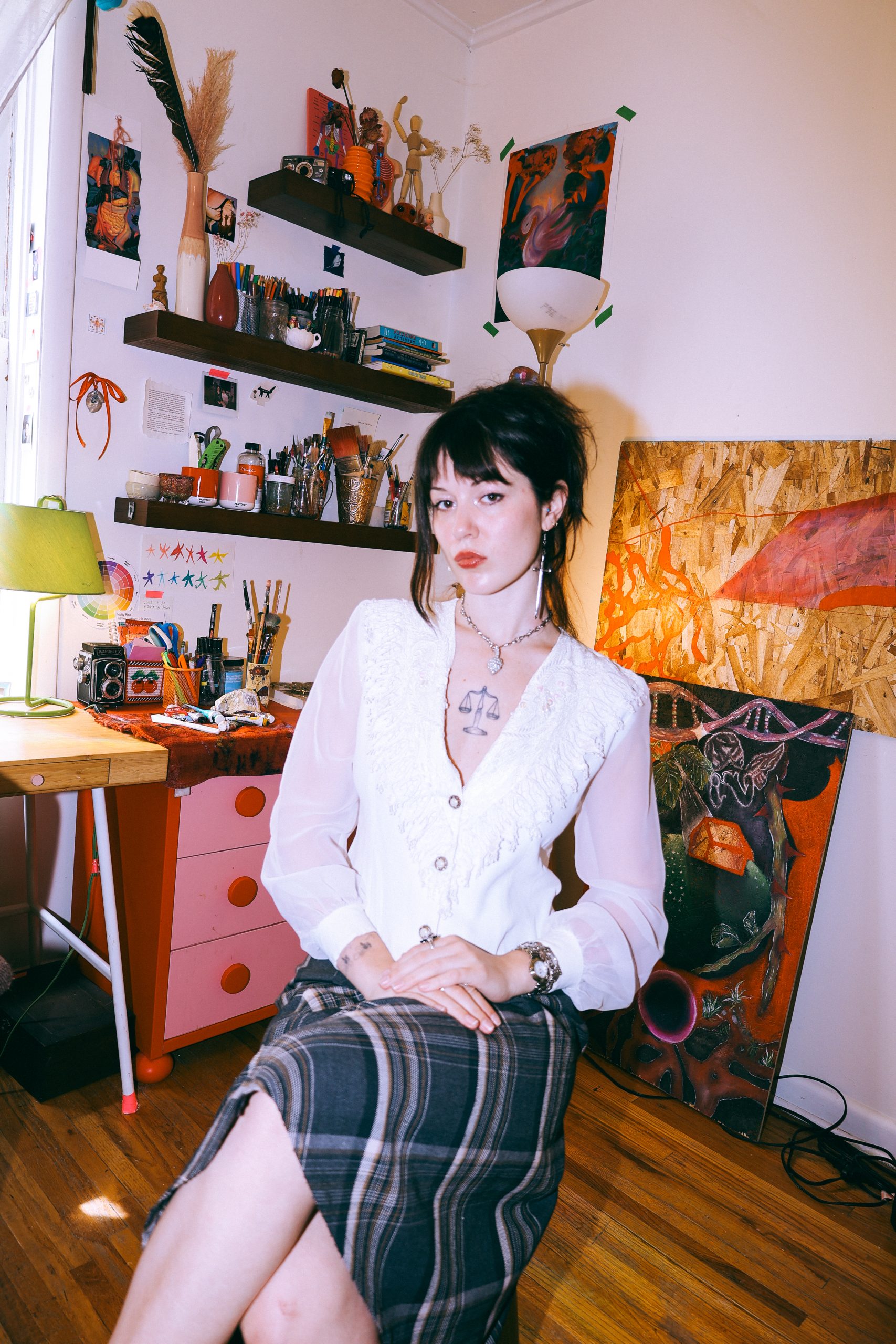
Allison Joy McKinney
For many contemporary artists, the space between lived reality and digital reality is becoming increasingly blurred and perhaps more ethically complex. For Allison Joy McKinney, these distinct realities merge. To understand the world more deeply, McKinney captures images of objects, people, and moments—sometimes seemingly fleeting—and reimagines them digitally. Her work becomes a somatic, phenomenological experience, inviting us to see the world through her eyes. Parts whimsical, meditative, psychedelic, and hypnotic, McKinney’s art invents realms where the body is illuminated, empowered, and liberated from pain.
McKinney grew up on a ranch in the woods of Northern California, where countless hours as a child in nature and isolation shaped not only her love of images, which helped her process the world, but also her existentialism. Her work is also largely informed by her experience with chronic illness; she considers the beginning of her art practice starting shortly after being diagnosed at 19.
“The absolute paradigm shift of chronic illness came on all at once, and I needed a way to reconnect with my vitality and inspiration,” she says. She was studying biology at UC Davis at the time—a path that wasn’t fully aligned with her anyway. She left school while recovering from a surgery that left her searching for meaning and asking herself what was truly aligned with who she was—”perpetually asking this, as we should.” Like Frida Kahlo, whose example of painting through pain and disability she cites as a formative influence, McKinney found that making art and acknowledging the artist identity she had always wanted but didn’t realize she could give herself became the mirror and the portal she was looking for. “Creating anything is facing yourself, excavating. I was excited and curious about the possibility of devotion to something over the course of a lifetime.” She moved to Salt Lake City six years ago and found a creative community for the first time in her life. After a few years of commitment to making, she went back to school at the University of Utah, and it completely changed and aligned her.
McKinney’s BFA thesis, The Opposite of Fear is Joy, articulated the process of moving past bodily fear toward a joyful groundedness, wrestling with the desire to both identify and not identify with the body. “The works acted as a yearning to remember our connection with the equally robust and fragile qualities of nature, to merge into the microscopic and escape the complications of my skin suit. To move away from the mechanical mind into the somatic body and attempt to find joy within the physical sensations to witness and confront the fleeting nature of being alive. I was really into the tension created between ‘natural’ and ‘artificial,’ earth and technology, body and mind, ego and spirit. It all exists tangled in this messy and beautiful way. Both automated and of earth, ‘faulty’ and faultless.”
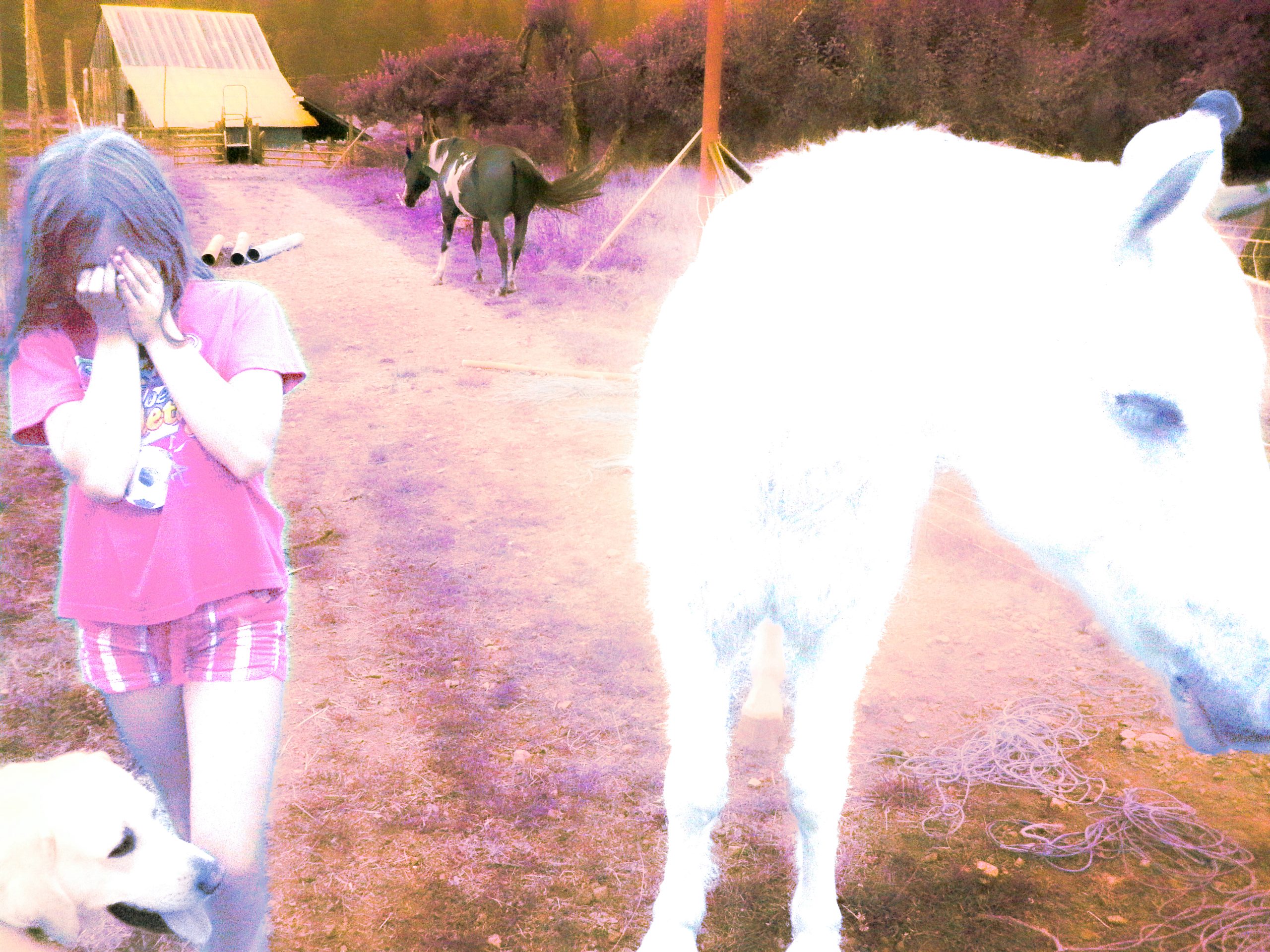
Blackberries and their thorns recur throughout the thesis, drawn from her Northern California childhood. For McKinney they carry a specific weight: the invasive, ungovernable quality of the plant mirrors mortality, the meaning we make of illness, and what she calls “an entropic susceptibility to biology.” But the image doesn’t stay dark. “And still ultimately, a fondness for my inner thorns, because they guide me to the berry. The meaning.”
That tension, between embodiment and dissolution, where the organic, the artificial, and the spiritual can all speak at once, runs through everything McKinney makes. She uses photography, heavy digital manipulation, painting, video, and sculptural installation. A lot of her practice comes from attempting to alchemize an internal state, theme, or conflict into visual form. She’s interested in work that feels both beautiful and slightly unstable—like it’s holding multiple emotional or psychological states at once and often emerges from an attempt to visually process contradiction, confess vulnerability, or visualize themes of transformation and identity.
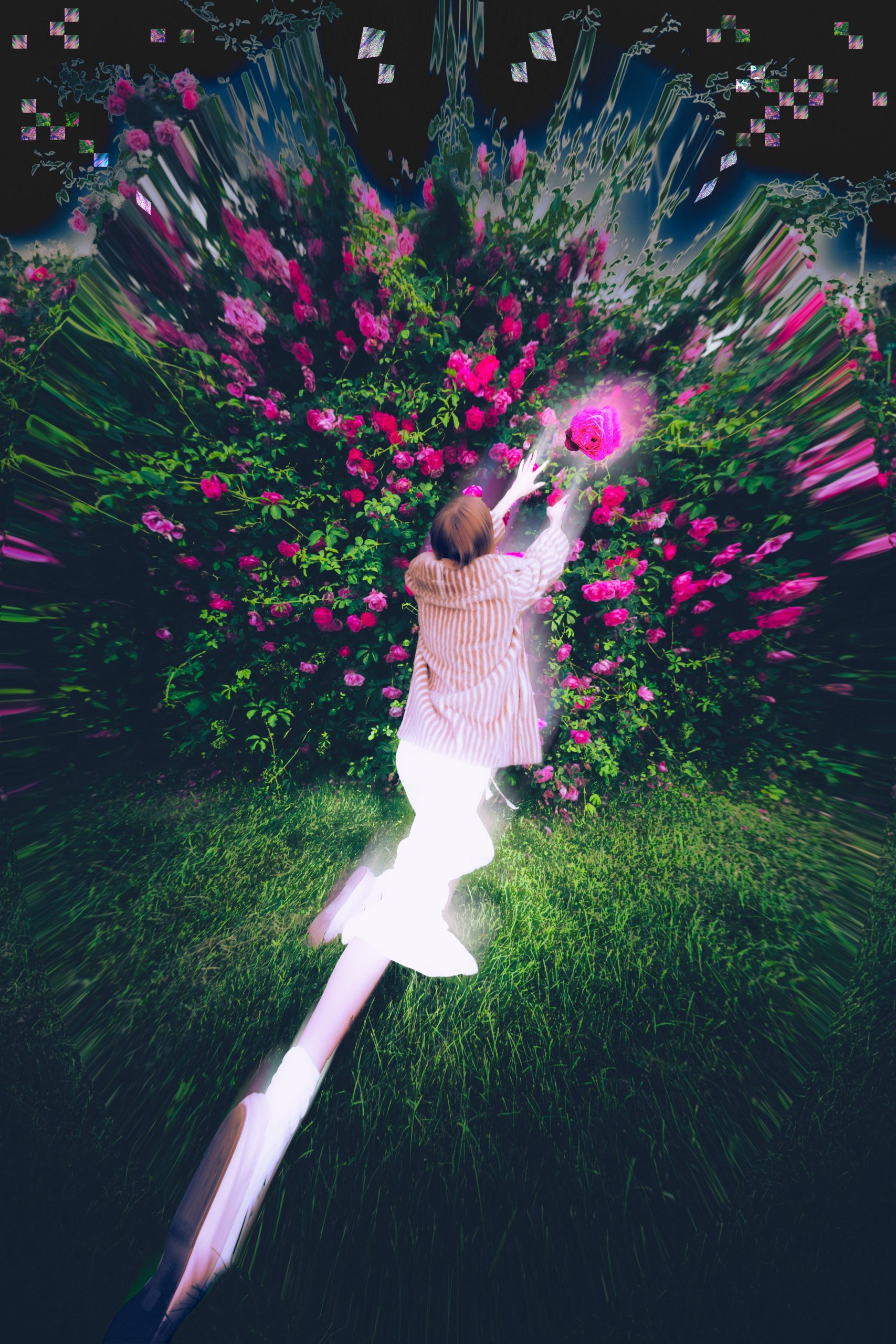 McKinney says she is drawn to making work digitally because she’s always loved editing images. Editing images feels like painting; except the camera, life, and light are all drawing for her, and she gets to do the fun part of colorizing. She likes the tension between unlimited control and glitchy surprises where she can surrender to happy accidents with lowered stakes. Often using layering, exaggerated color, or making things glow in a way that feels closer to how she meaningfully views thought, memory, and presence. “There’s something about the ability to endlessly transform an image, blow it up, and see its pixels that mirrors how buzzing and infinite everything actually is,” she says. She listens to the Cocteau Twins while creating — shoegaze as the unofficial sonic companion to work that wants to feel the same way the music does.
Another reason she loves heavy digital manipulation is that it allows space for an imagined dissolution, a daydream of hers. “Like disassociation, but out of pure cosmic pleasure and being rid of the complications of having disabilities,” she says. “The elasticity of the digital space is awesome for its world-building abilities and the way editing can help me imagine a greater aliveness. Taking the photo is experiencing the moment, but post-processing is the meaning-making.”
While McKinney primarily works digitally, she also feels the need to honor her humanness and create more tactically with her body. While she’s been taking photos since middle school, painting is what set her on the path of pursuing the journey of committing to her artistry while in recovery. She started incorporating mixed media because when showing her photography, she wanted the physical presentation and frame to merge with the image itself and exist more fully as an installation or object. “I think I just never want to limit myself to just one medium.” In terms of decision making, McKinney usually follows her current material interests in the present moment. “While some things stay in rotation like the colors red and pink, or lace, I’m currently experimenting with paper clay, solder, and textured glass. I especially love the textured glass for its ability to play with light in the space and offer different viewing experiences. It also transforms the piece into this hypnotic trap while distorting the image behind it, acting as a sort of shrine or shield.”
McKinney’s website is an artwork in and of itself. She approaches it as if she’s making a new piece, rather than just a portfolio. When she designed it, McKinney was interested in creating a navigation experience that feels interconnected with the art and slightly symbolic rather than purely functional. She divided it into four sections—Mind, Eyes, Body, and Self—which reflect the different layers of her practice, largely based around the feeling body. “Mind functions as a conceptual entry point and contains the manifesto behind my work. Eyes focuses on my photography and digital imagery. Body contains sculptural and conceptual bodies of work and installation views, emphasizing the physical presence of the practice. Self acts as a more diaristic space, including contact information, journal entries, and my CV. The site became a way to continually emphasize my themes of perception, embodiment, atmosphere, and identity into the digital space.”
-
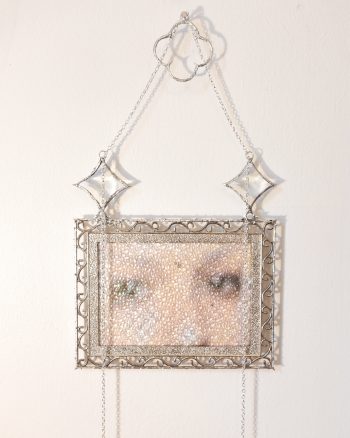
- “Archetype for our Shadow”
-
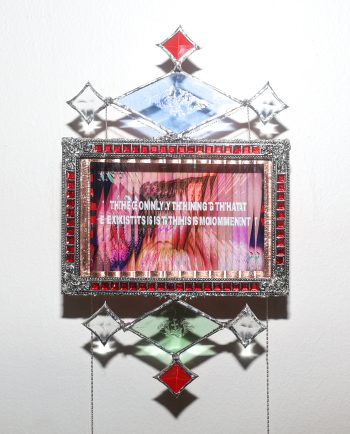
- “Bitch, You and Me Live Forever”
McKinney is clear-eyed about art’s relationship to healing — it works for her, but she doesn’t think it has to. “It is my outlet for the things in my head I don’t know where to put otherwise. Alchemizing it from mental clutter to physical form.” She’s equally clear about not wanting her practice defined by injury: in this season of her career, she says, she wants to decenter “the wounded part of me that creates from a place of pain or belief that I need to perpetually heal, repent, or prove my place in the world.” What she’s reaching toward is something larger — art and expression as conduits to greater authenticity, collective liberation, and understanding of each other, a vision informed in part by Audre Lorde, whose intersectional feminist philosophy McKinney calls transformative. (“Uses of The Erotic changed me.”) Art, she says, can “connect you to community, bring awareness to injustice, and imagine new worlds.”
Utah’s art community has been important to McKinney’s development as an artist and her path toward healing. “Existing in connection and conversation with my friends and community here has become vital to my wellbeing at this point. I’ve met so many wonderful people here who want to uplift and support each other in the artmaking process. I also admire the willingness of artists here to create opportunities for one another and build things from the ground up. There is a feeling that people genuinely know and support each other’s work.”
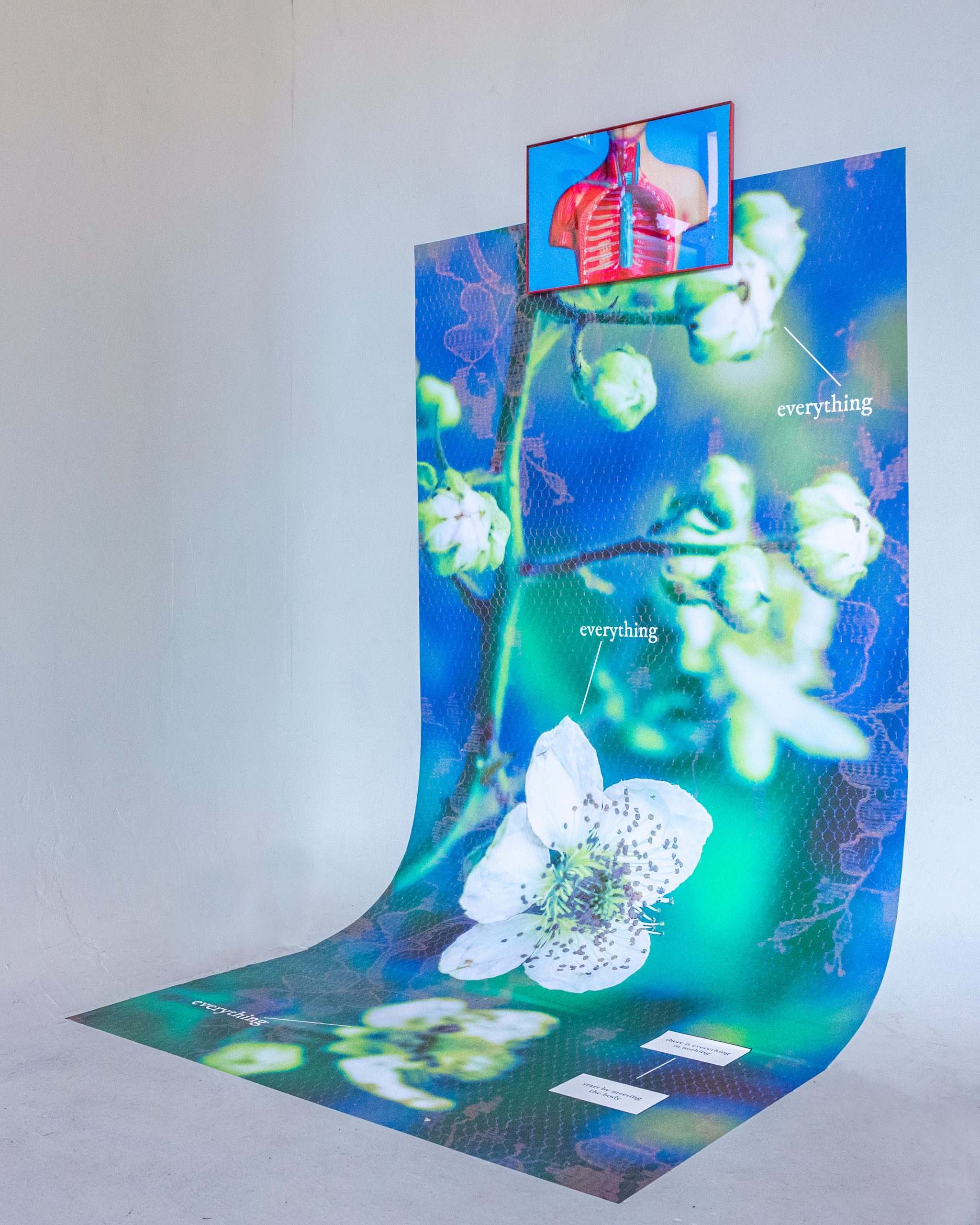
Mixed media installation from The Opposite of Fear is Joy.
That sense of mutual investment coexists with a clear-eyed view of what SLC is and isn’t. McKinney sees her generation as having a particular opportunity in a place defined by its contradictions — between tradition and contemporary culture, religion and secular life, wilderness and urban development. “While SLC isn’t an art capital, I feel inspired by the idea that my generation can be a catalyst for new ideas and help expand what is possible here. I think contemporary artists have a unique opportunity here, and I value spaces where artists can take risks, be audacious, and institutionally defiant.”
Recently, McKinney has been taking on photo clients, working on an album cover for a local artist, and showing work in exhibitions by SISTER collective, Wasteland, and Fice Gallery. Her next show is with Casita on June 27th; the theme is Unfinished and Imperfect. McKinney will be displaying an unfinished painting she hasn’t touched in four years because, “Perfectionism.” She is also working on updating her Why behind what she does, and carving out more free time to explore and play without an agenda. Her goal is to see what wants to come out of her when she has the space to listen to it.
All images courtesy of the artist.
DID YOU ENJOY THIS ARTICLE?
Help make more like it possible.
VENMO us a donation at artistsofutah

Or use PayPal to MAKE A DONATION.
15 Bytes is published by Artists of Utah, a 501 (c) 3 tax-exempt nonprofit.
Related posts:

Kasey Lou Lindley is an arts professional with formal training in fine arts, holding a BFA from Ringling College of Art and Design and an MFA from the University of Connecticut. She has written about contemporary arts and culture for Sarasota Visual Art and Art at Bay.
Categories: Artist Profiles | Visual Arts