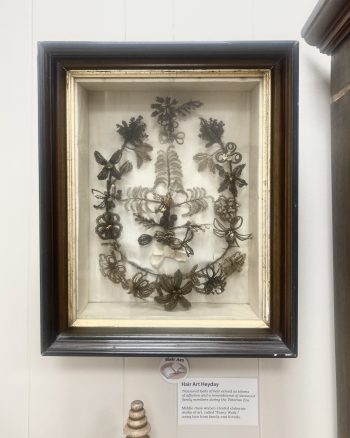
 If you know what to look for, they are not hard to find. In the Daughters of Utah Pioneer museums scattered across the state, you’ll discover them tucked among quilts and furniture and other artifacts of domestic life. They may fool you at first glance. This is a delicate necklace, that an arrangement of dried flowers, and there, mounted behind the glass, an ornamental curiosity. It’s only if you lean in that you notice the looping forms, the careful braids, the subtle shifts in color—these artifacts were not crafted with fibers or thread, but human hair, gathered and shaped into compositions that are both decorative and deeply personal.
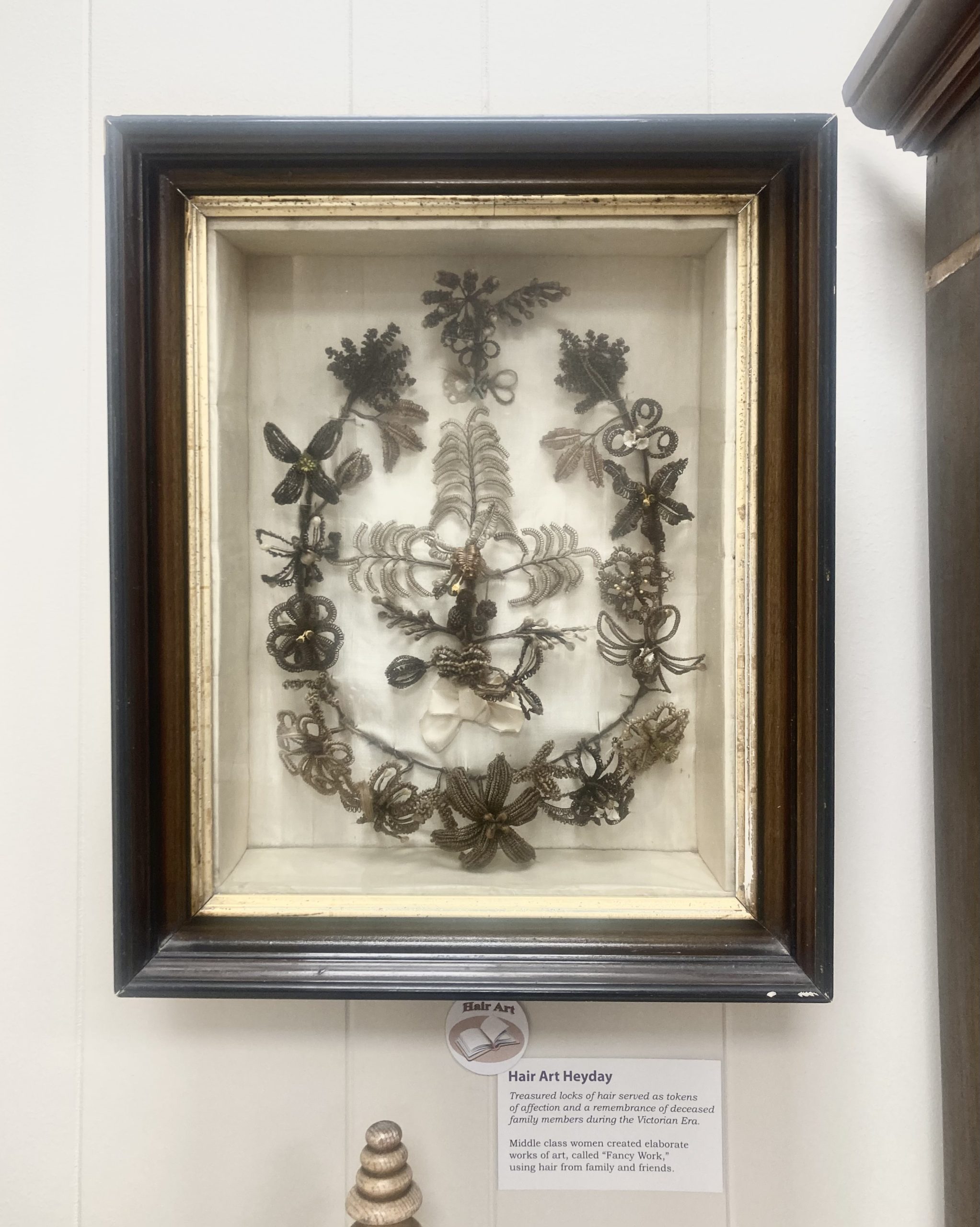
The practice has its roots in 19th-century Europe and America, where hairwork became a common form of both mourning and remembrance. As mummies from Peru to Denmark attest, hair does not decay, and so offers the most tangible way to preserve something of the body, both in life and death. Exchanged between lovers, or preserved by loved ones, hair became a token of affection and remembrance. And it could be transformed through detailed labor into intricate aesthetic objects. By the mid-19th century, instruction manuals circulated widely, and women, often young and not yet married, were expected to master the techniques. What they created hovered between craft and relic—bracelets, brooches, and, most elaborately, the framed wreaths that gathered entire families into a single composition.

Sharon Johnson, director of the Cache Daughters of Utah Pioneers Museum in Logan, is happy to show off their examples of the craft, sprinkled among quilts, furniture, and pioneer-era objects. In these framed wreaths, individual strands are looped and braided into flowers and leaves, each element often corresponding to a different member of the family. Shades of blonde and brown and hints of red distinguish the family members, so that the unified material is also a collection of individual presences.
Many of these works were made by young women, often in their late teens or early twenties. The labor is meticulous, requiring time, dexterity, and patience—qualities long associated with feminine accomplishment. The works gather together the material traces of a family and arrange them into a form that both preserves and transforms. Made at the threshold between girlhood and adulthood, they can be seen as offerings back toward the family the woman prepares to leave.


By the early 20th century, the craft had largely fallen out of favor, along with the doilies, antimacassars, and other trappings of Victorian domestic life. It was partly a matter of taste, but also reflected a changing relationship to the body and to death. As mourning became less formal, death and dying more remote, and industrial production offered easier ornament, the slow, deliberate work of hairwork slipped out of everyday life, surviving mostly as heirloom and artifact.
DID YOU ENJOY THIS ARTICLE?
Help make more like it possible.
VENMO us a donation at artistsofutah

Or use PayPal to MAKE A DONATION.
15 Bytes is published by Artists of Utah, a 501 (c) 3 tax-exempt nonprofit.

The founder of Artists of Utah and editor of its online magazine, 15 Bytes, Shawn Rossiter has undergraduate degrees in English, French and Italian Literature and studied Comparative Literature in graduate school before pursuing a career in art.
Categories: Visual Arts