

Karen Andrews studio, January 2026, is much as she left it when she died, including her last completed painting on the easel, lovingly framed by her husband, Ron Andrews.
When Alli Harbertson first walked into the Andrews home, it was the paintings that stopped her.
“They’re everywhere,” Harbertson recalls. The living room—where Karen Andrews’ hospital bed had been placed—was filled with artwork, paintings covering the walls and leaning against furniture while ceramics, blankets and small sculptures covered coffee tables, bureaus and dressers. “It was one of the first things I mentioned. It was a good way to get in.”
Harbertson had come late in Andrews’ life. The hospice chaplain originally assigned to the family had struggled to make a connection, and Andrews and her husband, Ron, had been hesitant to accept spiritual care at all. Harbertson was asked to try. When she arrived, Andrews was already close to death. Harbertson would spend only about ten days with her.
Even so, Andrews was clear about who she was. “I made all of these paintings. I’m an artist,” Harbertson recalls her saying, the pride evident even then. At one point Andrews instructed her husband, “Ron, take her around.” Much of that first visit unfolded as a quiet tour of the house, Ron Andrews walking Harbertson through room after room of paintings.
For Harbertson, who has served as a hospice chaplain for four years and whose role often involves helping people articulate what they leave behind, the meaning was unmistakable. “It was so clear that that was her legacy,” she says. “I was able to come back to her bedside and say, ‘You’ve made something really special.’”

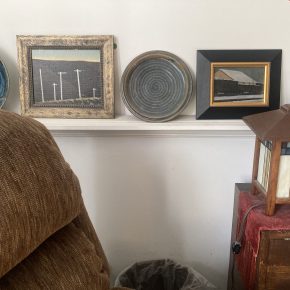


Karen Andrews died on New Year’s Eve, 2022. In the months that followed, Harbertson continued to support Ron through hospice grief services. The two grew close, and a recurring concern emerged. Ron Andrews did not know what to do with the work—more than 130 paintings in total—but he knew what his wife had asked of him. “She was so clear,” Harbertson says. “She said, ‘I made my mark. This is the mark I made—my paintings. Don’t let them go to the DI.’”
What followed became the second rediscovery of Karen Andrews’ work.
Born in Murray in 1945, Andrews was a largely self-taught artist. She did study some with Earl Jones and ran in artistic circles: the Andrews visited Lee Deffebach in her Tuscarora home; they were related to Claudia Sisemore; Ron’s golfing buddy was the late Tony Smith. Andrews began exhibiting her work in the early 1970s, shortly after she and Ron bought their Tudor Revival cottage in the Yalecrest neighborhood of Salt Lake City. By the 1980s, she was showing at the Springville Museum, the Salt Lake Art Center, the Art Barn, and in Utah Arts Council exhibitions. Her career was gaining momentum when it abruptly stalled.

Karen Andrews in 2003, in her newly constructed studio in the attic of the Andrews’ Salt Lake City home.
In 1985, after a one-woman exhibition at Sylvester’s Art & Frame in Salt Lake City, Andrews believed another artist had copied her work for a Park City exhibit. The experience was devastating. In a 2003 interview, she described learning that a trusted friend had helped facilitate the copying. “When I found out my friend was kind of behind it,” she said, “it was devastating, and I thought, ‘Oh, I’ll never show my stuff again.’”
For nearly 20 years, Andrews continued painting while retreating almost entirely from public exhibition. At the time, she said the withdrawal brought relief. “It was good to do it on my own,” she explained. “My paintings got so much better.”
That long seclusion ended almost by accident.
In 2003, art enthusiast Aaron Moffett stopped at a garage sale in Salt Lake City’s Harvard/Yale neighborhood. What began as casual conversation led to an invitation inside the house. The encounter left him stunned. “I thought, ‘Wow, these are great,’” Moffett recalled at the time.
Moffett helped found Artists of Utah, and a 15 Bytes profile followed soon after his encounter, reintroducing Andrews’ work to the public. She began showing again, including at Utah Artist Hands. Gallery owner Pam O’Mara remembered her first impression clearly: “I was excited because it was so unique. It feels like she paints with a lot of emotion.”
Andrews herself remained ambivalent about visibility. “I’m more comfortable with alone time, being in isolation,” she said then. Though she briefly returned to exhibiting, she soon faded into the background again. “She was just really a homebody,” Ron says.
She never stopped working, and at the time of her death, as Harbertson discovered, paintings filled the house. The upstairs studio she was building when 15 Bytes first profiled her is now packed with paintings, supplies and frames—Ron has kept it largely as she left it: partly out of fondness, but also because he’s overwhelmed by what to do with it all.
Harbertson, who had worked in museum and design settings earlier in her life, felt compelled to act—not to sell the work, but to ensure it was seen and placed. “It just felt wrong,” she says. “This work is too good. It’s interesting, it’s compelling, and it deserves to be seen.”

Ron Andrews shows one of the few paintings his wife Karen painted with a figure—of him, fly fishing.
Working with Ron, she contacted local arts institutions. Utah Arts & Museums staff inventoried and photographed the entire body of work. Representatives from public collections responded enthusiastically, selecting several paintings for future placement. For Ron Andrews, the response was both surprising and affirming. “I didn’t realize how talented she really was,” he has said, reflecting on the attention her work received after her death.
From that effort emerged Into the Light of Day, an exhibition at Material Gallery that opens Thursday, Jan. 15. The show presents a couple dozen paintings drawn from Andrews’ larger body of work.
Karen Andrews’ paintings are defined by solitude. Across more than a hundred works, only two include human figures. Her subjects—train yards, mills, aging industrial buildings—are often depicted at dusk or night. “It’s people in there working and I’m just out there alone,” she once said of her painting “Night Shift,” a depiction of an industrial building near Garfield, since razed. “The windows looked like stained glass to me.”
Her paintings are not lonely, but they are solitary—scenes observed without spectacle. Salt Lake Tribune art critic George Dibble said her depiction of the usual was unusual (Salt Lake Tribune, Aug. 22, 1976, p. 80). Many of the buildings she painted have since been demolished, lending the work an unintended archival quality. Even when they were made, they depicted a world already slipping away.


Installation view of Into the Light at Material Gallery.
-

- After finding a trove of photographs of New York, Andrews made the skyline a recurring motif in her work.

In press material prepared for the gallery, Harbertson writes: “Working from photographs she took in situ across Utah and New York City; Andrews’ paintings initially present a sense of photographic immediacy. At first glance, the works appear realistic—sometimes even cinematic—yet this apparent fidelity gives way to a more complex spatial and emotional register. A palpable sense of distance and quiet pervades each composition, situating the viewer within an image that feels both familiar and deliberately staged.”
Throughout Andrews’ long retreat from exhibition, the paintings never left the orbit of her daily life. They also never left Ron Andrews’ care. While Karen Andrews worked largely out of sight, Ron quietly ensured that the work remained ready. He framed and varnished the paintings, often repurposing frames found at garage sales. It was practical, but also intimate—another way the work remained within the boundaries of their shared life.
Karen Andrews resisted attention for much of her life, even as she insisted on the value of what she made. The exhibition at Material is not a revival, in the commercial sense, but, rather, an act of stewardship. “Ron didn’t want to sell anything,” Harbertson says of the exhibition. “He just wanted to see it happen—to see that she really did make her mark.”

Into the Light of Day, Material, South Salt Lake, Jan. 15-29. Opening reception, Thursday, January 15, 2026, 6–8 p.m., with a brief talk on Andrews’ work from 6:00–6:30 p.m. Closing reception: Thursday, January 29, 6–8p.m.
All images courtesy of the author.

The founder of Artists of Utah and editor of its online magazine, 15 Bytes, Shawn Rossiter has undergraduate degrees in English, French and Italian Literature and studied Comparative Literature in graduate school before pursuing a career in art.
Categories: Artist Profiles | Exhibition Reviews | Visual Arts




Readers of The New Yorker are aware that the greatest of its several editors was the renowned Mr. Shawn. We who contribute to 15 Bytes have our own Mr. Shawn, whose skills are not limited to the graceful and flawlessly accurate prose that our readers find in this memorial portrait and throughout the only magazine of its kind. For a writer, an attentive reader who knows where to let alone and when to intervene is a gift and a blessing. I hope everyone recognizes Mr. Shawn’s skill as a composer of text, and I am here to say he often modestly, without calling attention to himself, loans his gifts to his stable of avid writers to help them look almost as good as he.