
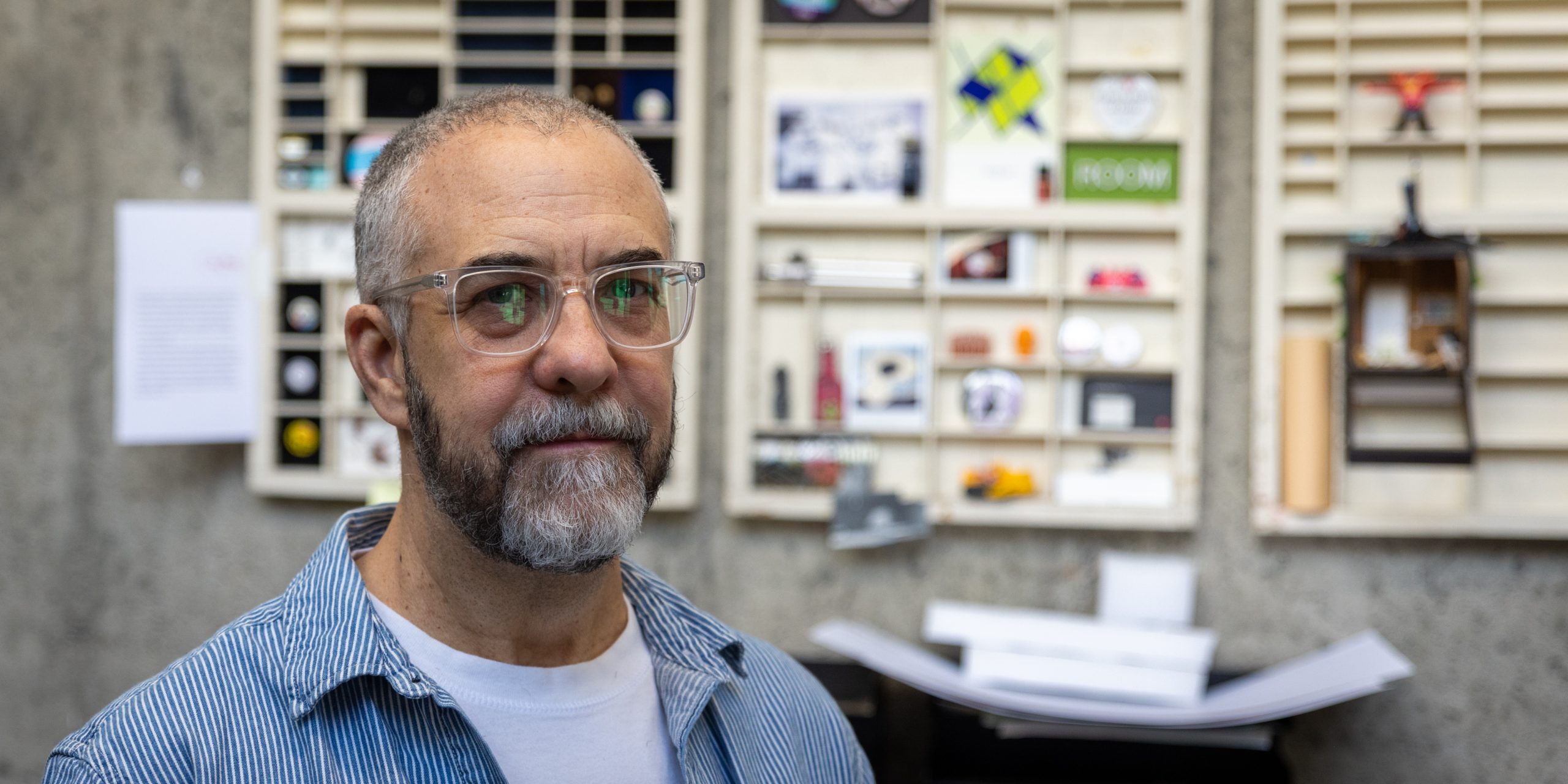
Salt Lake City artist Dan Evans at his studio on the campus of the University of Utah. Image by Steve Coray.
Dan Evans’ work begins with the question of what remains once an image has been pared to its essentials. “I’ve always been drawn to systems where clarity matters,” he says, “where you pare things down until the lack of recognition engages the viewer and holds itself.” It’s a clarity rooted not in what the image depicts, but in the structure left behind after everything recognizable has been reduced. His new exhibition, Peripheral Dependencies, at Finch Lane Gallery through December 26, presents photomontages that concentrate on edges, absences, and the quiet internal structures that shape visual experience. They are materially modest but conceptually exacting, built from an ethos of careful cutting, fitting, and refinement.
“I was a kid from Salt Lake City dropped into this incredible art school,” he says of moving to Los Angeles to attend Otis/Parsons for his BFA. “I saw the work of a designer who had done these major, commercially successful projects, and that was when it clicked for me—I realized design was something I wanted to pursue.” He remained in California to complete an MFA at the California Institute of the Arts, then worked in Los Angeles’s world of visual design and studio practice, where restraint met experimentation.
Evans’ background in California’s design and music cultures threads through Peripheral Dependencies, adding a subtle counterpoint to the clean geometry of his photomontages. It surfaces in the way his compositions feel edited rather than constructed. “Composition has always been instinctive for me; it isn’t calculated anymore,” he says. Several works echo the pacing of analog record sleeves, where cuts function like sequential beats. “There’s a sequence to how the cuts work together; it isn’t musical in a literal way, but there’s a rhythm to it, like moving through tracks.”

Dan Evans: Peripheral Dependencies at Finch Lane Gallery.
That sense of equilibrium is clear in the exhibition’s smaller compositions, particularly “Proprioception 1.” Constructed from irregular polygons sourced from printed books, the piece is a study in calibrated intuition—the quiet knowledge of where shapes belong in relation to one another. The sharpened edges contrast with the work’s overall effect: a composition that feels grounded, calming, and precise, with vivid red fragments acting as an anchor.
The use of red is a subtle nod to the University of Utah, where Evans joined the faculty in 2016. His work on campus connects him to a lineage of modern abstraction that the university has cultivated for more than half a century, shaped by clarity of form, disciplined paper-based practices, and a deep commitment to formal reduction. In many ways, Evans’ approach exemplifies the slow looking and material sensitivity that have defined the university’s visual arts programs since the mid-twentieth century, when Utah modernism was shaped as much by architecture and design as by painting itself. Students often describe his critiques as steady, methodical, and grounded in questions of proportion, weight, and visual logic. His works emerge as fragments cut with architectural accuracy, surfaces aligned with intention, and compositions assembled with a discipline that gives each piece its calm, load-bearing structure.
In Evans’ view, this kind of balance is a designer’s concern as much as an artist’s: “Asymmetrical balance is where the designer in me still shows up,” he notes. “It’s one of the hardest things for students to grasp, but it’s essential to making a composition interesting.” In “Proprioception 1,” that instinctive balance gives the work its grounded structure even as no single element dominates.
-

- Dan Evans at work in his studio. Image by Steve Coray.
-

- Raw material for Evans’ collages. Image by Steve Coray.
Evans’ technical discipline reaches another register in “Insolidation,” where angular fragments of found paper are cut with near-architectural exactness and fitted flush against one another. The reflective textures hover between matte and satin, revealing slight shifts in tone as the viewer moves. Every seam is intentional and every fragment feels weighted. This precision creates a grounded, almost physical sense of reassurance, as if the piece is holding its own center of gravity.
Evans’ approach to absence reinforces this sensibility. Evans describes the periphery as a site of meaning: “The whole piece is an assembly of peripheries—little bits of images cut back until nothing recognizable remains. If I can still see what it was, I have to cut it more. Paring things down keeps the image engaging.” His photomontages hold this tension; their gaps are active, guiding the viewer’s movement through the work. Each fragment seems to nudge the next into position, creating an internal scaffolding built from relational tension rather than mass. In their interplay of angles and openings, these works show how abstraction, shaped with patience and exactness, can produce its own stillness.
Peripheral Dependencies suggests that looking may depend less on focus than on allowance—letting edges overlap and generate their own syntax. For Evans, this is not only an aesthetic choice but a method for working through contemporary noise: composing with fragments, tracing order through distraction.

Cut paper fragments in Evans’ studio reveal the raw material of his process—shapes sourced from printed images and prepared for recomposition. Image by Steve Coray.
Peripheral Dependencies, Finch Lane Gallery, 54 Finch Lane, Salt Lake City, through December 26, 2025.
Second Gallery Stroll Reception: Friday, December 5, 6–9 p.m.
DID YOU ENJOY THIS ARTICLE?
Help make more like it possible.
VENMO us a donation at artistsofutah

Or use PayPal to MAKE A DONATION.
15 Bytes is published by Artists of Utah, a 501 (c) 3 tax-exempt nonprofit.

Hannah McBeth studied art history, classics, and Mediterranean archaeology before getting a Master’s at Cambridge University. She enjoys writing, hiking, and traveling to far-off places. Follow her on Twitter @hannahmcbee.
Categories: Exhibition Reviews | Visual Arts








Love Dan work, in the faculty show and Finch Lane. I came to the U of U to study painting and drawing after 25 years of interior design. Originally I was drawn to sculpture when Amie McNeil was faculty. Dan’s structure building of his work, adding just the right amount of color and value has stunning outcomes.