
Sam Forlenza inside his Salt Lake City studio.
When Salt Lake City artist Sam Forlenza decided—almost accidentally—that he would go to his Sugar House studio every day and post a new creation to Instagram each day, he describes it as “the brilliant, albeit naïve idea” that took hold simply because he was already there so often. “One day built on another and slowly I had been there a week and didn’t stop for months.” What began as an organic rhythm became what he jokingly calls a personal double-dare: “Can I get to the Studio every day and post something every day? Extra points if I had a trifecta or hat trick (choose your sport)—can I: (1) get to the Studio, (2) create something that day, and (3) post that day’s creation on IG?”
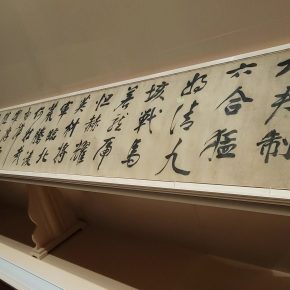
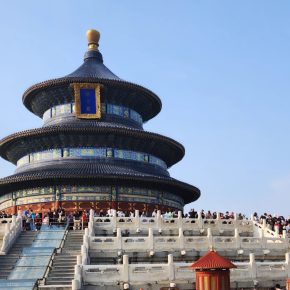
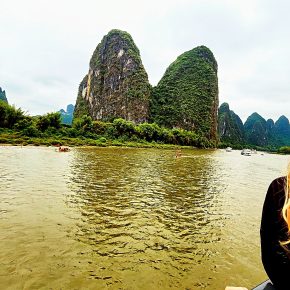
He gave himself “practical rules” as he went along. Travel out of state meant he could miss the studio, though he still aimed to keep posting. He hadn’t thought through what would happen if he lacked internet access, a detail that surfaced quickly when he and his husband found themselves in China in April. Before leaving, he had been warned he would almost certainly lose access to Instagram behind the Great Firewall. Instead, “it turned out I could generally access Instagram, and the best ‘reception’ was inside Chinese Ubers. Who knew?” The couple traveled through Beijing, Xian, Guilin, and Shanghai, where the Shanghai Art Museum offered him unexpected resonance: “galleries cram packed with amazing calligraphy which tugged at my heart strings and my long love of working in Black and White—think Robert Motherwell and Franz Kline.” In the M50 art district he met the international painter Lin Jin Chun, communicating through Google Translate and only afterward learning the artist’s significance. Predictably, he bought a small print.

Sam Forlenza (left) with Chinese artist Lin Jin Chun. Forlenza had plenty to distract him from his artistic goals in 2025.
In May, Forlenza traveled to Savannah for his great-nephew’s graduation—another legitimate break from the studio but not from the daily Instagram ritual. He visited the SCAD Museum, the Telfair, and several local studios, including Michelle Perez’s, returning to Utah with one of her small cradleboard paintings. Soon he was back at his own studio and returning to the challenge. The daily visits were not always glamorous. “Some days I went to my Studio and looked at my phone for way too long and as it got late I tried desperately to get something—anything—done.” His psychologist’s mind recognized the pattern: “often the most productive and revealing times in a psychotherapy session are the last few minutes, as the client is walking out the door.” Other days all he managed was housekeeping—cleaning, organizing shelves, priming canvases. “I decided that still counted as progress.”
The summer brought a new spark when he picked up a book on Picasso’s cutouts and began experimenting with his own. He produced around fifteen of these silhouettes on black or gray paper, then challenged himself not to let them become “Picasso copycats.” The project led him into three new series—Blossoms, Spring Garden, and Winter. The Winter works began on black-gessoed surfaces and referenced shifting weather conditions with titles like Squall, Wind, and Storm. He notes, partly amused, how much nature crept into his work: “Now don’t tell her, but I’m not one of her biggest fans.” After three decades in northern New Jersey, only minutes from Manhattan, he still describes himself as “a city boy… perfectly content to spend hours inside a good art museum oblivious of what is going on outside. (Oh, there are mountains out there, who knew?)”

Sam Forlenza, “Winter,” 30×40 in.
What surprised him most was how much harder the posting became than the making. “Posting on IG every single day was a bigger hurdle than getting to the Studio every day.” He counted even brief visits as valid—arriving at 10 pm and staying fifteen minutes still met his criteria—but Instagram demanded a constant stream of content. On desperate days he posted a humorous poem written years earlier (“Ode to a Toaster”), or works from decades past. “According to my rulebook this was my work and therefore still legitimate to post.” Revisiting these long-stored pieces brought its own excitement. Pairing the images with music became a quiet pleasure; he often selected understated instrumental tracks, “light or semi-classical.”
In the fall, he and his husband traveled to South Africa—Johannesburg, Durban, a safari, and Cape Town. The trip was exhilarating but draining. “Two major trips in one year might have been one too many,” he reflects. At the WITS Art Museum in Johannesburg, a docent guided them through a moving exhibition of Serge Alan Nitegeka’s work. In Cape Town they stayed at the Cape Heritage Hotel, whose hallways were filled not with polite landscapes but with contemporary art and sculpture. They attended a reception for artist Simon Venter and timed their stay to coincide with the First Thursday Art Walk, where Forlenza bought a small fabric work by Davina de Beer at the nonprofit AVA gallery. The stimulation was tremendous, but in its wake he felt his rhythm fray. “I suspect all the traveling, while extremely exciting and stimulating, helped to do me in.” The daily challenge, once novel and energizing, grew heavy. “The excitement and wonder became dread. Less is more.”
Still, the tally at year’s end astonished him. “I posted close to 300 times during 121 days, I met so many interesting people, had fascinating conversations, and created dozens and dozens of new art works.” The year, he says, may not have been a masterpiece, but it was unquestionably a personal success.
As he looks ahead to 2026, the momentum continues: an accordion book will appear in the Bookarts Roundtable exhibition in New Jersey from January through April; he will perform his piece Time Piece at 12 Minute Max at the Salt Lake City Public Library in February; and in March a solo exhibition will open at the Anderson–Foothill branch of the library.
Forlenza ends his account not with a summary of achievements but with a distillation of what the year taught him—ideas rooted in psychology and shaped by experience.
Lessons and Observations: Let me conclude, with fifteen observations. They incorporate ideas directly from psychology.
-
Just show up. You get credit for just being there. Set a regular schedule, use a timer, or some other device or aid, if it helps.
-
Consistency, as we know, counts. Forming new habits takes time. Be kind and forgiving to yourself.
-
Doing anything is better than doing nothing. Lower your expectations. “The Perfect is the enemy of the good.”
-
Have a space devoted solely to your art (See No. 5).
-
Block out all distractions. No screens, no calls, no refrigerator.
-
Relapses are part of the process; the road is not straight. Just because you don’t know where you are going (creatively) doesn’t mean you are lost.
-
Housekeeping counts. These mundane tasks helped to keep me focused on the creative process and kept me in the Studio.
-
Doing anything creative counts. Going to the art supply store (across the street) counts, or going to a gallery can be inspiring.
-
Do what works for you. This process may work for a time until another process becomes more useful. One size does not fit all.
-
“Overcoming or Joining with the Resistance.” Stealing an idea from psychotherapy, sometimes I needed to do little or nothing. I needed to give myself permission to be stuck. I needed to go with or join the resistance. Make friends with it and be kind and nonjudgmental to it and of yourself. It will pass. See resistance as a normal part of creativity (and psychotherapy.) Having supportive friends (and maybe a good therapist) can help and validate you.
-
“Approximating desired behavior” is worth noting. Another idea from psychology here. Taking the smallest step toward your desired behavior is helpful. If the goal is to paint a new canvas, any step toward that desired goal or behavior is helpful. Buying the canvas, bringing it to the Studio, placing it on the easel, placing your paints nearby, just sitting in front of the easel, the canvas—all of this gets us closer to the desired behavior of CREATING.
-
Sometimes taking a break, going for a walk, or purposely doing ugly or trashy work is important. The latter has been described as “embracing imperfection.” (See no. 3.)
-
Meet and speak to other artists whenever and wherever you can. Have a support system.
-
Continue to look at as much art as possible.
-
Acknowledge and celebrate all accomplishments.
“It has been an especially exciting and rewarding year,” he says. “I was extremely productive, feel very proud, learned a lot, and am incredibly grateful.”
You can scroll through Sam Forlenza’s year in art at instagram.com/sam.forlenza.

Categories: Best Of | Visual Arts