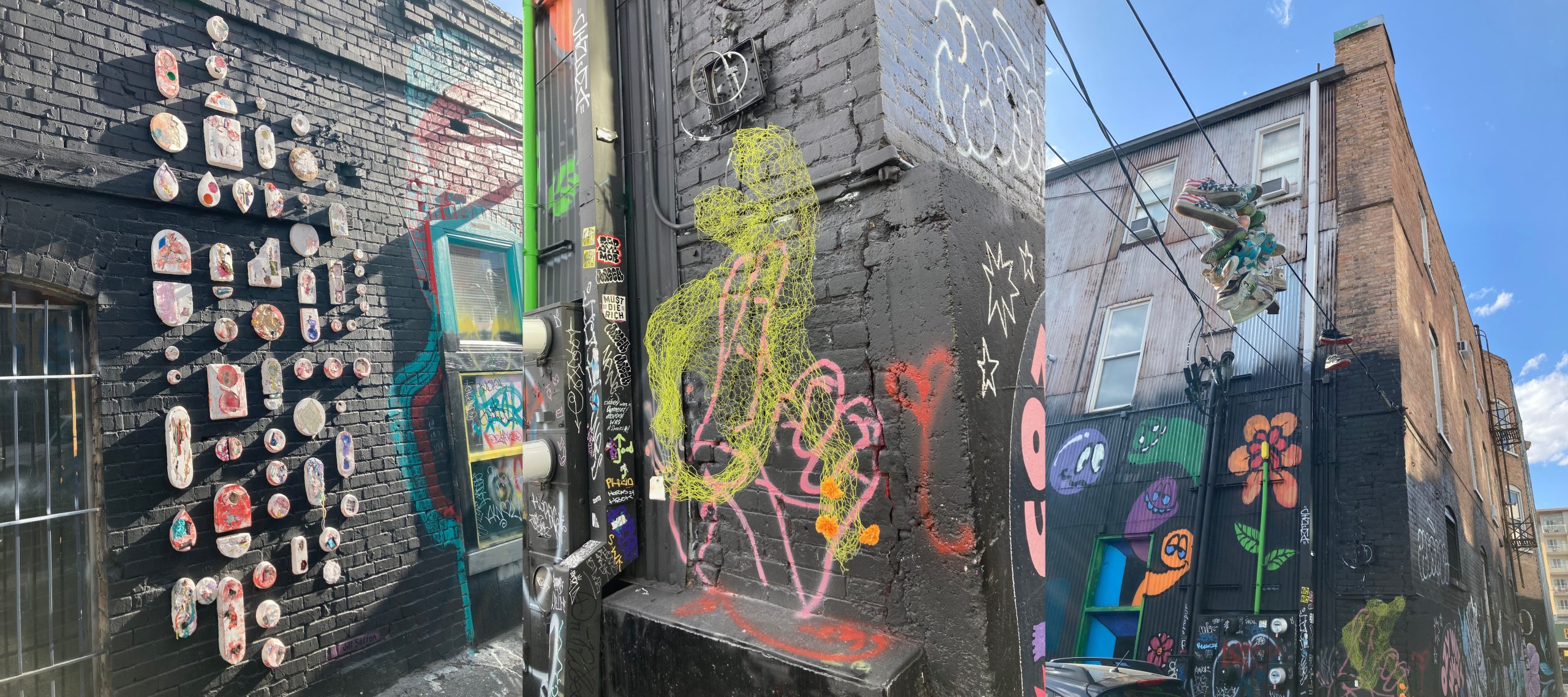
Images from 2023’s “Salt Lake’s Finest Billionaires: Backdoor Bandit Group Show,” the show Chuck Landvatter curated in the alleyway behind FICE in Salt Lake City.
On September 15, 2023, Chuck Landvatter and some twenty or so other artists transformed the narrow run of asphalt and the brick in the alley behind Fice and Copperplate Press into a spectacular exhibition for a single night: Salt Lake’s Finest Billionaires: Backdoor Bandit Group Show. The height of the neighboring buildings gave the sense of being in a canyon rather than an urban alley and made room for installations that exceeded conventional gallery walls. Guthrie’s studios overhead and a bar across the street fed foot traffic in both directions. Landvatter later recalled, “It felt like a rave in the west desert.” Remnants of the event still echo there. Just a week before Billionaires, Sister.SLC held the exuberant second installation of their Art Gallery & Zine Release at the elegant, if stodgy, Commercial Club. A few months prior Carlos Miranda and Angel Perez staged Valley Art Walk in Kearns to put West Valley artists on the map. If you missed these shows (like I did), you should have had your ear to the ground.
Ephemeral exhibitions in SLC, or pop-ups in common nomenclature, tend to appear in clusters. This spring Hunter Bailey and Celia Bangs Thomas of Wasteland presented the group show Horse in a vacant commercial space in the Uffens Building. Entrepreneur and artist Maddie Allen had an eclectic one-night exhibition, Muses, to showcase the art being made at Make Well, her art incubator and studio. The painter Cami Twede, collage artist Didier Bouchever, and photographer Jimi Bone teamed up for Almost Frame-ous, a joyous and irreverent exhibition hung on the walls of SLC Pub. This Saturday Casita Events will deliver the work of more than 30 artists at their Unfinished & Imperfect Art Show in Millcreek. What gives?
Utah’s gallery system, like most gallery systems, runs on the patronage of collectors, donors, and public funding. Unsurprisingly, that dependency shapes what gets shown: administrators have an incentive to favor known names and work with broad appeal because a misstep can jeopardize the relationships that keep the lights on. Meanwhile, the number of artists working in the state is far outpacing the declining number of spaces. The galleries that remain cannot accommodate various mediums and genres let alone meet the demand. Scarcity pits artists, many of whom are friends and collaborators, against one another for coveted spots in annual shows. Add to all this the simple disconnect between an artist’s working rhythm and a gallery’s annual call-for-entries calendar and the value and necessity of the pop-up format become clear.
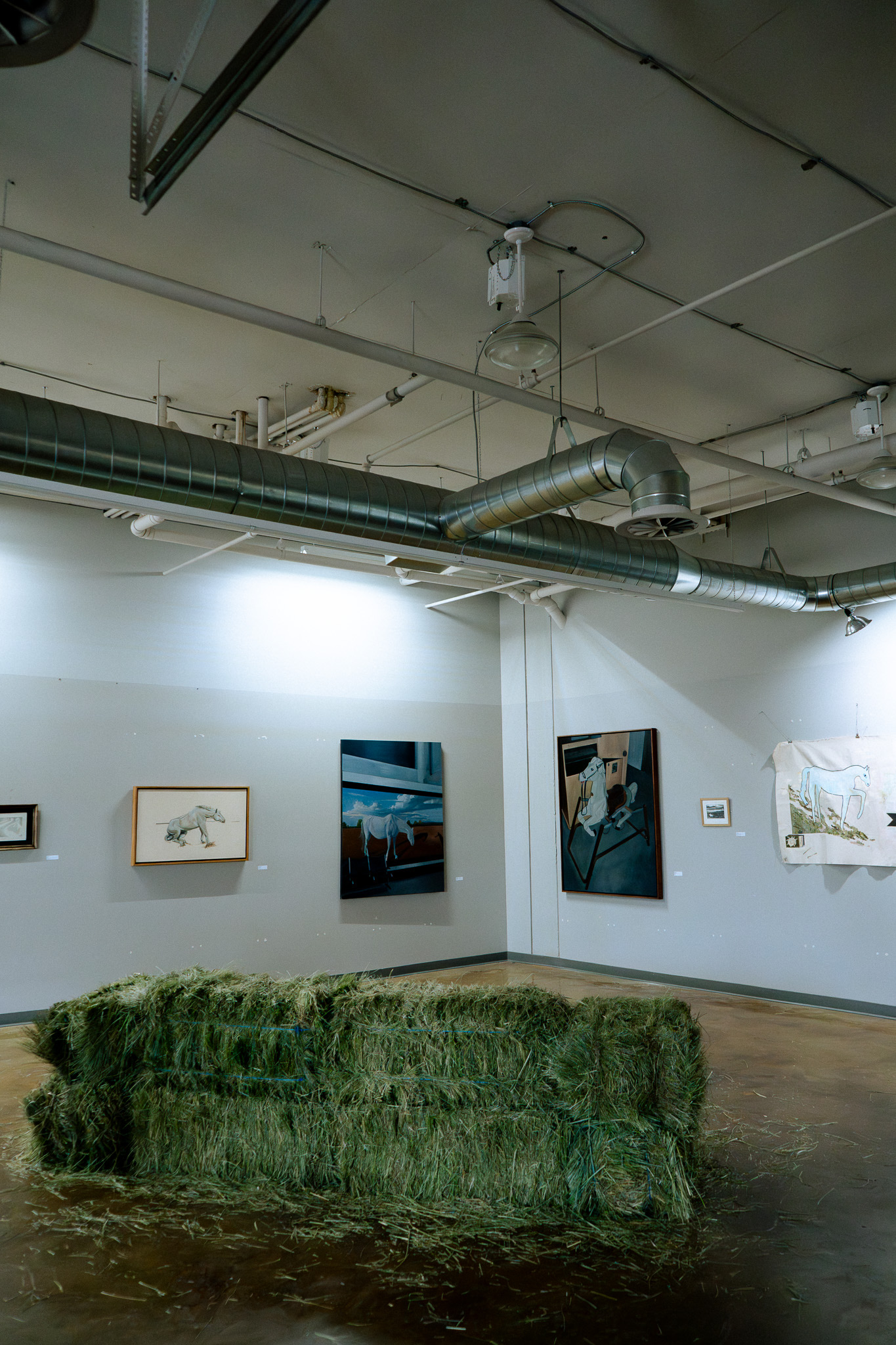
For their one-night showing of Horse, Wasteland went all in, including hay bales for seating.
The pop-up format provides a vocabulary and precedent for any solo artist, collective, or curator to circumvent institutional barriers and show work of their choosing. It accommodates almost any budget. Miranda and Perez chose a private home in Kearns specifically to eliminate cost and showcase West Valley artists in their neighborhood. Almost Frame-ous landed at SLC Pub because the pub’s owner, a friend of Twede, Bouchever, and Bone, offered its walls for free. Bone, whose photography hung for the first time, loves the goodwill that often accompanies the pop-up format: “It’s about artists helping artists.” Allen expanded Make Well’s studio wall space with hinged and painted hollow doors they made themselves. Allen frames pop-up events less as an endpoint and more as an “exhibition recital” for herself and studio subscribers. They are looking forward to their next pop-up in the fall. Wasteland uses Loopnet to find commercial spaces. Horse cost them $1,500 for three days: one to install, one to show, and one to teardown. In addition to a complementary aesthetic, they seek owner/lessors between tenants who will tolerate new nail holes in the walls. Bailey sees each outlay of time and capital as “building toward something” larger over time. They aim for three shows per year.
Some see the pop-up as an “anti-market,” as “art-for-networking,” or a way to celebrate and bring visibility to their community and subvert the status quo. They organize and participate to develop a sympathetic network of artists, curators, and followers who believe the work is worthy of support and investment. Most hope the relationships that germinate at the event will blossom into future opportunities, including exhibition in a traditional gallery. The perceptions contribute to the format’s reputation as a utopia where no one cares about money. In truth, few subscribe to that degree of artistic purity. As Landvatter puts it, “even purity has to eat!” Landvatter contributed $2,000 out of pocket for the Billionaires installation. Next time, he plans to have a mechanism for the audience to show the organizer and the artists their appreciation for the experience. In cash.
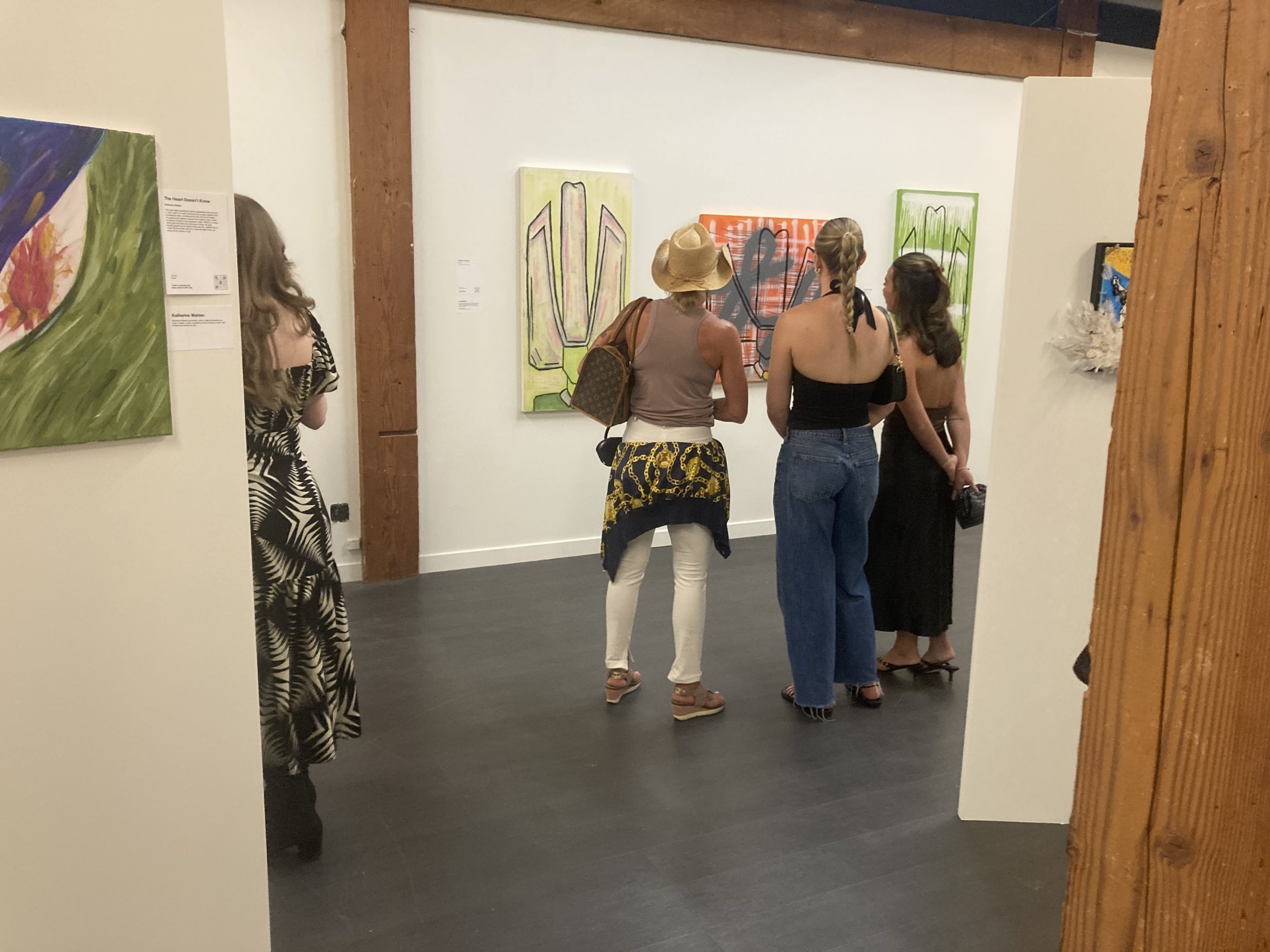
“Muses” at Make Well Studios, June 6, was an opportunity to show off the art as well as the space.
Yet every alternative model creates its own forms of gatekeeping. Where the gallery controls access through patronage, infrastructure, and social cachet, the pop-up controls it through ephemerality, insider information, and personal invitations. Allison McKinney describes the pop-up as “a night where artists come together to transform a space for their community.” Heard about the event after the fact? Sorry, that makes you an outsider by default. There is also the excitement of getting something while it lasts. Landvatter describes it as the “natural and attractive immediacy and urgency in offering and enjoying a never-to-be- seen-again experience.” Being in the know, like having the password to a speakeasy, heightens the allure. Being there signals belonging. Because of the closeness of the artist and attendees, especially at group shows, the line between artist and audience often blurs, and participants might overlook new faces.
The pop-up is a means for makers in the margins to challenge and expand what is possible. It gives new artists space to practice and create a following. Some find the format simply suits their making style and audience. Whatever the reason, a successful event solidifies relationships between artists, curators, and followers.
How can one grow an audience using an insular model like the pop-up? A group show rather than a solo show has an advantage over the solo show because each artist shoulders the work of promotion and brings a unique network to the event. Social media helps, but amidst the noise, “invitations” get lost. Because the event is ephemeral, few organizers think to send a press release to the mass media. Nonetheless an advance press release to SLUG Magazine, or this publication, 15 Bytes, could pique the interest of someone new. After-the-fact reporting is not always ideal but it can give weight to the exhibition. It also alerts outsiders to your presence and encourages them to keep their ears to the ground so they do not, (like I did), miss the next one.
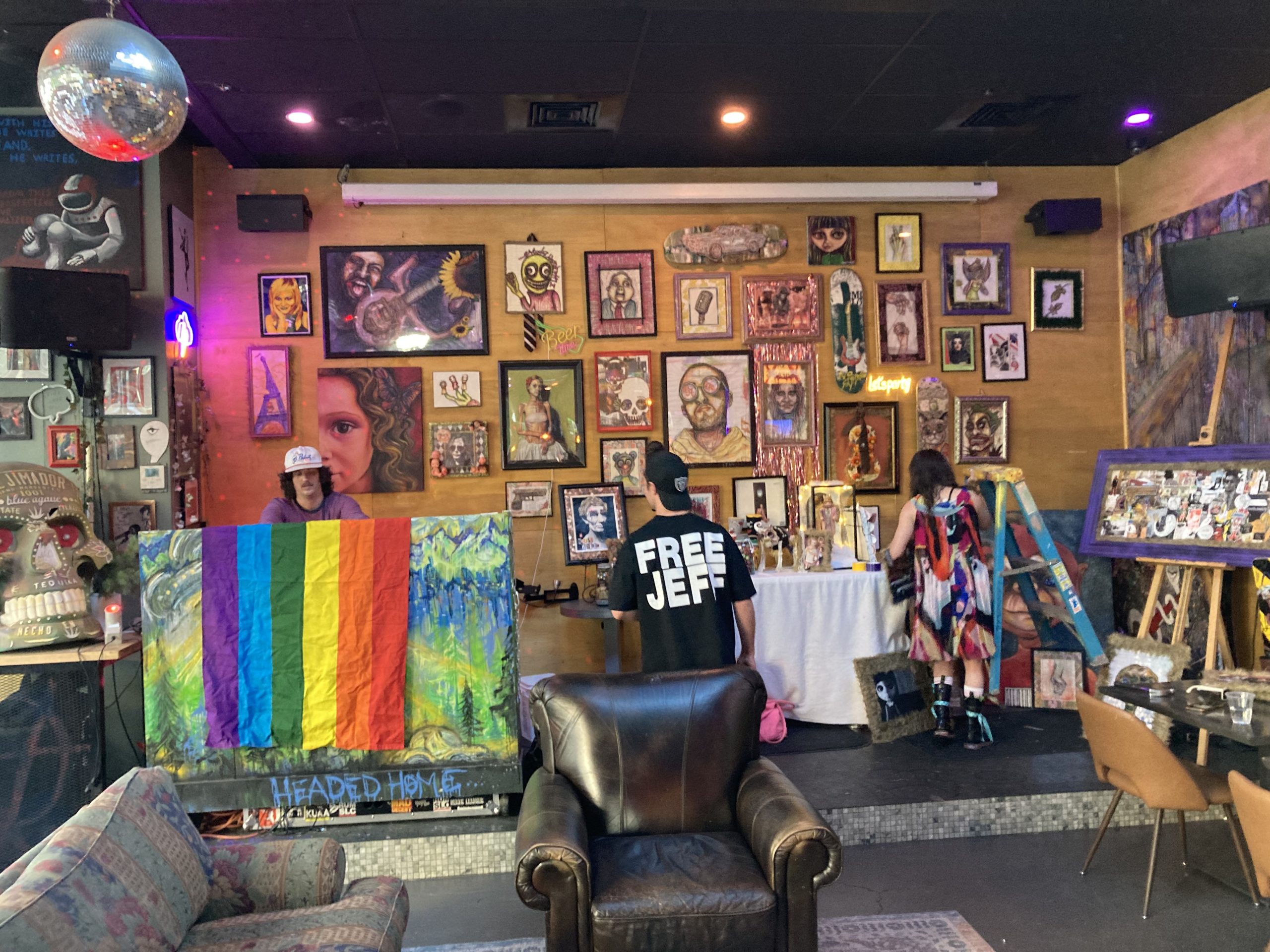
Almost Frame-ous was held at SLC Pub on June 10.
Casita’s Unfinished & Imperfect is Saturday, June 27, 6-11 pm. RSVPS required.

Brandi Chase is poet, student, teacher and maker of pots (most often, but one never knows). She loves red lipstick.
Categories: Visual Arts