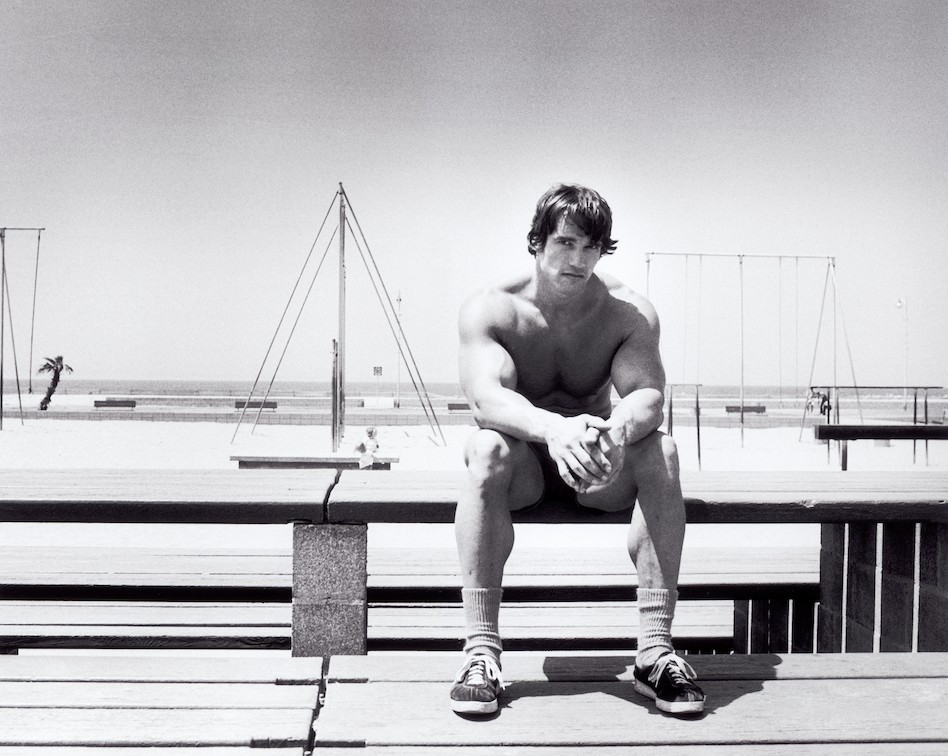
Portrait of Arnold Schwarzenegger by Michael Childers.
Over the years, Michael Childers has traveled a bit for work.
He’s photographed Sir Laurence Olivier at the National Theatre in London, Arnold Schwarzenegger at Venice Beach, California, and Andy Warhol in the artist’s Paris apartment.
This month, he’s headed to Logan for an artist talk and an exhibition at the Nora Eccles Harrison Museum of Art at Utah State University, which has received a gift of 21 of his photographs. It’s the latest stop in a six-decade career that has put his work on more than 200 magazine covers and 150 album covers and film posters.
Childers started taking photographs at 14, when his father gave him a Nikon camera, and he shot for his high school newspaper and yearbook. “But,” he says, “I always wanted to be a filmmaker. Photography was always choice number two.” To pay for film school at UCLA, he took headshots of his classmates, many of whom were up-and-coming actors, musicians and singers. “I was doing the headshots and Billy Gray from a [TV] show called Father Knows Best was my first big breakthrough.” Gray’s photo ran on the cover of TV Guide, and Childers began getting regular assignments from the magazine.
While still at UCLA, Childers met and started dating the film director John Schlesinger. Their personal and professional lives were deeply intertwined throughout their 36-year relationship. Childers worked on many of Schlesinger’s films, serving as director’s assistant on the Academy Award–winning Midnight Cowboy. He went on to work as a special photographer on dozens of films, and his photos, a visual history of Hollywood, are held in the library of the Academy of Motion Pictures.
Film sets also taught the would-be filmmaker what he didn’t want. He preferred being in charge of a session to collaborating with the 75-person crew of a movie. “I enjoy being the one running my one-man band here and working with people one-on-one.”
Through Schlesinger, Childers met Natalie Wood. “I got to meet my first movie star, a wonderful actress, Natalie Wood, and that really jump-started my whole career. I took some pictures on spec for her of her and her new baby. She loved the pictures and said, ‘I would love for you to come in and take some pictures of my next movie.’ I said yes, and those turned out, and suddenly I became Natalie Wood’s photographer until her death [in 1981].”

Portrait of Andy Warhol by Michael Childers.
The magazine work kept coming, too, including covers for After Dark, the infamous entertainment magazine of the 1970s. “Everyone in New York and London and Hollywood read that magazine, including Andy Warhol, who I met at a party. And he said, ‘I would love for you to come to work for me. I’m starting a new magazine. I think I’m going to call it Interview, Andy Warhol’s Interview.’ And I said loudly, I’d love to work with you, Andy!” Childers became one of the magazine’s first photographers. Over the years, Interview would also publish the work of Robert Mapplethorpe, Bruce Weber, Herb Ritts and David LaChapelle.
“So I started [at Interview] and I said, Andy, what type of pictures do you want? He said, ‘Well, I want them about beautiful people, just make them be beautiful, okay? And if they’re rich people, I like rich people.’ And I said, okay. ‘And if they’re beautiful and rich, I’ll give you more space.’ I laughed and said, okay! That’s a tall order.”
Childers photographed Warhol many times over a long working relationship and friendship. He says he was the only photographer Warhol allowed to shoot in his private residence in Paris. “Andy was the zeitgeist of what was happening in New York and becoming the superstar of all time, and remains to this day still at the top.”
Another chance meeting opened a new line of work: book jackets. “I went to hear a lecture by Ray Bradbury, the science fiction writer, and I went up to him afterwards, introduced myself and said that I could photograph him sometime. He said, ‘As a matter of fact, I need a headshot for my next book. Let’s try you out.’ So I went to his house, photographed him and sure enough, it was used on the book jacket. After that, I started getting lots of book jackets.”
Childers later gathered 100 of his best portraits of authors, playwrights, screenwriters and poets into a series titled AUTHOR! AUTHOR! Exhibited at libraries around the country and acquired by Yale University’s Beinecke Library, it ranges from Tennessee Williams, Gore Vidal and Jackie Collins to Amy Tan, Neil Simon and Erica Jong.
His longest working relationship, and one of his closest friendships, was with David Hockney, who died in June. “I met David in 1965 at [author] Christopher Isherwood’s house and I was totally entranced with his wit, his humor, his dazzling artistry, and I knew he was going to be the next superstar in art. We were neighbors in London, where I was living half the year, and we just became lifelong friends.”
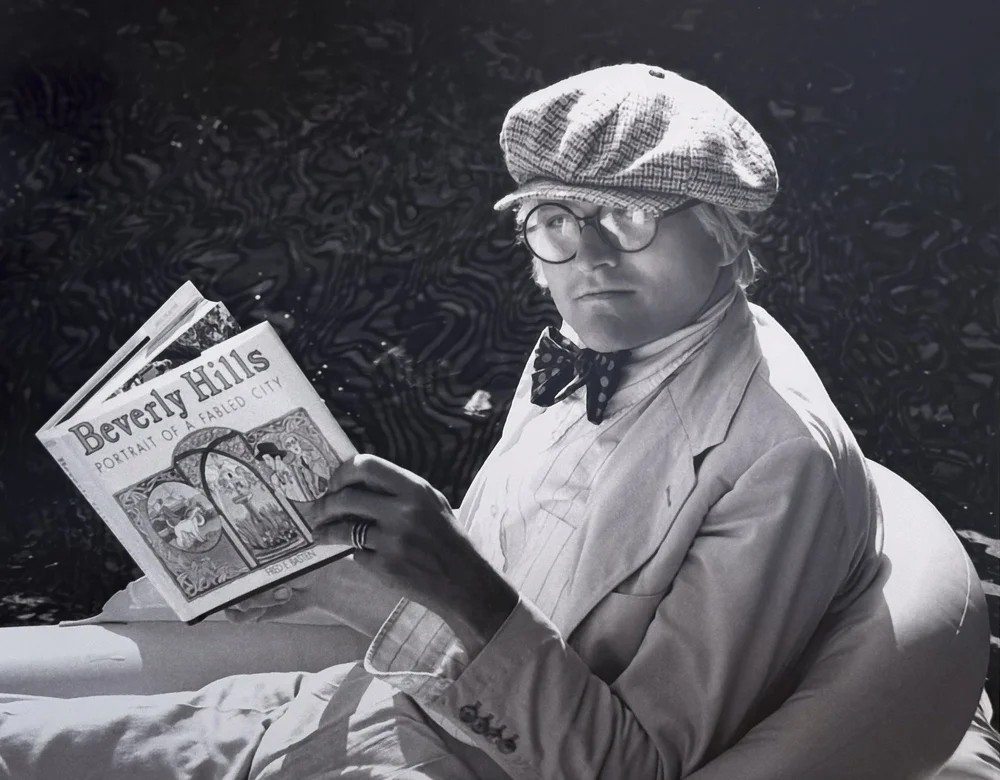
Portrait of David Hockney by Michael Childers.
Childers photographed Hockney for nearly 60 years, in a variety of settings and for a variety of projects. Those photographs have become part of Hockney’s lore and are in the permanent collections of Yale University and the Palm Springs Art Museum. “We really connected, and he trusted me, and allowed me into his very exciting artistic world. I photographed him everywhere: in Paris, in Hollywood, in Malibu on the beach.” For one of the best-known images, Childers convinced Hockney to float on a raft in a pool wearing a new, very expensive linen suit. “I had a great rapport with him, even when I made wild suggestions, which I thought he might not like or do, such as him floating in a raft in the pool in a $15,000 summer suit. And we tried it, and it’s become the most iconic photographs of David…
He always amazed me with his ingenuity, and his constant evolution of his artistry. [I’d ask myself,] why didn’t I think of that? Well, I’m a talented photographer. But I’m not a genius. He was a genius, a true genius.”
Childers says great portraiture is 20 percent technique and 80 percent psychology. “Studying acting and directing, I learned a lot about how to handle artistic people and actors, and above all, huge egos, which a lot of movie stars carry with them. And the most egotistical were architects, believe it or not. But I love architects, great architects like Frank Gehry and Richard Meier.”

Michael Childers. Photo by Mary Ann Halpin.
“And I’m so lucky to work with all these hugely famous people, [but] they have some huge egos. So I have to establish a collaboration, a sense of trust, set the boundaries in a photo session: what they would like out of it, what I would like out of it, and come to a meeting of the minds. Figure out what mood they were in that day, just how to deal with the situation that day, and [then] bring [out] the best. I was also very big into preparation, and I would discuss costuming and the props they wanted well before the session.”
The exhibition at NEHMA shows where those sessions led, with portraits of Groucho Marx, Dolly Parton, Cher, Clint Eastwood and Rudolf Nureyev, as well as fellow artists Ed Ruscha and Dale Chihuly.
When Childers talks with photography and film students at Utah State, he’ll tell them what he tells all young photographers: “Be ready when opportunity knocks on your shoulder, maybe once or twice in your life. If you’re lucky, be ready, be ready, seize the day!”
Stories from Beyond the Lens: Michael Childers Photographs, Nora Eccles Harrison Museum of Art, Nov. 11 – Dec. 12, 2026.
Artist talk: Stories from Beyond the Lens: An Evening with Photographer Michael Childers, 5–6 p.m. on Nov. 12 at the Russell/Wanlass Performance Hall on USU’s Logan campus, followed by a reception at the museum from 6 to 7:30 p.m.
Both events are free and open to the public.

Daniel Diem is a private project management consultant and principal of Daniel Diem Associates. He serves as chair of the Advancement Advisory Board for the Nora Eccles Harrison Museum of Art (NEHMA) at Utah State University.
Categories: Exhibition Reviews | Visual Arts