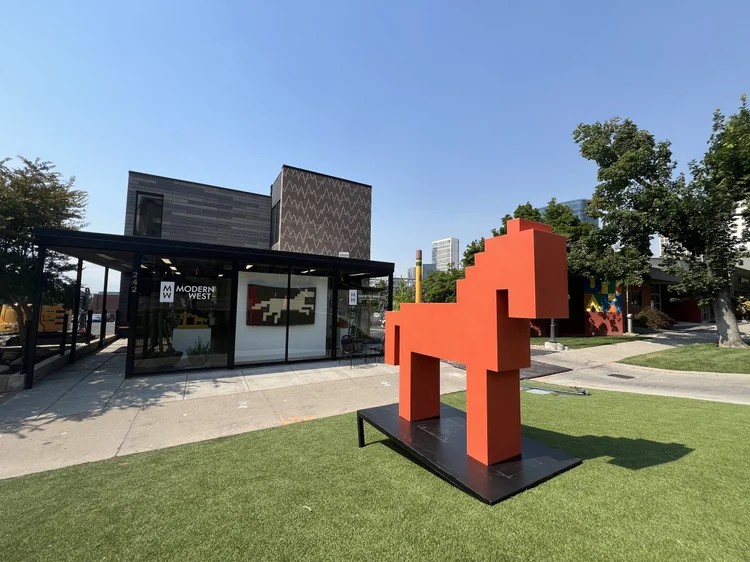
View of Modern West Fine Art in Salt Lake City with Mike Whiting’s “Horse,” 2026.
Horses have inspired artists for millennia. From the mesmerizing silhouettes in the Panel of the Horses at the Chauvet-Pont d’Arc cave in southern France, to the dynamic Mycenaean frescoes of ancient Greece, to Deborah Butterfield’s widely recognized sculptural interpretations, the horse has remained a persistent muse across cultures and eras.
What is it about horses that continues to captivate our imagination?
They have been our companions in sport, labor, travel, luxury, and mythmaking. They represent admirable forms of symbolism—freedom, strength, loyalty, wildness—and occupy a central place in the visual language of the American West. Modern West Fine Art’s current exhibition, Year of the Horse, explores this enduring allure and the horse’s particular resonance within Western art.
Curated by Shalee Cooper, the exhibition is inspired by 2026 being the Chinese Year of the Fire Horse—a rare astrological combination. In Chinese astrology, the Horse symbolizes independence, drive, and forward momentum, while Fire brings passion, intensity, and urgency. Together, they mark a year of heightened energy and transformation. Cooper’s curatorial vision uses this symbolism as a lens through which to consider the horse not only as a subject, but as a metaphor for vitality, change, and the spirited complexity of the West.
Before even entering the gallery, visitors are greeted by works from Utah artist Mike Whiting, whose pixelated horse sculptures reduce the animal to solid blocks of color and basic geometric forms. Inside and outside, these works evoke early video game aesthetics from the 1980s and 1990s—where representation is distilled to its most essential forms. Whiting’s sculptures are playful and refreshing, immediately disarming viewers with their humor and nostalgia. They remind us that iconic subjects are often reimagined through digital culture.

Ben Steele, “Sketchy Territory,” 2026, oil on panel, 24×29 in.
Ben Steele, an artist based in Helper, offers a witty and technically skilled take on Western iconography. His painting “Cowpuncher Pencils” juxtaposes a meticulously rendered colored pencil set with scribbled horse-themed coloring sheets, nodding to Pop Art’s fascination with consumer objects and mass culture. Steele’s command of paint and pictorial space is impressive; his works are visually delightful while prompting reflection on how Western tropes—particularly the masculine cowboy—are introduced to young audiences. “Sketchy Territory” further complicates this conversation. At first glance, it appears to be an oversized Etch-A-Sketch sculpture, but it is in fact a mixed-media framed oil painting. The “etched” image depicts cowboys wrangling wild horses, merging nostalgia, child’s-play, and technical prowess.
The exhibition’s range becomes even more compelling with the inclusion of Stanley Natchez, a contemporary Shoshone-Tataviam artist and educator based in Santa Fe. Natchez’s mixed-media works merge Native American iconography with symbols of modern American consumerism. Using beadwork, collage, U.S. dollar bills, and other materials, he creates layered compositions that interrogate value systems—what was once a critical resource (such as bison) versus what is now treated as currency (the U.S. dollar). His work draws attention to the tensions between cultural survival, capitalism, and the lessons embedded in Indigenous relationships to land and natural resources. Natchez’s artworks are powerful, prompting viewers to consider how histories of colonialism, extraction, and commodification continue to shape the present.

Stanley Natchez, “Postcard from Santa Fe,” 2026, mixed media on canvas, 22×30 in.

Lenka Konopasek, “Spectacle,” 2023, oil on canvas, 36×48 in.
Salt Lake City artist Lenka Konopasek offers a striking departure from her well-known paper works with paintings that capture the intense power dynamics of rodeo culture. Her scenes freeze the moment a cowboy is thrown from a horse—a split second of struggle between human dominance and equine refusal. The tension is palpable. Konopasek’s color palette heightens the drama, conveying urgency, velocity, and the raw physicality of the encounter. These works underscore the horse’s agency, reminding viewers that the Western mythos often glosses over the animal’s resistance and autonomy.
In contrast, Alexandra Fuller’s handmade salt prints introduce a haunting, atmospheric perspective. Her photographs depict horses within the fragile landscape of the Great Salt Lake, a site undergoing catastrophic ecological change. The salt print process lends the images a ghostly, timeworn quality, as though they are artifacts from a future shaped by the consequences of past environmental exploitation. Fuller’s work positions the horse as both witness and participant in the unfolding story of the region’s ecological precarity.
Year of the Horse is a thoughtfully curated exhibition that brings together a diverse and compelling range of artistic approaches. The result is a dynamic and multifaceted exploration of how this iconic figure continues to evolve in contemporary art. Through humor, nostalgia, cultural critique, ecological reflection, and technical innovation, these eleven artists collectively reveal the horse as a subject that is far from exhausted. Instead, it remains a potent symbol—one that continues to evolve alongside the West itself.

Alexandra Fuller, “Dissolution 01,” 2023, salt print, 23×30 in.
Year of the Horse, Modern West Fine Art, Salt Lake City, through August 1.
The exhibit includes works by Shonto Begay, Michael Coles, Phil Epp, Alexandra Fuller, Jim Jacobs, Lenka Konopasek, Stanley Natchez, Kevin Red Star, Ben Steele, Billy Schenck, and Mike Whiting,

Kasey Lou Lindley is an arts professional with formal training in fine arts, holding a BFA from Ringling College of Art and Design and an MFA from the University of Connecticut. She has written about contemporary arts and culture for Sarasota Visual Art and Art at Bay.
Categories: Exhibition Reviews | Visual Arts