
The 9-Line Bike Park turned an overpass into a playground.
There’s definitely a bit of odd packed into this nook of Salt Lake City: a bike park with a freeway for a roof, a winery that’s also a temple, a steel shop turned graffiti wall, a community garden in the middle of an industrial stretch.
If you wanted to point to a single place that keeps Salt Lake City weird, this block-long strip along 700 West, where I-15 passes between a cement silo and a grain silo, would be a good candidate. Past railroad tracks and empty lots, the Granary District and downtown sit to the east. Poplar Grove and Glendale to the west. Separating the two, freeway soars overhead. It’s a seam, where two neighborhoods come close to stitching together and where several landmarks have sprouted up to make this a place where oddities are at home.
There was no master plan.
In 2017, the city built a bike park under the overpass, where 900 East passes below I-15. The 9-Line Bike Park started small, in 2014, as a pump track carved into a corner lot that had mostly been used for dumping. The Poplar Grove Community Council pushed to expand it east, into the freeway’s shadow, and the city’s public lands program found the money. What had been vacant and neglected is now five separate riding areas, from a toddler-level strider track to jumps built for experts. The city commissioned local artists to spruce up the surroundings.
-

- Shredding the Gnar by Charlotte Pili
-
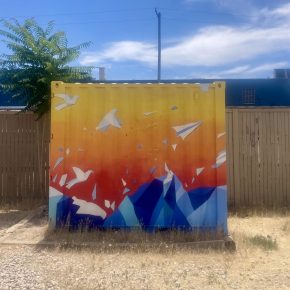
- Free Flight by Josh Scheuerman
-

- Shredding the Gnar by Charlotte Pili

Greg Ragland’s oversized vegetable sculptures lead from the bike park to the nearby community garden.
A community garden went in nearby that same year, run in partnership with Wasatch Community Gardens. Its centerpiece is a set of sculptures by Greg Ragland—four human-sized bell pepper slices leaning on each other, a peapod bench, a stack of cherry tomatoes on a toothpick-thin pillar. The pieces started in a lot in Central Ninth, in a garden the city had helped organize there. When that neighborhood gentrified and the lot filled in, the sculptures moved five blocks west, past the freeway, to land in another garden doing something similar and more. The pepper slices, Ragland has said, lean on each other the way the community depends on the garden, and the garden on it.
Older than any of it is the pyramid. At 707 Genesee Avenue, a 26-foot gold structure has stood since 1979, headquarters of Summum, a religion founded by Claude “Corky” Nowell after the Salt Lake City native described an encounter with higher beings in 1975. The pyramid is a temple, a meditation hall, and—because of how it’s zoned—a winery; the group’s sacramental wine funds the rest. Nowell died in 2008 and is mummified inside it, in a gold casket. Services are open to the public on Wednesday nights.


Not everything here was commissioned. The graffiti on Genesee, on the corner of a steel shop, is older than the bike park, and resurrects itself on a regular basis—tags and murals shift, get painted over, come back different. A city planning survey drew out the affection people have for it: one resident wrote that they hoped the tradition would be protected for as long as Salt Lake City has people living in it.
Wander down the street and you’ll find a ghost mural for MJB coffee, an orphaned railroad-crossing sign and a house that’s been given over entirely to accumulation. The brick wall out front is topped with ceramic owls and lace-edged planters. Birdhouses hang from the porch eaves next to a mounted cow, a star, a wreath. A hand-painted pumpkin grins from the gate. An old pickup at the curb is loaded with more of the same—whatever didn’t fit on the wall this week.
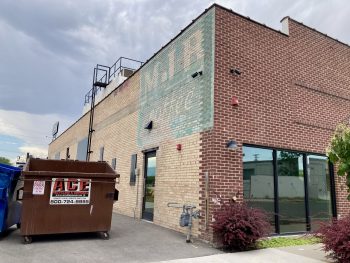


A half block west of the Summum Pyramid, you’ll find the bric-a-brac bungalow.
The two most recent additions both came out of Glendale’s arts program (because here is another seam: 900 South stitches together the west side neighborhoods of Glendale and Poplar Park and both have been involved in this block’s rejuvenation). Last spring, the wall of Rose Printing—a print shop that’s operated out of the corner of Genesee and 700 West for more than a century—got a mural of red roses folded into geometric shapes, painted during a volunteer night open to anyone in the neighborhood who wanted to show up with a brush.

The Rose Printing mural was created by Josh Scheuerman, with community help.
This summer, Liberty Blake added a fence weave across the street. It’s kitty-corner from the bike park, a place she knows well: she’s an avid mountain biker, and has been known to get some air at the 9-Line pump track. Her piece is built on the idea of a friendship bracelet: color woven through chain-link, running the length of a fence that used to just be a fence. Of everything along this stretch, it’s the one piece that’s literally stitched—thread pulled through metal.
An urban bike park, a relocated vegetable garden, a pyramid built by a man who says he met aliens, a legal graffiti wall, a house buried in birdhouses, a fence turned into a bracelet, a mural painted by whoever showed up—all in the shadow of the freeway that split Salt Lake City.
On the other side of the highway are railroad tracks, a haunted house, cement silos and empty lots. In this case, the west side has fared much better than the east. But as the Granary District continues filling in, and the planned development of the Fleet Block goes forward, downtown and this seam of oddities on the west side keep closing the distance between them, and the freeway may matter less as a wall and more as something both sides have learned to build around.
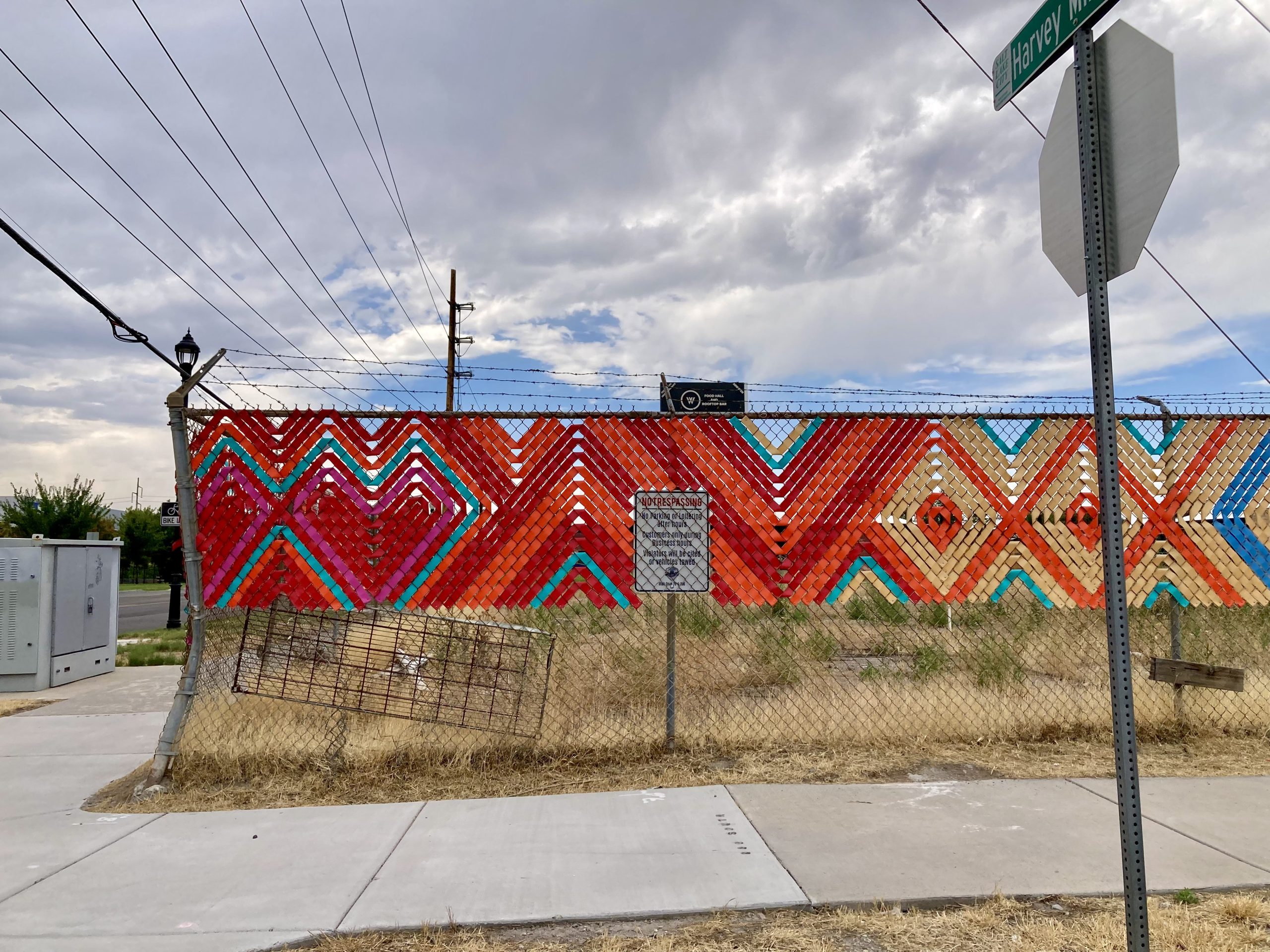
Liberty Blake’s woven art piece makes a friend of this empty lot on the corner of 700 West and 900 South in Salt Lake City.
Discover more odds at ends at the Utah Art Map!

The founder of Artists of Utah and editor of its online magazine, 15 Bytes, Shawn Rossiter has undergraduate degrees in English, French and Italian Literature and studied Comparative Literature in graduate school before pursuing a career in art.
Categories: In Plain Site | Visual Arts