

Roland Miller, “Horizontal Gantry from Base, Gemini Titan Complex 19, Cape Canaveral Air Force Station, Florida”
“We choose to go to the moon and do the other things, not because they are easy, but because they are hard.” —John F. Kennedy, September 12, 1962
Witness to the activities of modern humanity has led to any number of tempests in ever-so-many teapots. Was 9/11 a real or a staged event? What is Elvis up to today? Are birds real or are they conspiratorial drones? Is the Earth round or flat? A necessary companion to that last one is, Does outer space exist and, if so, have humans ever gone there? Arguments rage over the details presumed to prove or disprove each of these, arguments that inevitably miss the crucial facts. In the case of what has come to be known as the Space Race, one man with both documentary and artistic inclinations has spent years in accumulating conclusive evidence that is not sourced from remote evidence, but the proof of which remains here amongst us. And for now, a substantial portion of that proof can be seen in the George S. and Dolores Doré Eccles Art Gallery, part of Salt Lake Community College’s main State Street campus.
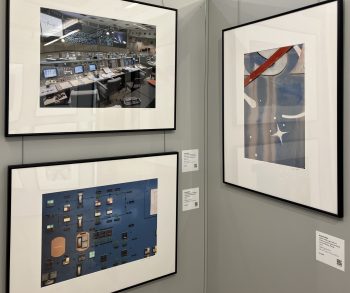
Abandoned in Place is the initially puzzling title of photographer Roland Miller’s magisterial archive, the sheer size and extent of which, down here among us, should allay any doubts about the reality of activities up above. That said, however, these exhibits do things that are much more rewarding for those willing to accept the evidence of their eyes. James Walton, director of exhibitions at SLCC and curator of Abandoned in Place, describes these photos as abstract works of art, and given the complex, indeed impenetrable sophistication of the original subjects, he’s not wrong. Probably the most familiar originals, yet indecipherable in spite of that, are the huge concrete structures that enable equally giant rockets to launch themselves safely, despite the tons of thrust, burnt fuel, and unbearable heat they had to regulate and endure. These launch pads are eventually sacrificed in the process, and so must be abandoned or replaced. Part of photographer Miller’s brief is to memorialize them for the historical record. Meanwhile Walton, who never fails to learn as much as he can from the artists he exhibits, pointed out at the opening that as substantial and even permanent as they appear, many of them have been or still are being demolished, leaving only these photos to prove such things existed.

Roland Miller, “Apollo Saturn F1 Engine Cluster Diptych, NASA Johnson Space Center, Texas”

Roland Miller, “Launch Control Room, Titan II ICBM Silo 395-C Vandenberg Air Force Base, California”
Anyone who follows the news may be excused for thinking that human activity in space is greatly diminished since the glory days of Moon landings. In fact, Space today is big business. Millions of people around the globe depend on GPS to replace the maps that once guided us all, and positioning is just one of many tasks undertaken by the hundreds of satellites still constantly in use and regularly being replaced. Miller hasn’t entirely ignored them, either, nor the even more gigantic rockets that feature in the return to the Moon and the presumed sequel: an assault on Mars. A few of his photos depict these shiny new rocket facilities and parts, including some from last year bearing freshly made, brightly colored signage reading “Boeing.”
Given how many human events disappear without ever having been visually recorded, future observers will surely appreciate the number of giant concrete structures and elaborately fabricated machines Miller has memorialized in his work. That they were discarded and lost in spite of their roles in what was arguably not only the greatest achievement of the United States, but perhaps in the history of the world, speaks volumes about both the capacity of humanity to pull itself together and achieve great things, but also our ability to symbolically drop the ball in the end zone, take a victory lap, and soon forget what made years of effort and sacrifice seem so necessary and important.

So the point of this exhibit and the work it contains may as well be that so long as government projects can be modified, or even cancelled before they are completed, over time there may turn out to be be no physical remains of this or that achievement, even one so spectacular as successfully landing on the Moon. And so it is that art has been and remains one of the best ways we have of hanging on to history.
Abandoned in Place: Preserving America’s Space History, The George S. & Dolores Doré Eccles Gallery, Salt Lake City, through Feb. 15.

Geoff Wichert objects to the term critic. He would rather be thought of as a advocate on behalf of those he writes about.
Categories: Exhibition Reviews | Visual Arts