 Few people stop at Cisco, Utah. Cyclists pedaling the long haul from Moab to Loma, Colorado pass through it. River runners cut straight across it on their way to the Cisco boat launch to start the three-to-four day float back to Moab. In its heyday, near the turn of the 20th century, the major traffic was trains—Cisco was a water stop in the age of steam engines, and the freight lines still roll through on a regular basis. Passing through is kind of what Cisco is for.

Which makes what artist Eileen Muza built here all the more unlikely. Over nearly a decade, Muza transformed an acre of ghost-town ruins into Home of the Brave—an artist residency of assemblage structures, colorfully painted campers, a restored 1923 log cabin, and hard-won community. The residency welcomed hundreds of visitors, with an explicit intention to create a safe space for queer artists in rural Utah. It was not without cost. Years of harassment from a neighboring property owner—including a shooting incident and a noise complaint involving a bird cannon set to detonate every ninety seconds for twenty-two straight days—eventually wore Muza down. They sold the property in December 2024 and moved on. (See the story in Southwest Contemporary.)
Kara Bard first encountered Cisco through Cisco Kid, a documentary about Muza’s residency that she saw at Slamdance film festival, and it stayed with her. When the property came up for sale she kept watching—until November 11, 2024, when the price dropped by $200,000. “Because it was 1111,” she says in a short documentary a friend recently made about her first months here, she took it as a sign. Her grandmother back in Quebec had warned her off: “Kara, you’re gonna be lonely.” Bard’s answer, as she tells it: “What a gift to be lonely in this place.”
She’s less lonely than expected. Bard has reopened the site as the Cisco Artist Residency, now operating as a nonprofit, and is currently reviewing applications for residency sessions. She’s clear-eyed about what Muza left her. “The bones are good and the bones are strong, but the reason the bones are so fortified is because of Eileen. I can’t take credit for that.” She plans to add a bike shop to the compound, a natural fit for a spot on the Moab-to-Fruita cycling corridor. Watch the documentary here.


Safety remains a live concern. Bard was granted a protective order in November 2025 following an incident on the property—separate from the neighbor conflict that defined Muza’s tenure—and is still working out how to open the site while managing that reality. She discloses the situation to artists before arrival, and says the Grand County Sheriff’s Office has been a reliable partner. The residency has had no safety incidents since opening.
There’s also the small matter of zoning: the property sits on land designated heavy industrial, making it technically illegal for Bard to live there full time. “Cisco has always been really outlaw,” she says.
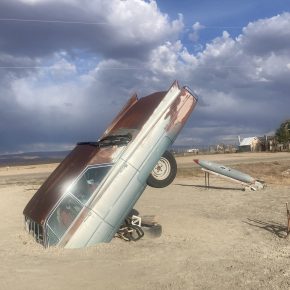
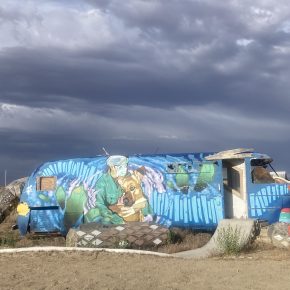
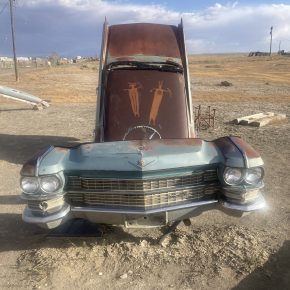
You don’t need to time your visit to a residency session. What Muza left behind—the mural bus, the snake ramp, the tire wall, the restored post office, the painted campers—sits in the desert sun weathering into the landscape, free to look at from the road or the edges of the property. Around it, the older ghost town does the same: cinder-block walls open to the sky, wooden structures bowing under their own weight, a century of accumulated objects slowly returning to the earth. Roam as far as the signs allow. It’s a ghost of a ghost town that haunts the landscape in bright, bold color. Worth the detour.






With our In Plain Site byline we feature publicly viewable art, both official and street art, throughout the state of Utah.
Categories: In Plain Site | Visual Arts