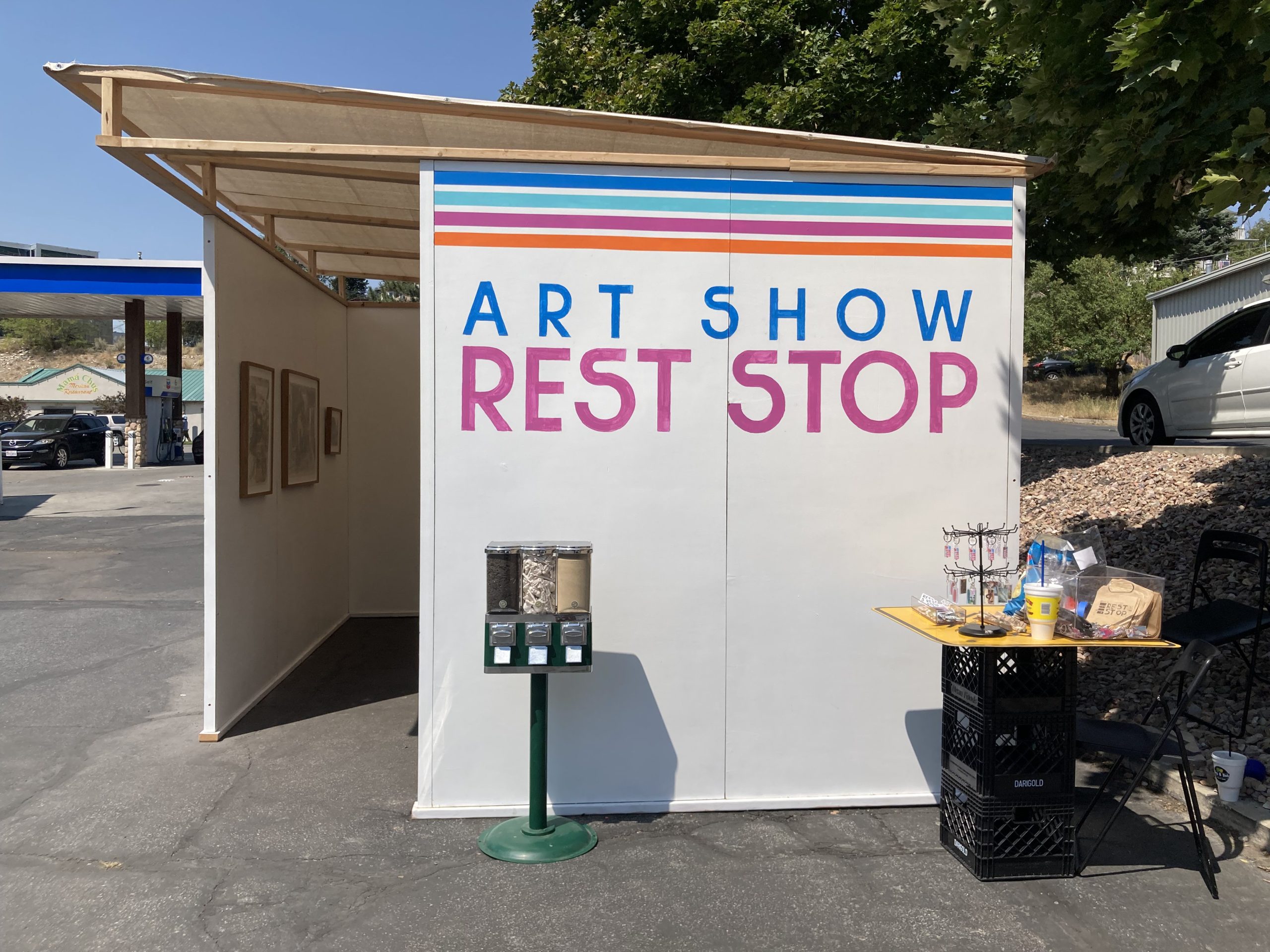
Project Rest Stop staged a pop-up exhibition at Will’s Canyon Stop, 1565 E. 800 South Orem, August 3-8.
The gas station may have become America’s true third space—that place outside home and work where strangers and neighbors still routinely cross paths.
Banking has gone online. The post office is going bankrupt. Even grocery shopping increasingly happens through apps and home delivery. But until electric vehicles charged overnight at home become the norm, Americans still have to visit the gas station. The attached convenience store may be one of the few places where locals mingle with travelers, cyclists, construction workers and families, all briefly sharing the same ordinary space.
Earlier this month, customers at Will’s Canyon Stop, at the mouth of Provo Canyon, shared something else: a pop-up exhibition spread across the asphalt outside the convenience store. For several days, the locally owned Love’s station became Project Rest Stop, an exhibition organized by BYU painting professors Madeline Rupard and Christopher Lynn featuring the work of thirteen student artists.
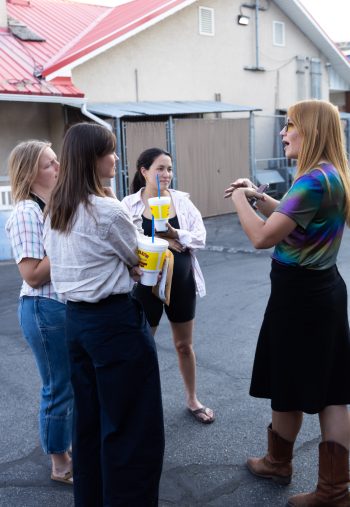
Madeline Rupard explains Project Rest Stop to visitors as they sip from their convenience-store sodas. Image by Hallie Farnsworth.
“I’ve wanted to make an art show at a gas station since I was a little girl,” Rupard says.
For years Rupard has painted highways and roadside architecture bathed in the luminous light of the American West. They are images of the sublime and the mundane and gas stations feature prominently. She treats them lovingly, as places of unexpected beauty, recalled memories and human connection.
“I don’t know if I’m going to paint them forever,” she says, “but they have a lot of poetry to me.”
Rupard regularly walks her dog in the area near Will’s Canyon Stop and gradually became acquainted with its owners, William and Holly Faulkner. “They’re always just so friendly when I come in,” Rupard says. “And there’s just a really nice mix of people that are out of town or foreigners coming through to go to Sundance, people that bike up and down. I just thought, this would be such a cool place for an art event.” She invested in the idea over time. “I kind of cozied up to them slowly over the year,” she says. “Then I was like, ‘I have this cool idea. Would you be open to it?'”
Her pitch included a PowerPoint presentation tracing a history of artists working in unexpected commercial settings. She pointed to projects like Prada Marfa, the Dunkin’ Donuts Midtown Gallery and New York’s traveling U-Haul Gallery. “The idea,” she says, “was turning an unconventional space into an art space.”
The idea also emerged naturally from her teaching. Rupard had begun noticing that many of her students were independently gravitating toward themes of roads, transit and movement. “I had all these students who were making work that was interested in transit,” she says. “I think there are things that are in the zeitgeist that come in and out, that are interesting to people as visual motifs of our time.” Whether that reflects something broader in contemporary culture or simply her own interests, she’s not entirely sure. “Maybe because this time we feel so transitory and things seem to pass a lot,” she says. “Or this is possibly my own self-projection because this is stuff I’m interested in.”
Students applied for admission to a summer intensive course knowing it would demand considerably more than a typical studio class. They researched, traveled, curated, marketed, raised funds and installed the exhibition together. Then, in temperatures climbing past 100 degrees, they spent the opening greeting visitors—some who had intentionally come for the exhibition, others who had simply stopped for gas or a cold drink. ”I’ve seen these students just self-activate and do things beyond grades in a way that’s so exciting,” she says. “They’re going way over the hours and the time that I require because they know people are actually going to see it. It’s not just getting a grade.”
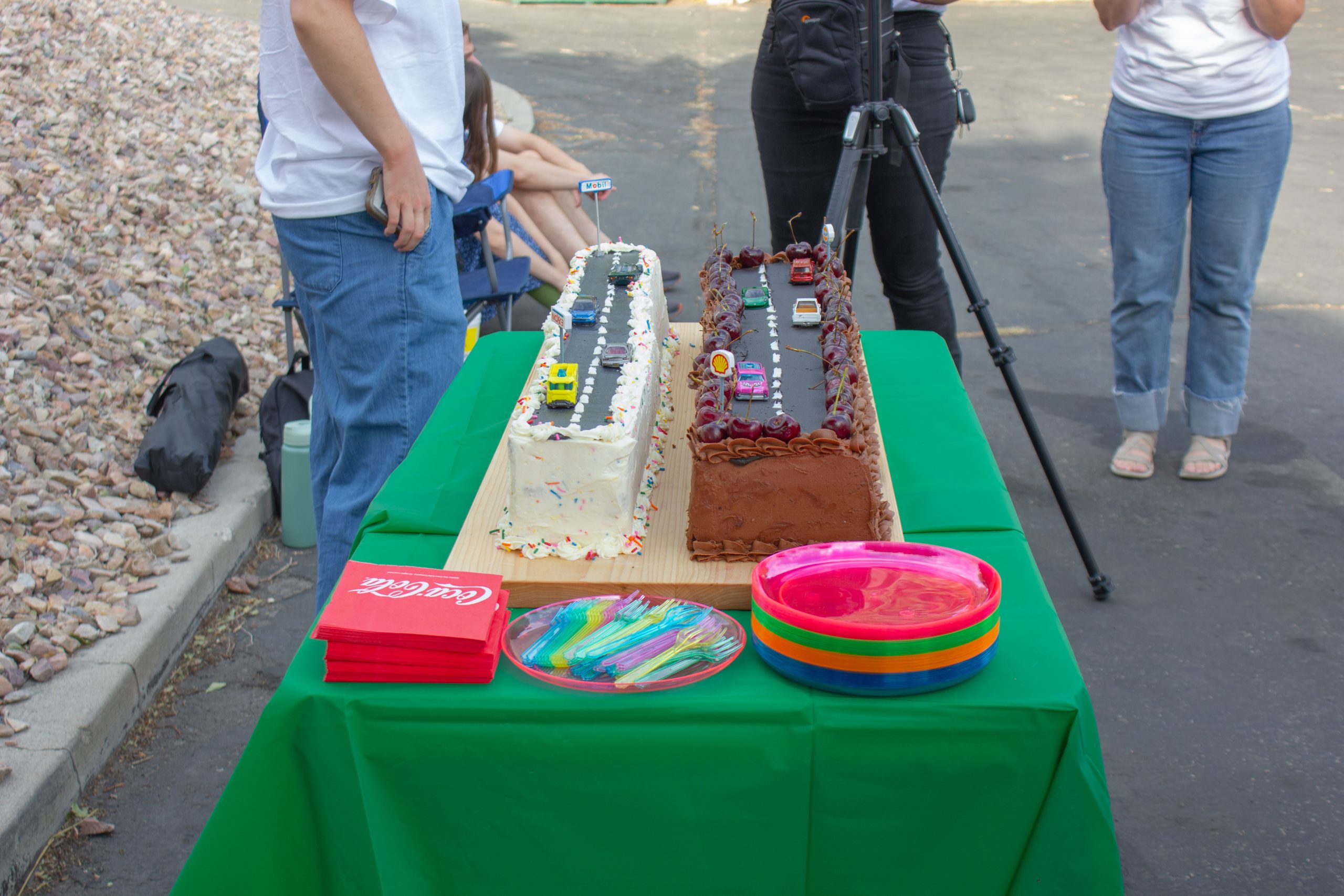
Image courtesy of Project Rest Stop.
She says one student staying awake until three in the morning baking a cake for the exhibition. “That’s not anything grade-motivated,” she says. “That’s just because she wants to. It’s really cool to see them actually act like artists outside of the university.”
Their summer research took them to Las Vegas, where visits to Meow Wolf’s Omega Mart, the Neon Museum and contemporary artworks scattered through casino resorts became part of the creative process. They later traveled to the James Castle House in Boise, where Castle’s humble materials and quiet observations of everyday life inspired several participants.
One student from Texas incorporated drips of motor oil into her drawings to evoke memories of a relative’s auto repair shop. Another, from Hawaii, explored sacred sites and the ways redevelopment can erase cultural memory. Other works depicted convenience store refrigerators, 7-Eleven storefronts and roadside Americana. “I feel like in Russian literature they often use the train station as a place of conflict because people are coming and going,” she says. “I think gas stations are kind of like that for us today.”
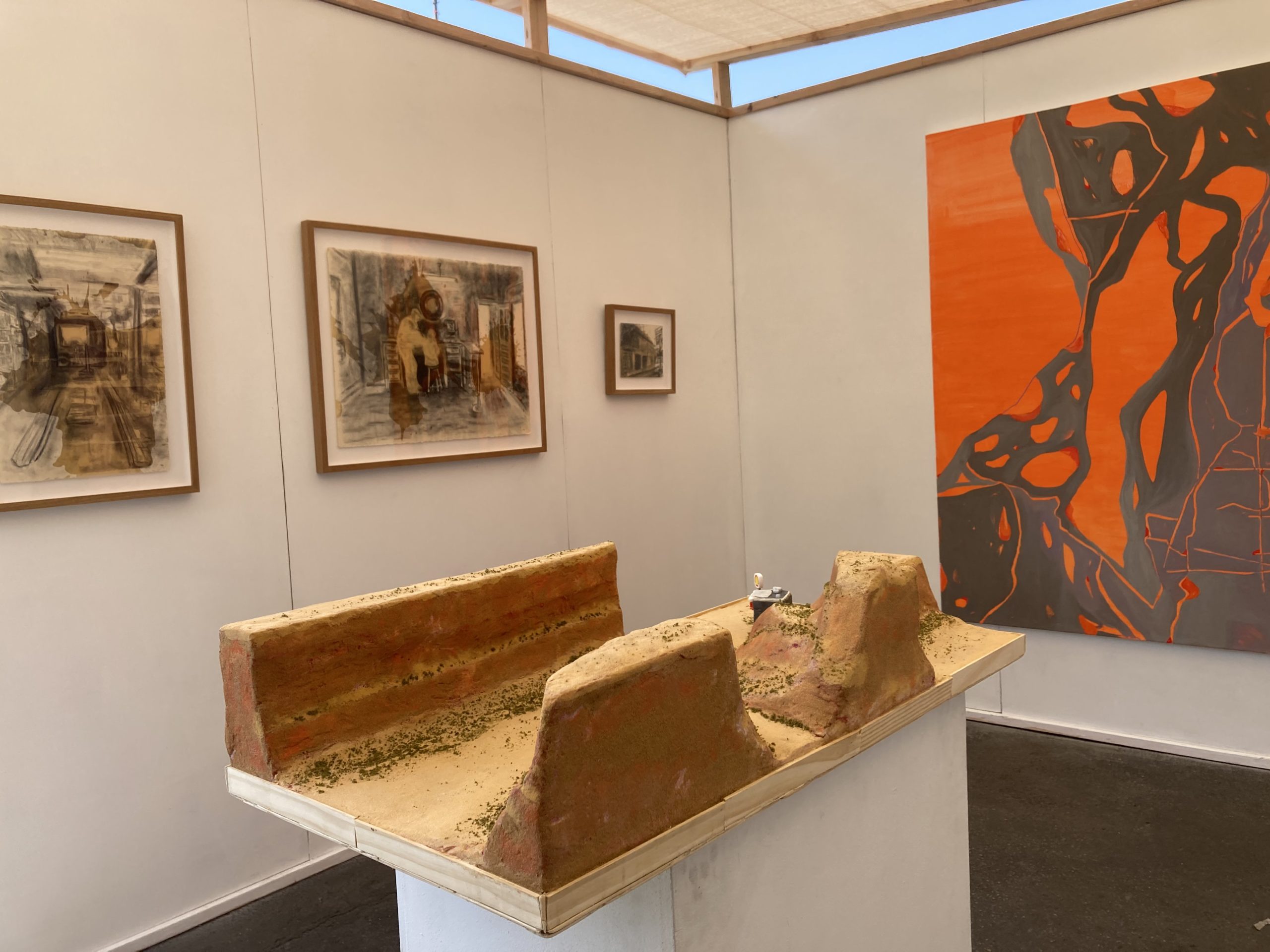
Images from the second installation of Project Rest Stop, Aug.6-8.

Rupard is quick to point out that while the original idea was hers, Project Rest Stop could not have happened without Christopher Lynn. “I had the idea,” she says, “but Chris was so crucial to this happening.” A former museum curator, Lynn became the organizational engine behind the ambitious project. “He’s really a spreadsheets guy that gives everyone a task and puts the deadline in,” Rupard says with a smile. “He was really good at scrutinizing proposals—not to limit them, but to sharpen their focus.”
The project also reached beyond the art department. Funding came through BYU experiential learning and an interdisciplinary Lacock grant, while English professor James Swenson’s students are contributing essays to a publication documenting the exhibition.
That collaborative structure reflects Rupard’s broader philosophy of art education. She worries that universities sometimes prepare students to make artwork without adequately preparing them to sustain artistic lives. “It’s the ethics of being an art professor,” she says. “I want to make sure that I’m not pumping up some fantasy. I want them to actually see themselves working as artists after.”

Madeline Rupard (back row third from left) and Christopher Lynn (back row fourth from left) with the students in their summer intensive who produced Project Rest Stop, on exhibit in the first week of August.
DID YOU ENJOY THIS ARTICLE?
Help make more like it possible.
VENMO us a donation at artistsofutah

Or use PayPal to MAKE A DONATION.
15 Bytes is published by Artists of Utah, a 501 (c) 3 tax-exempt nonprofit.

The founder of Artists of Utah and editor of its online magazine, 15 Bytes, Shawn Rossiter has undergraduate degrees in English, French and Italian Literature and studied Comparative Literature in graduate school before pursuing a career in art.
Categories: Exhibition Reviews | Visual Arts