
Meet the Fletchers at the Nora Eccles Harrison Museum of Art.
Meet the Fletchers, on view at the Nora Eccles Harrison Museum of Art through July 25, introduces visitors to three of the most important figures in 20th-century Utah art: Calvin Fletcher, Irene Fletcher, and their son Dale. Together, the exhibition argues, they embraced modern ideas and methods that fundamentally reshaped Utah art and, as the exhibition text argues, “… they became some of the most innovative painters in the history of Utah art by advancing a bright new spirit of artistic exploration that still resonates today.”
The exhibition, curated by NEHMA curator Dr. Danielle Stewart and BYU Art History Professor Dr. James R. Swensen, contends that especially Calvin’s willingness to explore new forms and ideas ushered modernism into Utah art. More broadly, the exhibition presents the Fletchers as a microcosm of many of the defining themes, tensions, and ideas in 20th-century Utah art.
Stewart and Swensen organize the work in the show thematically, placing works by each of the artists in conversation with each other in broad themes: place, family, a small section on religion, and the largest and most central to the show’s thesis, “modernity on the fringe.” Of these themes, “Modernity on the Fringe” is the exhibition’s intellectual center and the clearest articulation of its thesis. It begins by outlining Calvin Fletcher’s conversation in the late 1920s with artist Lee Randolph who told him: “Utah painters were ‘much behind the times’.” This troubled Calvin, who stewed over what to do, and his answer was one of the most influential decisions in Utah art history: he began an ambitious visiting artist program at Utah State Agricultural College bringing in artists like the aforementioned Randolph, as well as Otis Oldfield, Ralph Stackpole, B.J.O. Nordfeldt, Ralph Pearson, and Birger Sandzén, to teach for the summers.
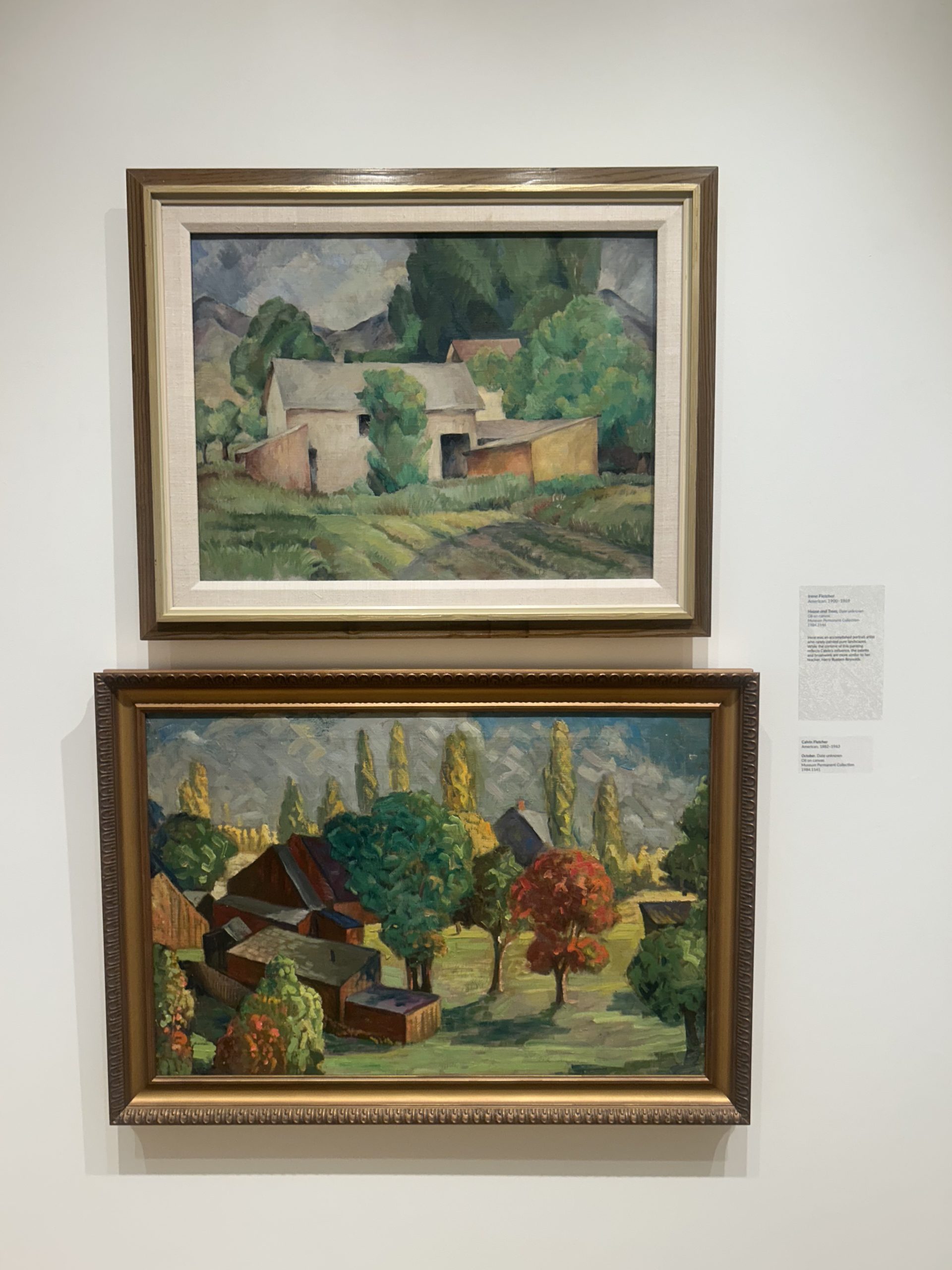
Two works by Calvin Fletcher showing his experimentation with modernist styles, including Cubism and Expressionism.
Sandzén’s turn teaching at USAC was especially influential and he came back three times in 1928, 1929, and 1930. The influence of these visiting artists and summer workshops led to the art department at USAC and the related Logan Art Group developing one of the most important modern schools and movements of 20th-century Utah art. It also gave Calvin the freedom to explore many of the “isms” of early modernism, experimenting with new forms, techniques, and approaches to mark-making. Irene, too, learned from the modernists and her painting style developed to be painterly, expressive, modern, and bold. As the curators write, “Rather than a weakness, the energetic artistic eclecticism seen in Calvin’s work and that of his colleagues—like Everett Thorpe and Gaell Lindstrom—was the style of USAC’s Art Department, which became the most innovative in the state and equal to any in the American West. Dale inherited this spirit of innovation, exploring a wide range of styles including Abstract Expressionism, symbolism, and later exacting realism.”
The exhibition stops short of giving the Fletchers, and the visiting artist program, credit for an increased innovation in art-making statewide, but I think the evidence points to the Logan Art Group, the USAC visiting artist program, and the modernism of Calvin Fletcher and his colleagues, influencing modernist artists across the Wasatch Front in the early 20th century. The Sandzén effect is real and informed the work of not only those who took classes in Logan, but also artists down south like Mabel Frazer, whose work took a turn for the bold and expressive during the same time period, and Philip Henry Barkdull, who encountered Sandzen not at Logan, but at Brigham Young University the same year he came to Logan.
This turn toward the modern was controversial in 1920s, ’30s, and ’40s Utah. Until her death in 1948, Alice Merrill Horne was Utah’s tastemaker and curator-in-chief. Her influence cannot be overstated. Although she championed some more modern artists, including Minerva Teichert, she remained committed to traditional notions of beauty. Logan, by contrast, because it was more geographically isolated, offered a fertile ground for experimentation and innovation under the leadership of Calvin Fletcher.
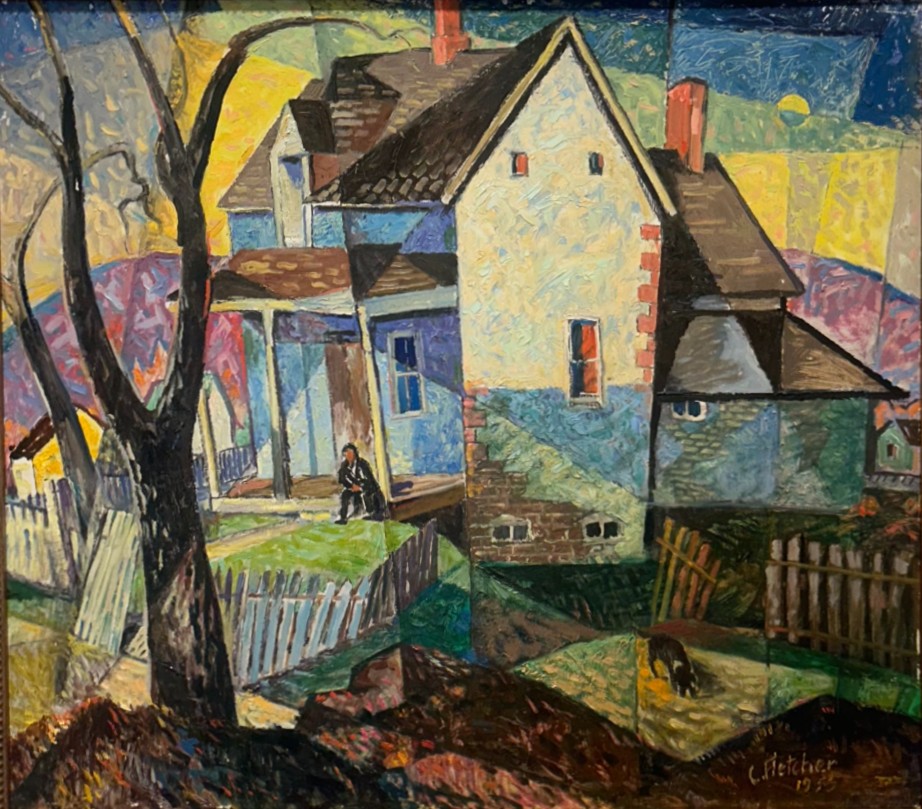
Calvin Fletcher, “Spring Fever,” 1955
The artworks in this section reveal the remarkable experimentation and openness Calvin brought to his craft. “4 A.M.” presents a minimal, flat, geometric interpretation of a Cache Valley farmhouse. Other paintings show Charles Scheeler-inspired abstraction, fragmenting both the picture plane and the rural subjects Fletcher chose to paint. Experiments with Cubism, Expressionism, and other modernist approaches appear throughout the gallery. The influence of the visiting artists—especially Birger Sandzén—is evident in Fletcher’s handling of paint. Rather than interpreting these stylistic shifts as inconsistency, the exhibition convincingly argues that experimentation itself was Calvin’s defining artistic achievement.
If experimentation defines Calvin Fletcher’s artistic achievement, the exhibition argues that Irene Fletcher’s defining contribution emerged during the Great Depression. Although Irene studied under Calvin Fletcher, the curators note that she credited her mentor Harry Reuben Reynolds more than Calvin with shaping her artistic style and career. Two of her most important paintings, both created in the 1930s, demonstrate her major contribution to Utah’s WPA-era art, even though they appear in different sections of the exhibition. The first, “Laid Off,” on loan from the Springville Museum of Art, is one of the most piercing portrayals of the Great Depression. It depicts a visibly scowling man sitting on a bench, eating a very small, very sad sandwich while staring defiantly into the world beyond the picture plane. Irene’s modern brushwork reinforces the immediacy and spontaneity of the scene. It is one of my favorite depictions of the Great Depression because it captures something quite different from other iconic artworks like Maynard Dixon’s “Forgotten Man” or Dorothea Lange’s “Migrant Mother.” Rather than sorrow, Fletcher gives us anger. The man glares at the viewer, resentful of both his circumstances and the forces that produced them.
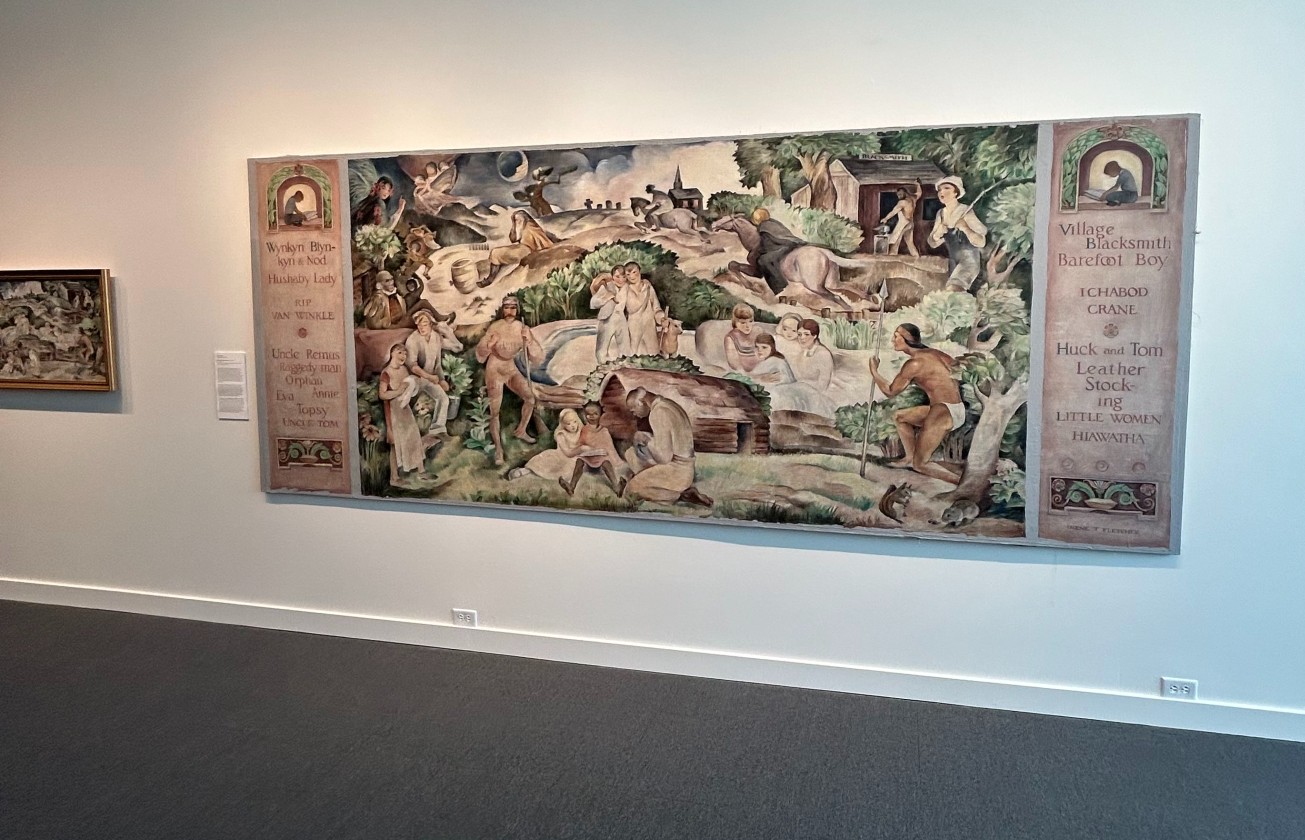
Irene Fletcher’s mural for the Logan Library.
The other WPA and Great Depression work is a large-scale mural, originally done for the Logan Library. Irene Fletcher was the only woman in Utah to receive a WPA commission for a mural in Utah and she painted this scene of famous characters from children’s books in the Logan Library. Though a relic of its time—it includes problematic depictions of racist stereotypes found in the literature—the work is one of the most significant pieces in the show. It demonstrates the ambitious level that Irene and all the Logan artists were working at. She created this large scale, multi-figure work for the community that hung in the Logan Library for decades.
The two works together cement Irene as one of Utah’s most significant artists of the 1930s and interwar era. Other works of hers show up mainly in the family section and speak to the sacrifices she made as a woman artist who took on raising Calvin’s eight children from his first two marriages, as well as the six they had together. As the curators insightfully point out, her self-portrait shows Dale right at her shoulder, leaning on her, showing how truly little time she had to paint and create as a full-time mother to over a dozen children.
The exhibition also explores the artistic contributions of their son, Dale Fletcher. Dale is most known for his role as the leader and philosophical founder of the Mormon Art & Belief Movement at Brigham Young University in the late 1960s. As a professor there he mentored young artists Gary Ernest Smith, Dennis Smith, and Trevor Southey, amongst others, to create art that was worthy of both words: “mormon” and “art.” Many historians of Utah art believe this is the most significant art movement that came out of Utah in the 20th century and the show, in some ways, makes the assertion that this would have not happened without the freedom and exploration his parents took in their art careers.

Dale Thompson Fletcher, “Another Tree House,” 1976, mixed media, 80×50 in.
Nearly all of Dale’s works in the exhibition carry a religious undertone, even those that initially appear secular. For instance, his 1961 “Tree House,” in the “place” section, is actually coded with religious symbolism and metaphor. For Dale, the treehouse was a way to express humankind’s continual progression through eternity. His 1960s painting depicts the literal treehouse, but by 1976, in “Another Tree House” he has fully fleshed out this metaphor depicting a man, surrounded by many moons, and superimposed with multiple symbols from Mormon temple rituals, sacred geometry, and more. To Dale, the treehouse was the ultimate religious symbol. Like his parents, Dale embraced formal experimentation. Unlike them, however, he increasingly used style as a vehicle for an intensely personal symbolic language. For Dale the style or materiality was just a means of expressing complex spiritual and religious ideas.
Though the exhibition looks back at the work of Dale, Irene, and Calvin from the 1910s through 1970s, the lessons the show teaches about art in Utah are still valid today. The themes and ideas that the three Fletcher artists grapple with still permeate the Utah art scene. The tension between modern and contemporary styles and ideas versus traditional academic styles is a conversation that still plays out in our Utah art worlds. Family remains a central theme and there are many families like the Fletchers who have made an outsized contribution to Utah art. The first was Calvin Fletcher’s visiting artist program at Utah State Agricultural College, which introduced generations of Utah artists to expressionism, painterly brushwork, arbitrary color, and other modernist approaches that would spread well beyond Logan. Likewise, the influence of the Mormon Art & Belief Movement and Dale Fletcher’s artistic philosophy at Brigham Young University cannot be overstated: many of the most significant artists in contemporary Latter-day Saint art trace their roots back to the questions that Dale and his students asked in the late 1960s and the styles they developed. The role of women artists and the women juggling work and family and making incredibly outsized contributions to Utah art, like Irene did, is also still a story we’re telling about Utah art.
Meet the Fletchers, Nora Eccles Harrison Museum of Art, Logan, through July 25.
Related posts:

Emily Larsen is a Utah-based curator, arts administrator, historian, and artist. She currently works as the Director of the Springville Museum of Art, where she has worked in a variety of positions since 2014. Her research and writing focuses on the Utah art scene c1880-1950. She is passionate about Utah’s art and cultural history and loves working with local Utah artists.
Categories: Exhibition Reviews | Visual Arts