
Micol Hebron, curator at the Salt Lake Art Center, in a gallery being prepped for an exhibition, photo by Simon Blundell
Micol Hebron, Senior Curator at the Salt Lake Art Center since August 2010, is surrounded by an audible buzz that is discernable from the moment she walks into a room. It could be the effortless way she conveys her fierce passion for art. Her intensity isn’t that of someone who is on their second pot of coffee, it’s an organic energy that is intrinsic to who she is as a person. You can see it in her eyes. Hebron has a thirsty sense of curiosity and a sharp intellect; as evidence of this a person needs to look no further than her vision for the Salt Lake Art Center.
“I see the art center as having maybe three primary objectives from a curatorial point of view. One is to bring in artists from around the country to inspire local artists and also to bring Salt Lake into the conversation about what’s happening nationally and internationally in contemporary art. Secondly I see the role of the Art Center as being a conduit for artists to gain exposure outside of Salt Lake City. If the Art Center can provide access to other gallery exhibitions or sister institutions that are similar to the Art Center in other cities, it can really function as an advocate for local artists to get shown elsewhere.” Third, she is also looking to “raise the bar by providing not only opportunities for local artists to show, but opportunities that are in fact competitive and in dialogue with the national art scene, so that artists recognize that when they show at Salt Lake Art center it is akin to showing at a major museum anywhere else in the country.”
A component of this larger goal is for Hebron to help the Salt Lake community to explore and embrace a wider range of art forms. She says the amount of talent and enthusiasm for art in Salt Lake is inspiring but observes that some of the work she has seen, while very well done, is often very “safe.” As an example she points to public sculptures in the area and observes how they adhere to standard conventions: they’re mostly bronze, monumental, and can be taken at face value. “Salt Lake City has an amazing community of artists. There are a large number of people engaged in the arts. They do seem to me to be favoring painting and traditional art forms so I would love to find a way to continue to support and grow the existing artistic energy that’s here into more and more diverse forms of art,” Hebron says.
-

- Self-portrait by Micol Hebron
-

- Three stage transfer drawing by Micol Hebron
-

- Kindness of Strangers, performance by Micol Hebron
-

- Love Thy Neighbor, performance by Micol Hebron
Hebron and the Salt Lake Art Center are in a state of transition together. As new space is created at the Art Center and ambitious goals are established, Hebron has started settling in to a new city. While it doesn’t quite feel like home yet, she does compare Salt Lake City favorably to her former home. “One of the things I noticed and that I really love about Salt Lake City is that people do seem to take their time in a way that allows for appreciation of the environment of family life, of spending time with friends, of just being in the moment, and that’s something that you really don’t see in Los Angeles.” Hebron says.
As she finds time to be in the moment Hebron is also able to continue working on her own art. She is able to compartmentalize her work as a curator and her work as an artist so one does not interfere with the other. She says that being an artist “informs my curatorial ideology. I think I’m perhaps more sensitive to the way that artists work or the way artists want their work to be seen or treated in the institution.” But she is mindful that the two do not intermingle.
-

- Bubblegum Pop, lightjet print from a video by Micol Hebron
-
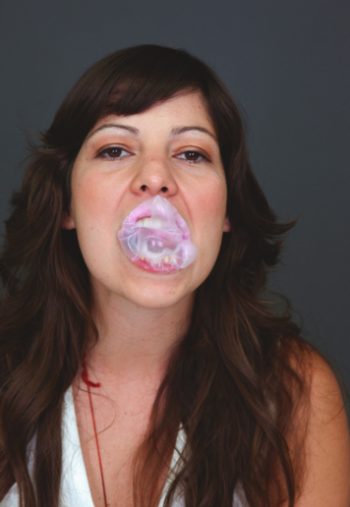
- Bubblegum Pop, lightjet print from a video by Micol Hebron
“The reason I keep things separate is because as an artist I have very particular opinions and ideas and objectives with my own work, but that’s a fairly myopic strain of inquiry. Whereas as a curator I feel like it’s crucial that my interests are very expansive, that I’m looking at a variety of media, a variety of statements, and a variety of ways of working, not only ways that are related to my personal practice. I also think for that reason it’s really important that I keep myself out of it, that it’s clear to the public that my role as a curator has nothing to do with my interest in promoting my identity as an artist. Those are completely separate.” Hebron says.
In her own work, Hebron explores among other things, feminist themes, power, identity, and gender roles. “I do performance art and video but really I work in a variety of media depending on the project. My recent work has been photographic, as I’m investigating the ways that the female subject is absent from a lot of modernist photography and trying to reinsert her in a kind of comedic and intellectual inquiry into how a contemporary female might view a modernist history with regard to the body. Much of my work looks at the role of women in contemporary and recent history and art history, and I’m interested in the way that the female subject is empowered or disempowered through means of identity construction.”
Female empowerment comes through not only in her work, it’s also a striking element of Hebron’s character. She expresses herself with a fearless honesty that has nothing to do with a desire to shock or be subversive, even though what she says may sometimes be interpreted that way. At the core they’re statements that stem from genuine confidence that allows for complete self expression.

Micol Hebron, photo by Simon Blundell
It’s difficult to assess how a person’s core is shaped, because it’s more than one simple life event that makes us who we are. Instead it’s a myriad of experiences that have an influence on us, and Hebron’s life is full of unique events that have brought her where she is today: She was raised by a mother who was empowered by her intelligence, a woman who was among the first class of women to be admitted to the Massachusetts Institute of Technology. She was raised by liberal parents in a tent in the woods where she learned to shoot deer and had a very direct, intimate relationship with nature. She attended Montessori schools where she was taught the world is a resource, one she was invited to explore and investigate. As a teenager in the 1980’s and 1990’s she watched the world transition from being analog to digital and she experienced a world that was the antithesis of the one she grew up in. That age celebrated consumerism and decadence, and she was drawn to academics, earning a earning a BFA in Fine Art, Summa Cum Laude, from UCLA and an MFA in New Genres, also from UCLA. She stayed in the City of Angels to teach, curate, write, and practice art.
To list the events doesn’t quantify the experiences, but instead gives you a small glimpse of Hebron’s background, and she is happy to share stories from her past. But when she talks about the Salt Lake Art Center and all that she plans for it, she leans in closer to engage in the conversation, her eyes grow wide with possibility, and that inaudible buzz around her grows louder.

UTAH’S ART MAGAZINE SINCE 2001, 15 Bytes is published by Artists of Utah, a 501 (c) 3 non-profit organization headquartered in Salt Lake City, Utah.
Categories: Art Professional Spotlight | Visual Arts