
The late, great Philip Guston once said, “I’m a night painter, so when I come into the studio the next morning the delirium is over. I know I won’t remember the details, but I know I will remember the feeling of the whole thing.”
Isn’t that the great beauty and power of night? As the harsh grip of daylight fades, no longer must everything be equally illuminated: every pebble, every ant, every blade of grass. Stripped of sunlight’s maximalism, evening allows us to give up relentless detail in exchange for atmosphere, mood, and tone—the feeling of the whole thing.
Nick Bontorno is a night painter, and Nightfall is both the title and subject of his debut solo exhibition at Alma Gallery, featuring 20 new oil paintings. Raised in upstate New York, Bontorno studied at the Lyme Academy in Connecticut before earning an MFA from Brigham Young University in 2012. He has traveled east and west across the United States for work, teaching at universities and high schools while also working in skilled trades, and speaks of painting as something he does “purely for pleasure.” There is a protective edge to the phrase, as though it has been hard won. In conversations about the new work, Bontorno reveals a skepticism toward the expectation that painting must justify itself through theory before it can simply be enjoyed. His work is evidence: these paintings feel unburdened by trend or intellectual performance. These are paintings by someone who loves to paint.
I’ve known Nick, on and off, for a little over a decade. We met at the end of his art school training and the beginning of mine. A few years later, we shared a studio in a warehouse near the railroad tracks in Provo. We were both piecing together a living through the gig economy, so our schedules rarely overlapped, but I remember the quality of our conversations: shared snacks, debates over Bruce Springsteen’s best albums, and arguments about which painters mattered most. I disliked the Fauvists; Nick was sure I was dead wrong. We both agreed on the Italians and Hopper, though.
Although we have only checked in every few years since, I feel fortunate to have watched his work shift and persist over the past decade. Knowing Nick and his paintings can feel like being let in on a good secret. But I’m not great at keeping secrets, which is why I offer this review. Nightfall features two kinds of paintings: lonely American scenes and moody revisions of canonical pictures. In the more modern scenes, darkened countrysides, old cars, farmhouses, young women, and scruffy men smoking cigarettes return the viewer’s gaze with easy indifference, as if unconcerned that their lives are being observed. Then there are the dark pastiches of paintings past: Christ crucified, The Last Supper, and references to canonical images, all bathed in the same twilit drama.


Questions of narrative arise around the modern scenes: Who are these people? Why are they depicted in these uncanny moments between day and night? What is the quality of their lives? Mystery endures not only in the imagery but also in Bontorno’s handling of paint. At times it feels solid and decisive, descriptive of light striking a plane; at others it becomes elusive and threadlike, as dry brushwork gives paint the quality of smoke or gossamer. His touch feels both naive and intentional. Though he builds compositions with broad gestures, he knows that a single brushstroke can alter a subject’s expression. To paint like this seems simple; but it is not. To decide where to be spare and where to let detail linger is the choice of someone with a careful and tender eye.
After previewing the exhibition in Bontorno’s storage space in Provo, I drove home through the pinkish Eureka wildfire haze hanging over Utah Valley. Feeling restless that day, I decided to go for a run. Jogging through the Orem suburbs, I put on Darkness on the Edge of Town (1978), an album whose mood felt aligned with both the threat of fire and the paintings I had just seen. At the top of Dry Canyon, I watched the sun sink into a smoky horizon and felt a pang listening to Springsteen sing about the desperation of ordinary American lives.
A writer once observed that we discover the universal through the particular. I realized on that foothill that part of the reason I find Bontorno’s work so evocative is simply the presence of dusk that unites his subjects. Does not all humanity, at day’s end, look up at the sky and feel a pang? Whether crimson orange, lavender blue, or dense reddish-purple, it is in that last flare of twilight that I perceive a sear of melancholy universally felt.

Nick Bontorno: Nightfall, Alma Gallery, Provo through Aug. 1. Art Stroll reception July 3, 6–9pm.
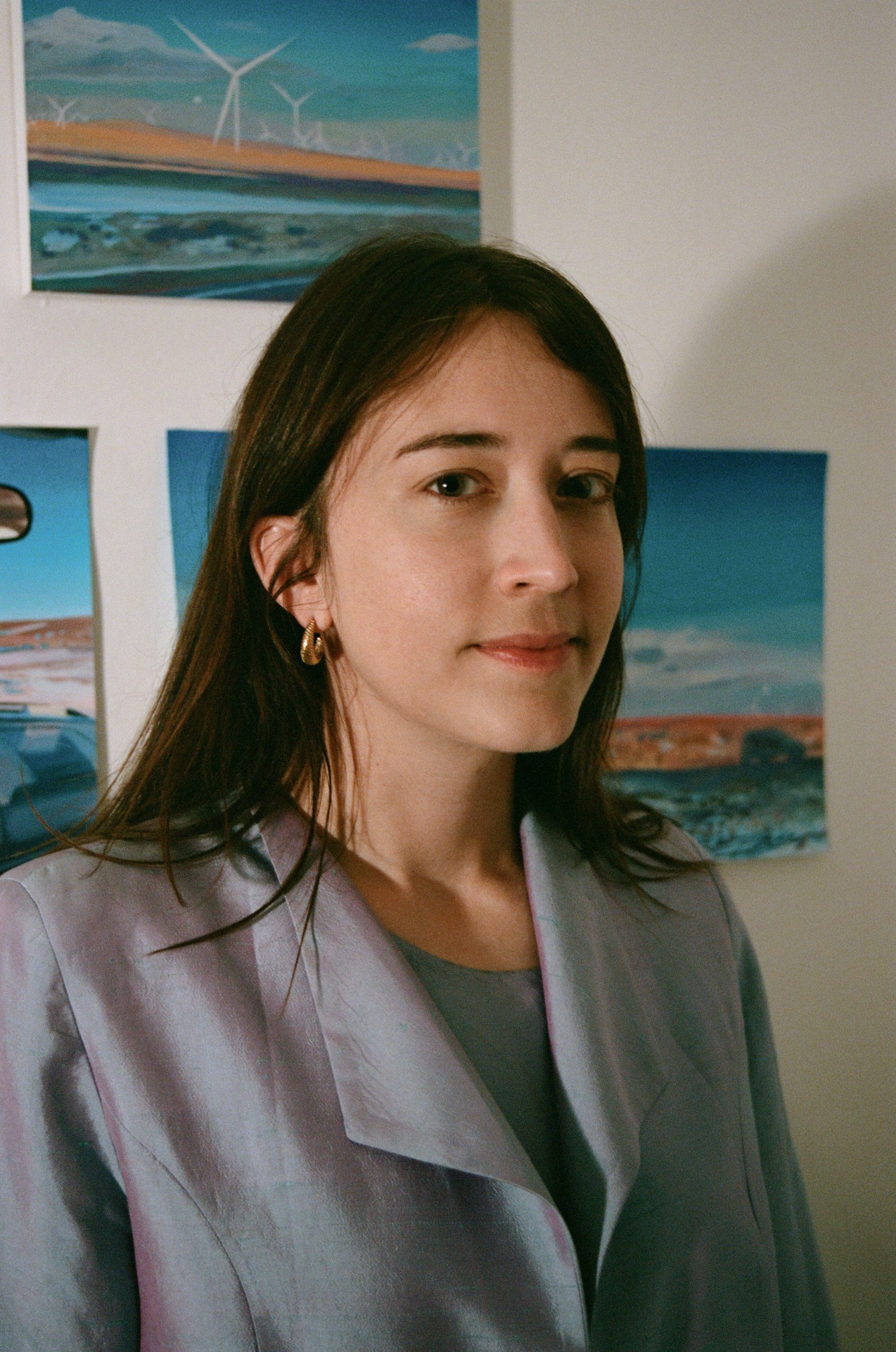
Madeline Rupard is an artist and educator based in Utah Valley. She holds an MFA from Pratt Institute and a BFA from Brigham Young University, where she joined as an Assistant Professor of Art in 2024. Her work has appeared in New American Paintings, Booooooom, SPRING/BREAK Art Show in New York, Material Contemporary in Salt Lake City. Her paintings consider the American landscape as one who has moved through it frequently and traveled across long distances. One of her greatest joys in life is driving down a sunny highway with a good song playing.
Categories: Exhibition Reviews | Visual Arts