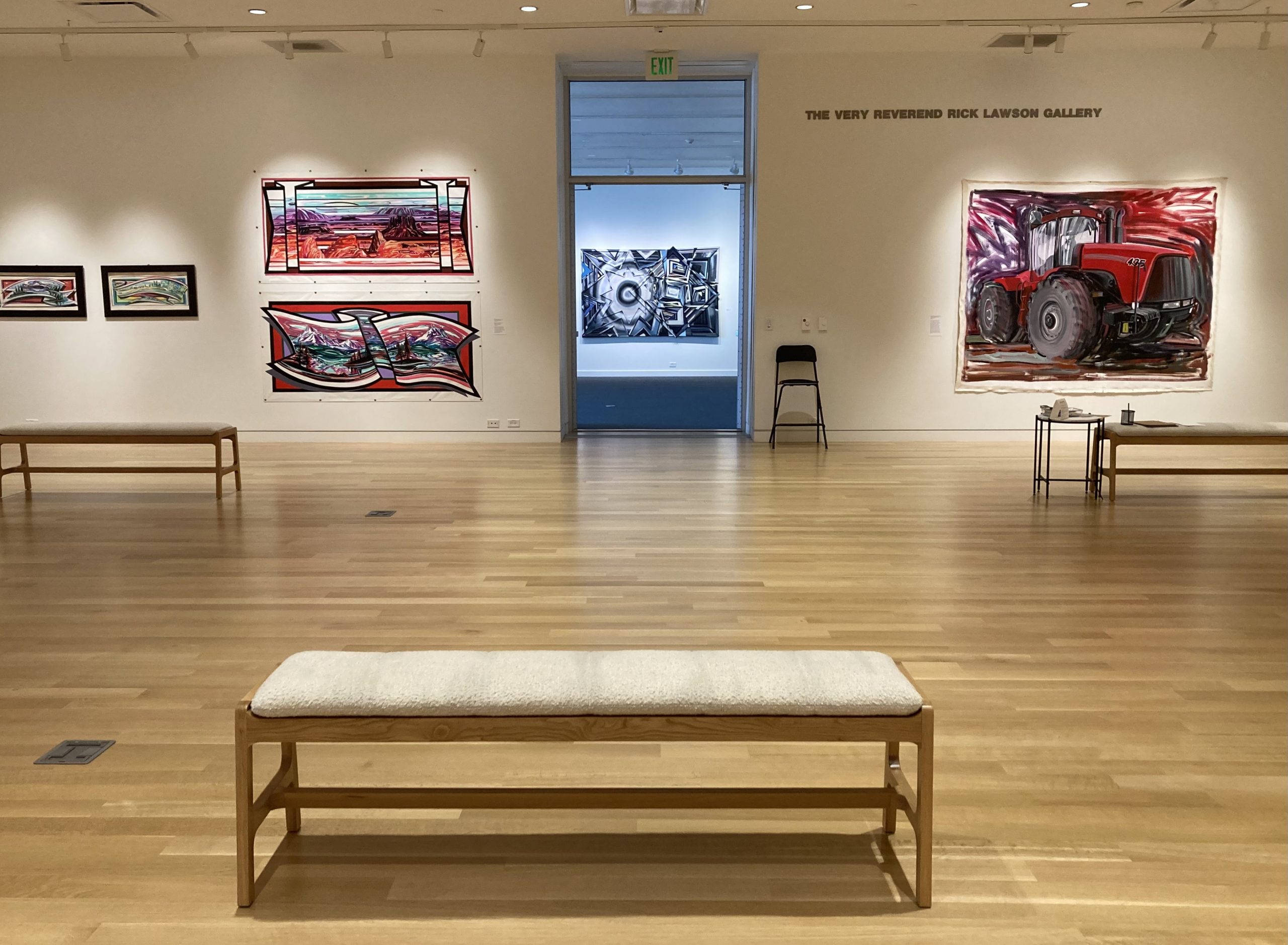
Karen Carson’s landscapes and agricultural machinery share a gallery at the Nora Eccles Harrison Museum of Art.
The Nora Eccles Harrison Museum of Art has a delicious habit of revisiting wonderfully idiosyncratic artists, many of whom have hovered around the canon without always entering it. Like Karen Carson, who told Anne Ayres in a 2003 oral history for the Smithsonian’s Archives of American Art, “I’ve just gotten sort of famous for being left out.” One Thing After Another, curated by Katie Lee-Koven and on view through December 12, devotes the museum’s upstairs galleries to five decades of her work.
Carson arrived in Los Angeles from Corvallis, Oregon, finishing her MFA at UCLA in the early 1970s. Minimalism reigned like a severe, and very masculine, monarch. Carson was a soft-fleshed upstart. A former 4-H sewing champion who had once taken grand champion for a party dress, she sewed the grid. At NEHMA, a long run of panels stretches down one wall—unstretched black and natural canvas, cut into big triangles and joined with heavy metal zippers. Barnett Newman’s “zip,” the stripe that runs top to bottom through his fields of color, was among the most solemn marks in postwar painting. The Minimalists who followed kept his flat, unbroken surfaces, building their objects out of steel and plywood. Carson’s zip is a zipper. “I really felt that my place as a feminist was to be in the masculine world,” she told Ayres. “I wanted to use irony, satire, or at least some kind of humor.” She seems less interested in reducing painting to its essentials than in finding out what else she can bring into it. Where a zipper is closed, it draws a hard diagonal across a black field. Where it’s open, a cream flap folds down like a tent door left open, and the white wall shows through the gap. Minimalism gone flaccid.
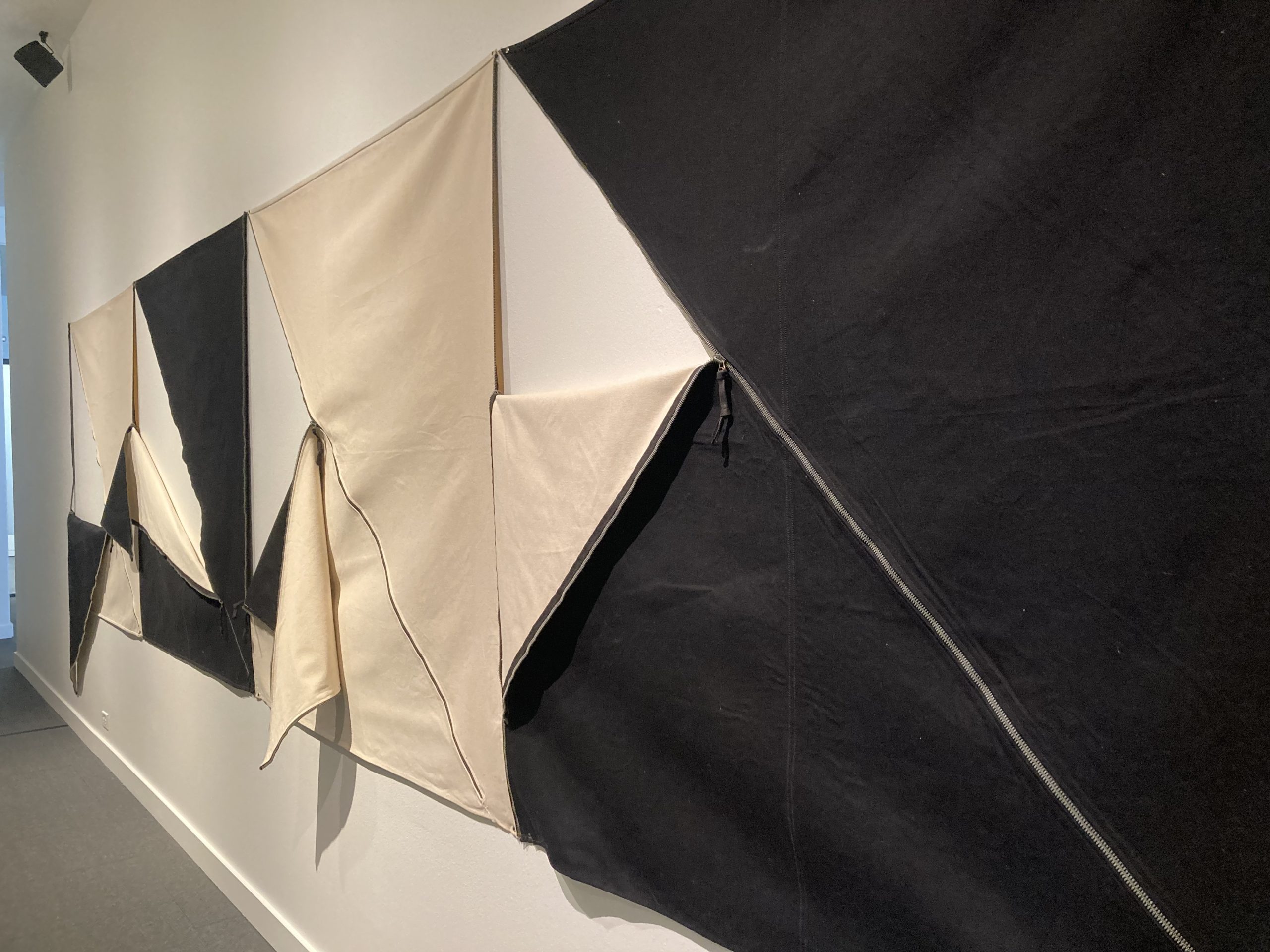
Carson’s early zipper works replace the rigid surfaces of Minimalism with unstretched canvas joined by heavy metal zippers.
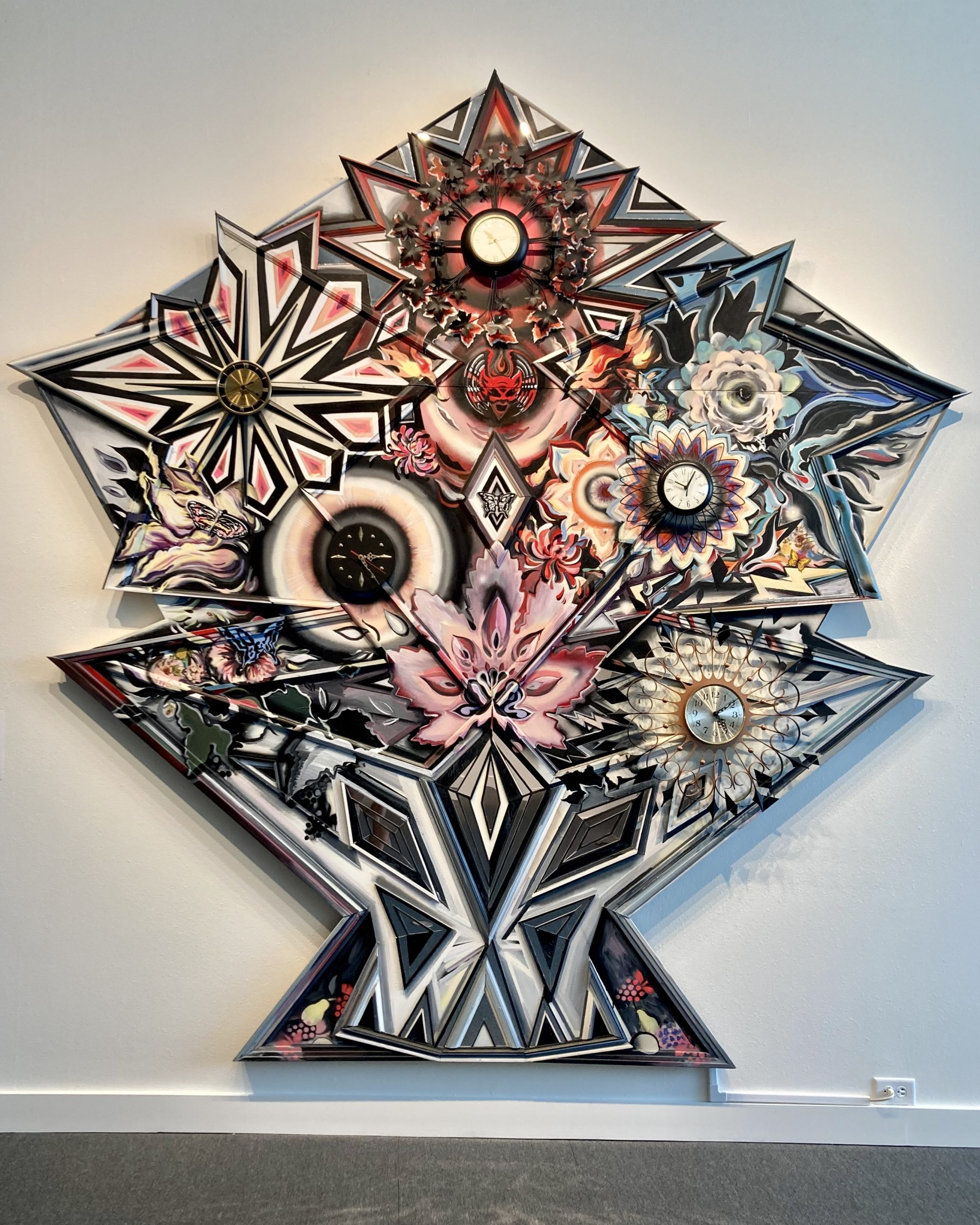
In “Flowers of Fate,” Carson assembles clocks, decorative molding, painted flowers and geometric patterns into an exuberant, altar-like construction. The work, acquired by NEHMA in 1996, exemplifies the maximalism that became her signature in the late 1980s and early 1990s.
For the next decade Carson moved around restlessly. She drew burning and shattered beds, and she printed plywood grain onto paper, tore it up and taped it back together. But it is in the works she began making in the late 1980s that her sensibility seems to come most fully into its own. After five years in New York, she returned to Los Angeles and began building paintings out of wood molding, assembling frames within frames, spray-painting them and inserting linoleum tiles and shards of mirror. They are exuberant and sometimes gloriously tacky. Anything but minimal. She called her love of kitsch “a gesture of conciliation between high art and low art.”
In Flowers of Fate (1990–91), which NEHMA has owned since 1996, clocks, sconces, electric candles and mirrors accumulate into something resembling a domestic altar. Butterflies are Free to Burn (1989) bursts outward from a starburst of mirror shards beneath a crown of painted flames and gold leaf. A metal butterfly, the sort sold alongside lawn whirligigs, perches on the composition. Moths go to flames, Carson reasoned, so “my work is so beautiful and compelling that it attracts large insects.”
The mirrors turn the excess back on the viewer. In God’s Eye (1989), a painted corridor recedes through successive frames toward a narrow slot of mirror. Lean in, and the figure staring back from the end of the hall is you. Carson called the series “Abstract Narcissism.” A niece who knew nothing about art once ran straight to one of them in Carson’s studio to put on lipstick.
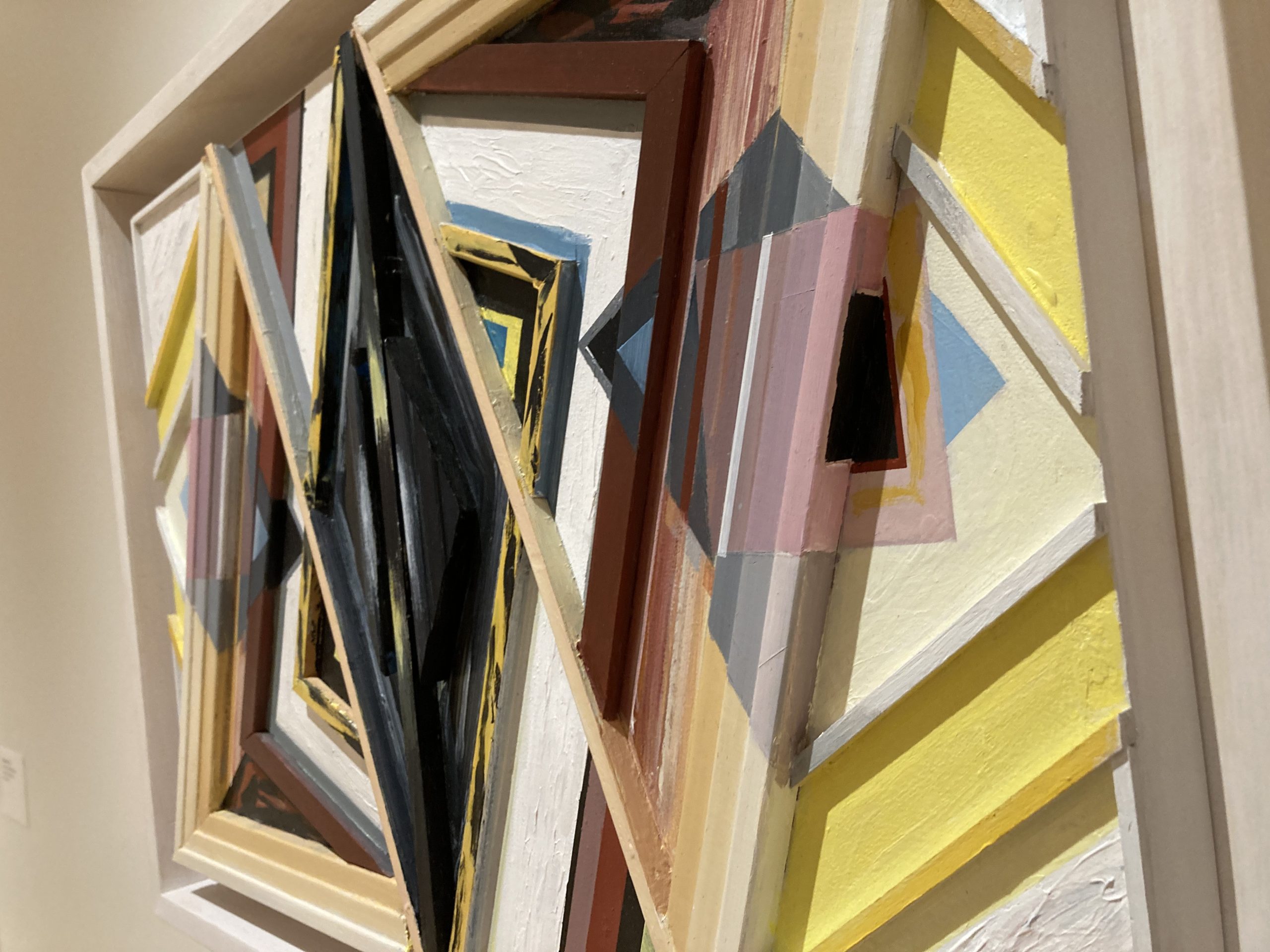
Detail from “Black Diamond,” 2018, acrylic on bas relief wood.
The drawings of those years carry the same appetite into their frames. In Hot Women and Mood Swings (both 1990), a woman cools herself with fans and another swings inside a ring of lunar symbols, both behind red Plexiglas in rococo frames painted to match. Dave Hickey once called her abstractions of the period her “hot flashes.” Here the joke stops being a metaphor.
In 1994, a residency at the University of Nevada, Las Vegas, brought the city’s signage into her work. Her “Life Posters” borrow the typography of circus banners and casino marquees to deliver messages drawn from her Zen reading. Breathe (1994) sets the word on a diamond, with IN and OUT pointing in opposite directions, like a carnival sign giving instructions for being alive. The painted banners that followed, like the cross-eyed, grinning Crazy Wisdom, shout with the immediacy of advertising.
When she began splitting her time between Los Angeles and Big Timber, Montana, the landscape entered her work as advertising too. Two vinyl banners, hung by grommets, offer up the West the way a gas station sells it, with red mesas staged between cartoon pillars. In the fire paintings, which she began in 2003, the summer a wildfire burned ten miles from her Montana home, loose flame and smoke sit inside hard geometric borders. “If a forest fire scares me,” she said, “I make it beautiful.”
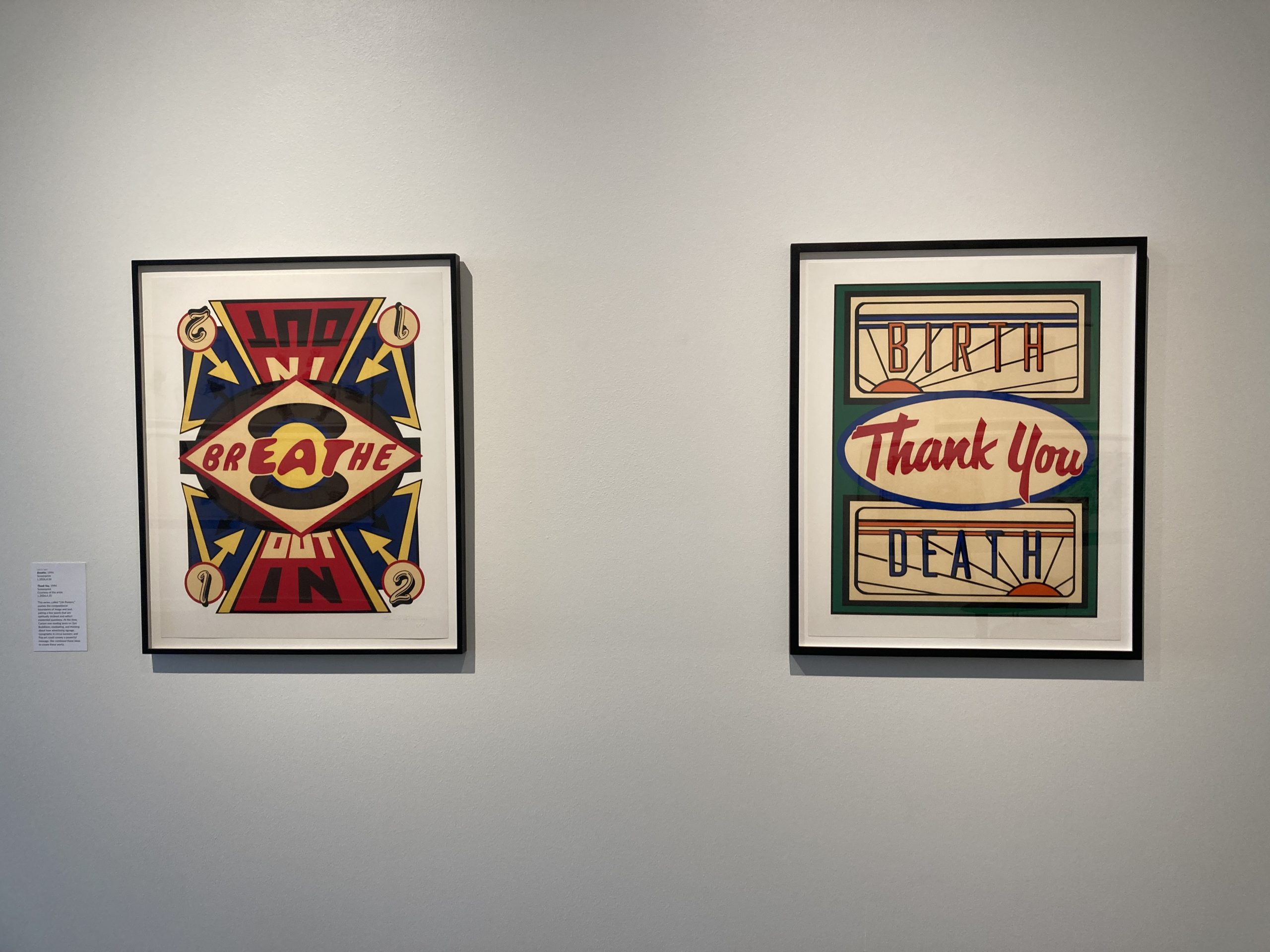
Inspired by the signage of Las Vegas, Carson’s Life Posters borrow the bold typography of carnival banners and casino marquees to deliver deceptively simple philosophical messages.
Montana also gave her the tractors. Carson has long poked fun at the brushy bison and elk that fill the state’s galleries. In her Rural Big Boys series (2012–2016), she painted combines, tractors and swathers at full scale on unstretched canvas.
The most recent work returns to relief. In Eye Shadow #5 (2024), mirrors set between gray and mauve slats catch fragments of the gallery and its visitors. Fifty years after the zippers, Carson is still finding ways to make abstraction open up.
Carson’s generation, she told Ayres, was supposed to work in “the developed series,” modifying one idea until it reached perfection. She found that “too agonizingly boring.” “If I were to imagine myself being a bad girl on any level,” she said, “it would have been that I just never did the same thing twice.”
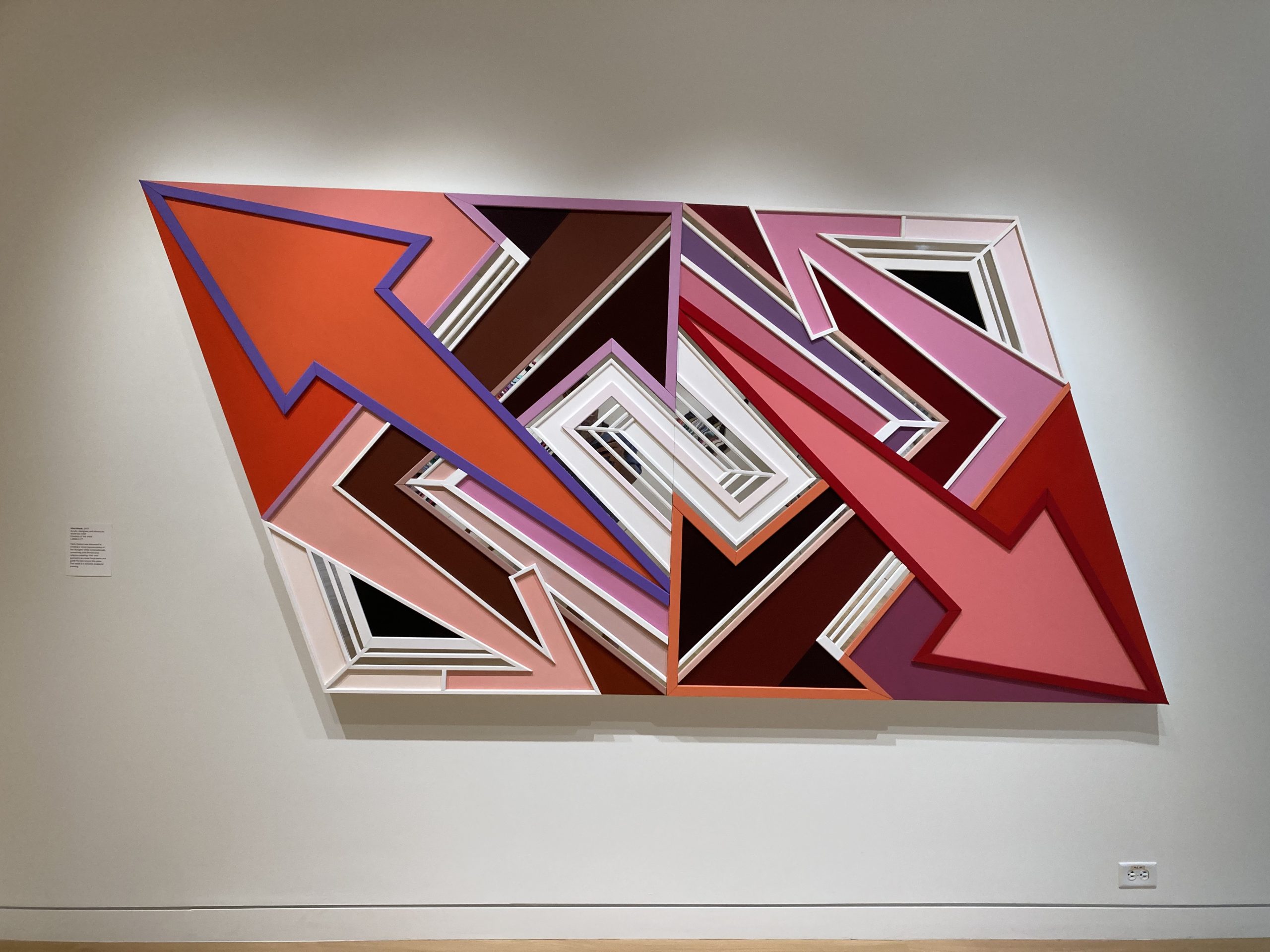
Karen Carson, “Milk Weeds,” 1997, acrylic, plexiglass and mirrors on wood bas relief
One Thing After Another: Karen Carson Retrospective, Nora Eccles Harrison Museum of Art, Logan, through Dec. 12.
The founder of Artists of Utah and editor of its online magazine, 15 Bytes, Shawn Rossiter has undergraduate degrees in English, French and Italian Literature and studied Comparative Literature in graduate school before pursuing a career in art.
Categories: Exhibition Reviews | Visual Arts