
Photo by Simon Blundell, 2017.
John O’Connell came to painting late, but spent the rest of his life making up for lost time. He died June 14, after more than two decades as associate professor of Painting and Drawing at the University of Utah. He was 64.
Born in Worcester, Massachusetts, O’Connell grew up in a big Irish neighborhood in the urban Northeast. He came to art late—his created his first painting at 28—after stints in engineering school, construction, and music. “There was a big experimental ‘I don’t know what the hell I’m doing’ period,” he once said. “Once I got connected to this art stuff it became clear what I was supposed to be doing.”
He graduated from Massachusetts College of Art in 1995 with both a BFA and a BS in Art Education, earned his MFA from the University of Connecticut in 1999, and taught at Middle Tennessee State University before joining the University of Utah faculty, where he remained for more than two decades.
Over that time O’Connell developed a distinctive abstract vocabulary: layered painted surfaces, recurring organic forms—seed-like ovals, calligraphic marks, skeletal structures—and buried writing that was felt more than read. The work was painterly in the traditional sense, gestural and accumulative, haunted by the body and by language.
Then, in the years before his 2017 solo show at the NAU Art Museum in Flagstaff, something shifted. A 15 Bytes profile of O’Connell written by Ann Poore in 2017—occasioned by a show at A Gallery in Salt Lake City — caught him at what she called “a high-water mark”: new work incorporating construction skills from his New England youth alongside the abstract visual vocabulary he’d been developing for years. He described the shift himself with characteristic plainness: “I’m really glad that I’m into something now that I’m not quite sure about.”
The table saw and chop saw moved from a corner of his studio to the center. Wood became, as he put it, like a paintbrush—and with it came a new way of asking the questions that had always preoccupied him. The resulting constructions looked archaeological: massive, layered, artificially aged, some as large as fifteen feet. But the aging was his own work, the rust manufactured, the history invented. That was precisely the point. “These surfaces that look like they may have 100 or 200 years of history on them,” he said, “the reality is the only history that is there is the history I put there.” The show title, A Subjective Archaeology, named what he had been circling all along — the idea that what looks like excavation is really construction, that the stories we tell about ourselves and our past are made, not found.
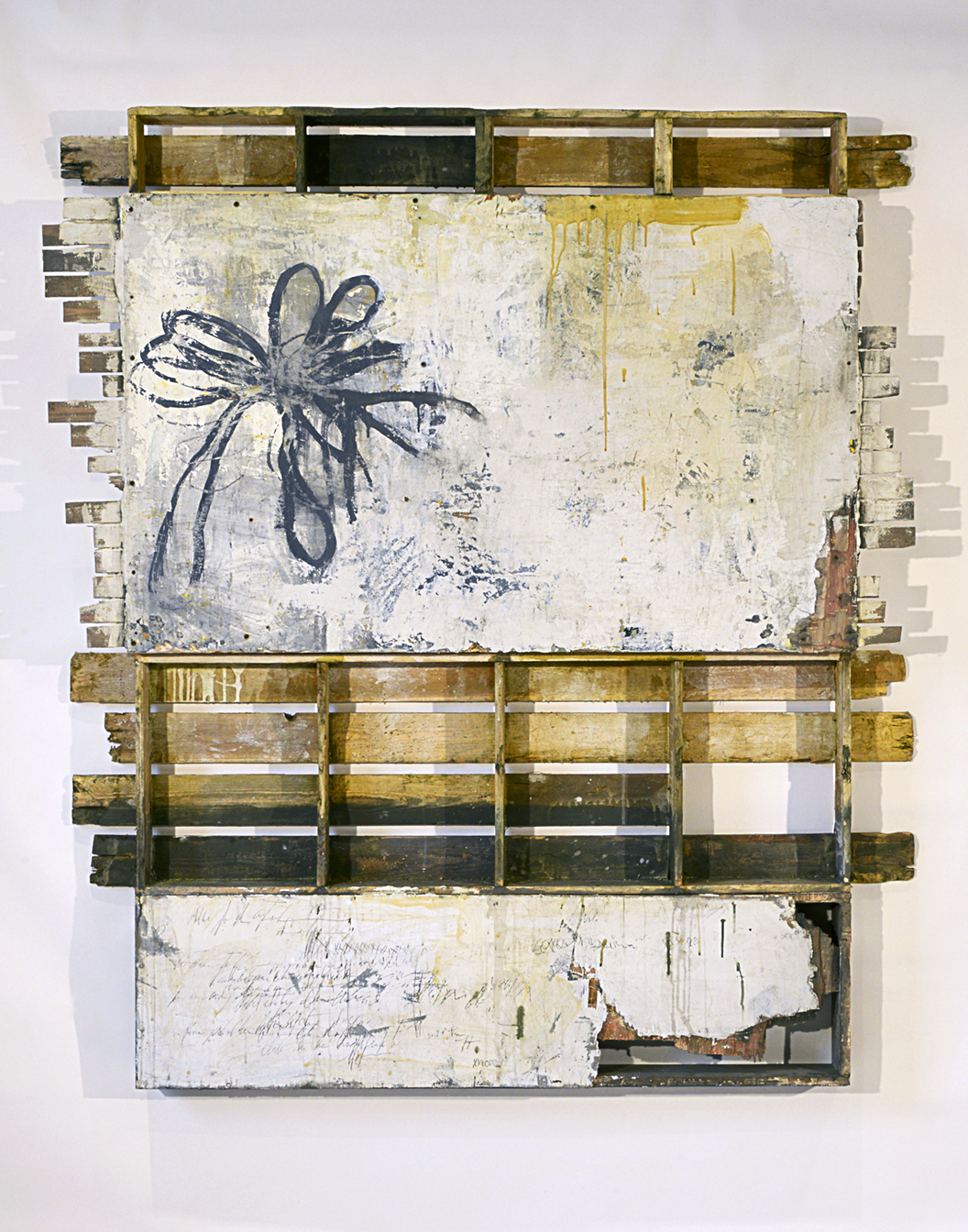
John O’Connell, “Slow Learner’s Club”
Though O’Connell was known for his abstract vocabulary, the conceptual stake of his work were equally important. O’Connell’s father suffered a stroke when John was 18, losing language progressively over the 22 years before his death. That loss seemed to haunt the work. He drew on the Dionysian notion of re-presentation: not a picture of something, but the thing itself made manifest. “I’m not making a picture of history in a painting,” he said. “I’m making a painting that has history.” He drove nails. He hit surfaces with a hockey stick, a hatchet, a belt sander. The studio, which he built himself behind his Salt Lake City home in 2006, functioned as a site of ritual. “Instead of prayer or good old Buddhist meditation, that’s what I do to negotiate the world.”
His exhibitions included solo and group shows at the Brooks Museum in Memphis, Rosenbaum Contemporary in Miami, the Lowe Gallery in Santa Monica, and the NAU Art Museum in Flagstaff. His pieces entered collections including the Marcia & John Price Collection, the Utah Museum of Fine Art, and the Mukesh Ambani Collection. In 2005 he received a major research grant from the University of Utah for “The Utah Land Project.”
But for many in Utah’s art community, O’Connell’s most lasting impact was in the classroom. In the days after his death, colleagues remembered him as a prolific painter who inspired young artists throughout his career; fellow faculty recalled long conversations about teaching and art that stretched back to his earliest days at the U. Students, for their part, remember him as someone who didn’t traffic in comfortable feedback. “John brought a brashness to the U that’s hard to come by in this city,” says painter Benjamin Childress. “He didn’t usually tell you what you wanted to hear and often wanted you to ask uncomfortable questions of yourself. But that’s what made him so good. He pushed you. He pushed you to dig deep, to find your voice, and be the best artist possible.”
That directness was leavened by a humor his students clearly treasured. Amy Ungricht, who worked with O’Connell throughout her time at the U, recalled that his criticism was “always very balanced and had such a sense of humor about it, that it would take the edge off.” When a student broke his arm and declared he couldn’t paint with a cast on, O’Connell pushed a paintbrush up the cast and told him it would make his work more abstract. When Ungricht photoshopped his image onto a unicorn—a running joke in his classroom—and turned it into a t-shirt, he held it up in front of the class and declared it the new required uniform.
Ungricht also remembered a more practical side: O’Connell focused on making painting as affordable as possible, so students could sustain the practice long after school ended. When she was applying to graduate programs, he offered to help her find ones that would pay her to be there.
O’Connell described his own approach to teaching as mentorship rather than instruction—getting students to access what was already in them. “I went into the arts because I couldn’t say what I needed to say any other way,” he said. “And I think most students are there for very similar reasons.”
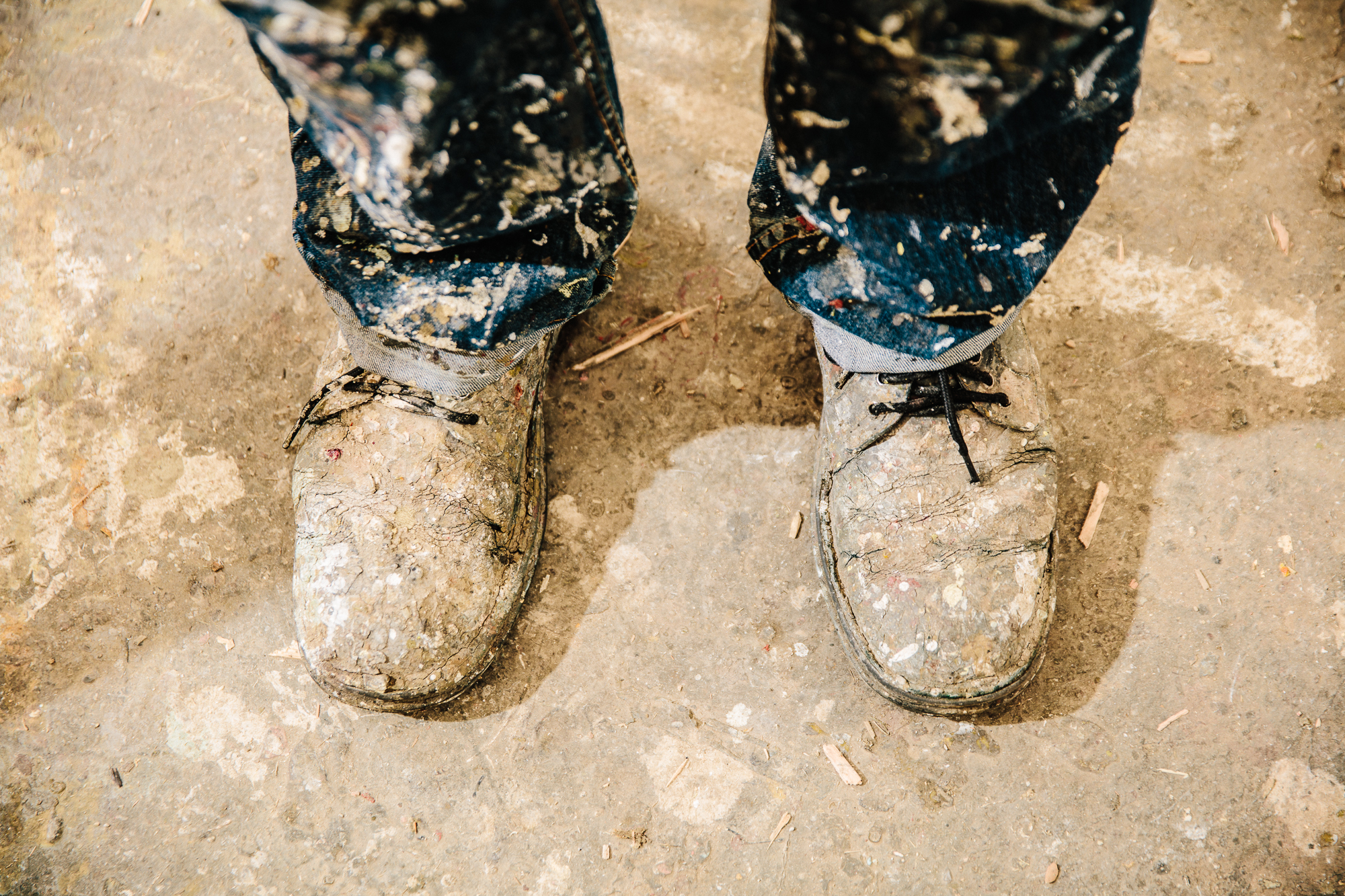
Image by Simon Blundell, 2017.
This audio is from a 2008 interview with O’Connell by Dallas Graham.

UTAH’S ART MAGAZINE SINCE 2001, 15 Bytes is published by Artists of Utah, a 501 (c) 3 non-profit organization headquartered in Salt Lake City, Utah.
Categories: In Memoriam | Visual Arts



I will miss my friend John O’Connell. I offer my sincere condolences to those who miss him.
I first met John O’Connell in Worcester sometime around 1979.
I was proud to call him my friend. He played guitar for the small circle of friends and he was good at it. He made little sketches on calendars hanging on your wall or scraps of paper. He would walk miles to be with his friends. He read many subjects and would ponder both the big question and the little ones. He went on adventures that some of us would say no to; I mean, how many people actually joined a circus? He helped me build that light delicate almost airy pile of rock at that lake in the woods. He was an honorable man even in his youth.
While our paths lead us to different locations, we managed to stay in touch by phone and had long rambling conversations. I miss him, he was like a brother.
Phil, this is Jenevieve, his son’s mother. Thank you so much for this beautiful picture of him. We miss John.
Sorry for your loss. He was my favorite uncle. I always wanted to reach out and tell him my 16 year old daughter is an amazing artist. Her sketches with watercolors of bees, birds and animals are ridiculously detailed. Even at 5 years old we knew she was amazing at art.
John would have loved to see it and been so proud. Seems like it runs in the family.