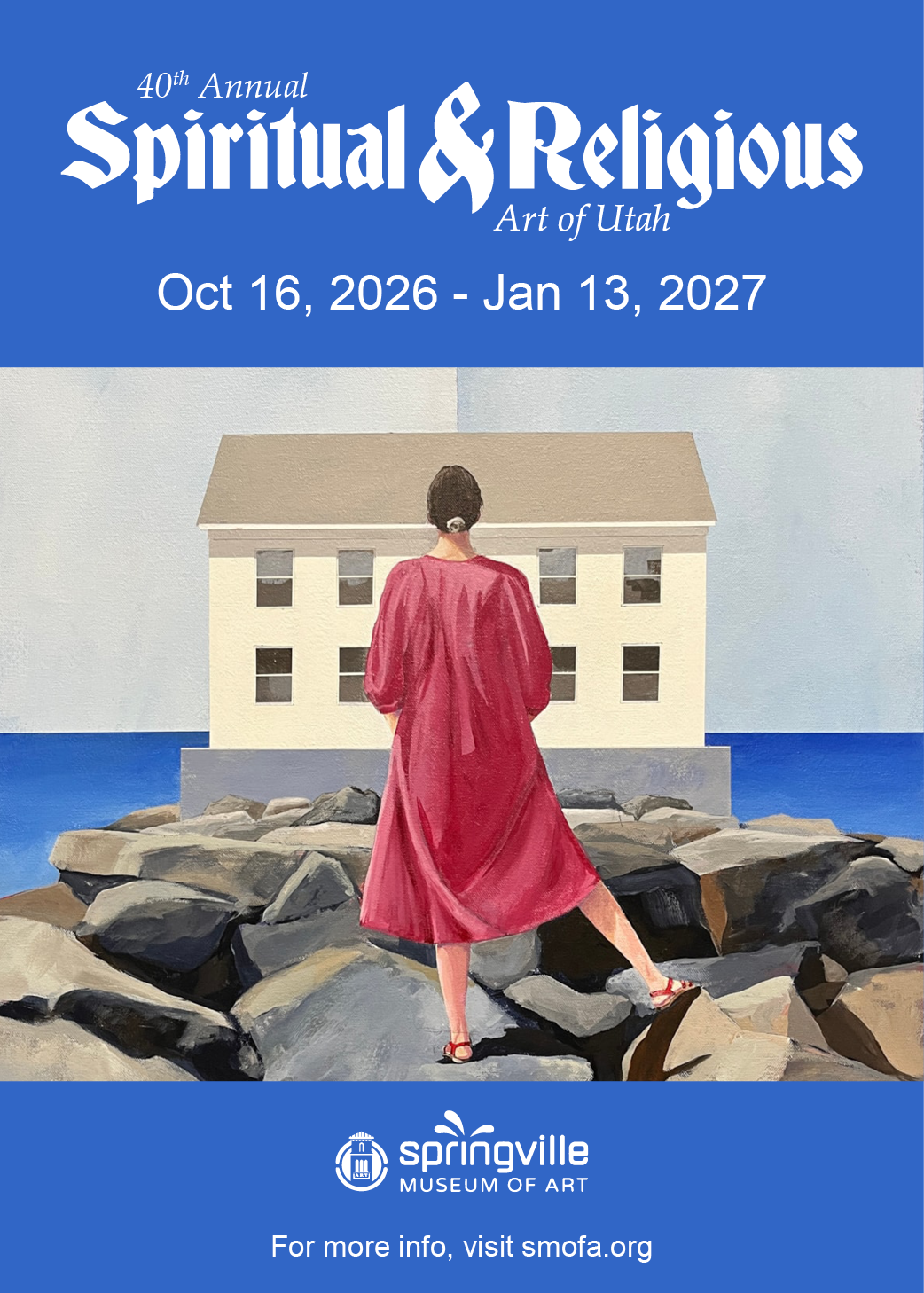
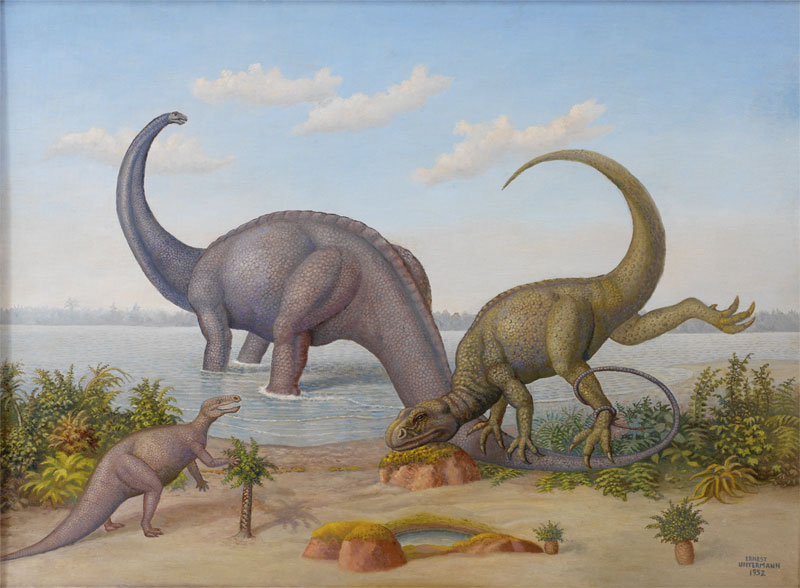
Cretaceous Saurapods and Ornithopods, by Gerhard Ernest Untermann, 1952, O/C 28 X 38, courtesy Springville Museum of Art.
The Natural History Museum of Utah is inviting artists to bring prehistoric creatures to life—and put them on billboards
Dinosaurs have changed a lot in the past 150 years. Once imagined as lumbering, oversized lizards dragging their tails across the ground, they’ve since become fleet-footed predators, feathered creatures and animals with fleshy features that would have been impossible to guess from their skeletons alone. In 2023, researchers suggested that Tyrannosaurus rex probably had lips covering its famously exposed teeth. In 2025, exceptionally preserved duck-billed dinosaur fossils revealed fleshy crests and spiky tails. And earlier this year, scientists described a dinosaur with skin spikes unlike anything previously documented.
Each generation’s dinosaurs look a little different. Both because paleontologists keep digging up new evidence, and because artists keep finding new ways to interpret it. Bones can tell us a great deal about an animal’s size, structure and movement, but they don’t necessarily reveal its colors, its contours or the soft tissues that gave it its living appearance. Your spouse looks a lot different clothed in skin and hair. So does a dinosaur. That’s where scientific knowledge meets artistic imagination.
Utah has its own history of imagining these prehistoric creatures. In the mid-20th century, Gerhard Ernest Untermann, a German-born artist who had studied geology and paleontology at the University of Berlin, painted dinosaurs and the ancient landscapes they inhabited. A friend of Earl Douglass, whose fossil discoveries led to the establishment of Dinosaur National Monument, Untermann settled in Vernal and devoted much of his later life to depicting the prehistoric world. His fanciful reconstructions, some of which remain in Vernal museums, offer a glimpse of how dinosaurs were imagined before more recent discoveries transformed their appearance. (Read Tom Alder’s 2010 profile of Untermann in 15 Bytes.)
Now the Natural History Museum of Utah is inviting a new generation of artists to try their hand at the same challenge. And this time, the dinosaurs won’t be confined to museum walls. They’ll appear on digital billboards along the Wasatch Front.
The museum’s dinosaur billboard contest is open to Utah artists of all ages, with separate categories for children 12 and under, teenagers 13–17 and adults 18 and older. Entries must be hand-drawn in traditional two-dimensional media—pencil, pen, crayon, charcoal or paint—and based on actual dinosaurs. Creativity is encouraged, but so is anatomical accuracy.

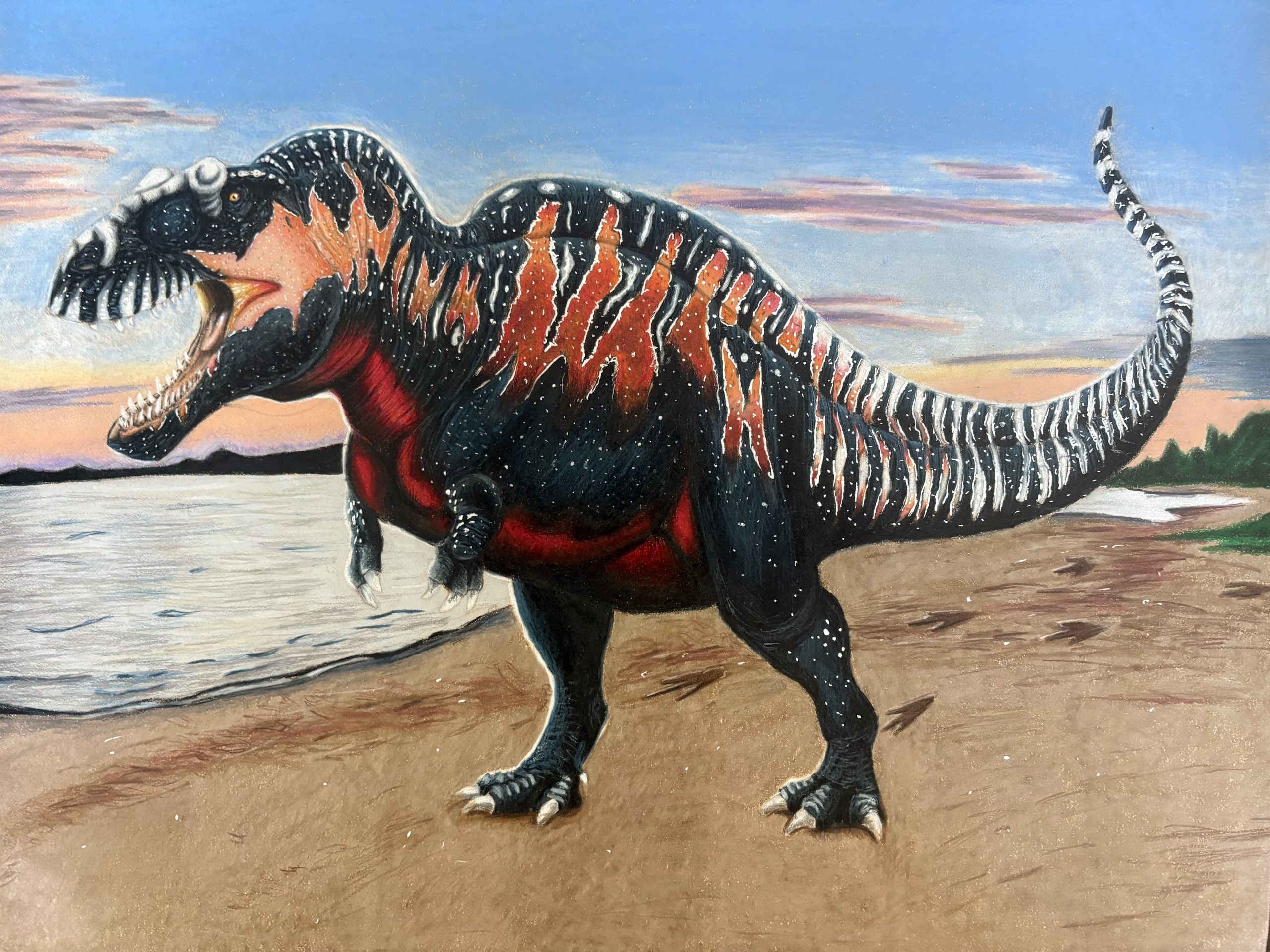
“When you see a dinosaur bone, it is hard to imagine what the dinosaur would have looked like when it was alive,” says Carrie Levitt-Bussian, NHMU paleontologist and paleontology collections manager. “Paleoartists bring fossils to life using their imagination and great talent; they enliven and flesh out the bony skeleton, breathing life into these ancient creatures.”
Utah’s fossil record offers plenty of inspiration. The state’s prehistoric inhabitants included the elaborately horned Kosmoceratops, the large-nosed Nasutoceratops and the formidable predator Allosaurus. Their remains, along with artists’ reconstructions of them, help populate the museum’s Past Worlds exhibition.
“As a paleontologist, I constantly work with illustrators and artists in many media forms to communicate the visions I see in my head based on my research,” says Mark Lowen, a vertebrate paleontologist at the University of Utah and research associate at NHMU.
Artists interested in taking up the challenge can download the official billboard template from the museum’s website or pick one up at NHMU, where drawing supplies are also available. Entries are due November 9, and winners will be announced November 18. Along with seeing their dinosaurs looming over Wasatch Front motorists, winners will receive prizes including VIP experiences at DinoFest in January, museum merchandise and dinosaur fossil casts.
The dinosaurs we imagine today may look very different from those Untermann painted more than 70 years ago. Seventy years from now, they may look different again. That’s part of the challenge—and the opportunity—for artists trying to bring an extinct world back to life.
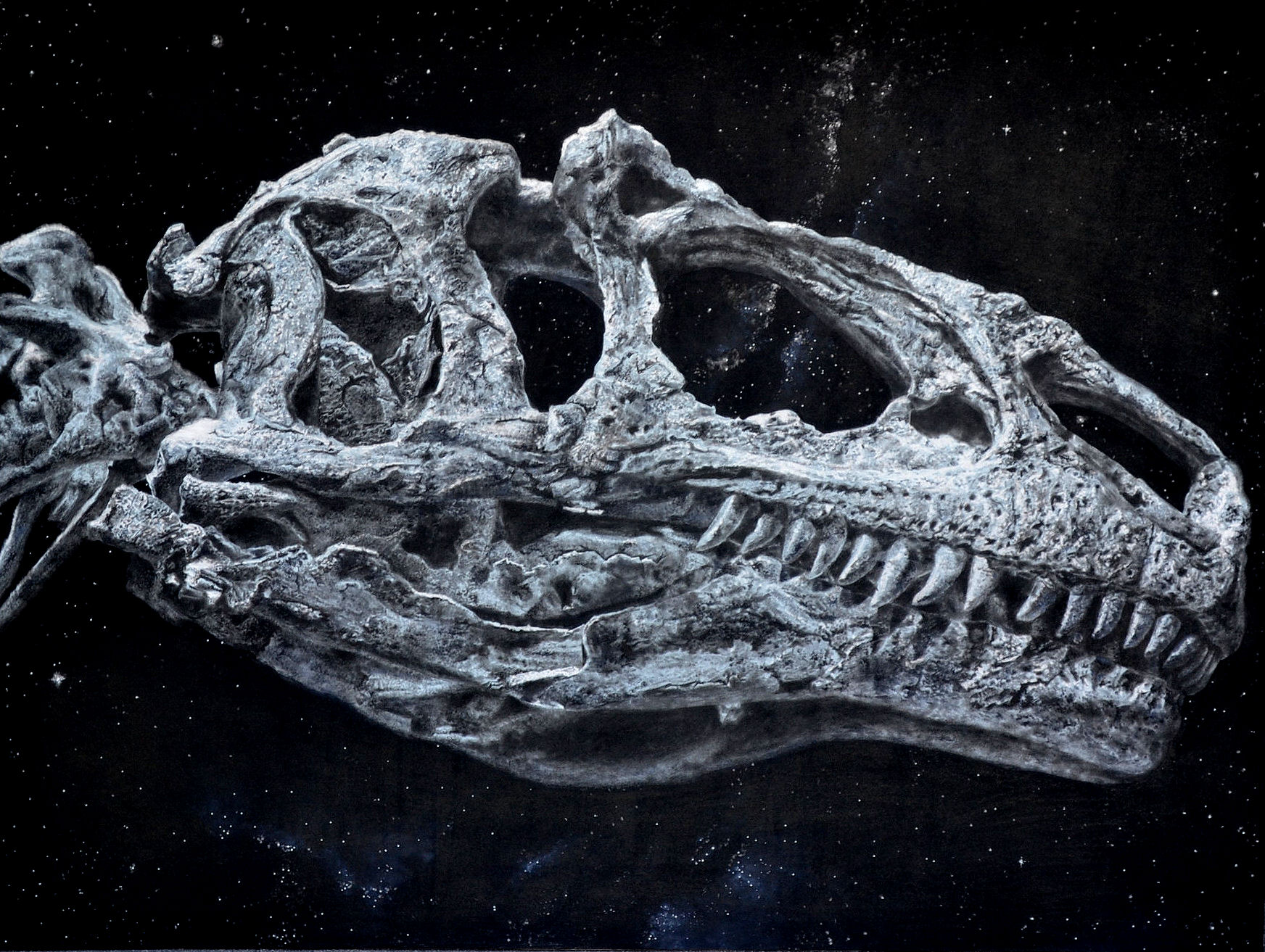
Contest details and entry forms: nhmu.utah.edu/contest
Images are from recent entries to this year’s contest. Courtesy Natural History Museum of Utah.

UTAH’S ART MAGAZINE SINCE 2001, 15 Bytes is published by Artists of Utah, a 501 (c) 3 non-profit organization headquartered in Salt Lake City, Utah.
Categories: Visual Arts