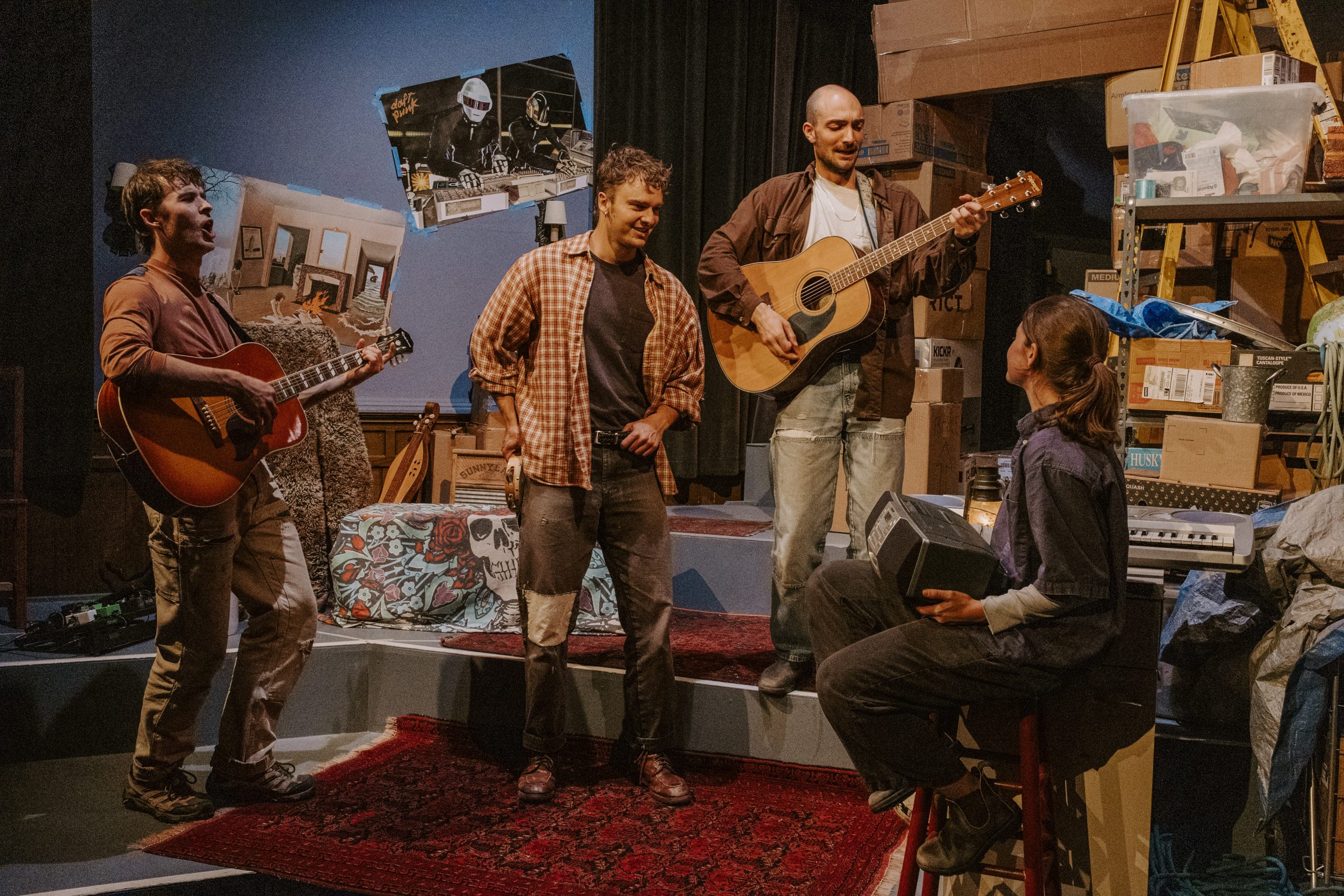
Left to right, Connor Johnson, Harrison Lind, Max Bastiani and Jessica Graham in Western Minerals and Their Origins. Image by Anna Chapman
When Western Minerals and Their Origins first appeared at the Great Salt Lake Fringe Festival in 2024, the creative team faced an unusual challenge. They would have just minutes to load in and out of a black-box theater, forcing them to imagine how a story rooted in Utah’s immense canyon country could be distilled into a compact, rapidly assembled production.
Two years later, the award-winning play has reached its largest stage yet.
Written by Utah playwright Connor Johnson and performed by Footpath Theatre Company in collaboration with Flying Bobcat Theatrical Laboratory, Western Minerals and Their Origins opens UtahPresents’ 2026–27 Stage Door Series at Kingsbury Hall with four performances Aug. 27–29. Rather than treating the move as simply a larger production, the artists have continued a process that has become central to the work itself: allowing each new venue to reshape the play.
“The seed of this play was our shared love of the wild spaces of Utah, particularly down in the Colorado Plateau,” Johnson says. “We wanted to capture the essence of how it feels to look at a great big sandstone wall and put it onstage.”
The play follows Ari, a young woman clearing out the garage of her late brother, an avid canyoneer. As the night progresses and the house prepares to be sold, the ordinary task becomes something far stranger. Objects accumulated over decades draw her into memories that blur with Utah’s geologic history, sending her on what the creators describe as a journey through “redrock, time, and her own memory.”
Part family drama, part environmental meditation and part theatrical experiment, Western Minerals asks how a stage can evoke places whose defining quality is their overwhelming scale—a question that has guided each new production.”I think the play has changed pretty dramatically while still holding on to its original soul,” Johnson says. “At the Fringe we were really just experimenting—how can we create a massive canyon in a tiny Black Box? Our set also had to be transported in and out of the space in 15 minutes,” he says, “so we were making design and story choices based on those parameters.”
When the production moved to Salt Lake Acting Company through its Making Space for Artists Grant last summer, the additional room allowed the creators to rethink the physical world of the play. “As a result,” Johnson says, “the play moved from a mostly imaginal plane, the contents of an old book, to a more physical, tangible one, the inside of an over-cluttered garage.”
Now Kingsbury Hall presents another opportunity. “As part of the UtahPresents Stage Door Series, the play is evolving again in accordance with the space, including the truly incredible vertical height available on Kingsbury Hall’s stage,” Johnson says. “As exciting as it will be to see it for the first time, I think there will be a unique pleasure for those who have seen each iteration of the piece, watching how it continues to reshape and change just like the canyons of our beautiful state (though in a much shorter time frame…).”

Connor Johnson and Jessica Graham, image by Anna Chapman
“Jess, Harrison and Connor’s love of hiking and climbing in southern Utah is at the heart of the play,” says Flying Bobcat co-founder and director Alexandra Harbold. “It’s thrilling to share that embodied connection with place within the supposed confines of a theatre space. The company spent a week in residence at Kingsbury Hall developing the production using Tectonic Theater Project’s devising technique known as Moment Work. “We each brought objects into the space (and a lot of boxes) to allow us to experiment, scaffold and score moments of sound, light, architecture, etc.”
For Robert Scott Smith, another Flying Bobcat co-founder, Kingsbury Hall offers more than simply additional square footage. It mirrors the landscape that inspired the play. “Having seen earlier versions of the piece, we all felt there was more story to discover,” Smith said. “When Stage Door came up, it immediately felt like, ‘Oh…this is the next version.’ Not because we wanted to make it bigger just to make it bigger, but because the story deserved another chapter.” He says the collaborative process encourages the artists to keep asking, “‘What else is in this story? What haven’t we found yet?’ That’s a really fun place to create from.”
The scale of Kingsbury Hall also resonates with the play’s setting. “When I think about Utah, I think about scale,” Smith says. “Red rock. Cliffs. Open sky. Landscapes that make you feel wonderfully small. This story belongs in a space that has that same sense of possibility. Between the creative team at UtahPresents, Footpath’s process, and Flying Bobcat’s approach, it feels like we get to fill that space with something that’s both intimate and epic at the same time.”
Since premiering at the Great Salt Lake Fringe Festival, where it won a Best of Fringe award, Western Minerals and Their Origins has continued to evolve through each successive production. This Kingsbury Hall engagement marks what the creators describe as the culmination of three years of development—and perhaps the beginning of a wider life for the play. “We want to tour this piece, regionally, nationally, and internationally,” Johnson says. “We believe that this piece could connect with any audience, paying forward the sense of awe and wonder that these places have given to us.”
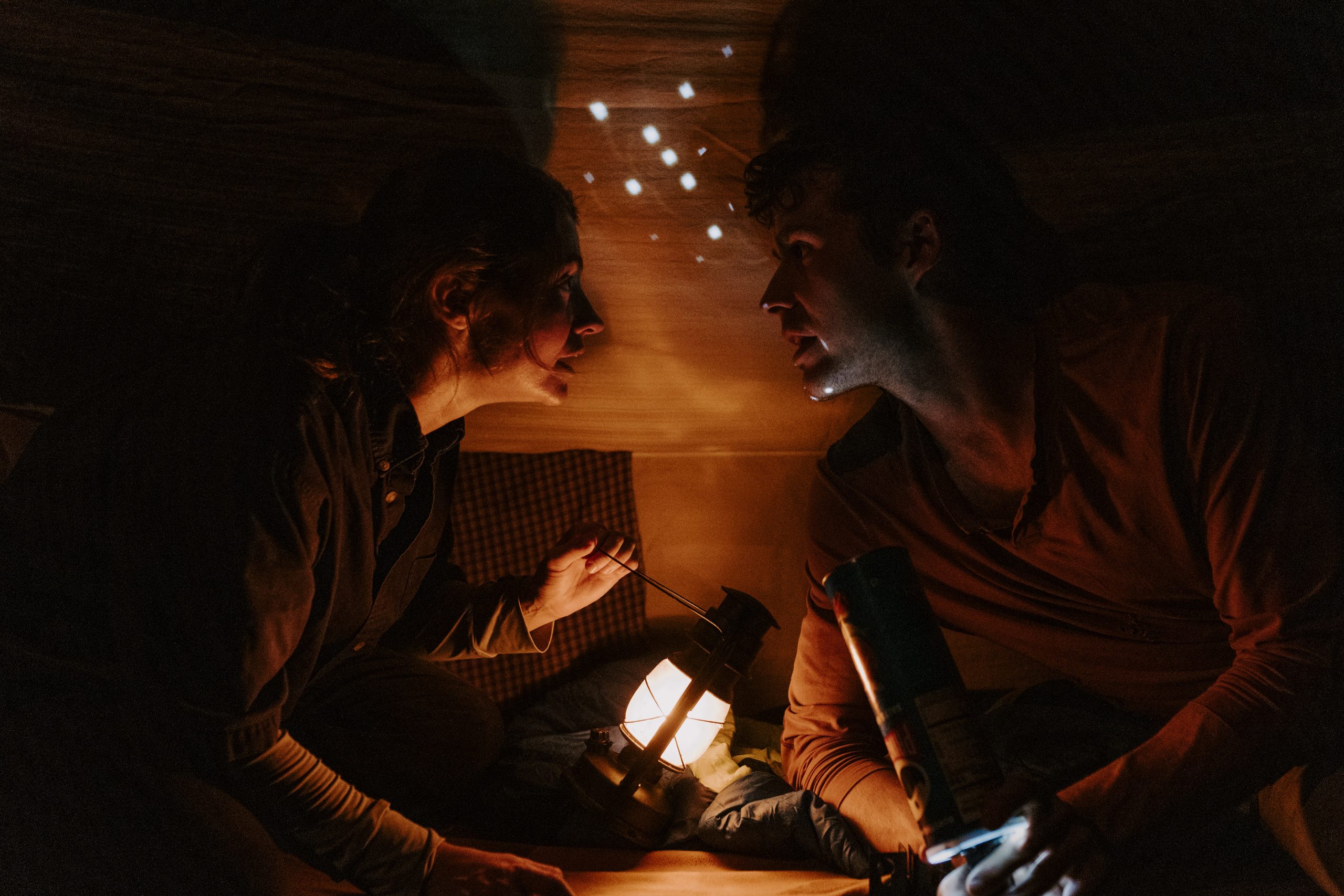
Jessica Graham and Connor Johnson, image by Anna Chapman
Western Minerals and Their Origins by Footpath Theatre Company, Kingsbury Hall, Salt Lake City, Aug. 27-29. Tickets: https://www.utahpresents.org/

UTAH’S ART MAGAZINE SINCE 2001, 15 Bytes is published by Artists of Utah, a 501 (c) 3 non-profit organization headquartered in Salt Lake City, Utah.
Categories: Theater