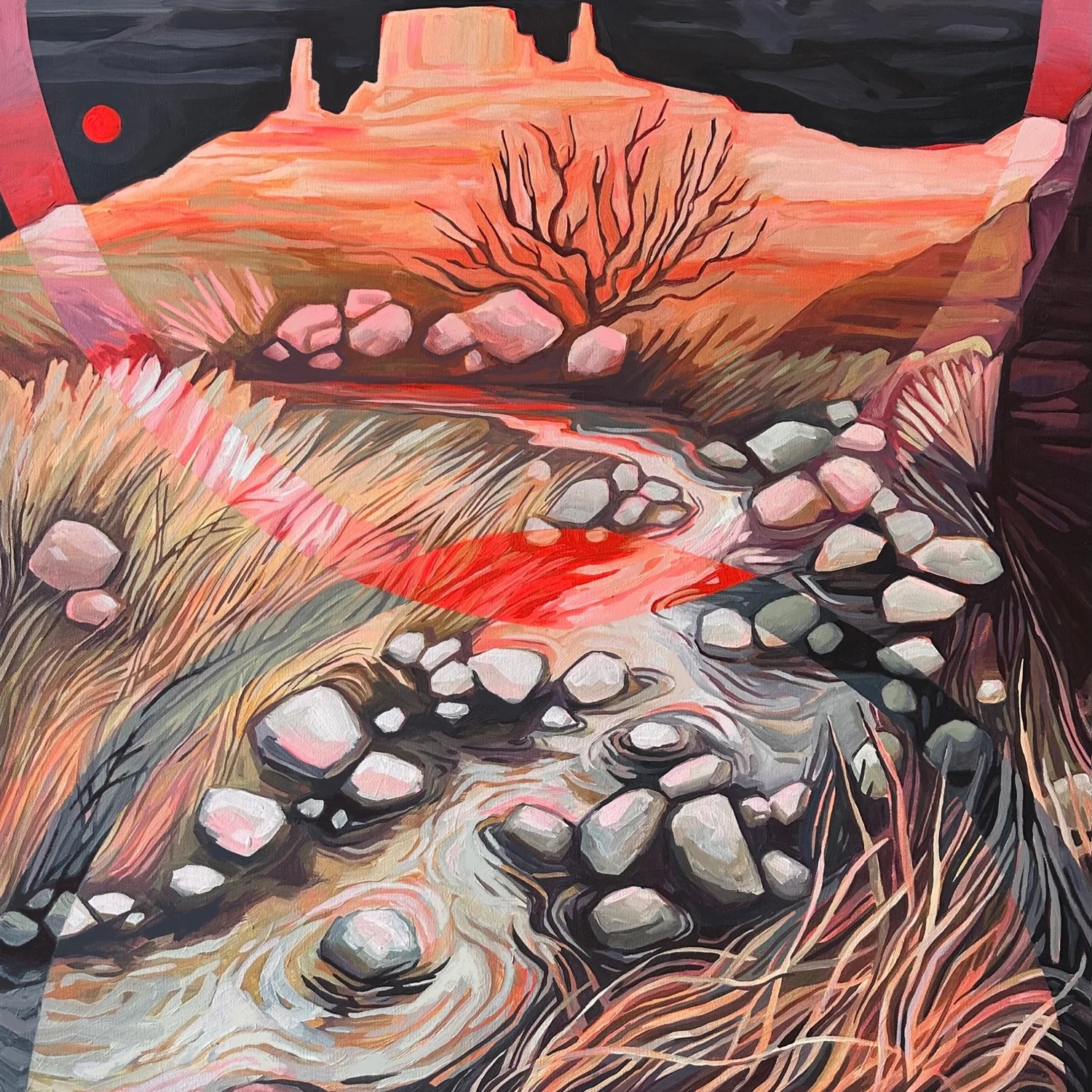
Caro Nilsson, “Water in the Desert, Gathering Storm,” 2025, acrylic and gouache on canvas, 30×30 in.
“There are hills, rounded, blunt, burned, squeezed up out of chaos…Between the hills lie high level-looking plains full of intolerable sun glare, or narrow valleys drowned in a blue haze…For all the toll the desert takes of a man it gives compensations, deep breaths, deep sleep, and the communion of the stars…It is hard to escape the sense of mastery as the stars move in the wide clear heavens to risings and settings unobscured.”
In her essay collection The Land of Little Rain, Mary Hunter Austin (1868–1934) paints a vivid picture of the landscape of the American West as both a place and a character: one defined by, and made discoverable through, personal observation. Austin dedicated much of her life to this contemplation, studying the signs of the land and rendering them into lyrical, attentive prose. Her writing suggests that to know a landscape is not simply to see it, but to look at it with practiced eyes.
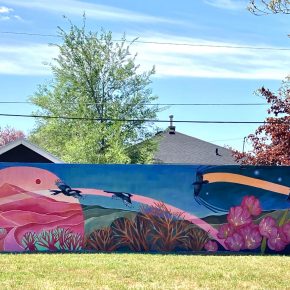
Carrying a similar spirit of the unrestrained eye, Salt Lake City-based painter and muralist Caro Nilsson invites slow looking, close observation, and an embrace of simultaneity in I Pulled My Shadow Into The Meadow, With the Sun. Its title places visitors somewhere timeless and wholly natural, inviting reflection on the offerings of the land.
Nilsson’s paintings are abundant with flowing brushstrokes, accumulating rhythm and movement across the canvas. Though grounded in the visual language of traditional landscape—boulders, placid animals, thin horizons of earth and water—the compositions are unmistakably untamed. Color moves almost centrifugally by way of hot mesa orange, muted wisteria, dusty ochre, and touches of almost synthetic neon pink (a rare, but not impossible, natural occurrence). These colors animate the land, allowing familiar elements of Western landscape to slip into a more reflective, psychological state.
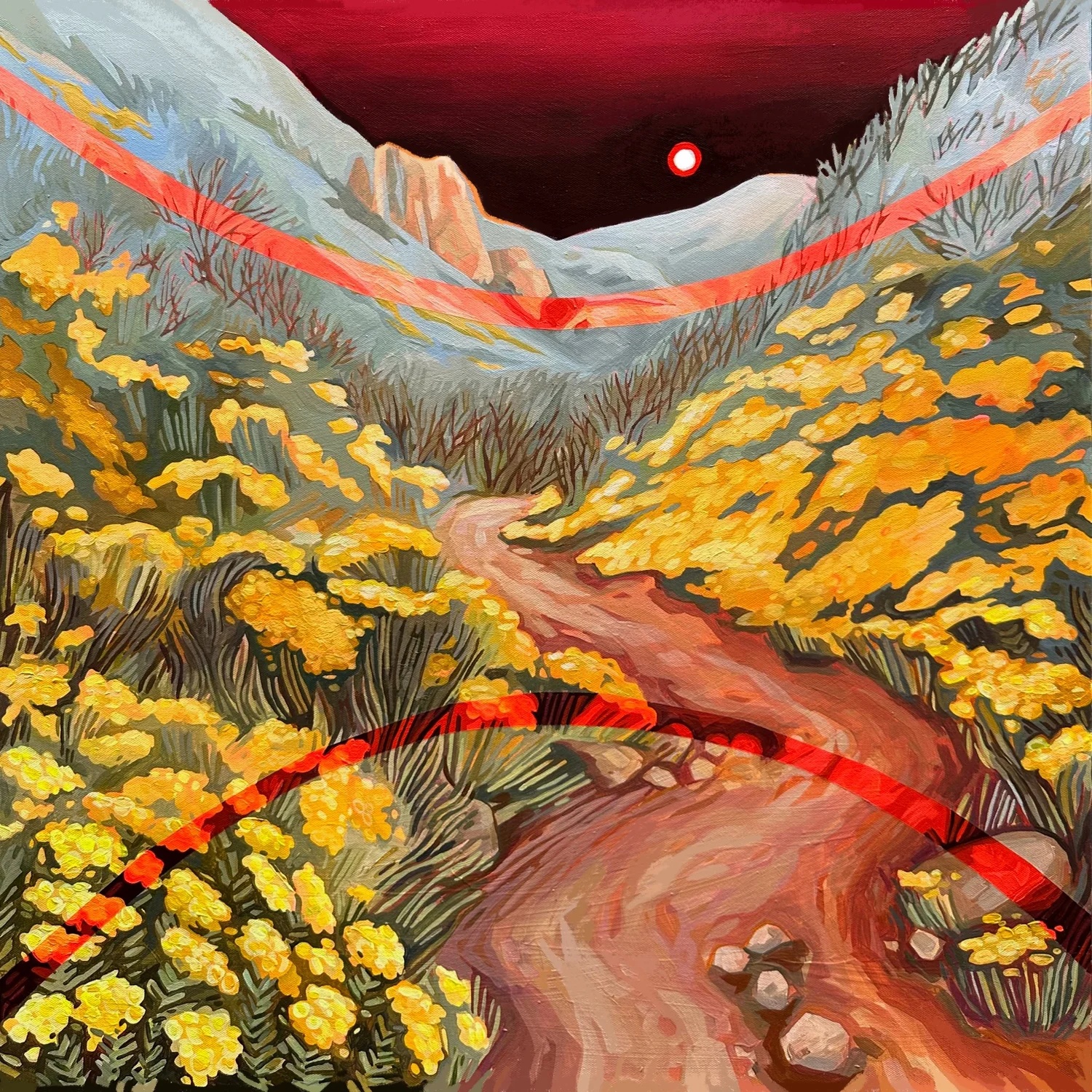
Caro Nilsson, “Myrtle Spurge in the Understory,” 2025, acrylic and gouache on canvas, 30×30 in.
Each piece carries the sensation of being somewhere and yet nowhere at all. Nilsson’s recent work engages with this nebulous state of being through what she calls the idea of “boundary places,” a concept that shares its roots with liminality and transition. These are landscapes that are, in the artist’s own words, painted from and by memory, and resist fixed coordinates or photographic reference. Through imagined geography, Nilsson approaches the psychological dimensions of landscape directly. After all, landscape painters can spend their entire career exploring how the exterior world becomes an expression of interiority.
Consider the painted myrtle spurge, a highly caustic plant, occupying the foreground of “Myrtle Spurge in the Understory.” In the corner of that same painting, a red-hot sun rages against a black sky. The landscape seems to slip free from human organization and cultivation. Grass thrashes like hair, wildlife assumes dominion, and death is as sure as water. Nilsson’s natural world is no less realistic than the one across the highway, but it reveals the beauty within the lawlessness. Each painting is a collision of beautiful, even violent, things.
Nilsson’s background in printmaking (B.A., University of Virginia) informs her approach to layering and tightly considered image composition. In more than one painting, negative space becomes a tool for shifting perspective, allowing the eye to move between foreground and background. The layers of paint communicate with one another: translucent spreads of red settle over earthy blues and greens, creating an effect reminiscent of a camera’s polarizing filter. When Nilsson paints an arc of sunlight or traces the flight path of a bird’s wingspan, it is as if she is opening up a photographic exposure, allowing her audience to see into a window of simultaneous day and night.
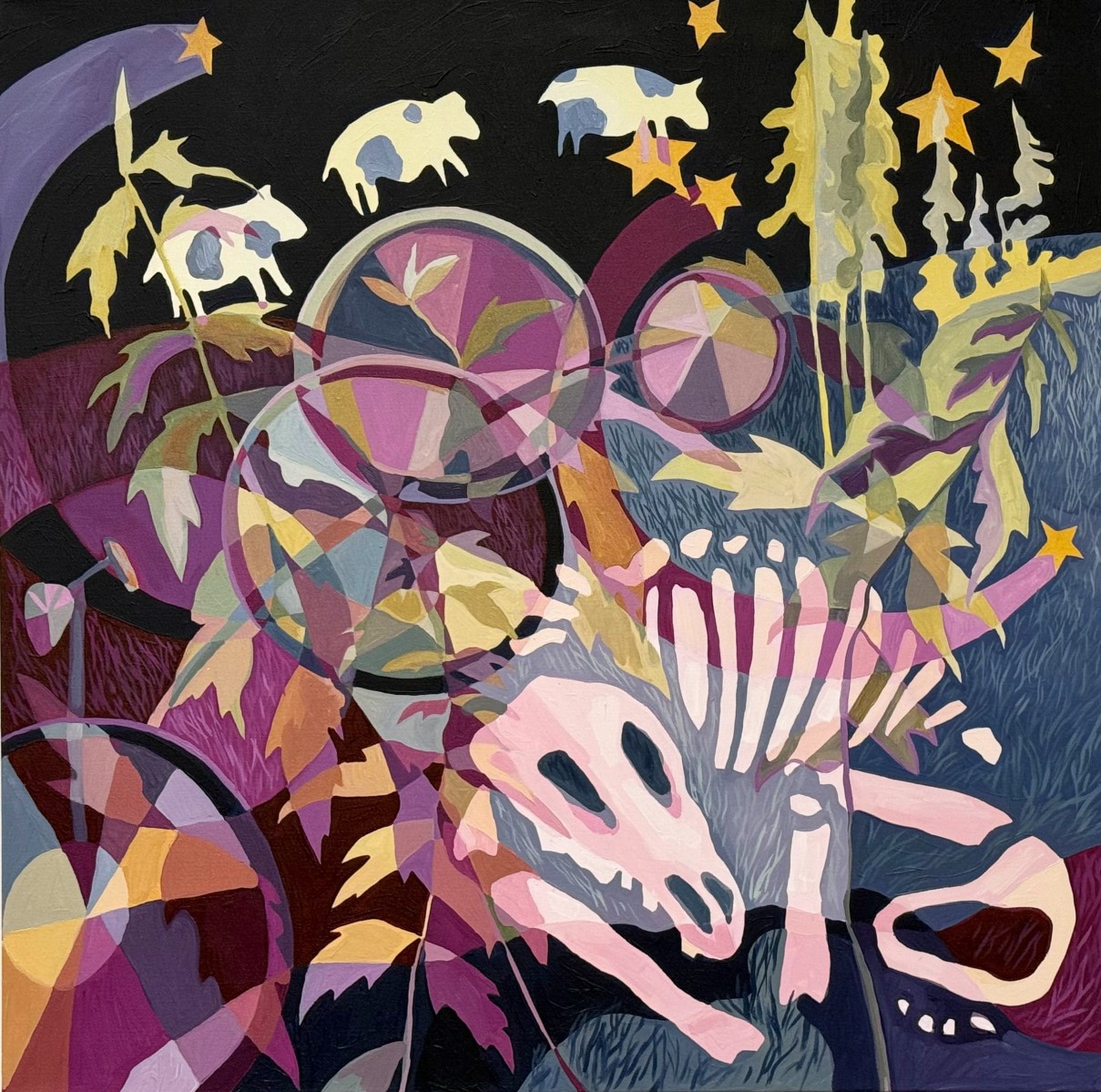
Caro Nilsson, “Sky Cows, Bones Beneath,” 2026, acrylic and gouache on canvas, 30×30 in.
Rather than capturing the landscape in a single instant, Nilsson gathers several into one image. Light, and equally, darkness, become her subjects, and she makes it a priority to depict their effects on the surface of the land. In a few instances, and perhaps consciously, Nilsson places viewers directly before a path, asking them to follow its intrinsic visual cues or consider how darkness might affect their willingness to wander. In this way, viewers are always bringing their own associations and sensations into the painted landscape.
Animals in Nilsson’s work–canine figures, birds in flight, and hooved skeletons–serve as witnesses to the changing land they occupy. Even as bones, half-submerged in the sea of grass, they mark time’s steady passage. Looking at “The Random Walk of Light,” it’s hard not to imagine the familiar scene of a skull at night, reclining in the moonlight beside a cactus and a tumbleweed. The images feel less like Western tableaux than meditations on the land’s indifference to the boundaries between life and death.
Nilsson speaks poetically about the land, but her paintings also demonstrate her deep trust in the act of looking. She trusts her own ways of seeing and similarly trusts the eyes of her audience to take time to uncover revelations of their own. Her paintings leave open the possibility of several things being true at once: day and night, beauty and hostility, life and death, suffering and joy. More importantly, her landscapes are places where emotional contradictions can exist without demanding resolution.
Perhaps this is exactly the appeal of boundary places—their capacity to hold seemingly opposite things in coexistence. Nilsson seems interested in what happens when observation becomes entangled with emotional vulnerability, memory, and imagination. The viewer brings these experiences to the landscape, even as the landscape unfailingly changes what can be seen. A joyful day can still carry the painful night. One can stand in the meadow with the sun and still carry one’s shadows.
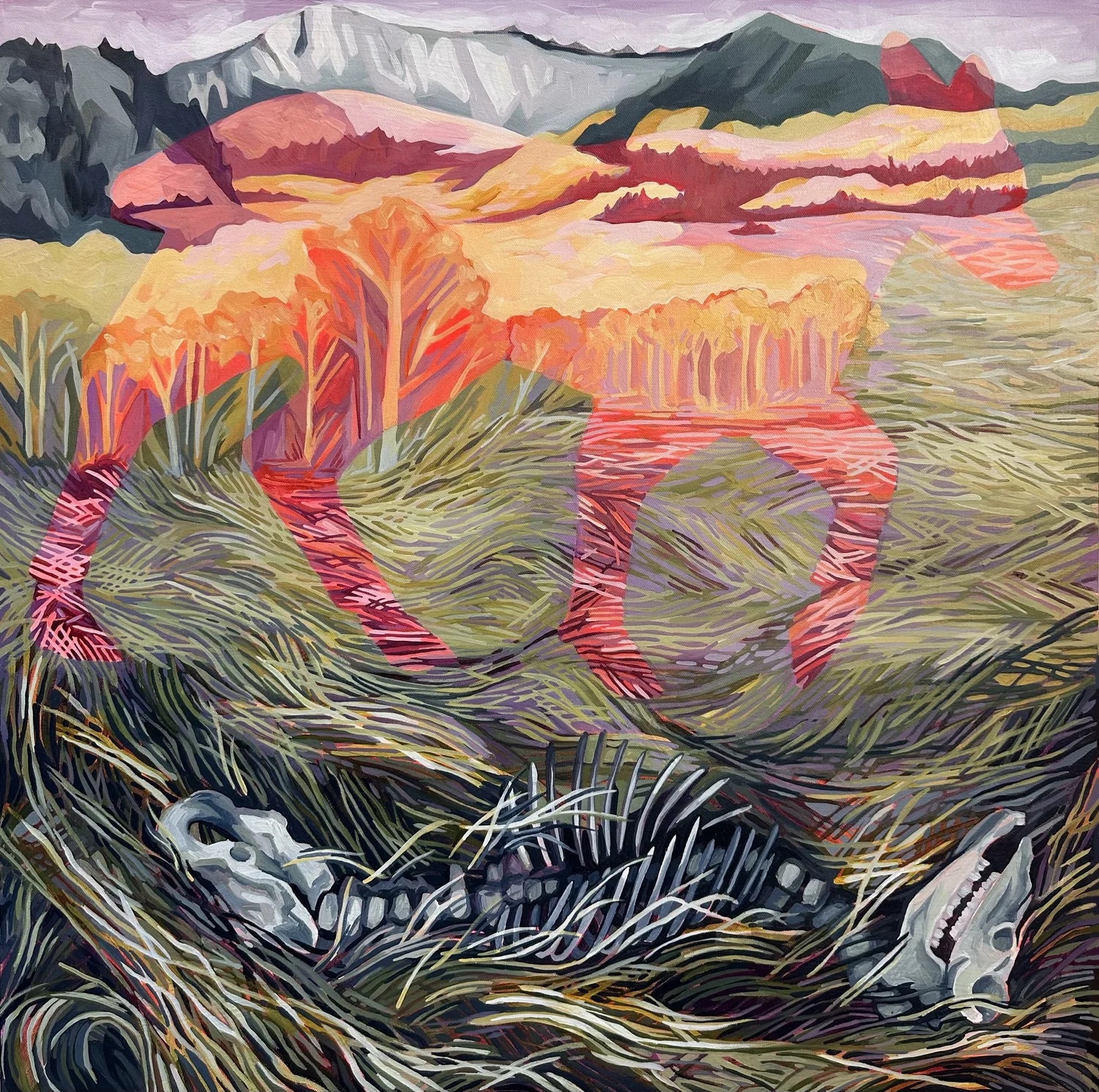
Caro Nilsson, “The Random Walk of Light,” 2025, acrylic and gouache on canvas, 30×30 in.
I Pulled My Shadow Into The Meadow, With The Sun, Gallery at Library Square, Salt Lake City through January 8, 2027.
Anna McIllece is a writer and visual artist from central Alaska who lives and works in Salt Lake County, Utah. She holds a BFA in Fine Art from Brigham Young University and approaches art through both studio work and critical inquiry, investigating outsider art, the ancient and cosmic, human ritual, and folk tradition. Forever drawn to the unsettling, she examines how folklore persists and reemerges within contemporary life.
Categories: Exhibition Reviews | Visual Arts