Alison Spencer never thought turkey vultures were particularly attractive. She knew they were important, and recognized that the king vulture is striking, but our local turkey vultures were, as she puts it, “common and plain, even ugly or scary to a lot of people.”
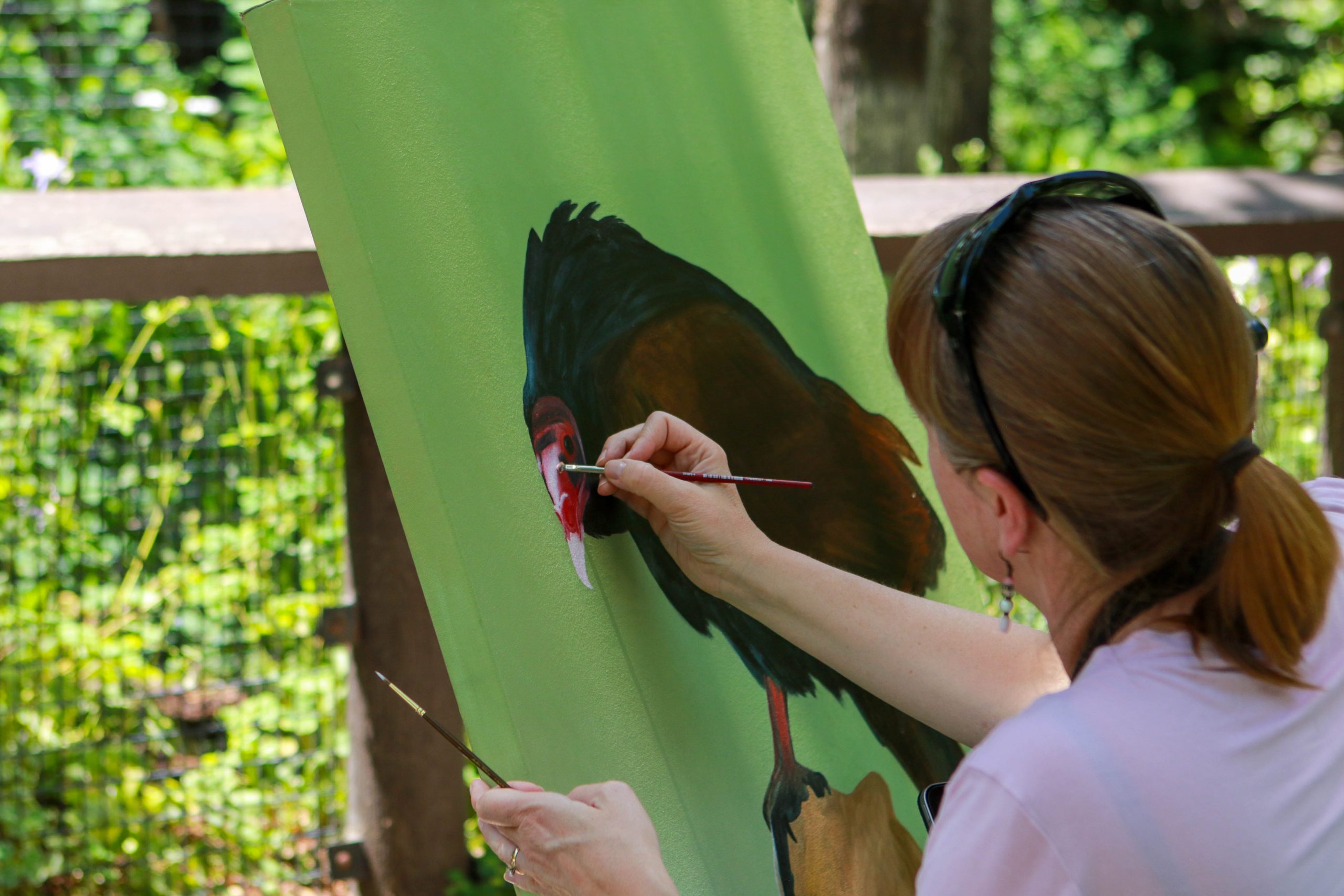
Then she spent four months sitting with one.
Spencer arrived at Salt Lake City’s Tracy Aviary in June as an artist-in-residence, charged with doing something she already loved: looking at birds and painting their portraits. She knew the aviary well. Her mother grew up in the neighborhood, and when the family traveled to Utah to visit grandparents, summer walks often took them there. “But, like most people, I’d never really spent time sitting and soaking it in,” she says. “I don’t know if the body of work is that different from what I planned, but the experience was infinitely different.”
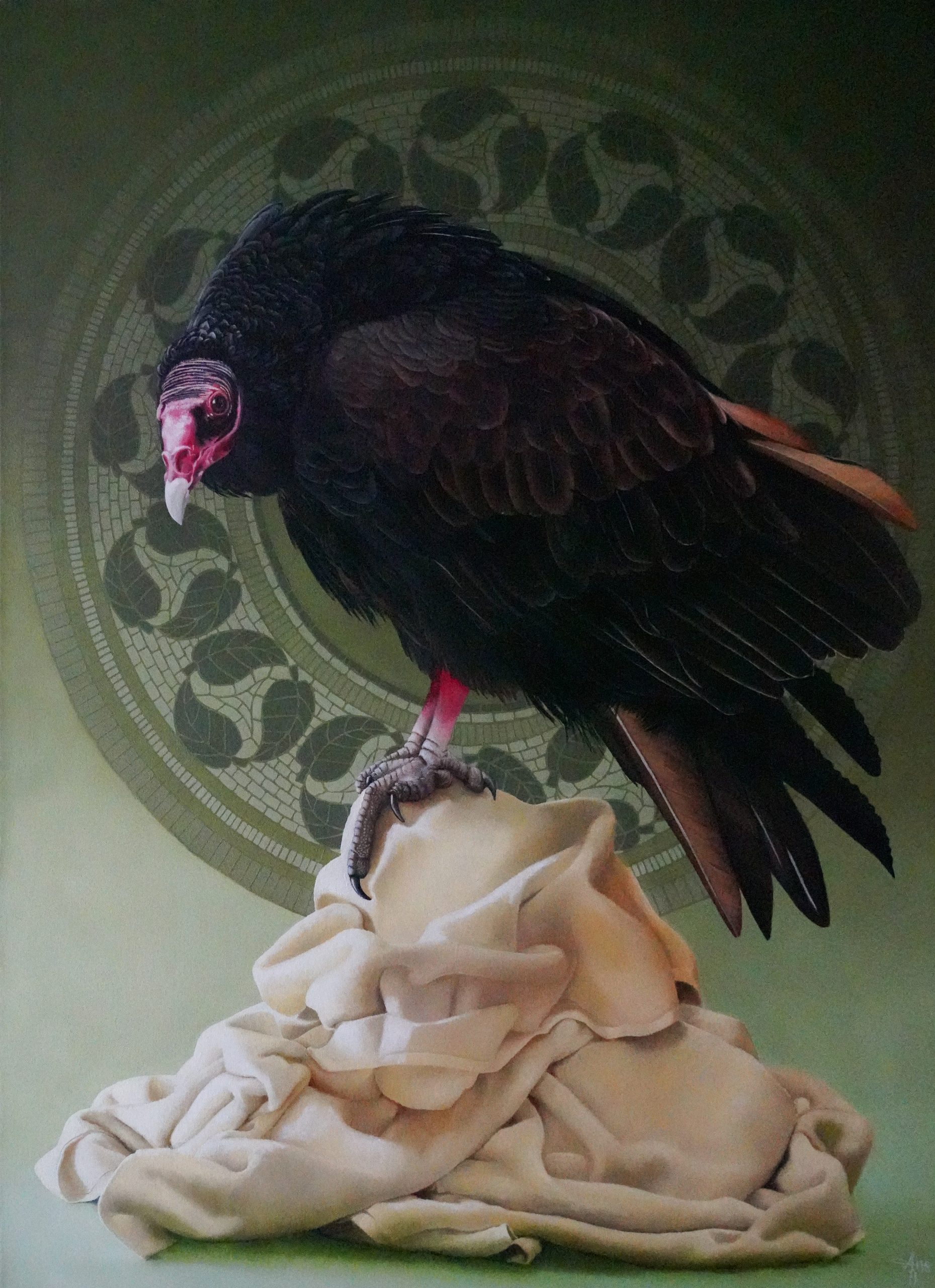
“Sitting and watching the turkey vulture at the Aviary for hours on end—I now think she’s one of the most beautiful birds I’ve ever seen,” Spencer says. “She’s a little shy, but gentle with the hawk she boards with; she spreads her wings wide to catch both raindrops and sunshine.” The paintings Spencer made during her residency are now on view at Tracy Aviary’s Chase Mill, Oct. 26-31.
“Portraiture of anything is wonderful in that way,” she says. “I’m not sure there’s a way to paint a portrait without falling in love with your subject or the person you’re painting for; there’s just too much beauty in individuals, and you notice it more and more the longer you look at someone.”
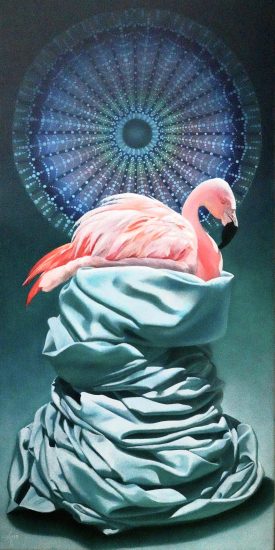
In her portrait of the turkey vulture, the bird stands atop an extravagant heap of pale fabric while a circular mosaic spreads out behind her like a halo. She has been staged as one might stage a wealthy patron. “I realized early on that I didn’t want to paint birds in nature,” Spencer says. “I want them to stand out, I want people to see them individually, like royal portraiture; I worry that it’s easy to dismiss them in natural settings as just another bird or part of the scenery.”
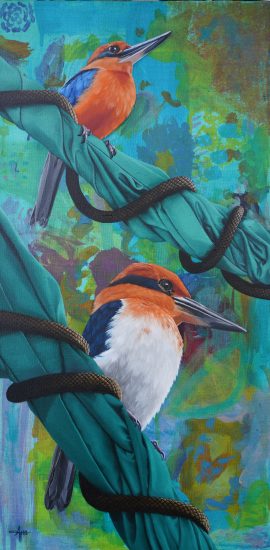
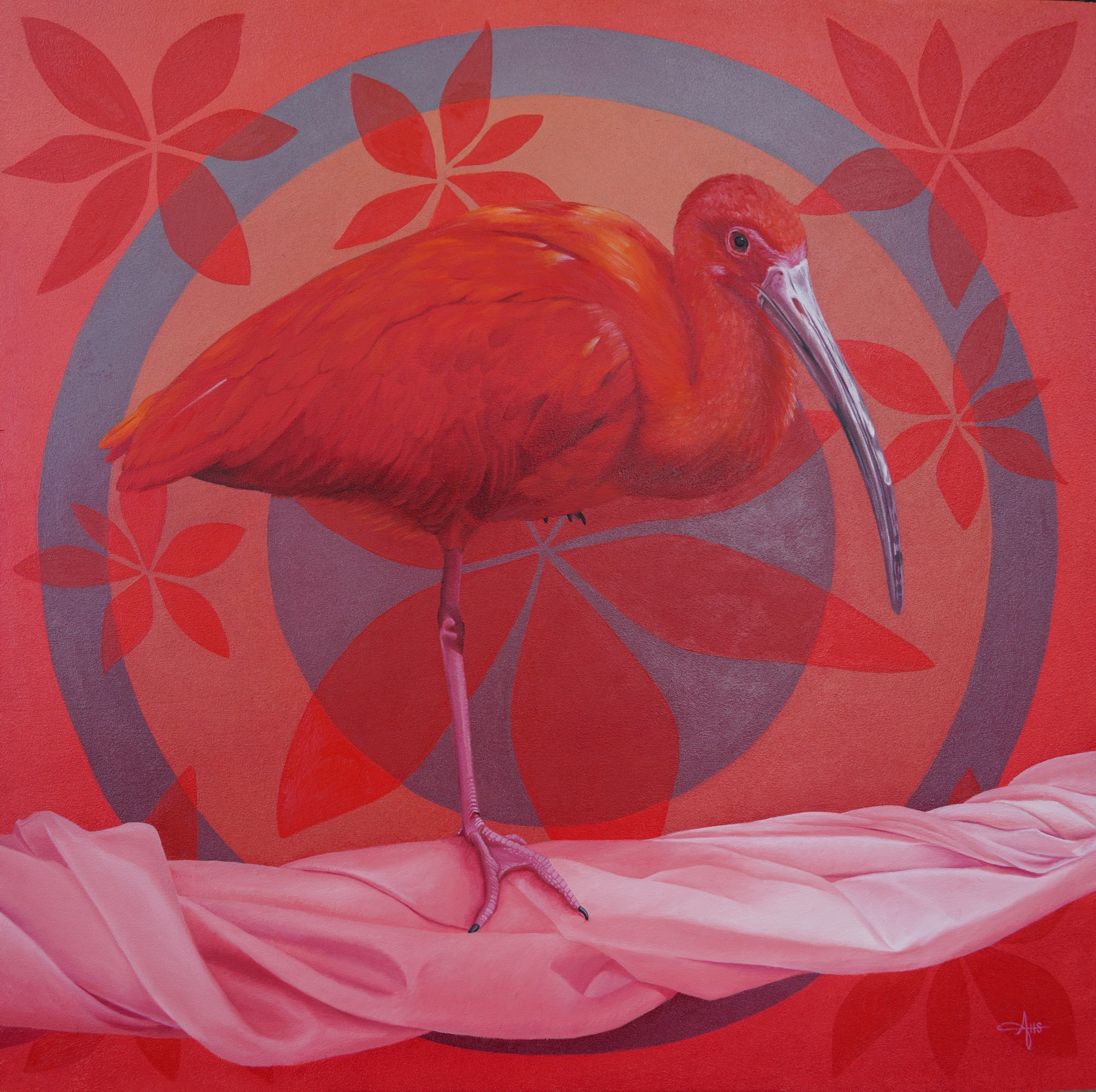
In her work, three king vultures emerge from a black ground, wearing laurel wreaths around their brilliantly colored heads. A scarlet ibis inhabits an almost entirely red world, perched on folds of pink fabric before a decorative arrangement of leaves and circles. Elsewhere, two Sihek kingfishers perch on bundled green fabric while brown tree snakes wind around them. The snakes are the invasive species that wiped out the Sihek in the wild on Guam.
“I learn as much as I can about the birds before I paint them,” Spencer says. “Then I try to incorporate natural elements in unnatural ways—like in the wallpaper or mosaic—and man-made elements in natural ways.” The result can be whimsical, but she also means it as a symbol of “our tendency to destroy what is natural with the idea that we can replace it with something better, which never works out well.”
Spencer hadn’t arrived at the residency with much of a plan. She saw an Instagram post containing the words “Tracy Aviary” and “art” and applied, she says, “before I had any idea what the job entailed.” She began with the superb starling, partly because it made the decision for her. The bird was curious about her from the first day—“small enough to paint fast, and intrusive enough that I didn’t have to think too long about how to paint him.” After that, the choices got harder. “People ask me all the time what my favorite bird is, and it’s always whatever bird I’m painting or watching at the moment,” she says. “I have dreams of painting them all, but I’m such a slow painter, and an even slower thinker.”
Much of the residency came down to looking. Spencer makes her own students draw from life, “not because photos aren’t useful, but because they leave out too much information.” Watching an animal over hours shows you its natural movements and individual quirks. It also shows you what a painting can’t hold. Spencer has long wanted to paint the sandhill crane but hasn’t yet. “It’s the elegance in their movement that makes them so beautiful,” she says, “and I feel inadequate trying to capture that in a single frame.”
“After listening to the beautiful but painfully loud macaws for four months, I’ve discovered I’m more of a vulture person; vultures don’t have vocal cords!” she says. “And if I was a bird that had to share an enclosure with a kookaburra, I would eat it to make the noise stop.”
She did look forward to the southern ground hornbills conversing in the morning. They have, she says, “deep, hollow calls like someone blowing into a half-filled bottle.”
Conversations with keepers and trainers opened another dimension of the birds’ lives. She learned that flamingos make excellent partners and parents, and that southern ground hornbills must learn through experience how to build nests soft enough to protect their eggs. She also learned that the disappearance of vultures has consequences far beyond the birds themselves: without them to consume diseased carcasses, dogs and rats take over the job, bringing disease back into human populations. “We like to think we can get rid of things we consider ugly without affecting things we consider beautiful,” Spencer says, “but we can’t.”
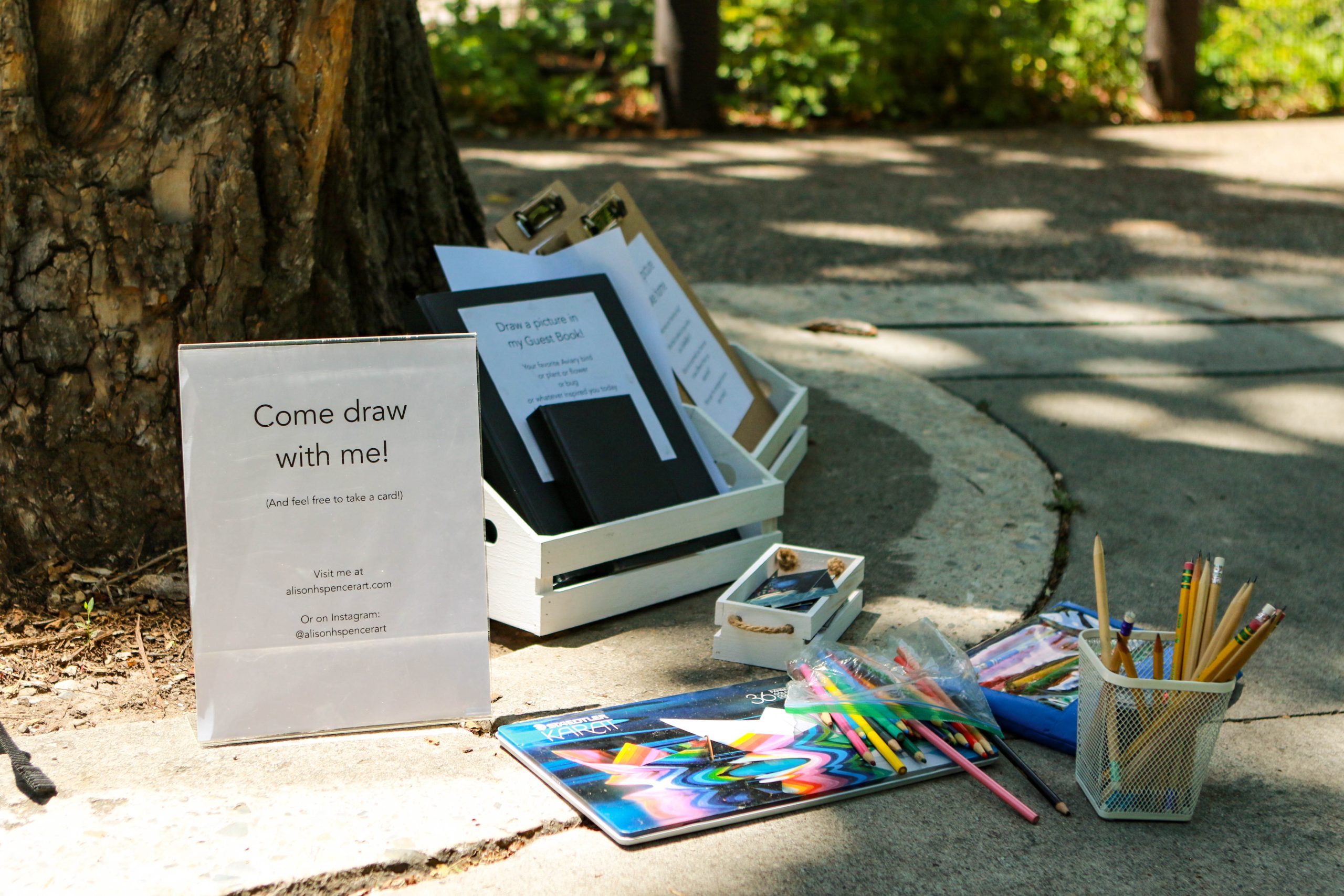
The longer she sat, the more she wished other people would sit with her, and sometimes they did. One guest, she recalls, told her, “It’s like we’re all being chased, and we’re running so fast all the time, but when we take a moment to slow down and sit like this we realize nothing is actually chasing us.” “People are lonely,” Spencer says. “Sometimes sitting still invites people to sit and share things they’ve longed to share with someone, about birds and art a little, but mostly about a lot of other things.”
Spencer grew up birding with her father. Now that he’s in his eighties, she takes him. “The world’s bird population is half what it was when I was born,” she says. “It’s been shocking and discouraging to return to places we frequented when I was young: where there were abundant bird populations then, it’s difficult to find birds today.”
“I struggle with hopelessness about the world in so many ways, and it makes me withdraw,” she says. “I think my paintings have become my hopeful, albeit tiny, contribution to make the world better.” She is candid about the risk that comes with that. “I’m not sure I have successfully avoided reducing the paintings to illustrations of an environmental message. But I don’t like showing my paintings without the stories that made me want to create them.”
“We rush so much that we forget how beautiful the world is,” she says. “Spending time observing anything living helps us understand them better; understanding leads us to love them, and love leads to doing what needs to be done to protect them. How much harder is it to step on an anthill after you’ve spent 30 minutes watching the ants struggle and work to carry your bits of potato chips into it?”
Alison H. Spencer, Tracy Aviary, Salt Lake City, Oct. 26-31. Reception: Friday, Oct. 30, 5:30-7:30 pm.
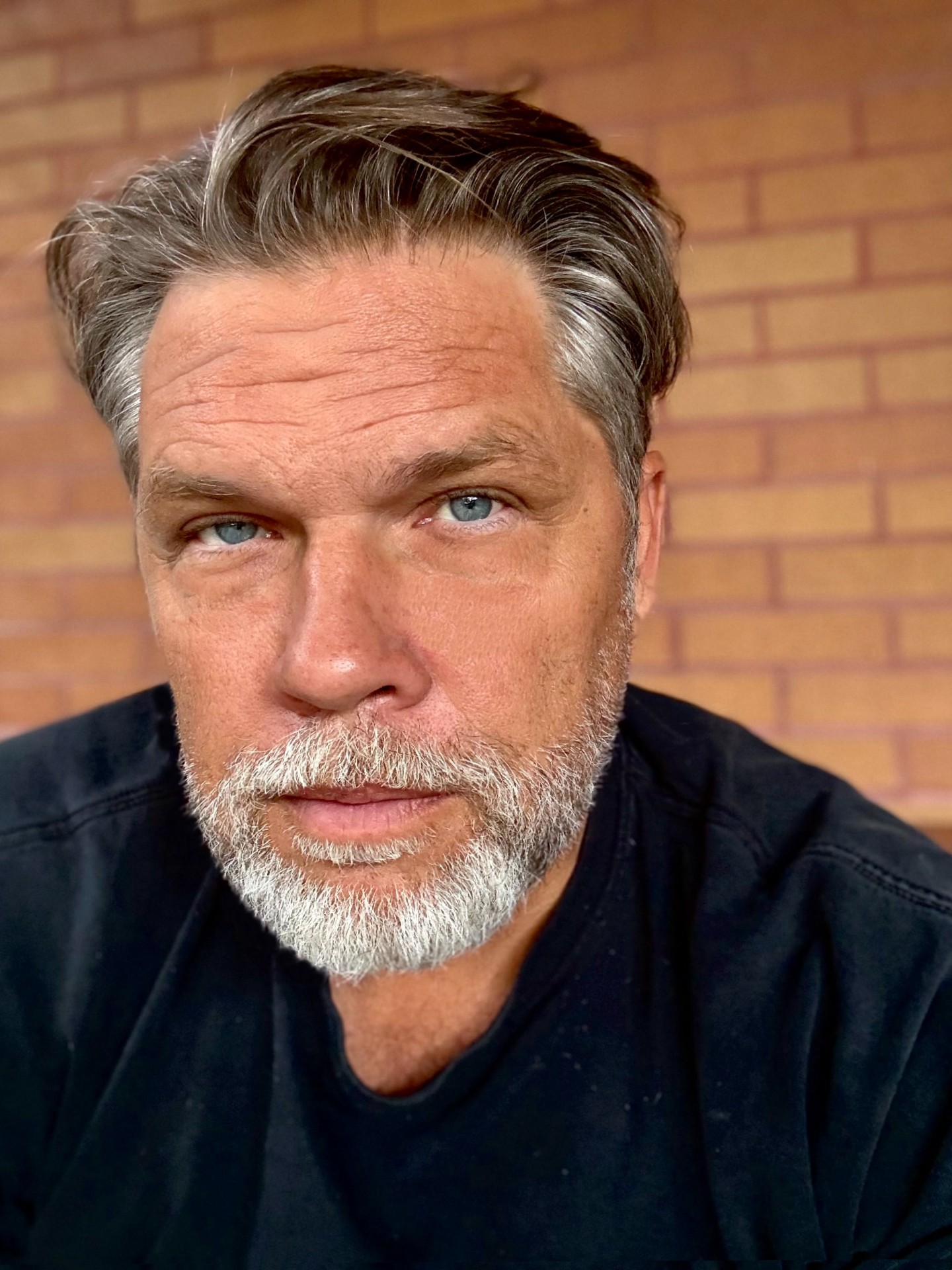
The founder of Artists of Utah and editor of its online magazine, 15 Bytes, Shawn Rossiter has undergraduate degrees in English, French and Italian Literature and studied Comparative Literature in graduate school before pursuing a career in art.
Categories: Artist Profiles | Exhibition Reviews | Featured | Visual Arts