 In 2001, as the University of Utah prepared the George S. Eccles Legacy Bridge for its Olympic debut, a copper skier statue called “Go for the Gold” went in near the bridge’s west stairwell—donated, not commissioned, by private donors. At the time, a university representative told the Daily Utah Chronicle that the U wasn’t particularly interested in erecting statues commemorating men. Twenty-some years and one more Eccles later, the university’s business school has installed a monument that doesn’t just commemorate a man but narrates his rise in bronze relief, with supporting cast members (the oxen, the spools, the thistle) and a ribbon-cutting attended by four generations of his descendants.
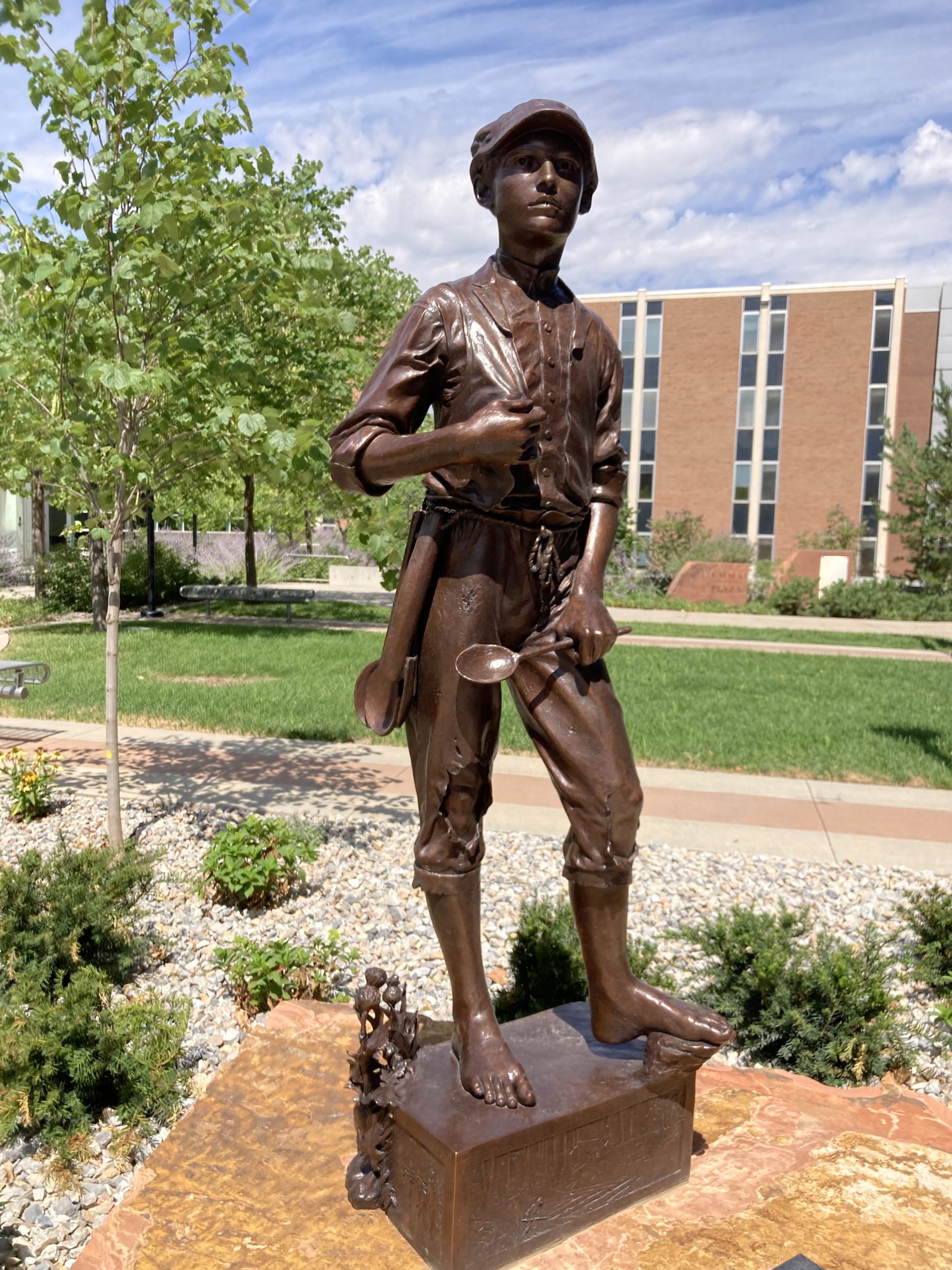
Last September, outside the Spencer Fox Eccles Business Building, the David Eccles School of Business unveiled a new bronze: a barefoot 14-year-old boy, a coil of rope at his waist, hauling his blind father’s carved wooden spoons and rolling pins down Ogden Canyon to sell. The boy is David Eccles, who would go on to found more than fifty companies, become president of seventeen corporations and seven banks, and die, mid-sprint, trying to catch an evening train from Salt Lake to Ogden. He was Utah’s first multi-millionaire.
The statue does not depict any of that. It depicts him poor.
This is, dean Kurt Dirks explained at the unveiling, the point. Eccles is shown “not at the height of his success, but as a young man, when he was just getting started”—a reminder to business students, most of whom will presumably arrive on campus with more resources than a lathe and a rope belt, “of what is possible, regardless of where you start.” University president Taylor Randall struck a similar note, calling the statue a reminder of what can be accomplished with “curiosity, grit, creativity, and an entrepreneurial mindset.”
It is, in other words, a Horatio Alger statue: less a monument to a man than to an idea about men, cast at business-school scale.
This is, dean Kurt Dirks explained at the unveiling, the point. Eccles is shown “not at the height of his success, but as a young man, when he was just getting started” — a reminder to business students, most of whom will presumably arrive on campus with more resources than a lathe and a rope belt, “of what is possible, regardless of where you start.” University president Taylor Randall struck a similar note, calling the statue a reminder of what can be accomplished with “curiosity, grit, creativity, and an entrepreneurial mindset.”
The 2001 statue arrived as an unsolicited gift; this one commemorates the family whose name is on the building behind it, unveiled by four generations of Eccles descendants. Whatever the university’s stated appetite for bronze men was in 2001, it has clearly found room for at least one more.
The business school’s statue isn’t the family’s first crack at this story. An earlier version — same 14-year-old boy, same relief panels of oxen and rail lines, same thistle for the family’s Scottish origins — already stands in Eden Park in Eden, Utah, near where the Eccleses settled in 1863, with language nearly identical to what the university now uses. A third telling, in the form of a mural, commemorates the family’s banking legacy at the Wells Fargo Center downtown. The George S. and Dolores Doré Eccles Foundation has a house style for this story, and it travels well — to a plaza, a mural, a business-school lawn.
Whether students walking past it each day absorb the intended lesson about grit and self-reliance, or just register it as another piece of building signage, is anyone’s guess. Either way, David Eccles — barefoot, blind father’s rolling pins in tow — is now a fixture of the Eccles School’s landscaping.

With our In Plain Site byline we feature publicly viewable art, both official and street art, throughout the state of Utah.
Categories: In Plain Site | Visual Arts