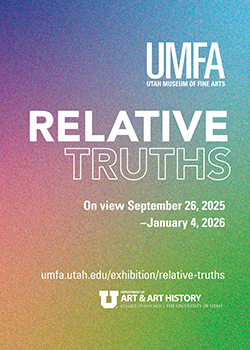
How do we know? How can we know? Where does knowledge come from? Whether in lectures, blogs, interviews, books, or, of course, art works, hardly a day goes by that the question isn’t asked. Then again, there can be little doubt that much of the conflict and violence that troubles the world’s discourse today could be assuaged if humankind knew the answer—if we could agree on what we actually do know and focus on finding out the things we don’t know, but should.
This question came to mind while reading the statement Emmaline Russell made in connection with her luminous landscape diptych, “Transparence,” which was shown at BDAC recently. “I am inspired by the parallels between geological time and the brain’s perception of time, and how both of these change and affect the way we remember landscapes,” she began. So she invokes the contrast between the vastness of geologic time and a brief moment of synaptic activity in the brain’s response. Surely a lifetime could be spent contemplating all of what that distinction entails. That said, she also suggested something more narrow. An artist’s inspiration only becomes art when the artist’s skill gives it physical form, so that the result nests the idea within its execution. Every work of art, even the supposedly conceptual ones, requires the artist to relate the execution to the intention. Russell chose to create an image of a sight familiar to anyone who chooses to dwell in nature, and to do it through the medium of countless vertical lines in subtly shifting shades of yellow and black. These lines may suggest the rays of sunlight pouring through the trees and dappling the ground beneath, or the rain that is essential to both living things and sculpted earth. Whether such thoughts are conscious or not, this superb choice of technique gives the viewer’s mind an adventure in perception, in assembling sensation and perception during the instant before the image snaps into view in the mind and rewards it with a satisfactory experience: one that takes that viewer back to childhood, when the eye and mind were busy discovering the necessary connection between what the world looks like and what is true of it. There hangs an excellent example of how we know what we see.
 Another artist who chose her approach wisely is Claire Taylor, whose “Cemetery Tree Felled in the Windstorm II” employs watercolor and colored pencil to play in a knowing way with time. When most itself, watercolor is another form of drawing—the most direct path from experience of the real world, through the artist, and into the work of art. When used in this way, the wet color dries to reveal its transparency and its fragility. It’s not necessary to have painted for oneself in order to feel how quickly, indeed instantly, the color was applied. Here the fallen tree has been sawn away, exposing its interior and leaving the torn roots exposed. We see the broken bark, the upset earth, and several of the denizen gastropods already returning to the work of making a living. A little harder to read are a couple of tombstones which, like the tree, have lost their upright orientation, as all things will in time. A possibly newer part of the cemetery takes shape in the distance, where they are represented by the absence of paint that was scratched away. The wind of the title can only be shown literally by its effects on other things, but Taylor has given it a symbolic presence in the form of serpents roiling like the storm in a quickly, but accurately limned bank of clouds.

15 Bytes has avidly followed Alison Neville’s series of miniature scenes depicting odd, revelatory moments in the conflict between humanity and the animals threatened with, or already made extinct, by our casual approach to the natural environment. The latest of these, “Orcas Sinking the Champagne,” marks several high points in her project. It is characteristic of them all that she builds her diorama inside an empty food container, typically a sardine can. This is richly symbolic, since the factory harvesting of fish and their machine preparation for marketing and consumption are part of the problem Neville means to confront. In “Orcas,” the can is round and invokes a swimming pool, which among other things is where these whales are often confined while being made to perform tricks, which they are able to learn due to their remarkable intelligence, even as it’s appalling for animals so like us in that dimension to be forced to live such lives. But what most people don’t know, including the media voices that are baffled by the attacks the Orcas have made on numerous yachts, is that these remarkable creatures are rapidly vanishing from the oceans.

From the beginning of her career, Alison Neville found ways to repurpose manmade castoffs that made her point about the struggle humanity imposes on nature. One of the most effective was a series of possibly obsolete school desks on which maps were engraved. She placed models of mushrooms on these maps that were simultaneously life-sized to the imaginary children who used the desk and as gigantic as atom bomb mushroom clouds in the scale of the maps. This aesthetic economy seems to have impressed her artistic portrayer, Pamela Beach, who paints the most complete figure portraits to be seen in recent years. She first gets to know her subject well enough to make the sort of portrait that in addition to depicting the subject, conveys an impression of who they are. Then Beach goes further, acquainting herself with the accoutrements and effects of the person, with which she constructs a total portrait that uniquely captures who they are. Her portrait of Alison Neville, which won a purchase award when it was shown, not only dresses her in a pattern featuring a garden’s worth of flowers, including the visible, flowering portions of mushrooms, but situates her among a roomful of such fungi. The decision to include one of Neville’s primary interests so fully in the composition constitutes another way for an artist to align inspiration with execution, and thereby transform her experience into art that contains so much she has uniquely come to know and then share.

DID YOU ENJOY THIS ARTICLE?
Help make more like it possible.
VENMO us a donation at artistsofutah

Or use PayPal to MAKE A DONATION.
15 Bytes is published by Artists of Utah, a 501 (c) 3 tax-exempt nonprofit.

Geoff Wichert objects to the term critic. He would rather be thought of as a advocate on behalf of those he writes about.
Categories: If You Really Wanted To Get Me Something | Visual Arts