Trent Alvey, “Great Salt Lake River,” altered photograph, 18 x 24 in.
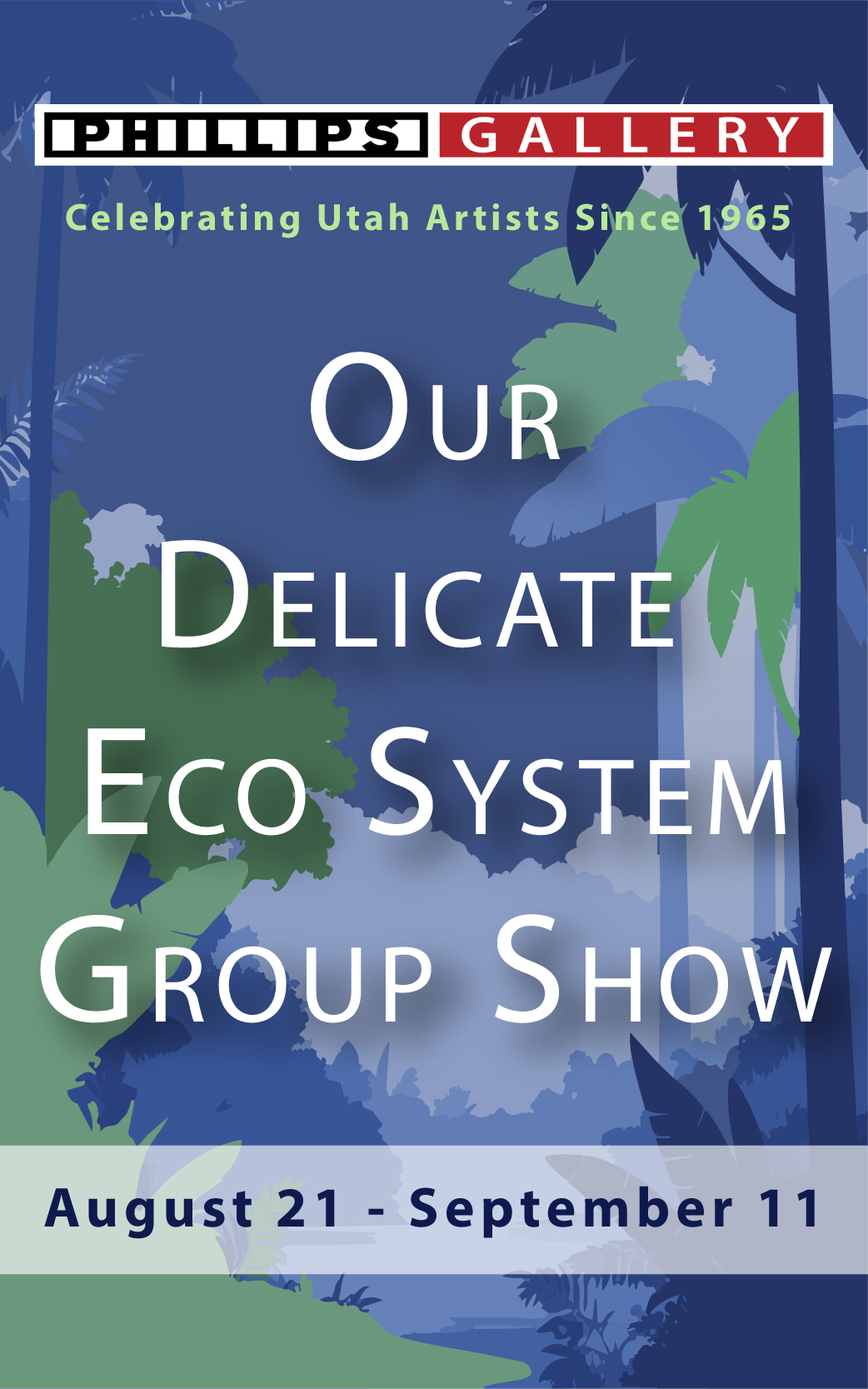
Our Delicate Ecosystem, on view at Phillips Gallery through September 11, continues the enduring environmental mission of gallery owner Bonnie Phillips. It is a cohesive collection of photography, mixed media, painting, sculpture and more that—in and of itself—creates its own “delicate ecosystem” of art, mirroring the exhibition’s theme of protecting the fragile interdependence of our natural world.
Each piece in the group show is skillfully conceived and executed. For example, in Liberty Blake’s collage, “Speyeria Nokomis Nokomis,” the artist employs an array of earth and sky colors, along with photocopied drawings of endangered butterflies that appear “pinned” as specimens hovering over the injured ecosystem. At the very bottom of the piece, the word FRAGILE appears upside down.
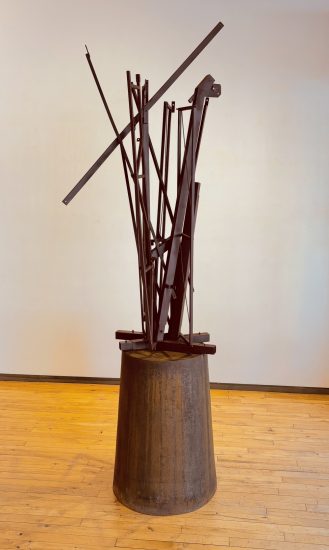
Cordell Taylor, “Fall,” painted steel, 87 x 32 x 18 in.
Trent Alvey’s altered photograph, “Great Salt Lake River,” is an indictment of humankind’s incompetent stewardship of the Great Salt Lake and its environs. Yet, through the photographer’s experienced eye, even this marred ecosystem becomes a thing of abstract beauty: an arresting grayscale composition that concludes with a splash of tar.
Most everyone has witnessed the debris of tree branches and bushes collected and stacked for disposal. There can be something visually satisfying about gazing upon such a bundle. Cordell Taylor’s painted-steel sculpture, “Fall,” however, is not a soliloquy on that subject. Instead, it is a tactile testimony to how an abandoned collection of steel junk—material that has marred ecosystems for centuries—might appear if haphazardly posed as vertically stacked sticks. It is an absorbing sculpture that, in a sense, makes amends for its past offenses.
The watercolor river stones in Rebecca Livermore’s “Stones 03: Too Hot” are rendered with hard-edged precision and arranged in what might be called a “Circle of a Dangerous Life” motif, incorporating the colors of a fragile ecosystem. The subtle gradation from dark to light within each color gives the piece its simple elegance.
When studying Corinne Geertsen’s “Eve,” a tour de force of digital wizardry, one is left guessing at its meaning. Unquestionably, when you see a snake and an apple together, you think of Eve. But there is much more going on here, as the digital collagist explains in the work’s exhibition art card. Beware, though: if you stare too long at the incredibly rendered Native American Eve, you might succumb to its pure surrealism and great craftsmanship.

“Eve,” Corinne Geertsen, digital collage (1/25), 25 x 21 in.
Kamelia Pezeshki’s delicate photograph, “Watermelon & Pear,” is a tastefully designed still life, a small collection of Earth’s abundance when everything works as it should within the bionetwork. Here, nothing looks out of sorts. Yet the symbolism behind each fruit, the photographer cautions, is pregnant with warnings about the fragility of our ecosystem. Nevertheless, the resulting color photograph is a well-organized and impactful image.
“Root Matter,” a diminutive totemic entity of wool and silk sari by Josanne Glass, is a curiously successful work of art that cries “realism” out of one side of its mouth while shouting “abstract” out of the other. Examining the faux rocks for vestiges of root remains is a satisfying and worthy visual pursuit. This is a wonderful piece and quite a statement on our delicate ecosystem.
Wendy Van de Kamp’s watercolor, “No Climate Change, My Ass?!,” has a Fauvist zeal that agrees with the title’s acerbic assertion: a firefighter battles a blaze that disrupts the delicate ecosystem—loss of homes, family displacement, wildlife deaths, burned forests, and more. The expressionist watercolor’s brushstrokes generate emotional impact, compelling the viewer to ask, “Was the fire human caused or a result of nature?” Either way, the ecosystem’s balance has been altered.
“Ghost,” a monotype by Tom Bettin, reaches out to the viewer with abstract-expressionist fingers, as it were, clutching at our eyes with the complementary colors of a forest floor that has been stirred together by the passage of multiple seasons.
-

- Josanne Glass, “Root Matter,” glass wool & silk sari, 15 x 10 x 8 in.
-

- Wendy Van de Kamp, “No Climate Change, My Ass?!” watercolor, 15 x 10 in.
Our Delicate Ecosystem also includes photography by Jim Frazer, Ron Brown, and Gini Pringle; paintings by Tom Howard, Jean Arnold, and Heather Romney; and mixed media by Maureen O’Hara Ure and Melinda & Joe Ostraff.
For a greater awareness of the exhibition’s purpose, gallery visitors are encouraged to peruse the art card accompanying each artist’s work. The cards detail each creator’s thoughts, passions, and hopes for the healing of our planet, realized through their chosen medium.
Our Delicate Ecosystem, Phillips Gallery, Salt Lake City, through Sept. 11.

Dave Gagon has been writing for more than 30 years, including 19 years as the visual arts writer and editor at the Deseret News in Salt Lake City. During his tenure, he reviewed the work of more than 100 artists from across Utah and received multiple writing awards from the Associated Press and the Society of Professional Journalists. Gagon is the author of Honorable Release (Signature Books 1992), a young adult novel, children’s stories and picture books, and songs that he has written and recorded. He also pursues photography through his ongoing A.I.P.S. (Abstraction In Plain Sight) project.
Categories: Exhibition Reviews | Visual Arts