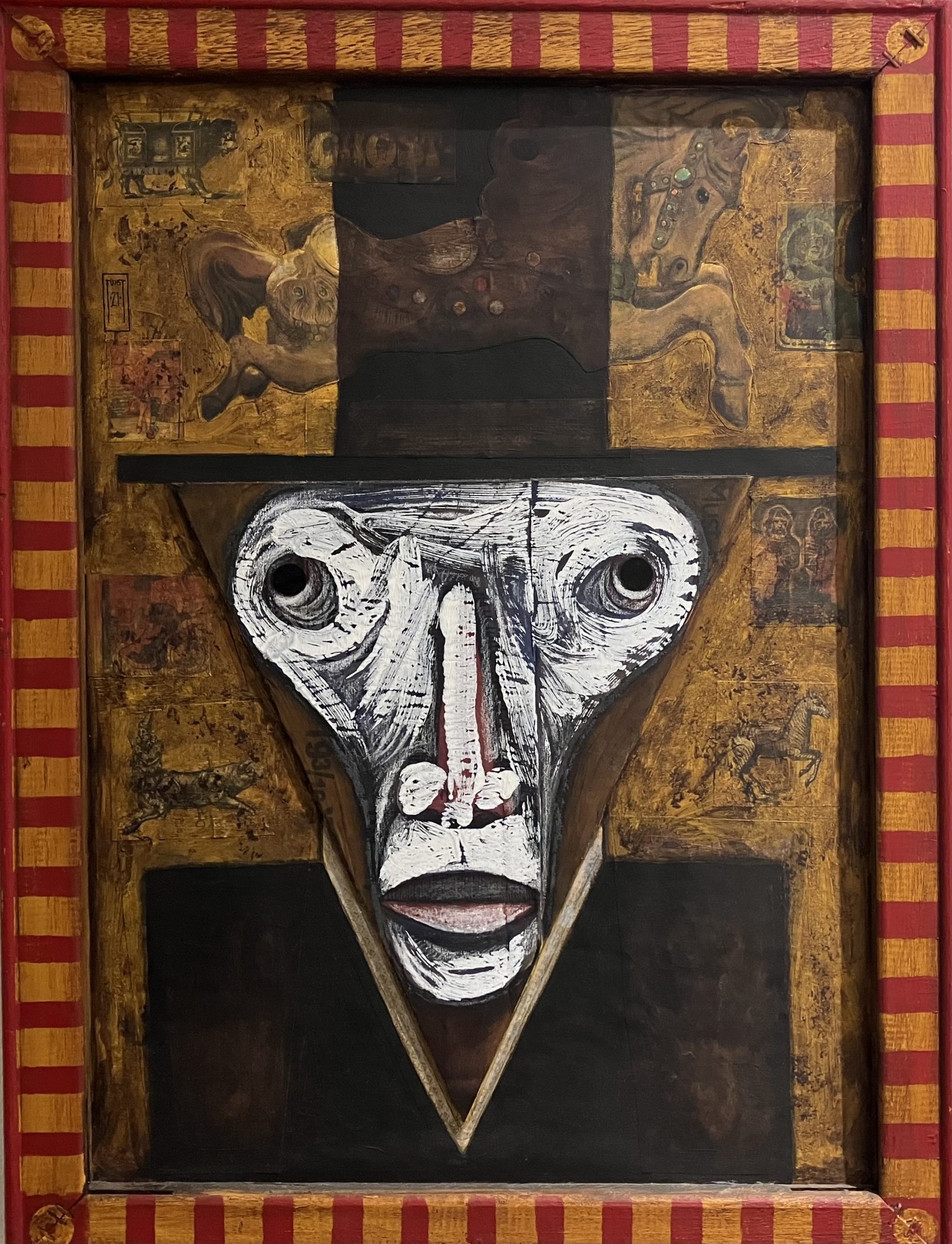
Grant Fuhst, “Carny”
It’s probably a good thing that so many sales galleries are going into smaller spaces and, especially, spaces with scaled-back rooms, hallways, and other narrow spaces. One reason is that this gives viewers a chance to see how well they work in similar spaces they may have at home: spaces where there’s not enough room to back up and bump into a sculpture.
Consider “Carny,” a mixed media painting by Grant Fuhst. This close-up face, constricted into a severe triangle, is done in bright, white paint with an almost dry brush. The result creates the illusion of high contrast: light and dark making strongly-lit shapes in what is really a smooth and evenly illuminated surface. The skin may also seem wrinkled, while the hollow eyes form tunnels that seem to converge on the viewer’s point of view. In the hallway at Align Real Estate, one of eight venues participating in the Sugarhouse Art Walk, the countenance is so close and so powerful, while the background is reduced to a pattern of brown and gold, that at first the isolated face may be all that is seen.
Align Real Estate is one of several places where a cellphone camera, which has substantial powers to alter the apparent distance to things, may come in handy. Using one here caused quite a change. Of a sudden, the overall figure is seen to be wearing a stovepipe hat and a black jacket with a white collar, against both of which the face, painted on a triangle of cardboard, comes forward in dramatic perspective. Further, the background is revealed to be carnival scenes done in tarnished gilt: a carousel horse, an ornamentally costumed lion, a saddled zebra, and other animals encouraging further interpretation. Most viewers probably know that a “carny” is someone who works in a traveling show, but may not know that as an adjective, it means “sly” or “artful.” So this carny, with his mask-like face, nose like a racy graffiti, and immaculately shaped and tinted lips becomes a meticulously depicted narrative character: one declines to accept his one-dimensional, assigned role. After centuries of trying to reveal the essence of the subjects they portray, artists have turned instead to capturing the ambiguity and uncertainty of how much we can actually know.
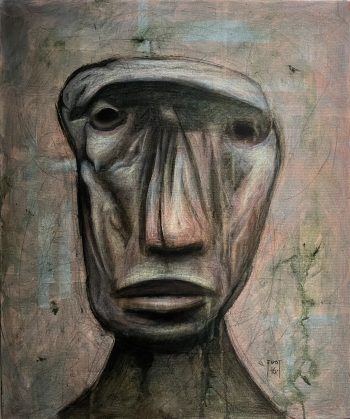
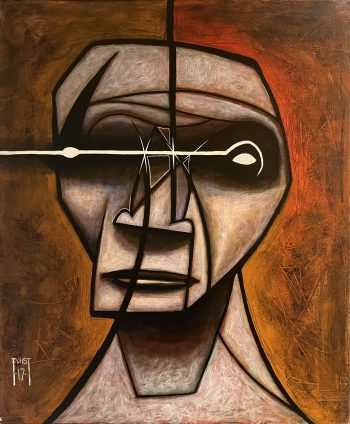
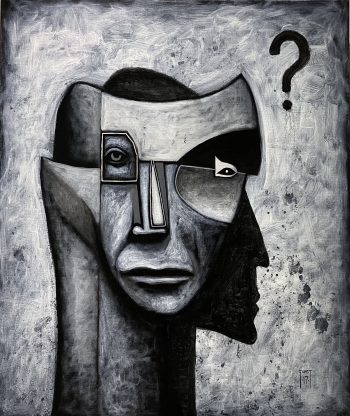
Possibly Fuhst’s largest body of work, at least here, is the consecutively numbered portraits labeled “Anthroposcopy.” The five-syllable title combines two Greek words, “anthropic,” which refers to the existence of human life, especially as it constrains theories about the universe, and the suffix “–scopy,” akin to “scope,” indicating viewing, observation, or examination. These freely modeled, mask-like portraits are paradoxically made of soft-looking, approachable media even as they build entire heads from antagonistic geometry and errant mark-making. They tend to low and heavy brows, widely-spaced eyes, and full lips. Each conveys a single mood or affect, though they aren’t titled with it. “#3” seems modest or complacent, “#6” might be self-conscious, and “#2” melancholy or even sad. Many have a large feature centered in the face, which seems to push the eyes apart. While it might be a nose, it might not represent any actual feature. “#12” recalls Cubist Picasso, with both a full face and a profile, one like a shadow to the other, along with a question mark, all in black and white. One set of four hung together on the wall demonstrates a variety of open-mouthed expressions.
-
- “Anthroposcopy 2”
-
- “Anthroposcopy 11”
-
- “Anthroposcopy 12”
Not all Fuhst’s work is anthropomorphic. “I Dreamed of Teeth” foregrounds a bottle-like shape with a bowl-like opening, on which a tooth chart is seen in perspective. Adjacent, on the other side, a cross-section of a tooth appears, likewise, seen through a cutout in the drippy and scratched surface. Other elements, closely serrated, lie on top of it, while white scratches surround the tall figure as if to support it. As dreams go, it’s more convincing than the usual images so labeled, which often could only be the work of someone awake.
The versatility and imagination seen so far get a real workout in three “Black Pictures,” also numbered, with 3, 12, and 13 present. Here subtle shading of smooth, sinuous, and sometimes symbolic forms and interiors, their contents suggestive of bodily organs or landscapes, produce effects that, in comparison to the preceding, seem almost conventional. In fact, they may represent the furthest departures from anatomical representation. Then in such completely abstract panels as “1-16-25,” the resemblance of the title to a calendar date and the experimental image arrays argue that these are journal entries, or Western meditations, as opposed to the brushed ink versions seen in the East.
The standard “version” of the artist is one who sets out anew with each project, but Fuhst may be a better example for today. When he has an idea that works, he pursues it into a series of related pieces, exploring the human types, the range of ornamental forms, and any evocative responses they may produce. He doesn’t set out to exhaust the material, but perhaps to add something new to our known range of visual types and qualities. Judging from the public response, it’s a welcome addition.
Sharing the walls at Align is an artist whose similar approach may be concealed behind his very different practice. Vincent Mattina seems more likely to show a unique, sculptural assemblage than a series of identical prints, though he definitely produces both. In fact, a careful look at many of his sculptures may reveal that they are built around a printed image, for which antique cabinetry, salvaged electronics, and once-commonplace accessories serve as a kind of elaborate frame. And while it probably would not be true to say that he never initiates an image purely from imagination, there is a functional symmetry between the way his objects begin with manufactured products, which are patinated by obsolescence or lack of maintenance, and the manner in which he uses old pictures as starting points for his often dreamlike images.
-
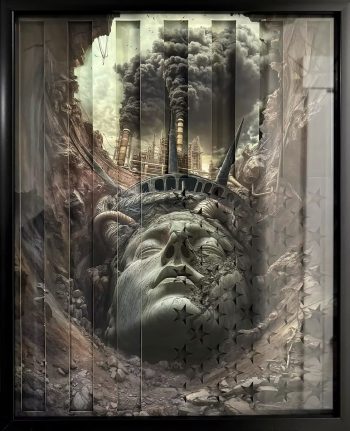
- “In Memoriam”
-
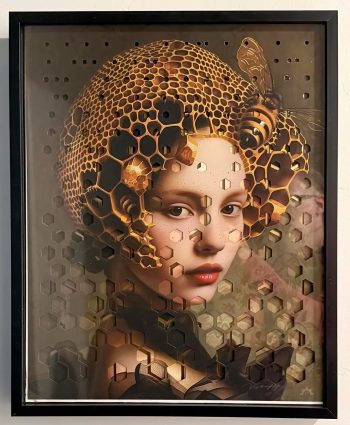
- “Hive Mind”
-
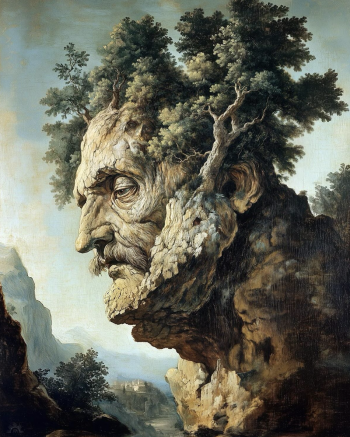
- “Pando”
It wasn’t that long ago that Mattina’s digital collages implied more disturbing, even oppressive narratives. In his statements, he attributed their dark, claustrophobic character to health issues like sleep apnea, in which a sleeper has trouble breathing, leading to both feelings and dream images of suffocation. While the magical qualities of those prints are still present, he now appears to take more pleasure in the ways waking memories and images penetrate sleep and liberate dreams. The metaphorical materials and related content that turn visual materials into art tend to be more subtle than the rigorous symbols so often employed when contemplating religion, psychology, politics, and similar, more contentious subjects.
One of the choices a collage artist makes is how apparent the cutting and combining will be. Where some collages crash the parts together to emphasize their artificial connection, Mattina blends his so smoothly they seem natural, or would if the effect didn’t finally call attention to itself. In “Sacajawea,” named for the Lemhi Shoshone woman who accompanied Lewis and Clark on their trans-continental exploration and guided them into the cultural realm they would otherwise have missed, geometric bands suggestive of language call attention to her official role as translator. On the other hand, the elaborate hat and period jacket worn by another subject seems almost right for the era she represents; so, titling the finished work “Nevermore,” which calls attention to the raven in her hair, so like in Poe’s popular poem, clarifies that it doesn’t actually belong atop her head.
Sometimes, the sheer quantity of added material dazzles the mind. “Main” is a word that could refer to either land or water, but in “Part of the Main” it also invokes plumbing in the form of all the waterworks that occupy the phenomenally complex head-shaped structure, which includes ladders and stairs, a balcony under the nose, and a lighthouse on top, plus ornamental street lamps, elaborate hanging walkways, decaying surfaces, and—oh yeah—a waterfall that cascades into the sea below. The sheer creativity of this covetable dwelling contrasts with the more focused “Broken III,” which while equally elaborate in its construction, is also clear in its intention to reveal the passageway deep into the mind or psyche of the subject.
Sometimes a bit of contemplation can reveal some of the thought that went into an image. In “Delicate Balance,” Delicate Arch, one of Utah’s signature places, appears to sprout from one end of a fragile-seeming old building. In the represented foreground, a watch face and coil spring may bring to mind the watch’s equivalent mechanism to the pendulum that keeps a stationary clock on time: the balance wheel that rhythmically coils and uncoils. Not all such references will be clearly known, perhaps even to the artist, but they do generate compound feelings related to the way discovered, natural principles like gravity and inertia underlie the mechanisms we depend on and wrongly assume are entirely human-made. References that may appear contemporary seldom are quite what they seem. “Pando,” Utah’s Quaking Aspen clone that may be the largest living thing in the world, is framed rather in terms of its age, believed to be 80,000 years. And although Mattina is well up on the current crises, the buried Statue of Liberty is more likely an exploration of archeology, or perhaps geologic time, than a provocative, but not very helpful comment on immediate threats to liberty.
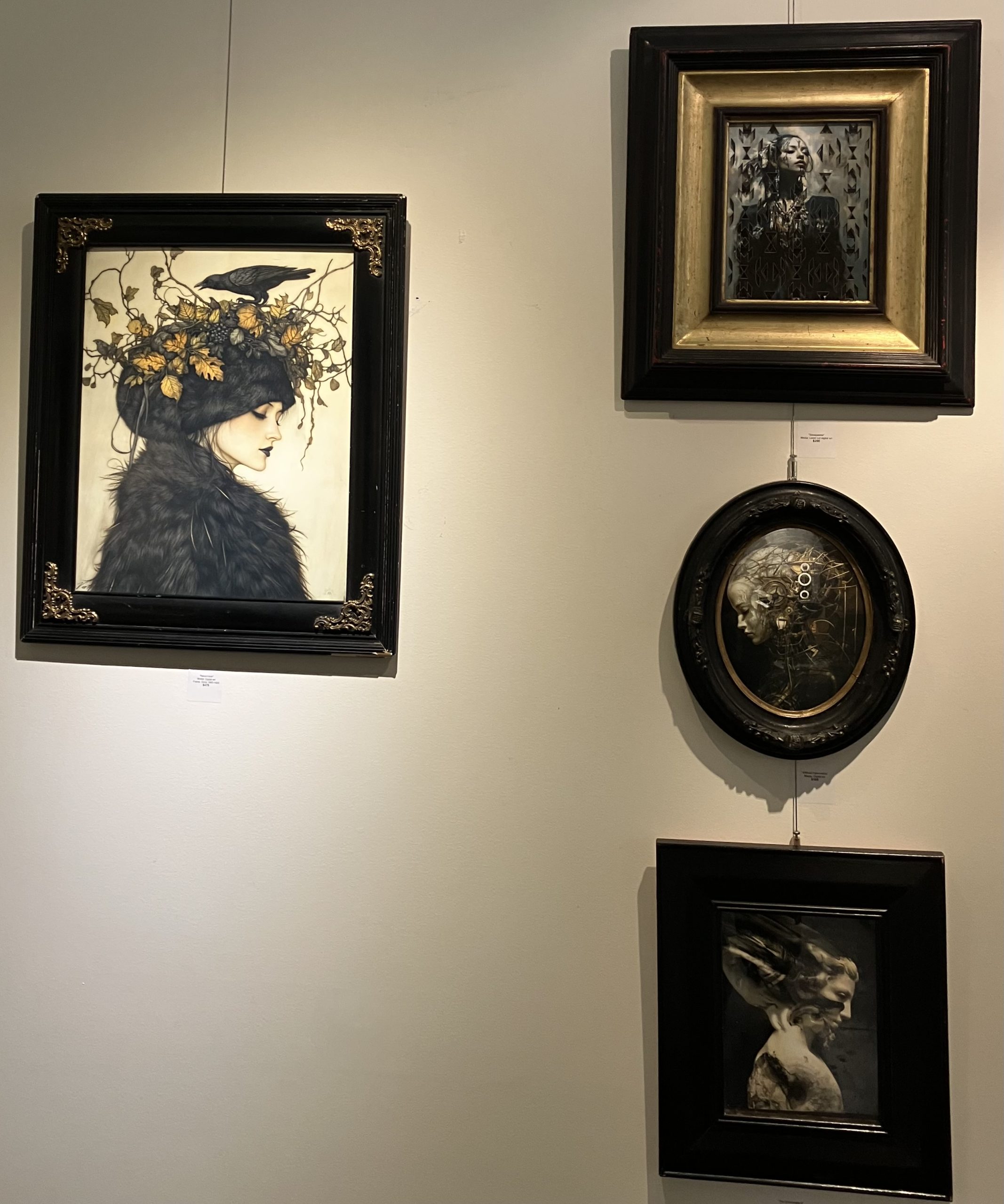
Works by Vincent Mattina at Align Real Estate. From left: “Nevermore,” “Sacajawea,” “Artificial Cybernetics,” and “The Unknowable II”
Most of these works involved giving up the actual third dimension, so important to sculptural and assemblage works, and settling for the illusion of depth seen in the print format. That may have been a bit too far for Mattina, more than he wanted to yield. In any event, in the last year or so he’s begun making layered prints that operate in space like a labyrinth. “Hive Mind,” for example, consists of three layers of paper that in addition to the computer-printed image have had hexagonal windows cut into them, allowing the eye to enter the interior spaces between layers, like thought can sometimes penetrate the mind. It’s no accident that the related beehive structure is worn like a hat by the subject. The reference to the mind, in part, means to indict the social structures of the hive, which the depicted individual—here a woman, but surely it could just as well be a man—inhabits. The reference to Utah is also deliberate, since it was encountering this place in particular that led the artist to the realization of how limited exposure within a homogeneous culture can inhibit the expression, and even the thinking, of an inhabitant. Again, of course, this effect isn’t limited to a particular location, but rather is a feature of human nature and institutions.
Both Grant Fuhst and Vincent Mattina are relatively prolific. Each has found stylistic devices he can explore through repetition, which allow him to explore the rather complicated relationship of appearances to the sometimes mysterious, at other times not so very different reality that underlies them. Realism, surreality, and expression are central to their approaches, which make use of history: both the history of art and of the Earth. Wonder energizes them, and in turn draws the audience into their visual storytelling. To see them together just might be a revelation.
Vincent Mattina & Grant Fuhst, Align Real Estate, Salt Lake City, through Aug. 15.

Categories: Exhibition Reviews | Visual Arts