

Megan Knobloch Geilman, “Thee End is Nigh and the Call is Coming From Within the House”
The 2025 Spiritual and Religious Art of Utah at Springville Museum of Art takes place in a nation and at a time when both those parts of the spectrum of reverence are under attack. So long as a dominant minority of our citizens is determined to ignore both the literal texts of the New Testament and the United States Constitution, the storm that rages in our land will continue and our need to find a firm foundation to hang onto will only increase. For this reason, I found myself seeking out, among the many fine works of art in Springville’s galleries, those artists who attempt to transcend personal appeals to remote forces and opt instead to speak clearly to anyone seeking a connection that brings not just noble sentiments, but workable values into our daily lives.
Thus, two artists—who likely collaborated unknowingly—moved me most deeply by making a collective point. Megan Knobloch Geilman concealed her indispensable truth in a wonderfully satiric digital assemblage that mocks the wasteful ways so many of our fellow citizens frighten themselves with shadows, even as they ignore the very real threats that inexorably close in on us. But with “Thee End is Nigh and the Call is Coming From Within the House,” she intends more, as her statement reveals. Raised as a child with a religious awareness of the many threats to our very existence, she now feels saddened to see so many of her peers unknowingly contributing to those same perils, and even more, made unable by the principles of their religions to communicate the danger to each other.

Pam Baumeister, “Gentle”
The other painting, Pam Baumeister’s watercolor “Gentle,” made their common point personal for me. Her image, one increasingly disparaged in our culture, of one person caring for another helpless fellow being, reminded me that before I settled into the arts, I trained for just such work … only to be dismissed from my avocation by a supervisor who saw me as a challenge to her personal power.
There are other works that carry similar freight. The all-but-ubiquitous Jason Lanegan’s “Reliquary for a Sacred Stone” makes his characteristically resonant call for everyone to respect the suffering and iniquity of their own, personal past not as a way to demand compensation from others, but to see in them a route to self-respect and the ability to love others.
In “Oasis (No.5),” Ron Richmond places a single, pristine carafe of water in a vast and parched, cracked and seemingly hopeless desert (or lakebed?). I believe he means this as symbolic of the capacity in each person to serve as such a vessel, in all its possible meanings, without regard to the very different choices made by others.
Two other artists deserve recognition for having served so long without losing the desire to create art of the present moment that nevertheless speaks timelessly. Darryl Erdmann paints his high regard for sanctuary, a concept that is literally and legally under siege as I write. And Frank McEntire, who a decade or more ago could have served as the namesake of this show, what with his scalpel-like manner of dividing the human spirit—the source of the word “spirituality”—from the base level malpractice of so much religion. Since then, in works like “Spring Without Voices,” he has added the sanctity of our earthly environment to his idea of what is sacred.
There are more goodly works, but these are the artists who spoke most powerfully to me.
-

- Ron Richmond, “Oasis (No.5)”
-

- Darryl Erdmann
-

- Jason Lanegan “Reliquary for a Sacred Stone”
-

- Frank McEntire, “Spring Without Voices”
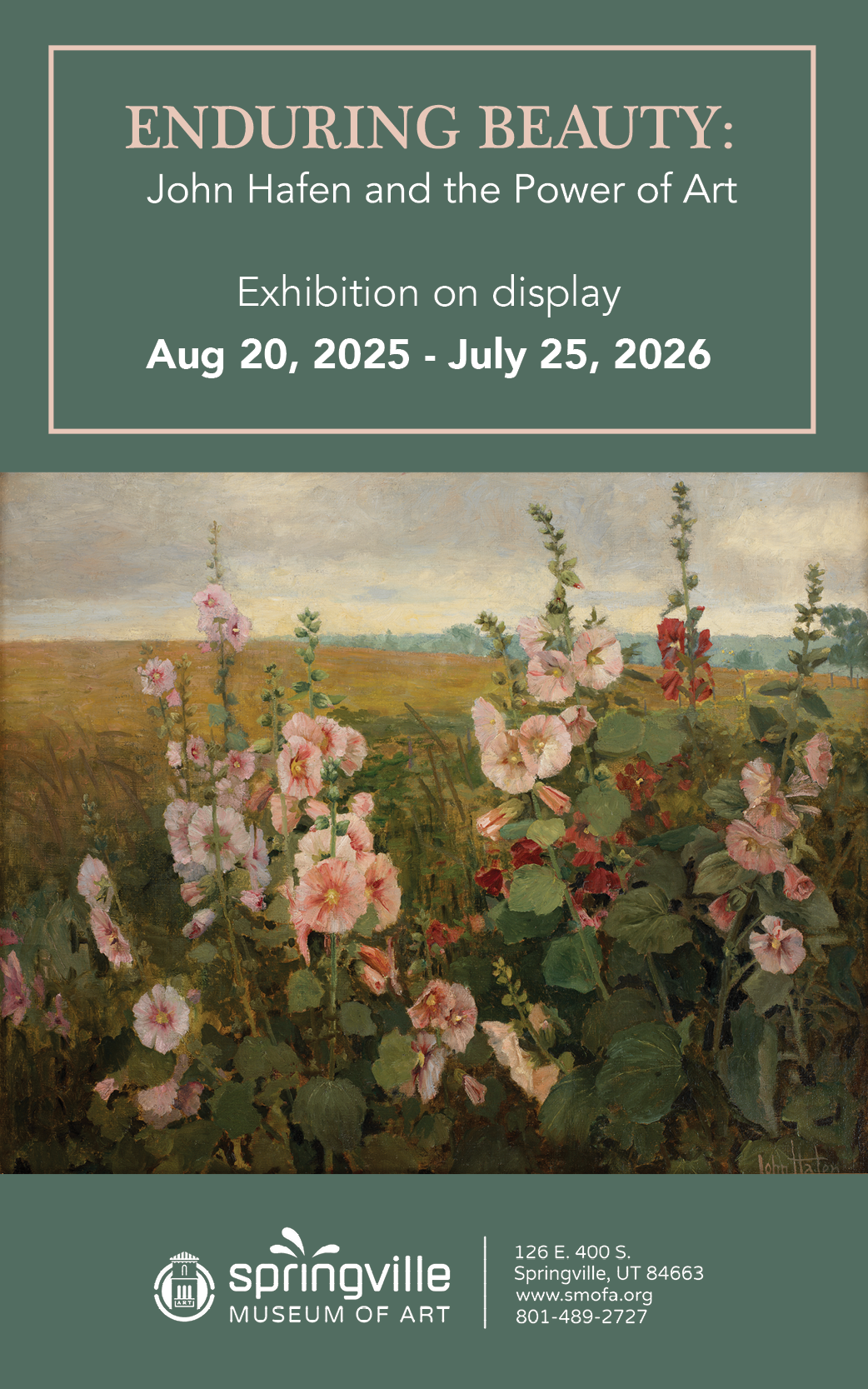
39th Annual Spiritual and Religious Art of Utah, Springville Museum of Art, Springville, through January 7, 2026.
DID YOU ENJOY THIS ARTICLE?
Help make more like it possible.
VENMO us a donation at artistsofutah

Or use PayPal to MAKE A DONATION.
15 Bytes is published by Artists of Utah, a 501 (c) 3 tax-exempt nonprofit.

Geoff Wichert objects to the term critic. He would rather be thought of as a advocate on behalf of those he writes about.
Categories: Exhibition Reviews | Visual Arts





Love your picks, Geoff! Thanks for coming and writing about our show!