
James Taylor “J. T.” Harwood (1860–1940) occupies a foundational place in Utah art history: a locally trained, internationally tested painter who helped prove—at a moment when the idea still needed proving—that an artist from the Wasatch Front could compete on the biggest stages of the art world and still return home to build a visual language for the region. Born in Lehi and active for most of his life in Salt Lake City, Harwood’s career arcs between two poles: the disciplined academic traditions he pursued in Paris and the intimate, place-based subjects he returned to again and again in Utah and abroad.
Harwood began as many early Utah artists did: through apprenticeship, community, and grit rather than through an established local art infrastructure. As a young man he studied with prominent early Utah painters—including Danquart A. Weggeland—and, encouraged by mentors, set his sights on Europe. In 1888 he became one of the first Utah-born artists to travel to France for advanced study, enrolling at the Académie Julian and later the École des Beaux-Arts. This wasn’t a brief “grand tour” so much as a serious investment in technique and professional standing. He wanted the figure to sit convincingly in space, the tonal structure to hold, the paint to feel intentional—not merely decorative.
That ambition paid off. Harwood is often noted as the first Utah artist to have work accepted into the Paris Salon (1892), a milestone that mattered both personally and symbolically. It signaled that Utah’s art scene—still young, still peripheral—could produce an artist whose work met the standards of Europe’s most scrutinized juries. The Salon acceptance becomes, in retrospect, a kind of keystone fact about Harwood: he is a bridge figure, connecting Utah’s pioneer-era art culture with a broader international professionalization.
Yet Harwood’s story isn’t simply a success narrative. Like many artists, his output and visibility rose and fell with circumstance. After the death of his first wife, Hattie, in 1922, accounts of his career describe a period of diminished momentum—an artistic life affected by grief and the practical realities of aging and responsibility. Then, in one of the more affecting turns in his biography, Harwood remarried and entered a late period of renewed energy. The years of his second marriage (often discussed under the heading of “the Ione years,” 1927–1940) are repeatedly singled out as a time of vigor and productivity, including works made during travel and extended time abroad.
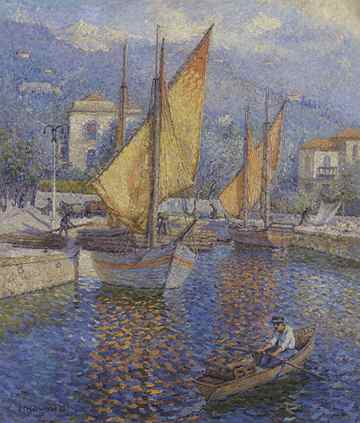
This later work broadens the usual picture of Harwood as only a Utah painter. In the 1930s he produced scenes in Southern France and Italy—farmhouses, orchards in bloom, and boat-filled waterfronts—works that reflect both a mature painter’s confidence and an ongoing delight in light. At the same time, he never abandoned the quieter satisfactions of local subject matter. Paintings connected to Utah sites—like Liberty Park—place him in a lineage of artists treating everyday public spaces as worthy of sustained attention.
Harwood’s appeal, then, is not only historical. It’s also human-scale. The Springville Museum of Art (a major steward of his legacy) describes him as known for “slice of life” genre paintings, citing works such as Boy and Cat: My Little Son, Heber James—a reminder that, alongside the Paris-trained academic painter, there was an artist willing to dwell on the domestic and the familiar. In those pictures, technical training becomes a means rather than an end: drawing and composition serve the emotional clarity of the scene.
Today, Harwood’s work continues to circulate through public collections and archives in Utah, allowing researchers to trace both his finished paintings and the documentary record around them. The University of Utah’s Special Collections, for instance, holds a Harwood photograph collection that includes photographs and slides of his paintings along with family images—materials that underscore how thoroughly his art life was entwined with personal history and local memory.
In the end, Harwood’s legacy is best understood as a set of crossings: from Lehi to Paris and back again; from official institutions like the Salon to the informal authority of family and place; from academic finish to the quickened touch of late-life seeing. He is a painter who helps define what it meant—and still means—for Utah artists to be in dialogue with the wider world without losing the particularities of home.

View in collection
View in collection

View in collection

Artist listings in our Utah Artists Directories are open to all visual artists who reside part-time or full-time in the state of Utah. The listings will remain on our site as long as the artist resides in the state. There is no annual fee for the artist listings. A one-time setup fee is required to create an artist listing. To learn how to create your listing click here.
Categories: Historical Utah Artists


