 “Just take a little sip. Don’t breathe when you do. Nor light a match.”
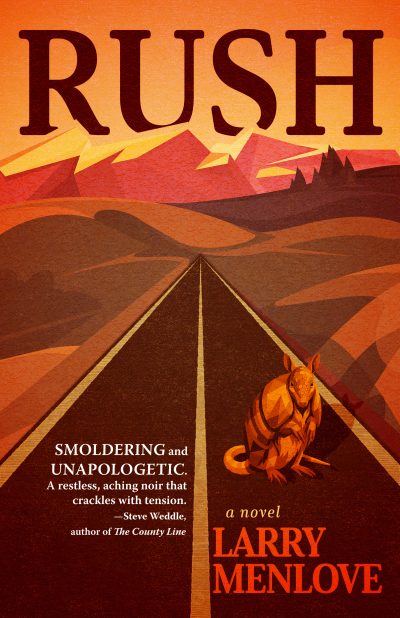
Larry Menlove’s novel Rush is …
Well, it’s a lot of things.
Let’s start with two brothers, Frank, the town sheriff, and Driggs, his older brother who moves drugs and people for a powerful criminal organization.
There are deep mineshafts and brutal murders.
There’s a lot of sex going on in this fictional town set in Utah’s Rush Valley, between Tooele and Eureka.
And beer! If all the beer-drinking scenes were cut, this novel would be a pamphlet (pace Mark Twain). There are passing references to sodas after a Mormon church service, but a bishop pulled over by the sheriff for a minor infraction turns out to be drinking beer, like the rest of the characters.
Driggs’ Mexican-American wife makes her own tortillas and, when not armed with her tortilla press, seems quite benign. Her daughter Jilleen is anything but benign. A “cute little pink pill with an intricate dragonfly etched on it” triggers hallucinations worth rereading.
Did I mention the little armadillo, Petey? Don’t worry, things turn out well for him.
Set in the early 1980s, Rush is told by an omniscient narrator with a knack for interesting detail. This scene between Driggs and a young man he has recruited to work for him, for instance:
Then Driggs had reached down under the seat and pulled out a pistol. It was gray-black and smaller than any gun Bart had ever seen. He handed it to Bart and he held it like a baby in both hands. It was heavy. Cold. He looked at it, the fine edges, the wood-looking grip that was held on with little screws. The trigger was a solid piece of metal, not like a trigger, something you would pull back like a sliding screen-door, say, or a cigar cutter. It said Colt on the barrel. Bart ran his finger over the word. He lifted it to his nose, like he’d done with the armadillo earlier that afternoon.
Petey, by the way, is carried around in a bag when he’s not in a sink or barrel, and characters comment now and then on a potent smell they can’t place. The narrator never points readers to Petey as the source, but a little research reveals that, when stressed or frightened, armadillos excrete a foul-smelling fluid from an anal gland.
The novel trusts readers to make connections. I smiled, for instance, at an implied relationship between Petey and Driggs (totally unfair to Petey, who would never pay his employee to sacrifice a pinky finger):
Despite the open windows in the big car Johns could smell the sweat on Driggs. He had smelled it all day. It broke out on him in the wash, as though the little scramble Driggs had made back in there had bubbled up some primal essence from deep inside him and it had oozed out his pores. Johns didn’t think the smell bad, just feral.
The rural folks inhabiting this novel are skillfully characterized, their language and ways a quiet, pleasing ostinato. For instance:
“[Dylan] and that new wife of his gettin’ along?”
Frank thought of Jilleen’s mama. She was nothing like Jilleen. Fat. Quiet. Ugly. Thought of the old donuts she always had on her kitchen counter. God-awful. “Yeah, I think so.”
Rose Jean rubbed at a persistent smudge on the counter with a rag. “Get you anything else, Frank?”
He thought, Yeah, a bus ticket out of here. He looked up at her and smiled. “Nah, this is good.” He took the last of the coffee in his mug and swallowed. “Like what you’ve done with your hair, Rose Jean.”
She tucked her chin to hide her pleased smile and muttered a thank you, rubbed at the smudge and moved on along the empty counter, clunked her pot into its spot in the coffeemaker, and said, “You see Dylan, tell ‘im Rosie says, ‘Hi,’ won’t you?” She slipped back into the kitchen through the flapping doors.
“I will,” he replied to the doors.
Because a good many residents of rural Utah are Latino, their language and ways inflect the novel as well: “Lo siento,’ she said to the man in her hallway, ‘pero es mi casa.’ She kicked at the fancy sole of his shoe. ‘Es me hija, tambien. Pendejo.’ She spit.”
Utah’s west desert is also home to Goshutes, one of whom is working for Driggs. He returns to the reservation from a brutal escapade in Wyoming and finds a note from his mother:
“Gone out west. Making money. There’s frozen pizza in the freezer. Don’t drink my good beer. It’s good beer. Drink all that Schlitz. Postscript: Where have you been?”
Johns grinned at the “Postscript.” His mother read a lot of books and magazines and newspapers when she could get them. She was a literate Goshute woman.
The narrator himself (I read him as a man) is an especially interesting character. His precise descriptions often close with thoughtful, enigmatic observations, as in this conclusion to a fraught conversation between the brothers:
They held a long gaze then, a gaze through the years rolled back like the riffle of a hot breeze through the scrub leaves that might cause a fly to lift and buzz across the way to the wet underside of a rock overhang in the bed of Skull Creek and find itself entangled in a web, winging and rolling until there is nothing but a smooth wrapped blanket of silk.
His terminating observations often contrast or contextualize the preceding violence with nature:
They stood there in the sudden stillness. Effervescing bubbles fizzing out there in the darkness, and then that was done, and there were crickets strumming a rhythm that was slow and familiar as a summer night in the canyon of soft warm breeze and natural innocence.
The narrator is omniscient in a conventional sense. But I love that he reveals himself at times as all too human:
The man slipped to the floor, his lungs chuff-chuffing for oxygen that would not come, and his eyes were wide above his open mouth, the worthless tongue back in there speaking no words of any merit other than gasping noises that in the dark of some ancient time might have bespoke a revelation of disenchantment for an afternoon that did not come to the probable fruition because of a creature that should have been like a lamb to slaughter that bore teeth of immeasurable sharpness.
When he tends to grandiloquence of this sort, I imagine him as a native of Rush who left for college and who has returned to inflict his rural peers with wordy wisdom. Makes me love him all the more.
The novel’s narrative structure is especially interesting. Most notably, each of the novel’s four parts opens with an italicized scene—for the most part uncontextualized interactions between Frank and Driggs/Dylan. They provide isolated glimpses into the brothers’ past, as in this conversation that precedes Part I:
Frankie.
Daddy?
No. Frankie, get your little ass back in the truck.
Dad.
Go, I said. Go!
Hold him up, Dylan.
Frankie, go!
Is that Uncle Bryce?
No. It’s a dead calf. Now go get your little ass back in the truck.
Dyl, you go around that side.
Here?
Yeah. OK. Drop him.
Shit. That’s deep.
Daddy?
Frankie, I told you to stay in the damn truck.
“Is that Uncle Bryce?” “Drop him.” “That’s deep.” I’ve read the novel twice now and can make sense of these phrases that intimate motivations for the grown brothers’ thoughts and actions. I admire the narrative sophistication the four suggestive fragments represent.
The passage that precedes Part IV will haunt me forever:
Frank put his hand into the bag, took out a handful. He looked at Driggs. This is dad?
I reckon it is. It’s what we paid for. It’s what he wanted, wasn’t it?
Frank let the sandy ashes filter through his fingers. A hard chunk stuck between his pinky and ring finger. He picked it out and examined it. Bone. Tooth? Smooth polished like a small white stone in a riverbed. He slipped it into his jeans pocket.
They walked on into the warming dawn, the dew frost melting and wetting their boots, the ashes clinging where they walked through their spreadings.
. . .
At the truck they looked down at their boots. The brothers spread out and tried to clean the ashy paste off in the weeds, each working their feet into the cheat grass until the wet was soaked through to their socks and their boot leather was milky.
They stood in the sun looking out over the valley. Their father drying there on their boots.
Their hard-bitten, controlling, moonshining father drying on their boots!
Driggs reached into his jacket pocket and pulled out a flask. Here’s to the Raw. Here’s to our father. He took a sip. And then he handed the dented tin flask to his little brother.
Postscript:
Larry Menlove received the Utah Original Writing Competition’s first-place award in 2024 for his as yet unpublished novel “The Same River.” His widely published short stories have drawn awards as well. He is a thoughtful reviewer of works by other writers, including a generous review of Sam Rushforth’s and my book Wild Rides, Wildflowers: Philosophy and Botany with Bikes. He titled his review of Karin Anderson’s 2025 novel, Things I Didn’t Do, “Blood and Belonging in this Bizarre Corner of the World.” That’s exactly where his own bloody novel is set.
I travelled through this territory last year with my son and granddaughter, on our way to see the Onaqui herd of wild horses. During the hot, dry summer of 2026, wildfires threatened Eureka and Stockton in Juab and Tooele Counties. After reading Anderson’s and Menlove’s vivid novels, I’ll never see this country through the same eyes.
Rush
Larry Menlove
Shotgun Honey Books
November 2026
316 pp.
$18.95

Scott Abbott, Professor Emeritus at UVU, has published scholarly books, books of creative nonfiction, travel books, and a book on academic freedom at BYU. His translations include works by Nobel Prize Awardee Peter Handke and botanist Gregor Mendel. Author page at: https://www.scottabbottauthor.com
Categories: Book Reviews | Literary Arts