Shirin Abedinirad’s “24 Frames”
It’s probably safe to assume that it’s a coincidence: that what will likely be among the last great shows in the splendid, large gallery at UMOCA, where so much current or contemporary art has met the collective gaze, should take time as one of its thematic examples of what cannot be measured, and to do so in virtually the same week as the international authorities who keep track of time have decided to eliminate the leap second. So perhaps before plunging into the concise but subjective ways artists conjure time as an experience, a pause in which to recollect the supposedly precise and objective struggle to measure time might be appropriate.
Real time begins with astronomical facts. Our only home rotates in space once a day, and the effort to divide that recurring interval has been largely successful. Twenty four hours profit from the arithmetic advantage of the dozen, which is divisible in more ways than ten. The days are not all identical, but the differences are too small to be detected by us. Not so fortunate is the year, the passage of Earth around the Sun, which does not divide into a regular number of days. In fact, it’s a quarter day too long, and so every four years we add a leap day that evens out the accumulated error. But a whole day is a little too long, so an agreement was reached to leave out one leap day per century. Ah, but that’s not quite perfect, and so our latest century, the year 2000, included a leap day. Still not done, the masters of Coordinated Universal Time (UTC) added the leap second in 1972, which unlike the preceding is not regular and cannot be predicted. Now they’ve given that up and accepted that fixed time intervals will have to do for now, and future societies can adjust it when and if they want.
There are, of course, at least two parallel tracks made by time. In one, identical seconds pile up into minutes that become hours and days on up to millennia. This sounds sufficient, but as errors accumulate, as its rigor is used to measure the imprecision of life, it satisfies no one. So it’s just as well that our artists reflect our experience of time back to us in measures we can share. And so, in Time, Truth, and Other Immeasurables, along with time, the curators at UMOCA here sought out examples of “truth, vastness, spirituality, deep time, and history,” with which they seek to address things unseen that may be enduring: the infinite and the immeasurable.
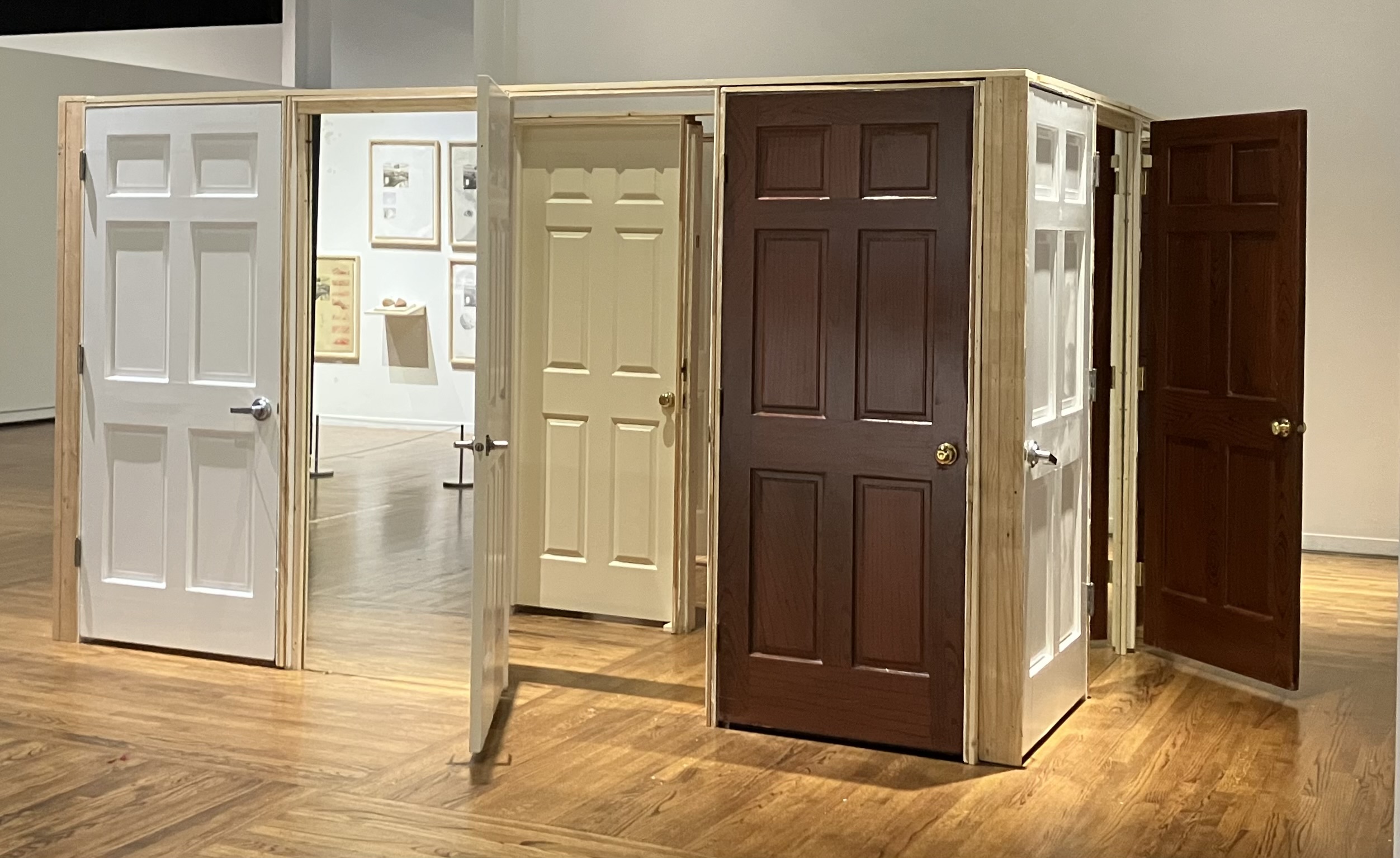
While the layout of UMOCA allows audience members to size up a show from the mezzanine-like perspective of the main floor, plunging down the stairs can reset expectations, so that what viewers find at the bottom may still be surprising. Here that’s Shirin Abedinirad’s “24 Frames”—the title invokes the speed at which motion pictures are traditionally exposed and played back—and which appears to be a building comprised almost entirely of what are known as “bible doors,” each framed with a cross above and an open book below. There’s a whole, further game of substance and ephemerality going on here, ranging from the view through to other works in the distance to the up-close act of opening a door and meeting oneself coming the other way. Though born in Tabriz, Iran, Abedinirad has combined familiar subjects and techniques both before and since becoming an assistant professor at Utah Valley University. Her videos, performances, land art, and installations span themes of gender, sexuality, and compassion, while an encounter with the desert in 2013 led her to focus on light-friendly materials like water, mirrors, and raw environments that act like thresholds between the body, the environment, and the infinite. “24 Frames” doesn’t coalesce into a representation, but invokes unconnected, yet familiar experiences of small passages, exploration, and frustration, and the near panic of becoming lost in a fun house maze.
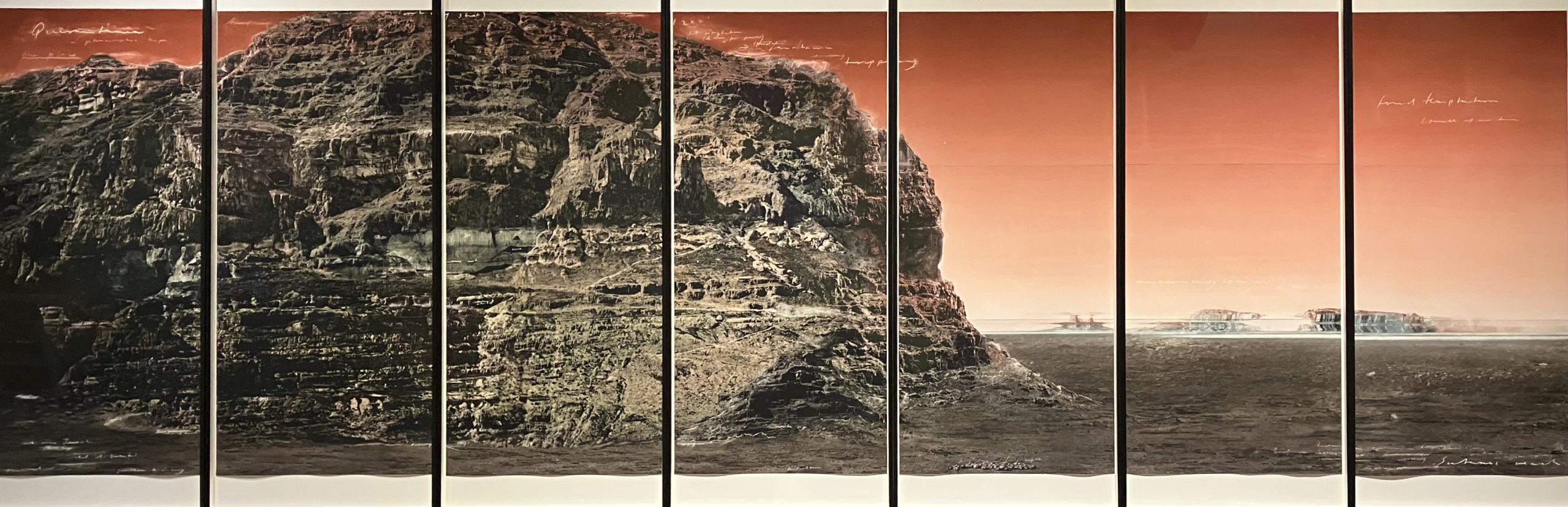
Tacita Dean, “Quarantania”
One of the scarce, and likely to be even scarcer resources of UMOCA, is its seemingly infinitely adaptable walls, which allowed whole teams of mural artists to bring their work indoors and up close, then eventually gave the unsurpassable William Kentridge a place to show how powerful his animations really are. Here, they give Dawoud Bey the chance to show how coordinated motion in two or three simultaneous projections can give his subjects an irresistibly powerful dimension. Bey can clearly see beyond what most photographers do, and has pioneered uses for multiple images that makes them work in new ways. Contemplating the four Black girls who were killed in the notorious 1963 Birmingham church dynamiting, and the two Black boys shot to death hours later, he determined to find children the same ages as those six, and then to find six adults who show what they would be like today had they not been murdered. And now “Evergreen,” his three-channel video at UMOCA, brings plantation life in the South to life and presence to a degree that eludes more conventional efforts. At the same time, the humility of an artist who wants to capture the look of the world through the eyes of a murdered child gives everything he does an extra dimension. Dawoud Bey finds a power in his images that can change a viewer the way his subjects changed him in his discovery of who and what they truly are.
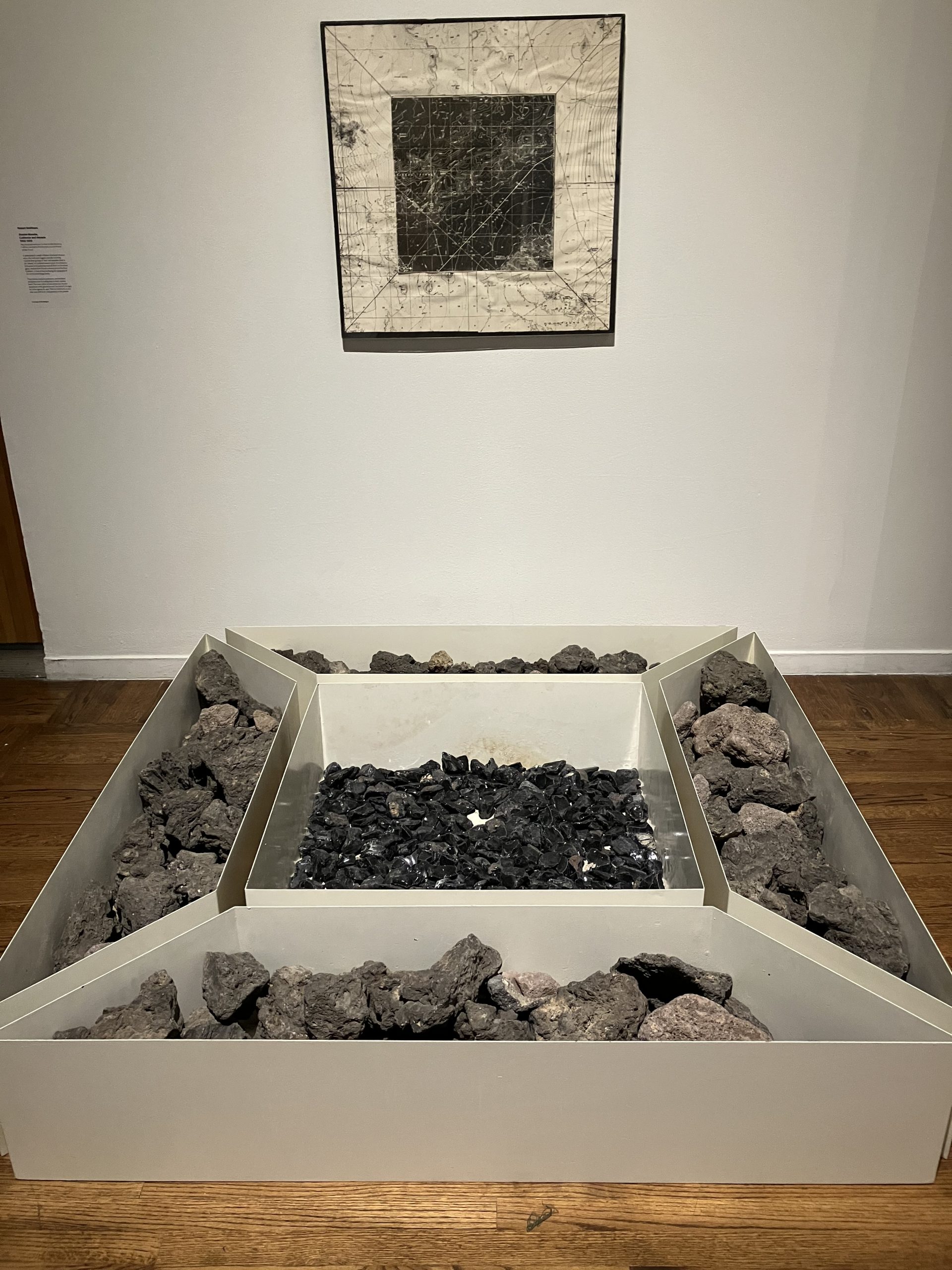
Robert Smithson, “Double Nonsite, California and Nevada”
Any group show is likely to contain threads that tie the parts together in unexpected ways. In this case, the emergent links include the Spiral Jetty. Robert Smithson, whose emphasis on the site of his Jetty helped clarify the meaning and importance of site in art, further sealed the deal with a series of “Nonsite” works, and is represented here by “Double Nonsite, California and Nevada.” This installation exemplifies his determination that his day’s monuments would be built “not for the ages, but against them.” By composing together contrasting materials—two different minerals of vast age contained in modern, manufactured containers—he wants to force his viewers to become aware of the simultaneous contrast of deep time vs the present. His premature death in the presumptive middle of his most productive years leaves us to wonder where he might have taken these early ideas, which may indeed remain unfinished.
Nearby, “It Lingers …” is a similarly variegated installation by Martha Rosler that demonstrates the fundamental dishonesty of how the media misrepresent war. Exhibits include suffering-free promotions of heroic soldiers in bloodless triumphs or being welcomed in ticker tape parades. Using all sorts of found representations from the gamut of published and otherwise distributed sources, Rosler builds on a lifetime of experience in breaking images down to reveal how subliminal meaning is created and words are distorted, which she’s done with issues around wealth and poverty, housing, and especially gender roles in society. While she has a strong connection to the West, she has also been a prime player in DIA Art, an avant-garde foundation that owns both a converted industrial gallery in Beacon, New York and the Spiral Jetty, the responsibility for which DIA has taken seriously for almost three decades.
Then there’s “Quarantania,” a billboard-sized landscape photograph by the British filmmaker Tacita Dean. Dean works with the most conventional materials, like photochemical motion picture film, chalk-on-blackboard drawing, and photogravure prints. She tends to use these in straightforward treatments, though “Quarantania,” which depicts The Mount of Temptation in the Judean desert, is covered with largely illegible graffiti. It seems a little simplistic to suggest this is about the unintelligibility of scriptures, whether in words or facts. From time to time, however, she creates something like a two-acre wheat field in an abandoned plot mere blocks from Wall Street that she planted and harvested herself to make a point about the difference between the financial world, which arguably creates nothing, and those who produce the food we eat.
-
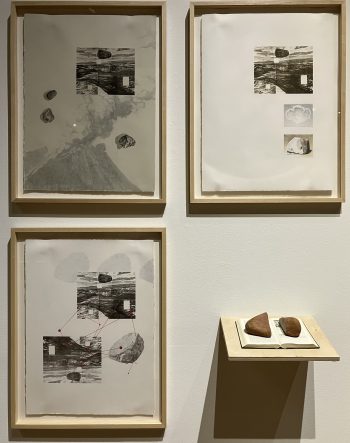
- Ron Linn’s “i dreamed i saw a stone fly over no man’s land (mesa) /angle of repose 2024”
-
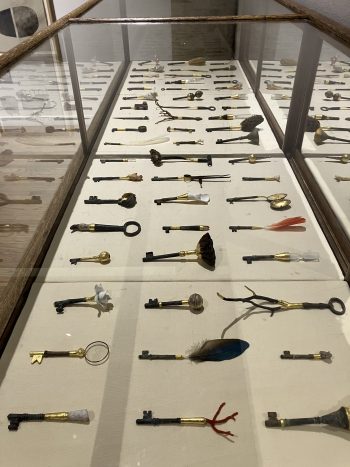
- Beth Krensky’s “Keys to Open the Beginning Before the End,”
There are twenty two artists participating in Time, Truth, and Other Immeasurables, and their works run the gamut from simple and direct demonstrations of craft to elaborate exercises. While most are seamlessly executed, in others the ideas take precedence over quality of expression. In Beth Krensky’s “Keys to Open the Beginning Before the End,” every part meticulously joins together familiar objects into unique objects previously unseen, apparently in search of magical implications if not actual magic. Ron Linn’s “i dreamed i saw a stone fly over no man’s land (mesa) /angle of repose 2024” epitomizes the current trend towards elaborate layering of means that paradoxically allows the audience more freedom to interpret the results for themselves. He creates lithographs of stones that, once printed, he draws on to combine a printed drawing with an actual drawing. Then he juxtaposes a printed book and a real stone as the fourth corner of a rectangular exhibition, so as to further combine orderly geometry with chaotic nature. Here again, the artist urges us to look more, look more deeply, and never stop.
And then there is Kara Walker, one of today’s foremost artists. She uses a technique no more elaborate or detailed than a shadow, yet with which she expresses a whole world of subtle truths and complex emotions. She makes comic details, such as the juxtaposition of the slave owner’s sword pommel to the protagonist’s torso, or the way one of her three children hangs from her breast, into revelations of the truth behind one of the most inaccurately, and indeed dishonestly portrayed epoch’s in American and human history. The sheer simplicity and directness of her images allow telling truths, such as the presence of humor in tragedy, without implicating herself as their source, even as her audience knows she is somewhere behind the curtain of anonymous-seeming images. Ultimately, Kara Walker exemplifies Canadian philosopher Marshall McLuhan’s observation that an older medium can undercut later ones because it lies closer to the origins of our learning to read images, an effect he compares to looking through a rearview mirror.
Holding a mirror up to Nature is, of course, one of the definitions of art. If there is one thing all these artists have in common, it would appear to be an emphasis on viewers remembering to look, always and deeply. To that end, they have provided some new mirrors, and some polished older ones, from which their audience is encouraged to learn new ways of seeing, but not to forget the value of doing so with their own eyes.
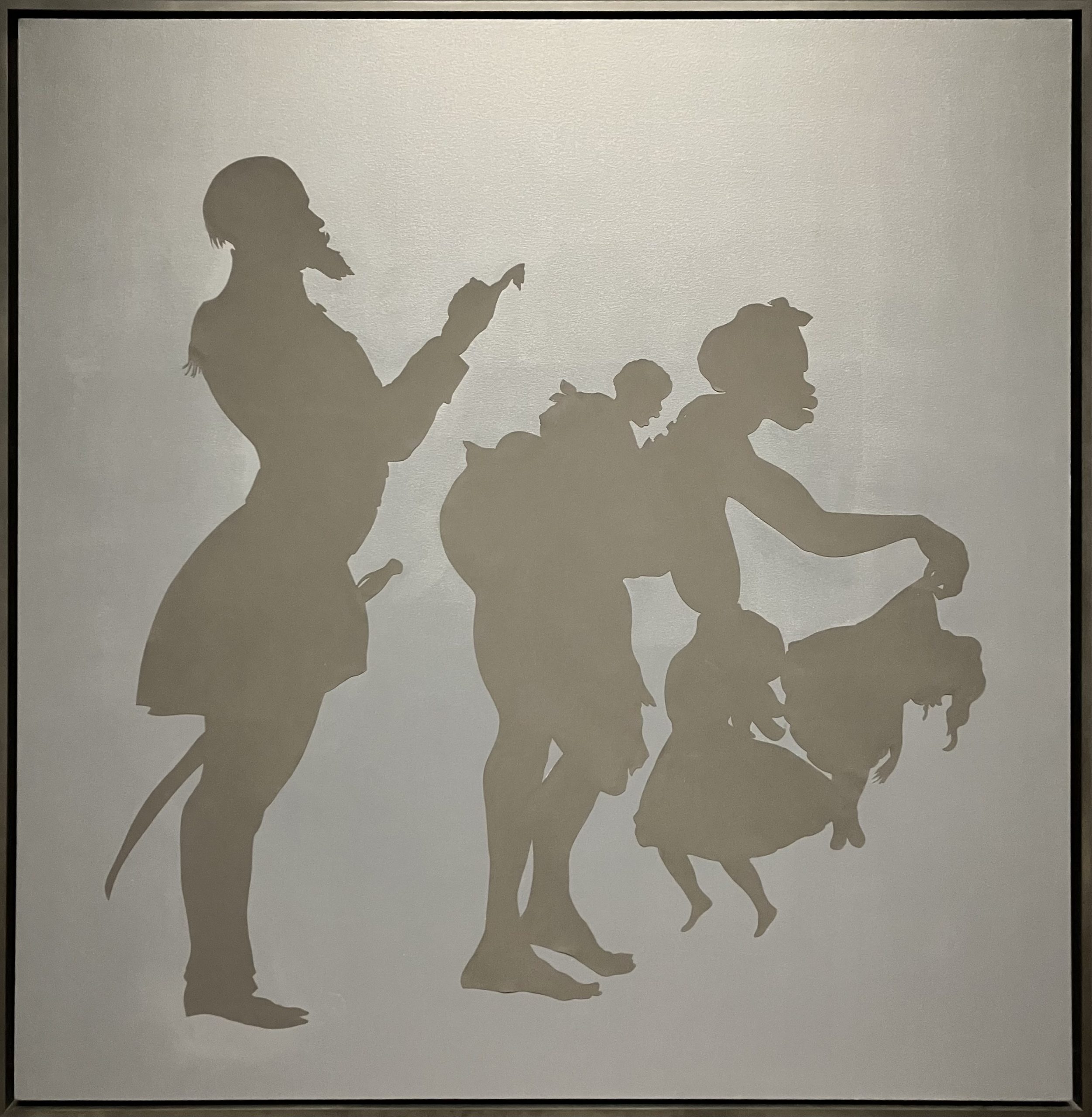
Kara Walker
Time, Truth, and Other Immeasurables, Utah Museum of Contemporary Art, Salt Lake City, through June 5, 2027.

Categories: Exhibition Reviews | Visual Arts