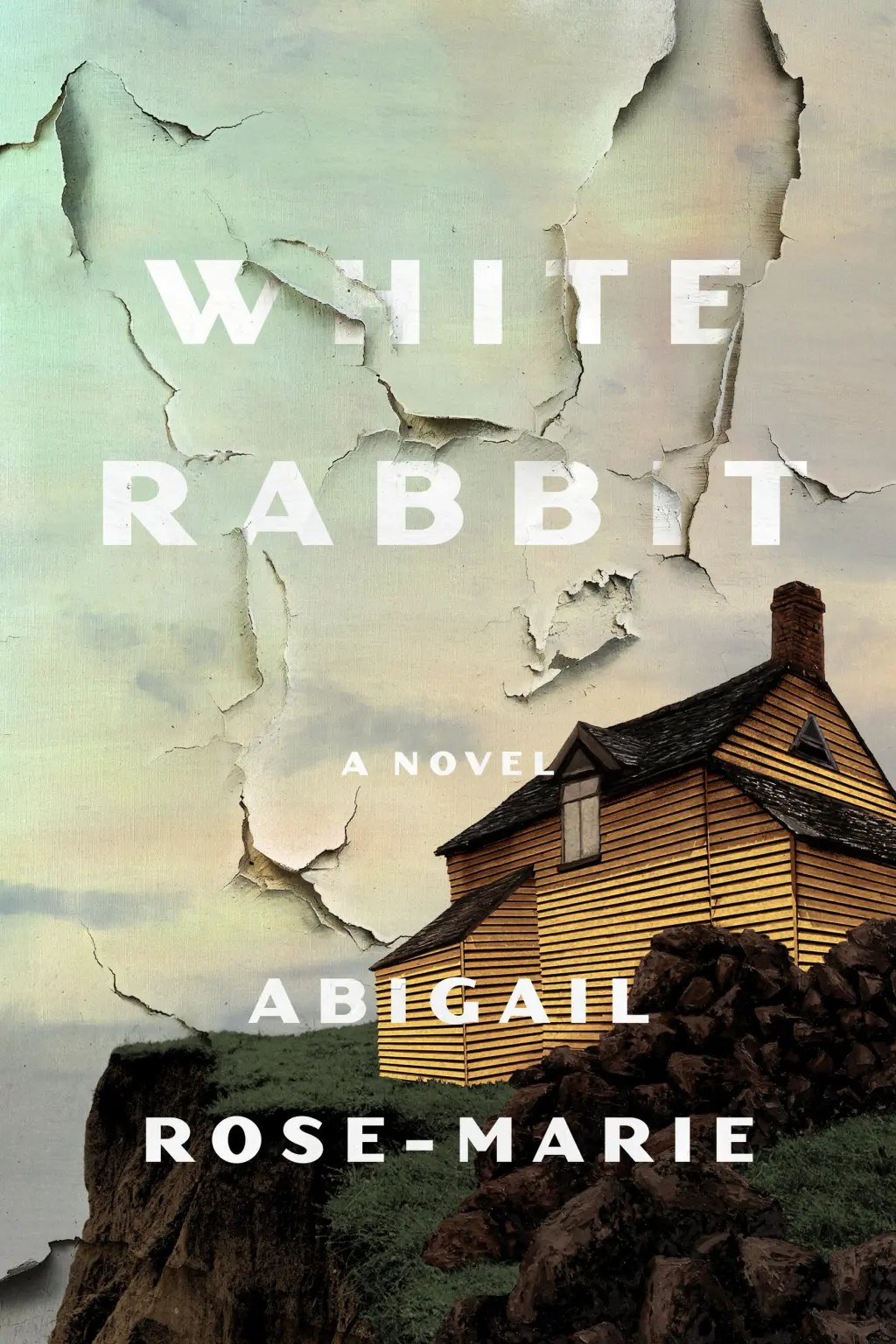
 I like a good ghost story. Especially this time of year. And especially a slow-burn intellectual ghost-tale that reveals like a puzzle. Think Henry James’ The Turn of the Screw, or Shirley Jackson’s The Haunting of Hill House. Ghosts roam free in Abigail Rose-Marie’s exceptional novel, White Rabbit. The most obvious is Sylvia Plath’s spirit, who “haunts” the eleven-year-old girl Penelope, who lives in Plath’s childhood home, the yellow house on the bluff in Winthrop overlooking the sea on a Massachusetts shore. Penelope doesn’t fear the ghost of Sylvia Plath. She craves the devotion of a poet spirit around the house. The ghost appeared not long after Penelope’s father abruptly left on January 26th, leaving many things around the house undone, like the drywall.
He never got around to it after he started working at the school and now the walls, like everything else inside Octavius, are stuck on January 26, waiting for Dad to come home and make time start ticking again.
Penelope spends time in the house, named Octavius, making small talk to the masks her father, the high school theater teacher, made that hang from the rafters in the attic. The masks speak back to her as characters as natural as the living do in the yellow house on the bluff. She lives with her mother, and then her aunt Apple and Apple’s boyfriend, James, move in for a while. Penelope walks along the wood plank trail to the mailbox talking to Monet, her cat.
“The clouds are stuck in the trees today,” I say to Monet. “The clouds are stuck in the trees and the sky is blue, blue, blue.”
Penelope often speaks with triplicate descriptors: “…white, white, white,” “…stuck, stuck, stuck,” “…dark, dark, dark.” And though she speaks to the ghost of Sylvia Plath the ghost doesn’t talk back, even though Penelope is a font of fascinating facts: like the nature of border relations in Brazil and North Africa, for instance, or the square root of 1,037—the miles she believes separates her from her father in Minnesota. And she knows the amount of tears a human can produce in a year.
“It might make you feel better.” Julian likes to say things like this and I tell him that a human can produce up to thirty gallons of tears each year. I think about what thirty gallons of tears would look like all lined up in rows and hold my breath for forty-four seconds and then I feel right again.
Julian, Penelope’s “tutor,” comes to the yellow house on the bluff on Tuesdays to play games like Risk and eat peanut butter sandwiches with grape jelly, never strawberry, because Penelope won’t allow the color red inside her body. Julian also asks questions in a gentle prodding way, and he listens. They do not talk about ghosts while they play their games, and Penelope keeps the secret that her mother is slowing turning blue.
“What are you afraid of, Penelope? Julian asks suddenly.
I look at the armies lying in piles on the table. Blue and yellow and green. “Fear is an unpleasant emotion caused by the belief that someone or something is dangerous,” I recite.
Penelope sometimes gets nervous and does repetitive tasks to calm herself, like reciting the National Anthem. Her mother might be doing something simple like closing the door to keep the light out in the “red” room where she develops film.
This makes me nervous, so I shake the dice in my fist real hard and recite the lyrics to “Bohemian Rhapsody” in my head because I like how the words sound going around and around in my mind.
Penelope is obsessed with finding her father, who now “…lives in a blue house and has a dog named Ranger.” She projects herself living there: “I live in Minnesota in a blue house with a purple door and a wooden swing that hangs from a tree.” When she talks to her father—Thursdays when her mother is working at Pete’s Place and she is home alone—she says, “I will come to the blue house in Minnesota and give Ranger a bath.”
The steady repetitive cadence of Penelope’s unreliable narration is soothing and belies all that is haunted beneath the words, beneath Penelope’s neurodivergence, complete with the “jeebies,” beneath the relationship she has with Sylvia Plath’s ghost who is a guide helping her navigate the ever-stuck day of January 26.
One of Penelope’s father’s obsessions was “White Rabbit” a play derivative of Alice’s Adventures in Wonderland that he meticulously wrote for the theater students of Winthrop High to perform on opening night, January 26. But he has left. Penelope is the only one who has seen the play performed, and she is running out of time to puzzle together a way to find him and bring him back before her mother gives way entirely to the blue.
Abigail Rose-Marie has in White Rabbit gifted us a shadowy tale filled with luminous moments of genuine joy, of heartbreak, and uncertain salvation, all told by a precocious girl who cannot contain her curiosity. She is as whole a character as any I have read, and I will freely follow into any rabbit hole Penelope cares to lead me down.
The day is ripening and, when I walk outside of Octavious and stand on the front porch to look down through the tunnel of trees that lead into town, I feel giddy. It is a glorious day and only good things happen on glorious days.
White Rabbit
Abigail Rose-Marie
Hachette
256 pp.
$29

Categories: Exhibition Reviews | Visual Arts