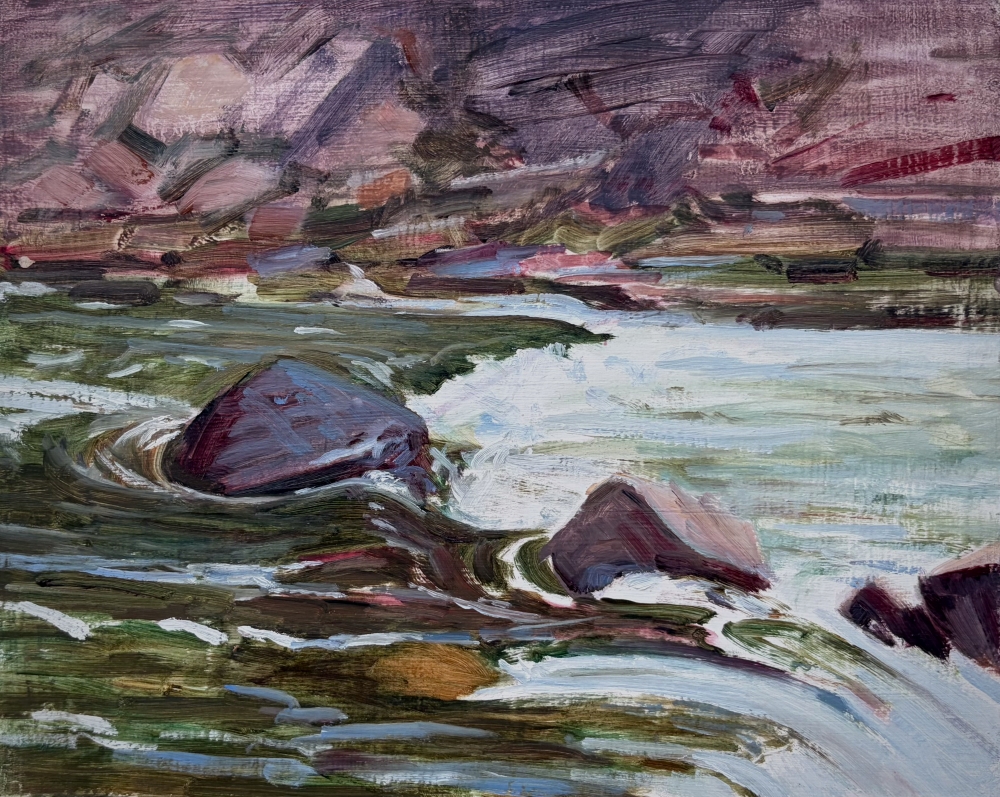
Earl Jones, “Little Cottonwood Creek,” oil on board, 8×10 in.
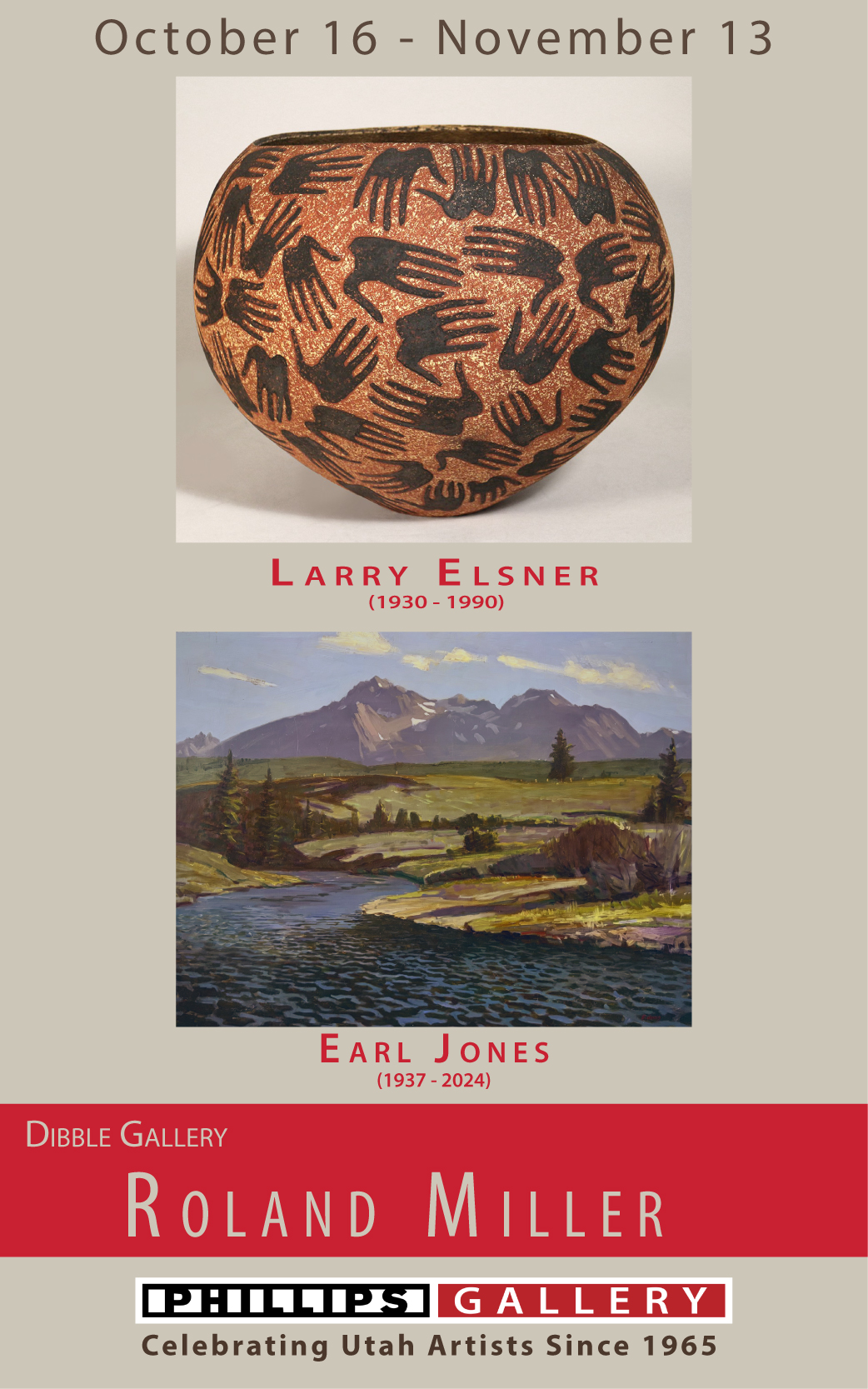
“Jones and Elsner have been exhibited together before,” says Steven Salabsky, a fine art consultant at Phillips; and it is easy to see why. Their signature mediums might have been different, but they sang the same song: form, balance, value, and the skillful manipulation of light—on the subject for the one and on the object for the other.
Earl Jones (1937–2024), a Utah art legend—and Phillips Gallery staple—has paintings in the show that represent a 53-year period of his work, dating back to 1973. What is impressive about his pieces from the ’70s is the confidence of his broken color palette, and the simplicity of his design and brushwork.
In a later painting, “Little Cottonwood Creek,” Jones’ brushstrokes are thick, lush, impactful—as if LeConte Stewart whispers his influence over the subject. Yet Stewart’s whisper is second only to Maynard Dixon’s shout when Jones presents us with a sweeping vista and imposing cloud as he does in other paintings.
In his visually playful painting, “Untitled,” the artist renders his foreground in a “large swatch pointillist style” that would make Matisse smile. The masterful control of composition and brushwork is visually riveting.
It was an outstanding decision by Phillips to exhibit multiple small works by Jones. He felt strongly that “art should be accessible across economic classes; that it belonged, by cultural right, to everyman.” Small pieces, he continued, “fit that standard better, in some ways, than the large iconic pieces.”

Earl Jones, “Untitled,” oil on board, 8×10 in.
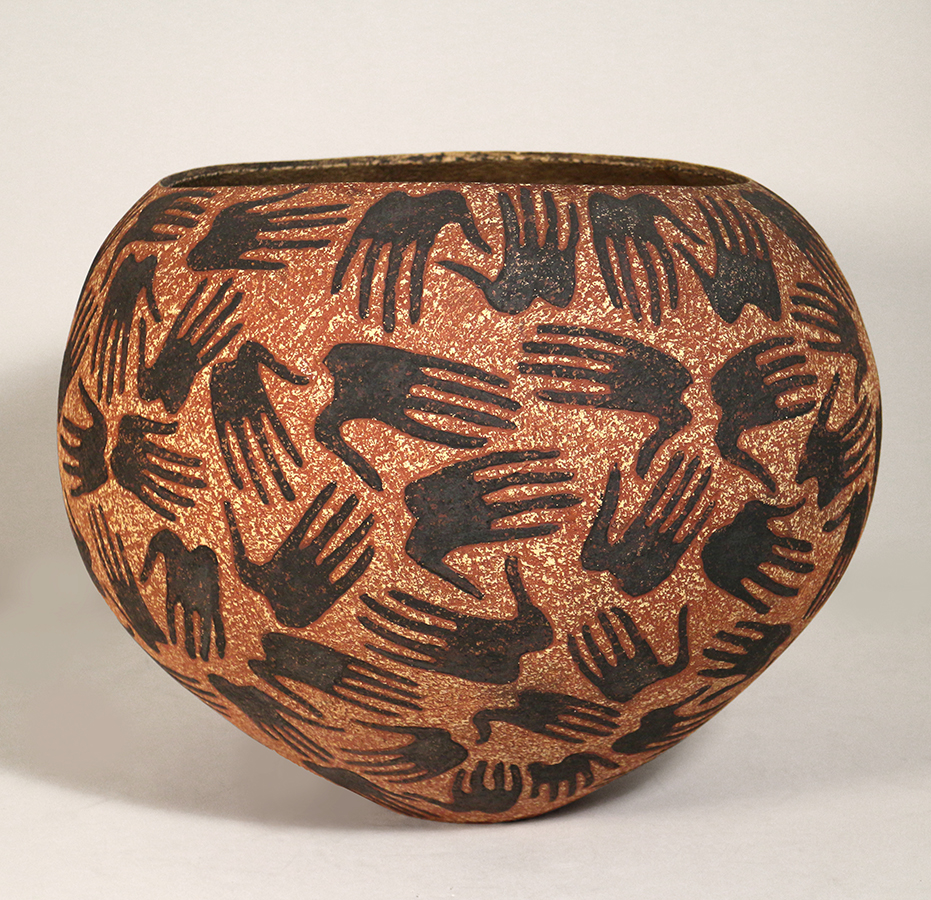
Larry Elsner, “Hand Pot II,” ceramic, 13 1/2 x 15 x 15 in.
Larry Elsner (1930–1990) was adamant that form follow function; his work in the show supports the maxim. Even the eye-fetching piece “Hand Pot II” (ceramic, 13½ × 15 × 15 inches) looks as though it might be functional, yet it is not. The perfectly placed petroglyphic hand imprints do, however, give the pot an exceptional, primal voice. It is stunning.
The sculptor’s “Torso Vessel” (ceramic/stoneware, 21¼ × 17½ × 9 inches) will remind some of Brâncuși’s “Torso of a Young Man.” However, Elsner’s sculpture rests boldly firm, steady and untroubled by its dominating form, taking us on a journey of tangible texture and monochromatic magic, unconcerned by innuendo.
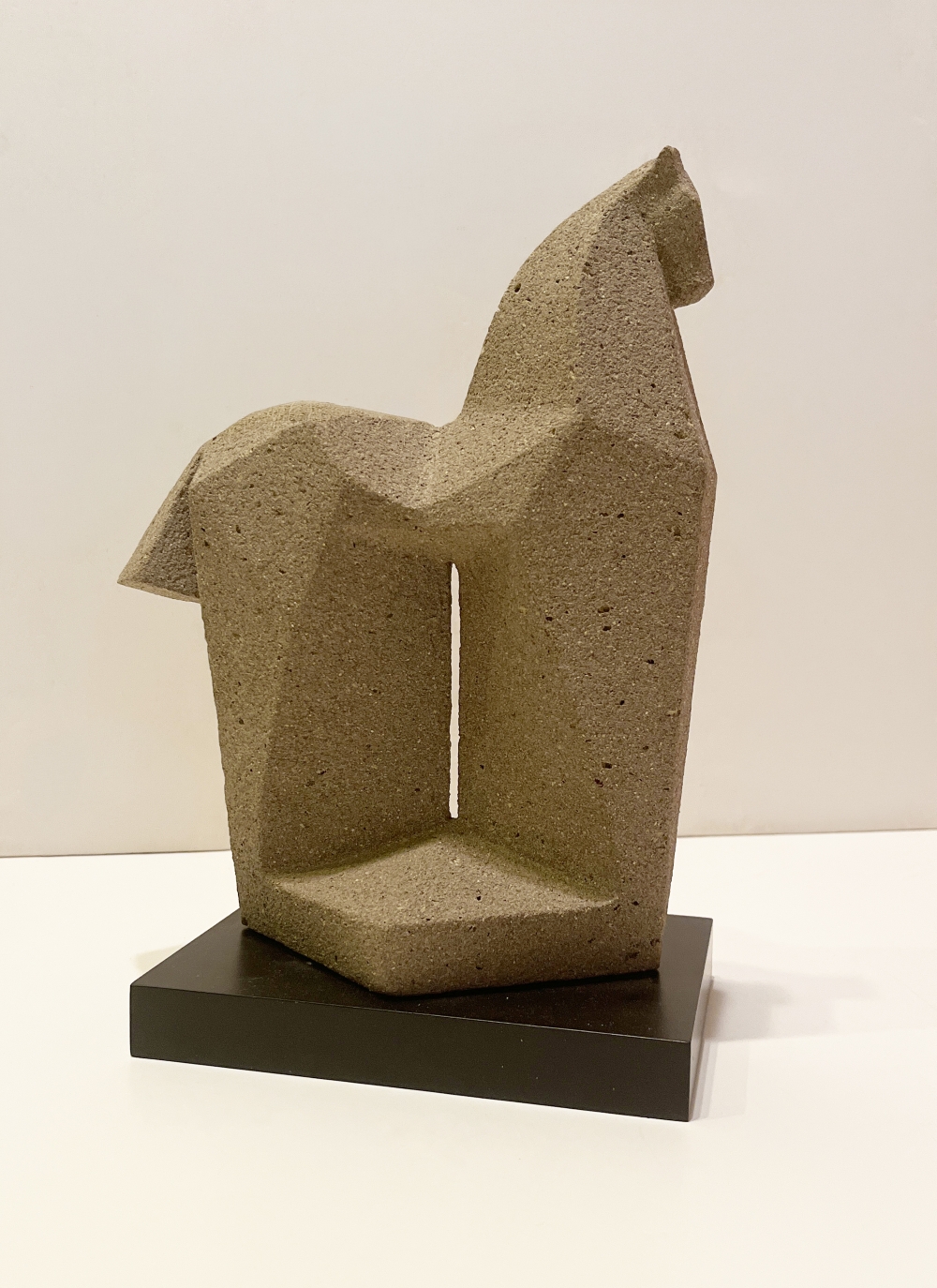
Larry Elsner, “Cubist Horse,” ceramic/stoneware, 11 x 8 1/2 x 4 in.
“His majestic ceramic horses have always been prized by collectors,” writes the gallery of Elsner’s equine art. “They have personality, style and undeniable charm.” An example is a work that shouts modernist intention: “Cubist Horse” (ceramic/stoneware, 11 × 8½ × 4 inches). There is no function here, only Cubist form: a visually energetic angularity.
In the Dibble Gallery, Phillips has yet another influential addition to the exhibition: photographer Roland Miller, who spent more than 35 years “capturing the haunting, forgotten relics of the United States space program.”
Multifaceted and still producing work, Miller has created photographs that come across as though he had a sleepover with past master photographers Harry Callahan and Aaron Siskind and spent the time exchanging ideas on design, cameras, printing paper, filters, ASA, developers, cropping, dodging, composition, the f/64 Group and more, into the wee hours of the morning.
While all the photographs in the exhibit are technically flawless and fascinating from a historical perspective, a few have such a strong design sense that they deserve mentioning. “Aft End of Artemis, 2 Core Stage” employs a tightly cropped grid design that embraces four red circles in the snug composition. Once fashioned from gleaming metal and other technology, the now weathered wondered reeks of ’60s Pop Art, … but in an excellent way.

Roland Miller, “Aft End of Artemis, 2 Core Stage,” archival print, 24 × 17 in.
“V-F1 Enging Cluster, NASA, Johnson Space Center, TX is a cold, metallic horizontal composition crowding together vertical engines that seem to materialize as pods in a science-fiction horror film. And while its worn metal should leave us cold, the composition feels inviting and right.
Lastly, “Discovery Launch, NASA, Kennedy Space Center, FL” is so crisp in its color and classical in its composition that viewers will be ignited by the spirit of the image and the exhilaration it visually invokes.
Phillips Gallery’s exhibition of work by Larry Elsner, Earl Jones, and Roland Miller will more than satisfy all who desire a great gallery experience. The art is penetrating, beautiful, and cogent.
Earl Jones, Larry Elsner & Roland Miller, Phillips Gallery, Salt Lake City, through Nov. 13.

Dave Gagon has been writing for more than 30 years, including 19 years as the visual arts writer and editor at the Deseret News in Salt Lake City. During his tenure, he reviewed the work of more than 100 artists from across Utah and received multiple writing awards from the Associated Press and the Society of Professional Journalists. Gagon is the author of Honorable Release (Signature Books 1992), a young adult novel, children’s stories and picture books, and songs that he has written and recorded. He also pursues photography through his ongoing A.I.P.S. (Abstraction In Plain Sight) project.
Categories: Exhibition Reviews | Visual Arts