
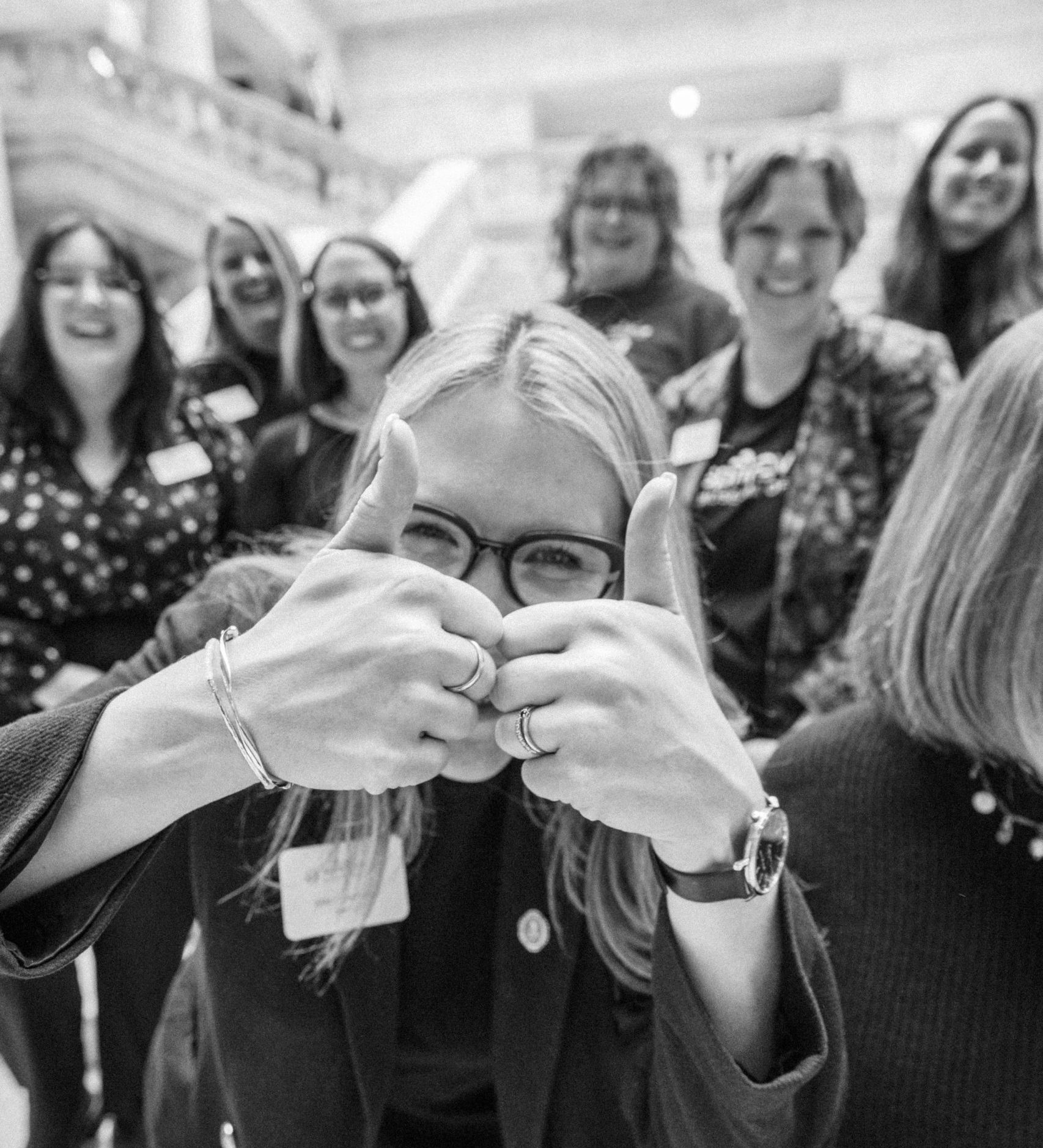
A childhood dream come true. Every year as the director of the Springville Museum of Art, Emily Larsen brings the winners of the High School exhibition to be recognized at the State Capitol.
The warm, inviting style of 1930s Spanish Colonial architecture is one of many elements that makes the Springville Museum of Art distinctive. The focus on Utah artists, on the surrounding community, and on educational outreach—all critical to the museum’s mission and history—are others. But it’s the people that bring all these things together, led by one of the many women leaders in Utah museums–Director Emily Larsen.
Working at an art museum was a childhood dream for Larsen. “I have loved art since I was a little girl. I got really interested in art history in junior high and that’s when I started telling people I wanted to be a curator and work in museums. In high school, I worked at the Treehouse Children’s Museum in Ogden. That taught me a lot about the visitor experience in museums.” Then, when she was a “very nerdy high school senior, she applied for a museum internship program in Florida, convinced that no other high school student could possibly want it as badly as she did. She didn’t get in. “I was devastated, but it also lit a fire under me.”
She began writing to Utah museums instead. Springville responded, and Larsen drove down from North Ogden to interview with then-Associate Director Natalie Peterson. She got the internship, started at BYU that summer and spent the next two and a half years moving through different departments at the museum. “Then they couldn’t get rid of me!” she says. “I just kept saying each semester, ‘Can I do another internship?’ … It taught me to love this museum.”
That early connection to the Springville Museum of Art (SMA) began a path of years devoted to the organization, culminating in her current role as its leader. Her retelling of the story highlights both her incredible dedication to the museum and her effervescent personality.
“I graduated from BYU and I was like ‘I’m going to go get my PhD and be a very fancy art historian and go to a big museum or into academia’. I came home early from my mission and it really changed my perspective on my whole life and the role of art in our lives. I started looking into art therapy or community-based arts and put the PhD on pause. I applied and was offered the job (at SMA) as the Curatorial Assistant and Registrar. It was such a good fit for me because the museum is so community focused and the idea of asking how art can improve and transform lives is so baked into what we do here.”
Larsen became Assistant Curator and Registrar, then Head of Exhibitions and Programs. While working full-time at the museum, she earned a master’s degree in history at the University of Utah. She eventually became Associate Director, and when Rita Wright retired, Larsen applied for the top job. She became director in January 2023. “The museum’s mission and my personal values align so much that it’s been just a perfect fit,” she says. “I love being here.”
In some ways, Larsen’s trajectory—from teenage intern to museum director—is an unusually literal fulfillment of the philosophy on which the Springville Museum of Art was founded: put young people in contact with art and trust that the encounter will matter.
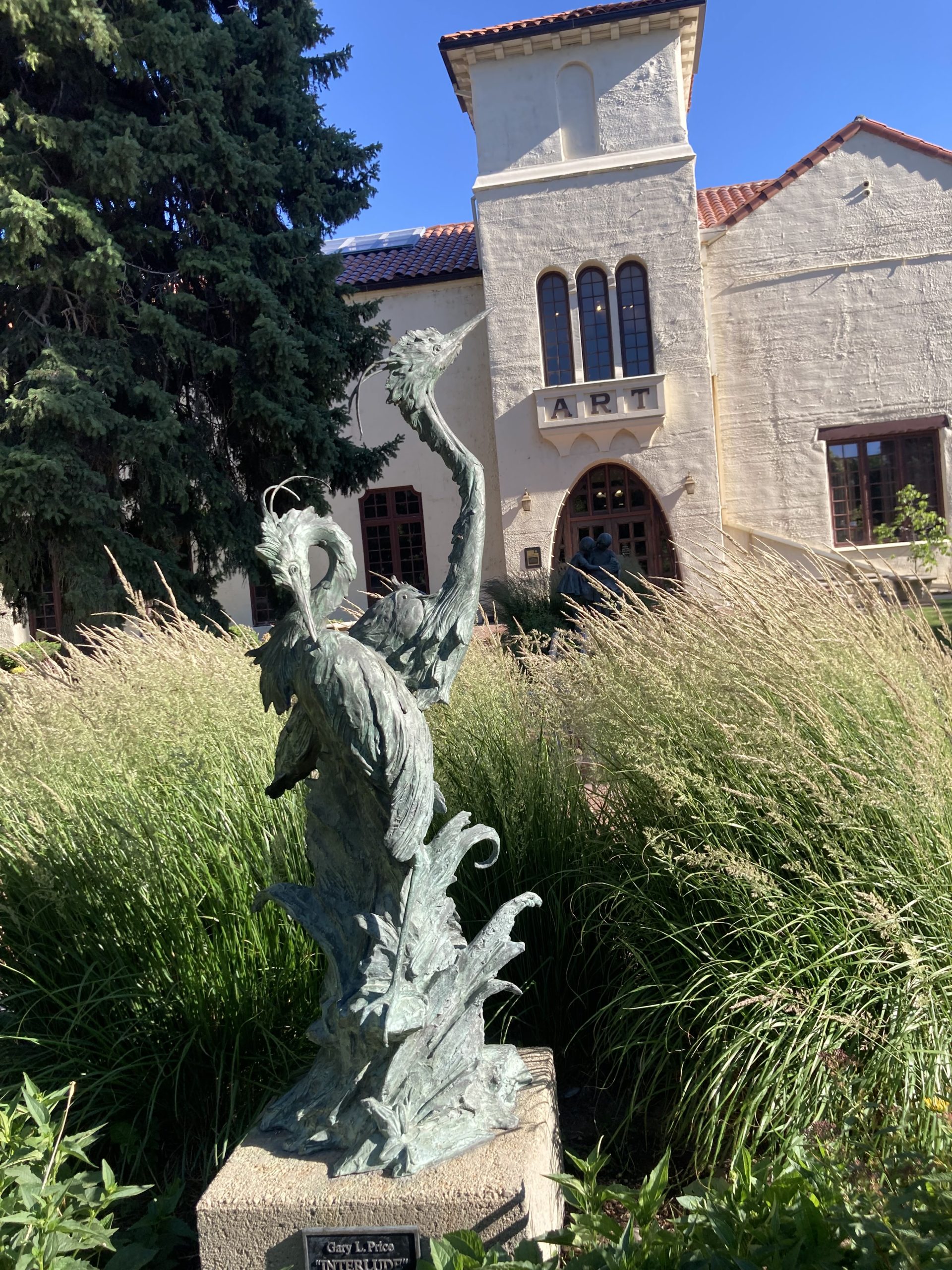
A sculpture by Gary Price points to the Springville Museum of Art, built in 1937. Image by Shawn Rossiter.
“I always say we have the most magical origin story of any art museum I know,” Larsen says.At the turn of the 20th century, Springville community members began an effort to give local students access to original art. Exhibitions were organized in the high school halls and auditorium by the art teacher, with students helping to hang the work. Underlying the effort was a belief that exposing young people to art could have effects far beyond the classroom. “They believed that if you got kids invested in art, that they would be invested in art their whole lives and that would make the community better indefinitely,” Larsen says. “Community driven, student driven—all those things still influence what we do today.”
The program expanded in the 1920s with the Annual Spring Salon. “They put out a call for art to artists across the nation. Artists like Edward Hopper, Norman Rockwell, Georgia O’Keeffe, and the Taos Society of Artists would send artwork to this show. In the 1930s this became a huge sensation.”
A collection began to form as works were purchased from the exhibitions, but creating a permanent home for them required a much larger community effort. Combining New Deal funding from the Works Progress Administration with support from Springville City, the LDS Church, the school district and local residents, the Springville High School Art Gallery was dedicated in 1937.
The museum collection formed early on as they bought works from the show. The building itself took a huge effort and a lot of coordination. With a combination of New Deal funding from the WPA (Works Progress Administration), the City of Springville, the LDS Church, the school district, and the community, it was dedicated in 1937 as the Springville High School Art Gallery, the museum for the students’ collections and exhibitions. “In the middle of the Great Depression, there was this emphasis on beauty. The students, with one of the art teachers, fired and built all the clay tiles you see on the floors. It was really a labor of love. An investment by this community in the power of art and arts education. What has been prioritized in all the building projects over the 90 years has been exhibition space. That goes back to the mission: how do you make more art more accessible to more people.”
Providing access is a broad reaching goal for both Emily and the SMA. It can be seen in the building itself, the exhibitions, the advisory committees, and with their expansive educational programs. “About a quarter of our operation focuses on education programs. We receive funding through a program called POPS (Professional Outreach Programs in the Schools). We serve students at every school district in the state on a rotation, serving about 35,000-40,000 students and teachers from about 350-400 schools each year. It’s hugely important to us.”
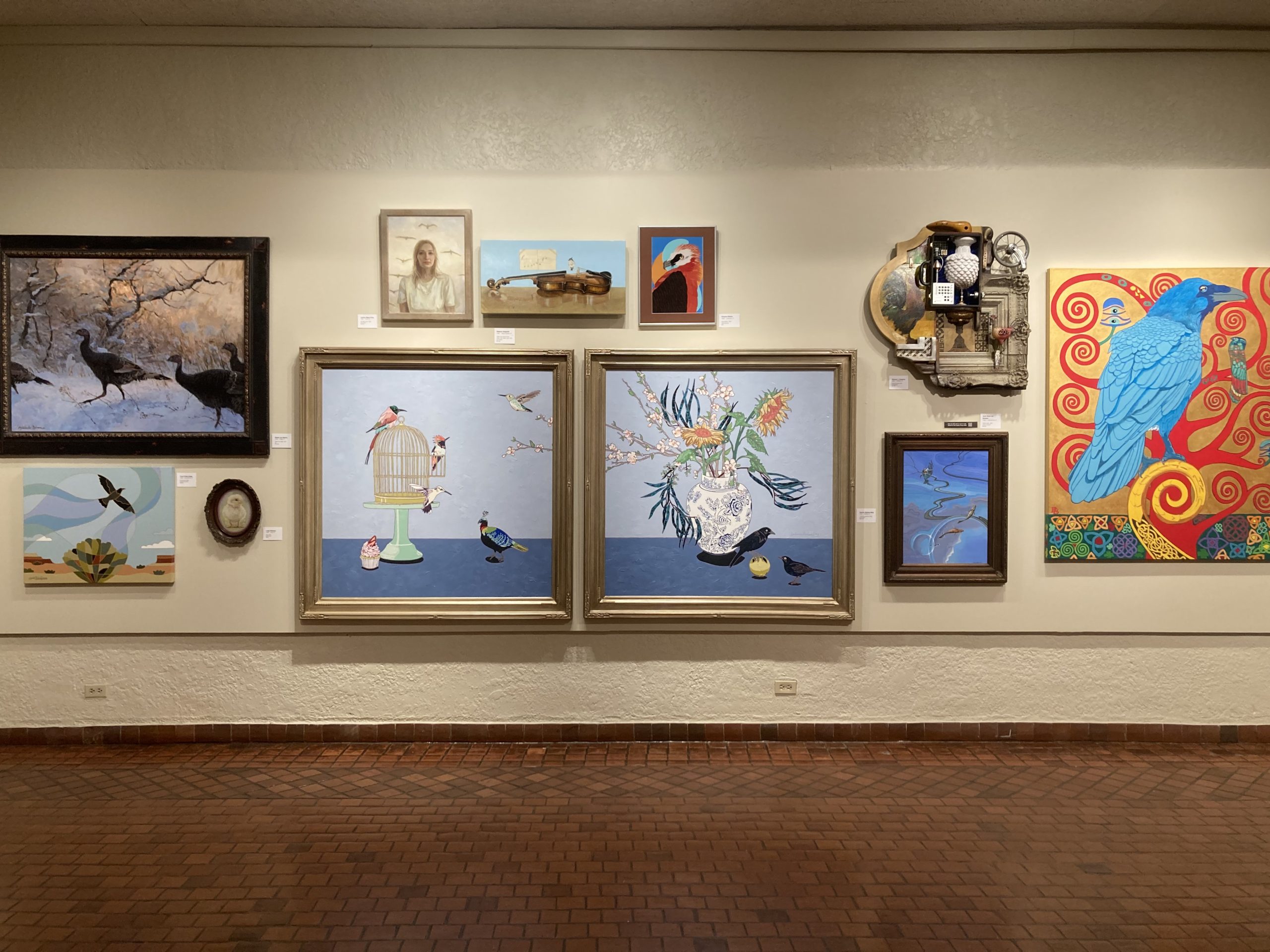
A view of the 2025 Spring Salon. Begun in 1922, the Salon remains the museum’s most important annual exhibition. Image by Shawn Rossiter.
Access also means a tight connection to artists and the community. “This museum supports artists, supports students, and is a community museum really serving the families in the area,” Larsen says. Its collection is particularly strong in Utah art and Utah history, and acquisitions are made with advice from a committee that includes board and community members.
“We do a lot of catalogues, and the historian in me appreciates how important they are in the moment, but I also realize it becomes priceless in 20 years when you’re trying to find out what happened in Utah in 2026. I find that, for our mission of preserving Utah art history, the catalogues are really important and supporting artists is hugely important to us and the catalogue becomes a tool that supports them as well.”
The museum’s approach to exhibitions has also become deliberately collaborative.
“Curator is in no title in the museum anymore. “Usually, it’s Allison Pinegar (Head of Exhibitions & Programs) or I as the team lead and then it’s really collaborative with our education staff and our registration staff. We often work with external collaborators and advisors. One thing that’s really important to us with our exhibitions and programs is that things are really accessible and that people can come and make their own meaning and interpretation. It’s not our style to have this strong expert curatorial voice. We are trying to give context and then give the visitor a lot of entry points to find what is meaningful for them. That’s really core to our curatorial philosophy here. Being visitor centered is really the goal of our exhibitions.”
That visitor centered approach is at the heart of how she looks at museums in general and how she and her staff – and, by extension, the museum field – can create an atmosphere that welcomes everyone, that is comfortable and engaging, and that eschews the old standard elitism of the industry. “I think we, as museums, have the responsibility to challenge elitism. There are so many people who are intimidated and feel like museums are not for them. That’s why I often say, ‘we’re a museum and no snobs allowed’. I tell my staff all the time that the worst thing we can ever do is have someone come in here and feel stupid, like they do not have the right knowledge to make connections with the art.”
“The architecture really helps us here because it’s so warm and that’s something people comment on all the time,” she says. “I think museums in Utah do a really good job of this overall and we’re lucky that it’s the ethos of our whole community. It’s so critical that we remember that, for a long time, museums were intentionally exclusionary and we ask ourselves, ‘how are we counteracting that now?’”
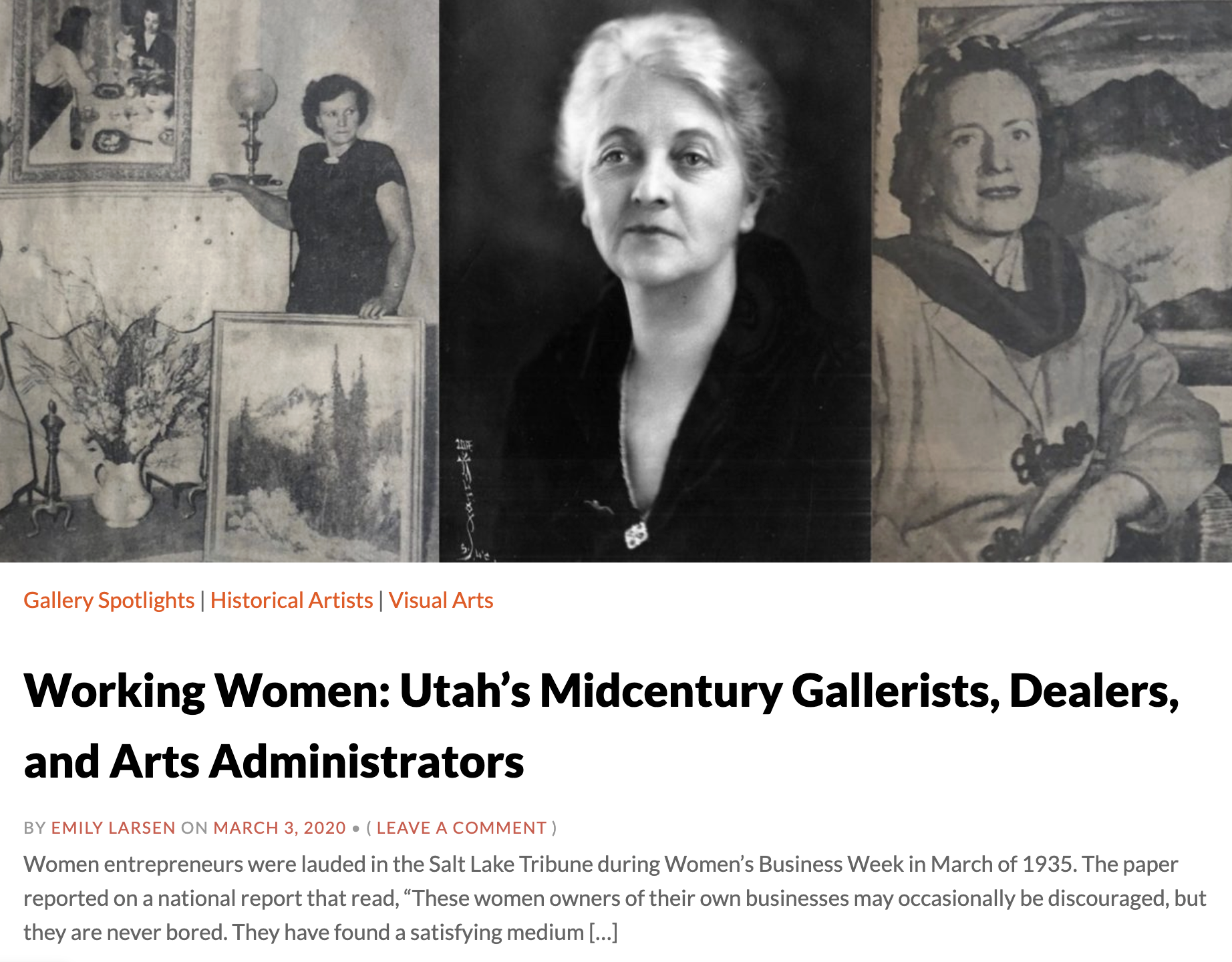
In conjunction with her Master’s program at the University of Utah, Larsen began publishing articles on women in Utah art history in the pages of 15 Bytes. She continues to write articles for the publication and servers on its board of directors. Find her article here.
Larsen’s interest in how museums and art institutions evolve extends beyond her work in Springville. For more than a decade, she has collaborated with BYU art history professor Heather Belnap on research into women in the art world during the late 19th and early 20th centuries. They have published articles independently and together and are working toward a larger project that Larsen hopes will eventually become a book. “Right now, we are both seeing so many women in leadership positions as a return to the first half of the 20th century when women like Alice Merrill Horne, May Huntington, and Alta Rawlins Jensen, were really running the art world in Utah. Heather is a feminist art historian and researches these women that are part of my own history and cultural traditions. It’s been very meaningful to work on that.”
Emily Larsen’s contributions to the Springville Museum of Art go far beyond the walls of the museum building. Her excitement is clearly creating more of the same within her staff and with the artists and community members with whom she works so closely. From an undergrad intern to the Director of the museum, she has built her career at SMA and is now in a position to ensure its future and its impact.
“All the experience I’ve gotten outside the museum – being on boards, doing research with outside collaborators – has influenced how I think about this institution and the impact it can have. It’s been an amazing journey and I feel lucky to be here.”
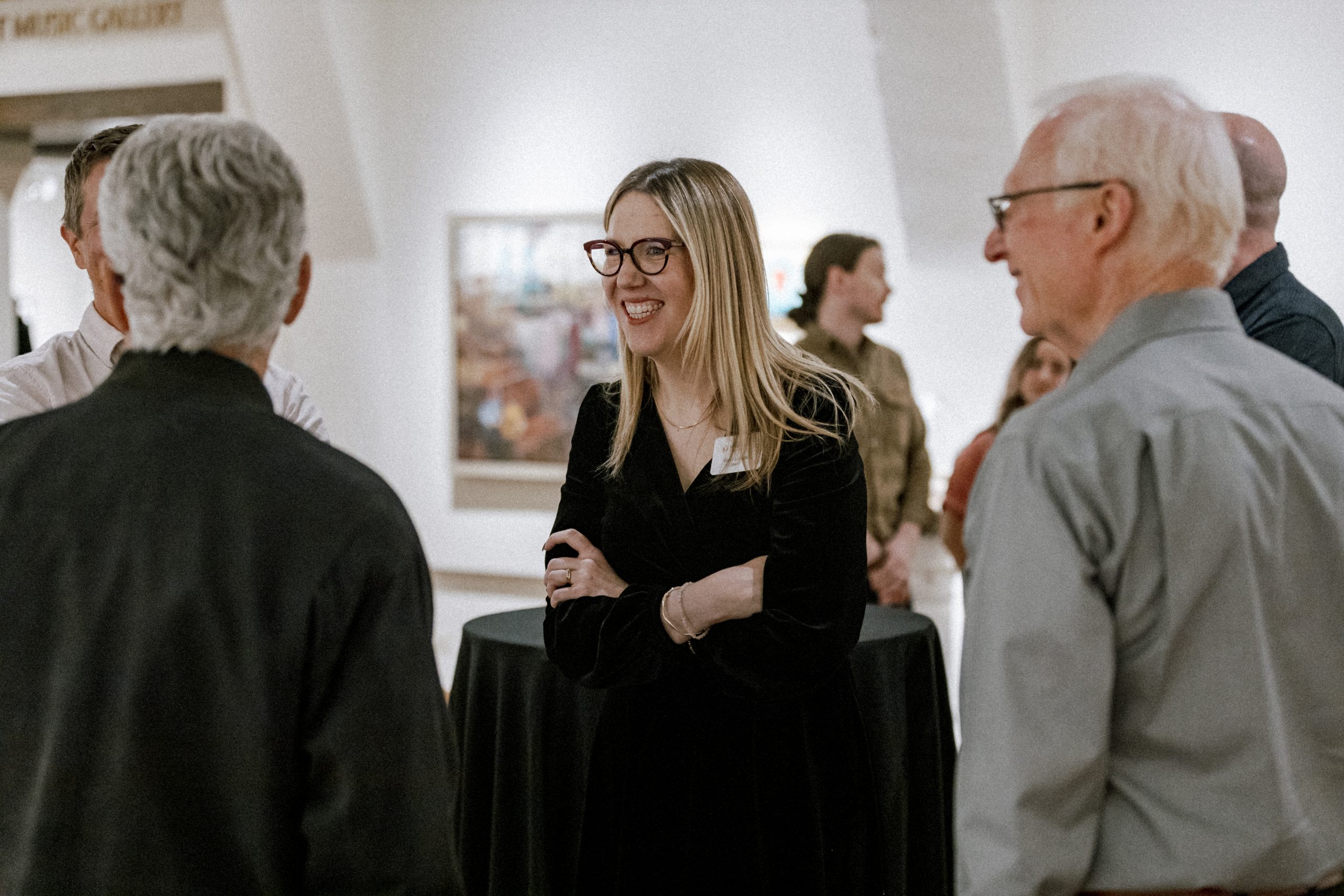
Emily Larsen’s infectious enthusiasm spreads to patrons at the 2026 Spring Salon.
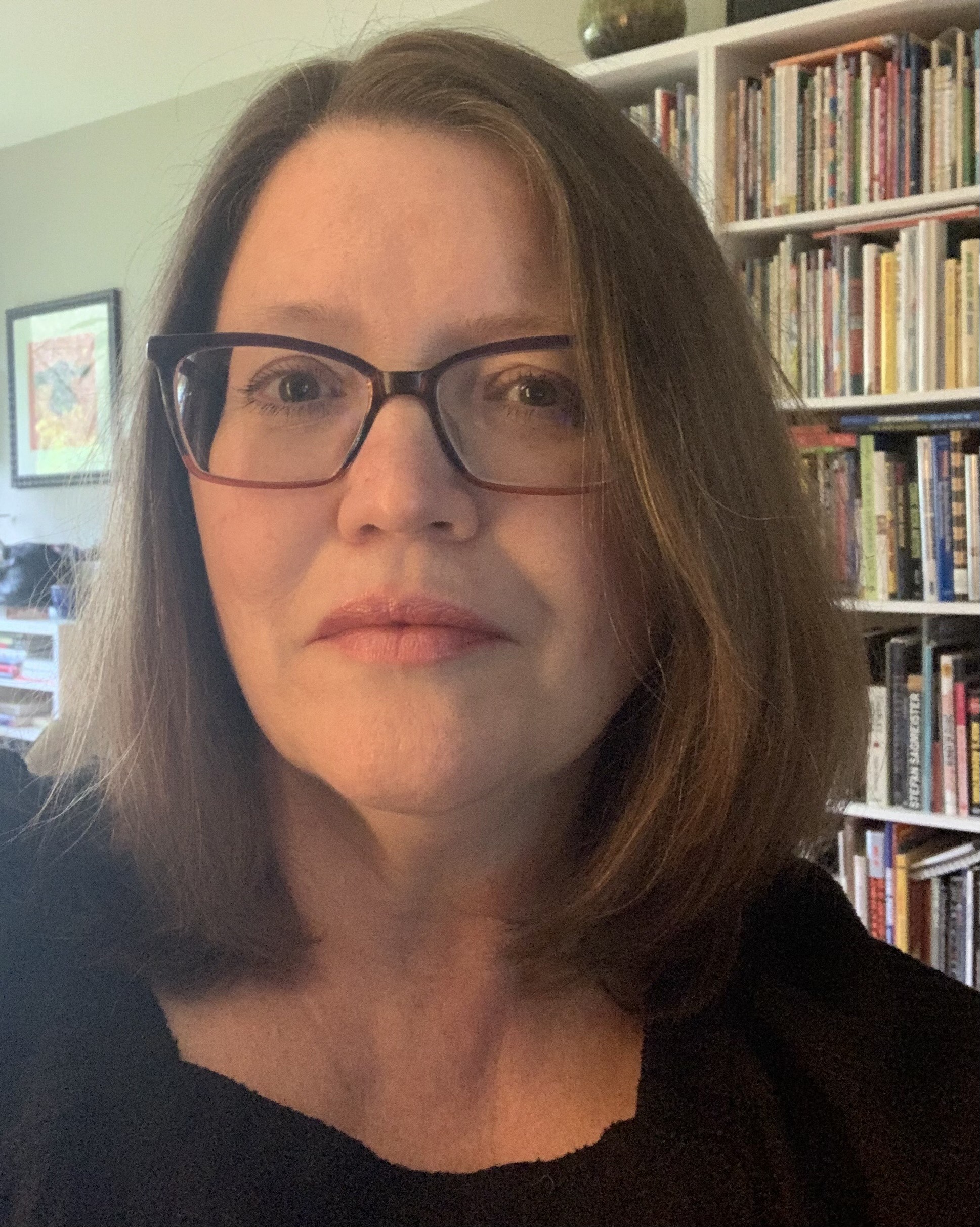
Gina Cavallo has been a curator, registrar, and executive director in museums for over 35 years. She spent many years as an art critic for publications in Phoenix. She began her career at the Phoenix Art Museum and the Heard Museum, was a founding curator at the Scottsdale Museum of Contemporary Art, spent two terms managing exhibitions at the Virginia Museum of Fine Arts, and was the Executive Director at the Mission Inn Foundation & Museum in Riverside, California. Her current role is Director of Development for Taproot Theatre Company in Seattle where she also serves as the curator of the Kendall Center Exhibition Series. She moved to Orem in 2024 with her husband, a theatre faculty member at UVU.
Categories: Art Professional Spotlight | Featured | Visual Arts



Emily has excelled as the Springville Museum of Art Director! She has a wealth of knowledge and commitment to the community. SMA has always had great art educators leading the museum and Emily is making her mark in significant ways which advance the power of the arts throughout Utah. Kudos Emily!