Utah has never been as monolithically Mormon as the cliché would have us believe. As evidence: the many virgins of Salt Lake City.
Of course, native peoples were here first. Then, after 1847, whole towns were established by Latter-day Saint immigrants, and many remain predominantly Latter-day Saint to this day—evidenced by the uncrossed spires of their wardhouses and temples. Other communities grew up around mining or the railroads, however, and attracted people from places Mormon missionaries had never visited—which is why Carbon County has so many Italian surnames. In Salt Lake City especially, you’ll find evidence of non-LDS immigrants, from the Greek Orthodox Cathedral to the Buddhist temple in old Japantown.
For evidence of the Mexican community that has shaped the city for more than a century, just look for the Virgin of Guadalupe.
According to Catholic tradition, the Virgin appeared to the Indigenous convert Juan Diego in Mexico in 1531. She has since become not only Mexico’s patron saint but one of its most enduring cultural symbols. Roughly one in five Salt Lake City residents now identifies as Hispanic or Latino. While a good deal of that growth is recent, the community’s roots in the city stretch back generations. The Virgin of Guadalupe’s image offers a way of tracing that history through the city’s neighborhoods.
The most official of these Virgins sits in Guadalupe Park, a small pocket park at 619 W. 500 North.
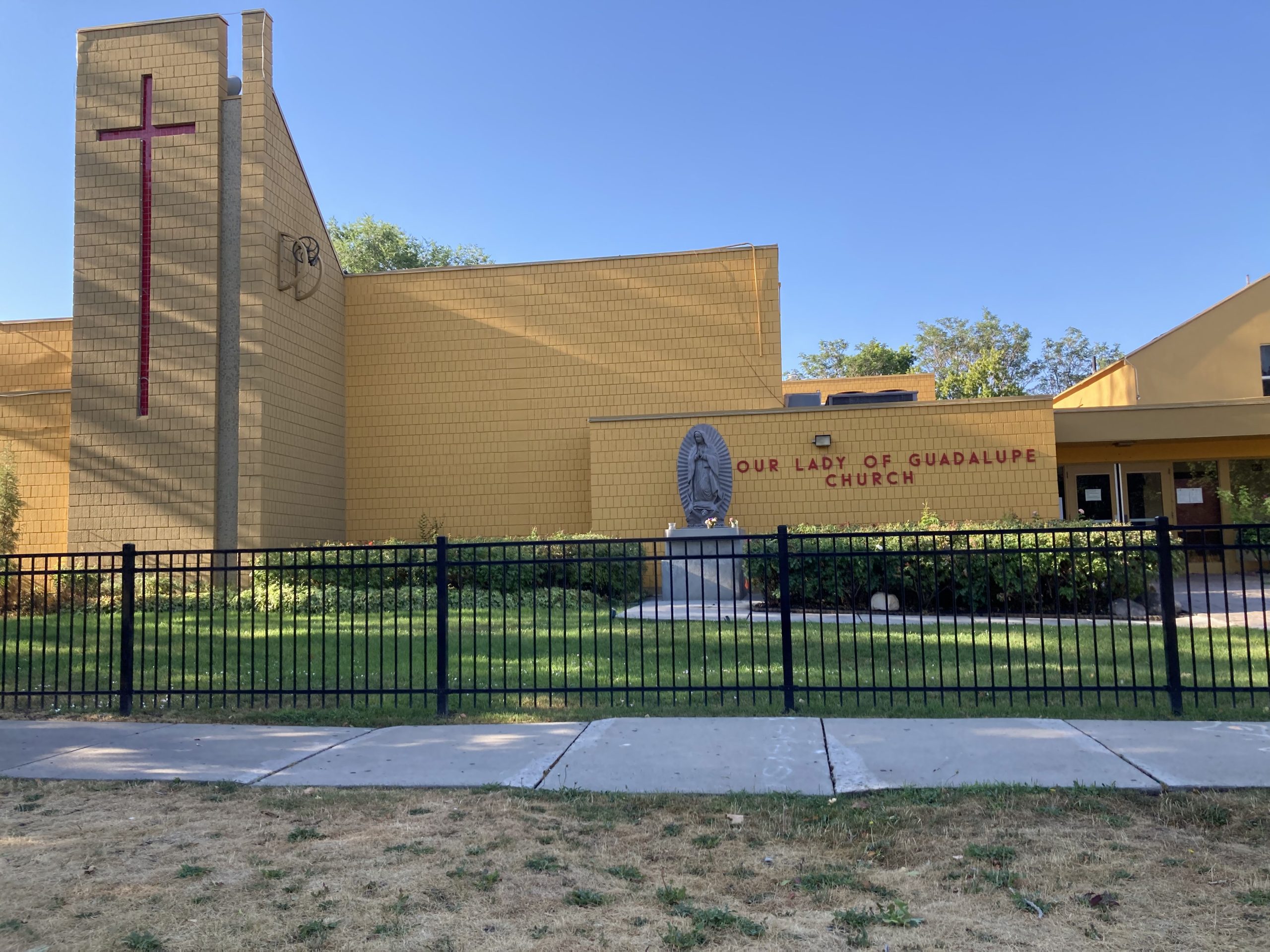
The area north of North Temple and west of the railroad tracks became home to a growing Mexican community who came to work on the railroads in the 1920s. The area was open fields stretching toward the Jordan River, but a neighborhood grew up around Our Lady of Guadalupe Parish. The church’s roots go back to 1920, when a priest at St. Patrick’s began celebrating Mass in Spanish for a growing population of Spanish-speaking Catholics, many of whom had come by way of New Mexico. He proposed establishing a mission dedicated to Mexico’s patron saint. It took years to secure a permanent Spanish-speaking priest, but nuns who had fled religious persecution in Mexico in the wake of the Mexican Revolution kept the mission’s school running. In 1947, the parish relocated a surplus Army chapel from Camp Kearns to its present site at 300 North and 700 West. Expanded in 1972, it continues to serve a Spanish-speaking congregation, its exterior marked by an image of the Virgin of Guadalupe.
When Interstate 15 was built in the 1960s, it sliced the Guadalupe neighborhood in half. The parish church was left on the west side. A six-block long section of the neighborhood, with North Temple at its base and capped by the 600 North exit/entrace, remained on the east. It still bears the name Guadalupe. At its heart is a small park, built in 1987.
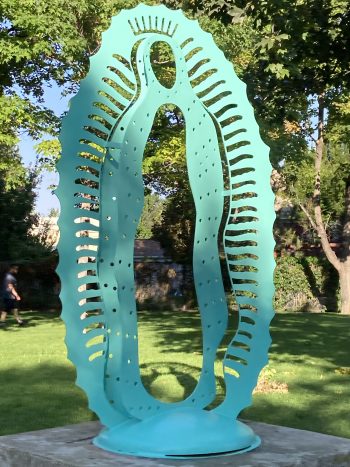
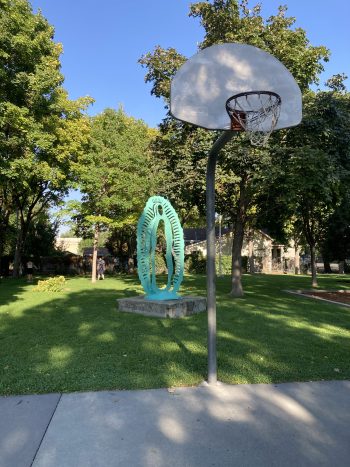
Inside the park, artist William “Willy” Littig installed “Lupita, the Woman,” a painted steel sculpture that reduces the traditional image of Our Lady of Guadalupe to its essential silhouette: a radiating, scalloped aureole in turquoise, perforated with small holes suggesting the star-covered mantle, a crown at its peak, and a hollowed negative space where a body would be. It’s an abstraction, but an unmistakable one—anyone who grew up with the image would know immediately what they’re looking at.
The sculpture was one of Salt Lake City’s early public art pieces. A plaque at the sculpture’s base dedicates the piece to Littig’s father, Hugo F. Littig. The park itself was dedicated that December, timed to coincide with the Feast Day of Our Lady of Guadalupe, capping a fifteen-year effort by neighborhood residents to organize around a shared corner of green space. At the dedication, a city official said the sculpture represented the same compassion the Virgin had shown the community. Nearly forty years later, Lupita’s base is still regularly strewn with roses and prayer candles.
Traveling southeast, crossing downtown Salt Lake City, the Virgin appears again—not in steel, but in the trunk of an ordinary American elm.
In May 1997, city workers cut a branch from a tree at another of the city’s pocket park—Taufer Park at 700 South and 300 East. The flat knothole left behind revealed an outline resembling Our Lady of Guadalupe, head bowed, cloak trailing. Word spread quickly, particularly among Latino Catholics who saw in the marking an echo of the sixteenth-century apparition in Mexico. What had been an ordinary bus stop became a pilgrimage site. Concerned about the wooden steps people had built to reach the image nine feet above the ground, the city replaced them with something sturdier and relocated the bus stop rather than disturb the shrine.
The tree has taken some hits since. In 2002, just ahead of the Salt Lake City Olympics, a vandal chiseled the knothole out entirely. Seven years later, someone tried to set the stairs on fire. None of it ended the devotion. For years, a photograph of the lost image, sealed beneath Plexiglas, hung over the scar.
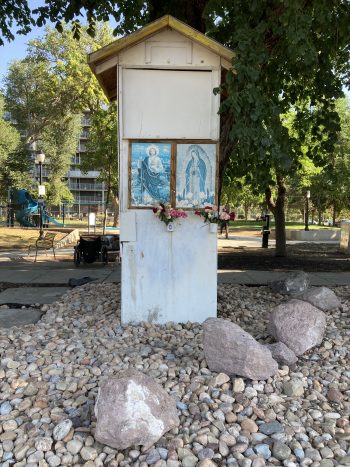
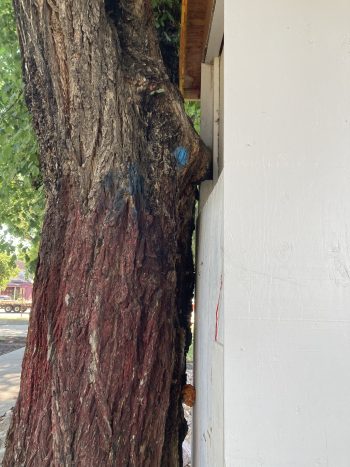
Today the shrine has a small peaked-roof structure built directly against the trunk, housing framed images of St. Jude and Our Lady of Guadalupe, flowers set in vases beneath them, the ground around it terraced in river rock. The original cut is boarded over now, though traces of blue and red paint still bleed into the bark below it.
Moving west again along 900 South and passing beneath the interstate, the Virgin appears once more in Glendale.
A resident of Salt Lake City’s Glendale neighborhood for more than fifty years, Eli Herrera lives on a well-kept property near Jordan Park. The south side of his lot was lined with mature trees that had been there as long as he has. When he finally cut them down three years ago, he left two trunks standing, trimmed to the height of his one-story home.
While cleaning the bark from the trunk closest to the street, he saw an image in the grain of the wood: the Virgin of Guadalupe in a flowing robe, and just above her, the profile of Christ’s face. Herrera began carving and pecking to bring the figures into sharper relief, then added a steel crown at the top. When he painted blue acrylic around the Madonna, someone warned him the color would bleed in the rain. It did—but only into her robe, which has been associated with that particular blue for so long that a shade of it bears her name. The color has since faded, though Herrera plans to repaint it this fall.

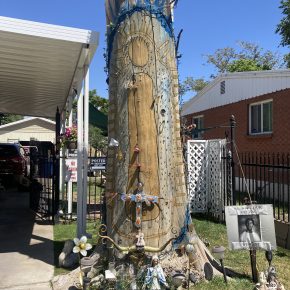
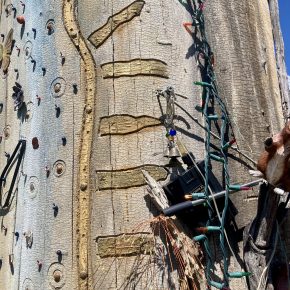
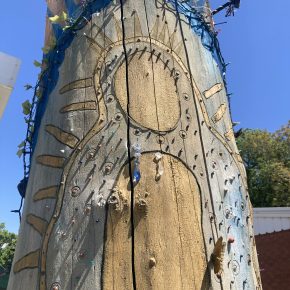
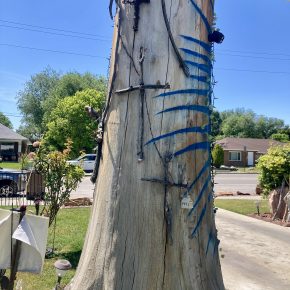
He has continued adding to the shrine for the past three years, including lights that illuminate it after dark. People have come to pray at the house—enough of them that he’d prefer not to make his address public. Among the regulars is a young man from the neighborhood whose life has been undone by drugs. He comes weekly to pray, and Herrera has let him attach a small cross at the base of the tree. (Next to the tree, tucked against the shrine, is a protest that long predates the Madonna tree. A photo of his nephew, Caleb Herrera, is framed by the words: “We want our meeting. We want answers.” He was killed under suspicious circumstances in 2003.)
These aren’t the only instances. A small sculpture of the virgin is in the rear parking lot at X, and she appears on walls across Salt Lake City, where murals often place her alongside portraits of loved ones. Walk through Salt Lake City looking for the Virgin of Guadalupe and you’ll discover an unofficial map of the city’s Mexican community.
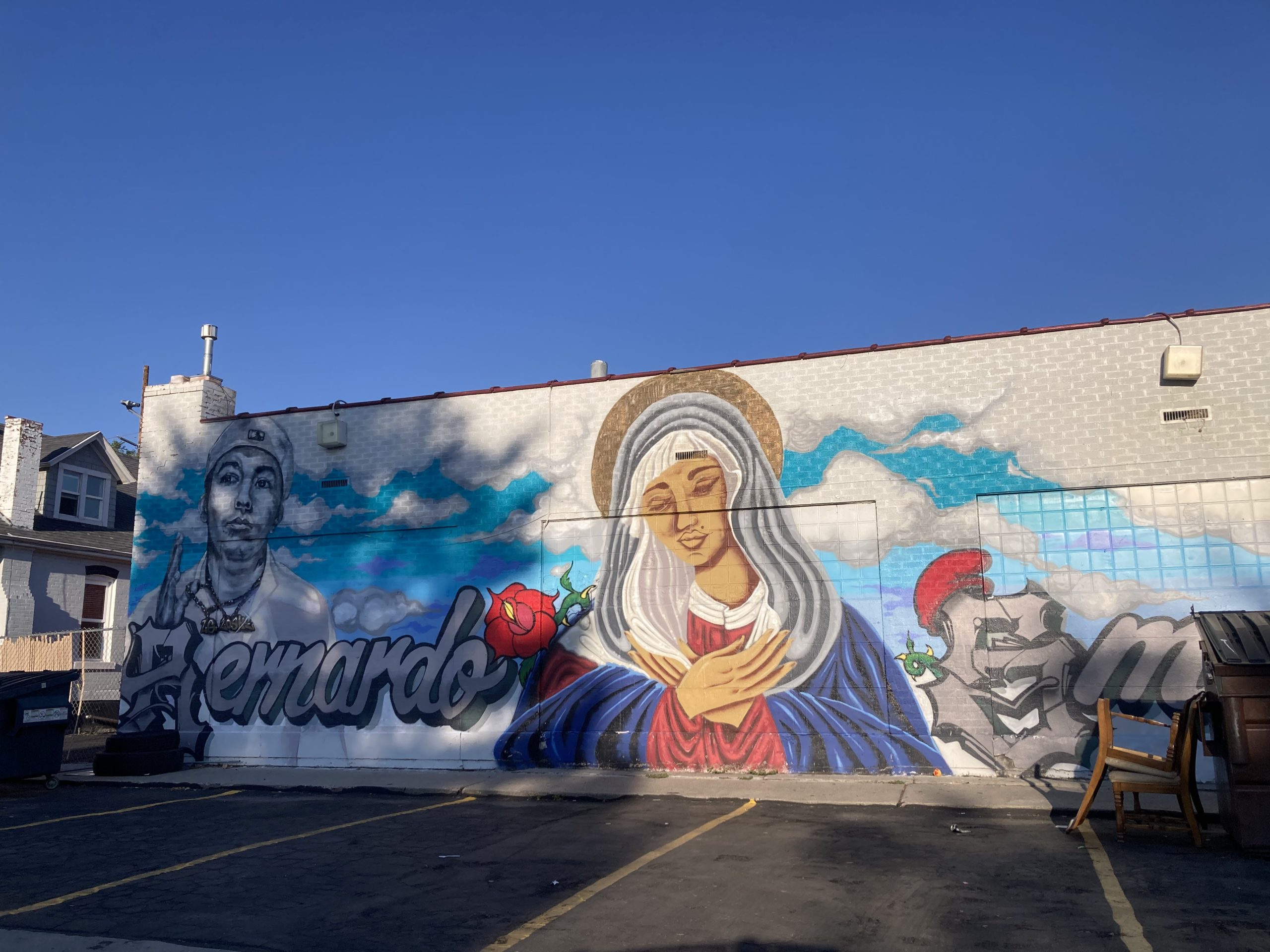
Guadalupe Park Block Party, Friday, August 28, 6 to 9 p.m., Guadalupe Park, 600 West 500 North, with the unveiling of new mural by Beto Conejo.
DID YOU ENJOY THIS ARTICLE?
Help make more like it possible.
VENMO us a donation at artistsofutah

Or use PayPal to MAKE A DONATION.
15 Bytes is published by Artists of Utah, a 501 (c) 3 tax-exempt nonprofit.

The founder of Artists of Utah and editor of its online magazine, 15 Bytes, Shawn Rossiter has undergraduate degrees in English, French and Italian Literature and studied Comparative Literature in graduate school before pursuing a career in art.
Categories: In Plain Site | Visual Arts