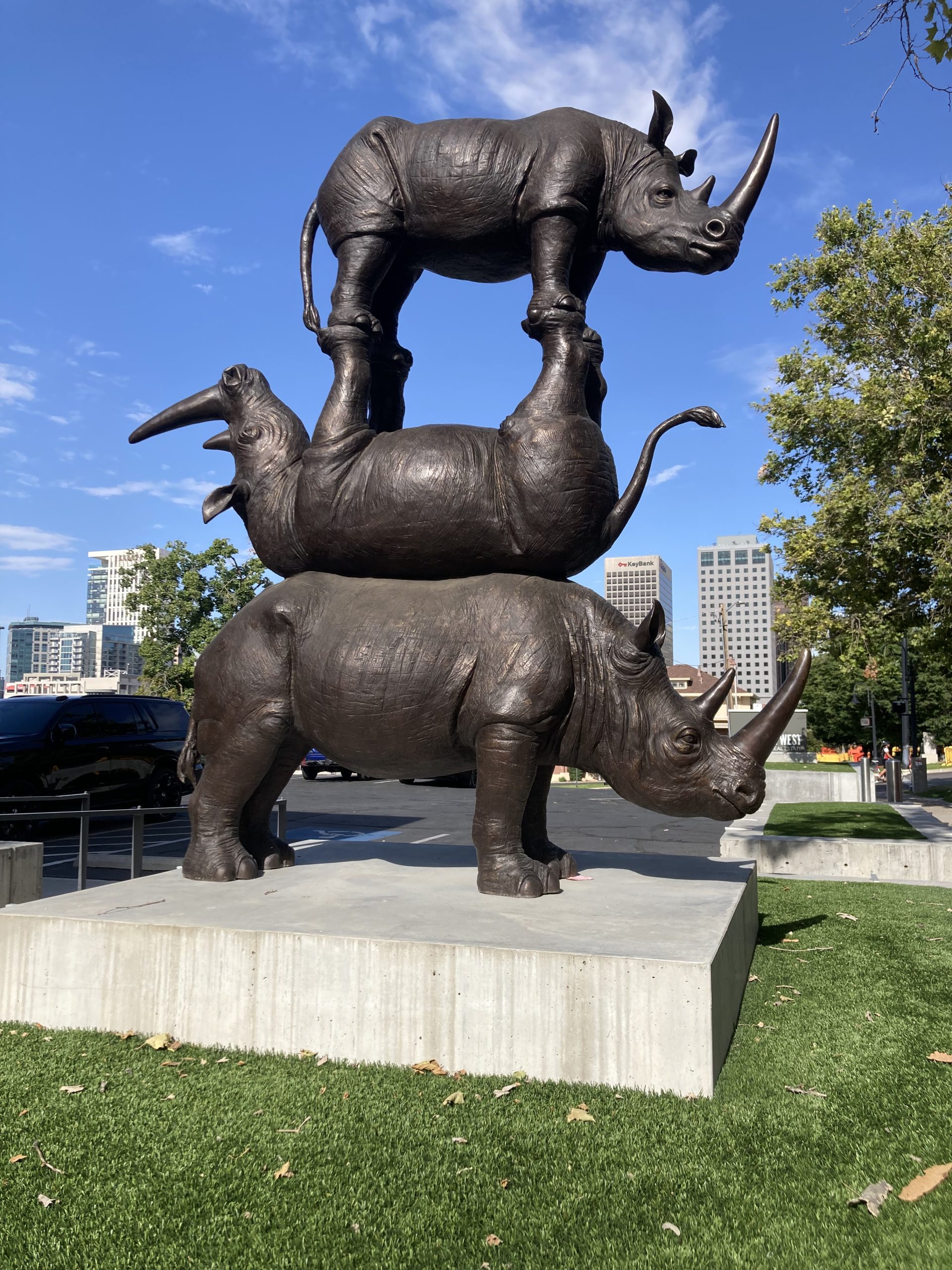
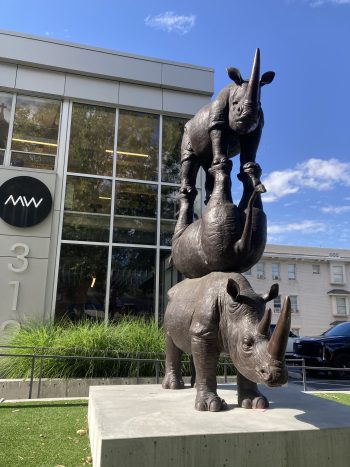
Gillie and Marc, “The Last Three,” 312 East South Temple, Salt Lake City
New York art critic Jerry Saltz once offered a piece of advice to young artists and critics alike: know what you hate. And this sculpture, on South Temple, is what he hates.
In March 2018, Gillie and Marc Schattner unveiled “The Last Three” in New York’s Astor Place: a 17-foot bronze stack of the three surviving Northern White Rhinos, one balanced improbably atop another, meant to call attention to the subspecies’ extinction. Saltz, writing for New York Magazine’s Vulture, was not moved. He called it “mad-ugly,” a “kitschy monstrosity,” and “a circus of extinction come to town,” adding that it “proves my adage that 95 percent of all public sculpture is crap.” He compared the stacked rhinos to “a Vegas acrobatic act” and, for good measure, told readers that if they liked the sculpture, it meant they had bad taste.
A smaller version of that same piece is in Salt Lake City, at 312 East South Temple, one of several sculptures—an ostrich, a sumo wrestler, a rhino among them—that developer Steve Price has installed on his downtown properties.
Gillie and Marc are, by their own account, unbothered by this kind of thing. The couple met on a shoot in Hong Kong—Gillie modeling, Marc directing—and built a career designing big, brightly colored, instantly photographable bronzes: rabbit-women and dog-men riding scooters, endangered animals posed for maximum selfie yield. When Saltz went after “The Last Three,” they wrote him an open letter thanking him for the attention. Their argument, more or less: any headline is a good headline if it gets people talking about rhinos. All publicity is good publicity.
Gillie and Marc have kept installing sculptures in cities around the world regardless. Saltz continues to call them, “the worst two artists in the public sector.”
So, when Saltz was in Sydney in June—for Vivid Sydney, where he was a featured speaker—he photographed himself standing next to Gillie and Marc’s bronze of “Rabbitwoman and Dogman” “Unfortunately I saw this @gillieandmarcart sculpture when I was in Sydney, Australia,” was his one line caption. He tagged the artists directly.
This time, Gillie and Marc didn’t write a thank-you note. In a since-widely-shared post, they described the pile-on that followed—thousands of comments, “harsh, cruel and deeply personal”—and said it left them questioning whether to keep making art at all. They framed it, ultimately, as a story about resilience: messages of support arrived alongside the abuse, and “the world doesn’t change because of the people who criticise. It changes because of the people who keep creating.”
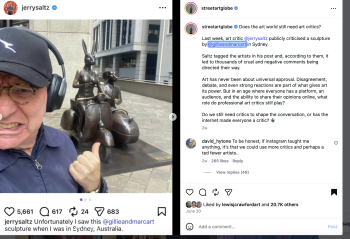
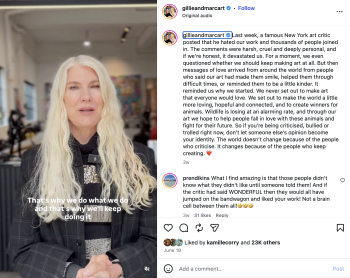
The account @streetartglobe, reposting the exchange, put the sharper question out loud: does the art world still need critics?
Since Saltz’s 2018 take-down, the media world has changed. Gatekeepers have lost their power. Everyone with an instagram account can be an art critic.
But social media seems to only have two settings: cheerleader or troll.
 A critic’s job, at its best, is neither. It’s supposed to be the room in between. When appropriate, a considered “I don’t think this works, and here’s why” that leaves space for the artist, and the public, to disagree back. Saltz’s Astor Place review, mean as it was, still argued a position: that public sculpture too often chooses spectacle over form. His Sydney post argued nothing. It threw down a line and said: now argue amongst yourselves.
So, what do you think about SLC’s “The Last Three”?
DID YOU ENJOY THIS ARTICLE?
Help make more like it possible.
VENMO us a donation at artistsofutah

Or use PayPal to MAKE A DONATION.
15 Bytes is published by Artists of Utah, a 501 (c) 3 tax-exempt nonprofit.

The founder of Artists of Utah and editor of its online magazine, 15 Bytes, Shawn Rossiter has undergraduate degrees in English, French and Italian Literature and studied Comparative Literature in graduate school before pursuing a career in art.
Categories: In Plain Site | Visual Arts