“Open wide the floodgates / wash away extractors from the shore. / may we never again measure / this body by economic value. / may we count our blessings / by the flaps of wings. / may we be the ancestors who stepped / in the path of destruction / and said no more.”
-lake words
Trent Alvey opened her BDAC show, An Ecological Reckoning: Tar Seeps of The Great Salt Lake, with a poetry reading and remarks on the dire state of the Great Salt Lake. Milo, a poet and local activist, read original poems from lake words, a queer abolitionist love letter to the Great Salt Lake. Ben Abbott, from Grow the Flow and a plant and wildlife sciences professor at BYU, followed with his presentation on how and why we have arrived at the current state of dire, drying affairs of our neighborhood saline lake—and what it could look like if left unabated.
It was a powerful move on Alvey’s part to give young anarchist queers the stage in a room of elders and those who bear monetary and social capital. Milo’s words echoed a deep resonance in the room of seemingly Bountiful and Davis County residents and regulars, artists and their friends and family. It was a radical moment, hearing words that are strung together in eloquence and strength and assuredness on the demise of the lake at the hands of corporate extractors. The poems spoke on how the magnesium from our neighborhood lake is being used to bomb innocent children in Palestine—how one violent colonial project on our neighborhood shores is funding another violent colonial project overseas. (lake words can be found around town for free, printed and assembled by hand at Saltgrass Printmakers. Any donations to the project go half to printing, and half to getting people in Palestine sim cards to remain connected to the outside world.) It was a powerful start to the evening, the spoken word taking science beyond the literal and into the spiritual dedication to this body of water.
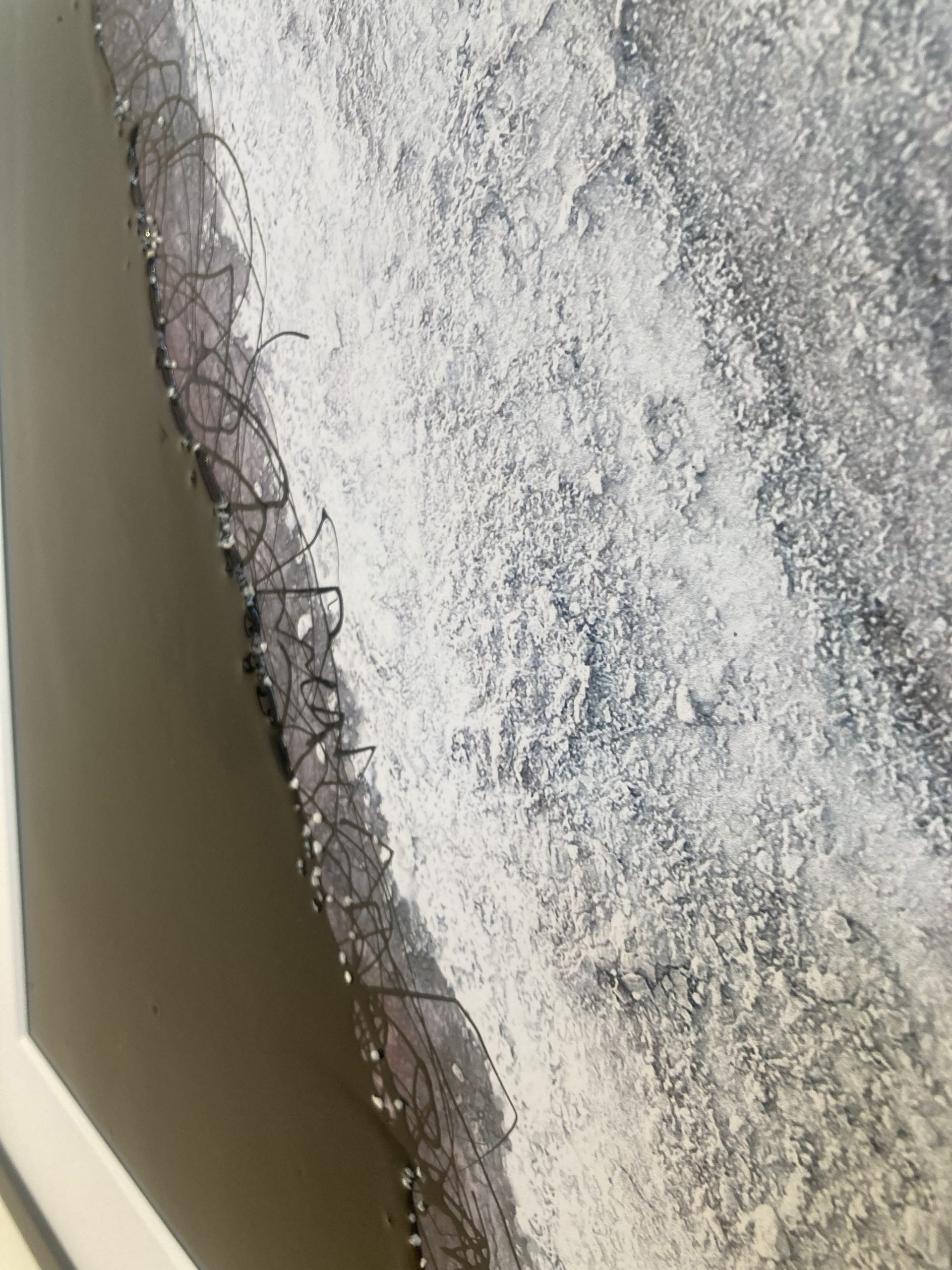
Detail from one of Trent Alvey’s altered photographs.
Ben Abott took the Salt Lake to a bigger picture: one among a community of dying saline lakes around the world—a 60% loss globally. But Abbott posits that we could be the first to save our precious environment, and if we don’t we could end up looking like Lake Owens or Lake Urmia. Los Angeles spends $2 billion annually on keeping the dust down from Lake Owens—a haunting number given that Salt Lake City sits much closer to the source of the toxic dust, in a valley home to more people living near a saline lake than anywhere else in the world. Abbott wanted to assure us that we shouldn’t be working to save the lake for the Olympics coming to town. We need to be working to save the lake for our existence in this place any longer. The crowd was clearly moved. They wanted to know how this could be shown to lawmakers and leaders, because there is no way you can watch this presentation and not be moved to take some action. It worked at the heart, the science, the dire nature of it all.
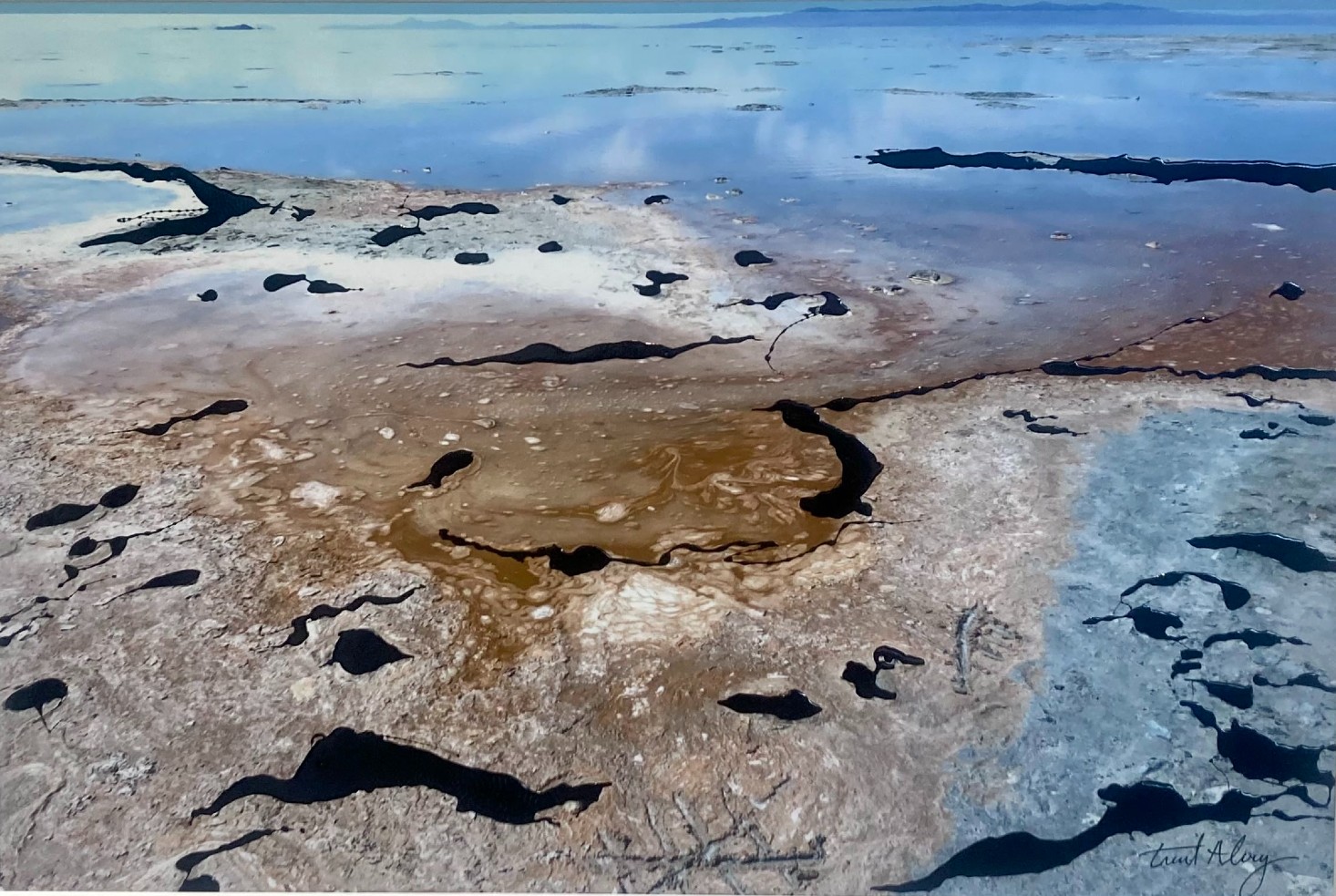
Alvey’s work hangs in the adjacent gallery—photographs taken at the Tar Seeps of the Great Salt Lake, on the remote northeastern shore near Robert Smithson’s Spiral Jetty. At these sites, Alvey has scouted the fissures in the earth oozing pools of raw petroleum as the lake bed is exposed, creating, as her statement reads, “what scientists call ‘death traps’ and what is seen as portals between geological time and our current moment of ecological reckoning. As the lake shrinks, more tar seeps become exposed—trapping increasing numbers of pelicans, owls, coyotes and other animals in its thick, sticky tar.” Like an oil spill, but where the human cause was accumulated across time rather than in one blow. The seeps at Rozel Point, where the artist focused her work, reveal a consequence of the drying that happens even when we aren’t around. The tree certainly still falls in the forest even if you didn’t hear it.
Alvey has altered her photos by pouring what looks like her own oil spill over the fissures in the ground she captured, creating pools or interspersed smatterings of oil oozing out of her photograph’s foreground. It brings the two dimensions off the canvas, reviving, fro me, teenage memories of the 2010 BP oil spill and the sight of innocent wildlife covered in nature’s molasses.
The altered photos speak to art as action more than beauty to bring to a living room. They are a statement, a snapshot in time of this dire moment. They are beautiful in appreciating the landscape, in capturing the silence of shores that no longer lap. In them, a mourning lingers, a grief that is loud in its silence. An encroaching black death trap crawls and spreads—perhaps a bigger metaphor for the lurking black death that is crawling closer as the lake continues to disappear before our eyes.
This black gold, with hundreds of thousands of years of history in its liquid, comes back to haunt us. The shorebirds’ skeletons coated in the seeps in Alvey’s photos snapshot a timeline—what will come of those bones far beyond our lifetimes.
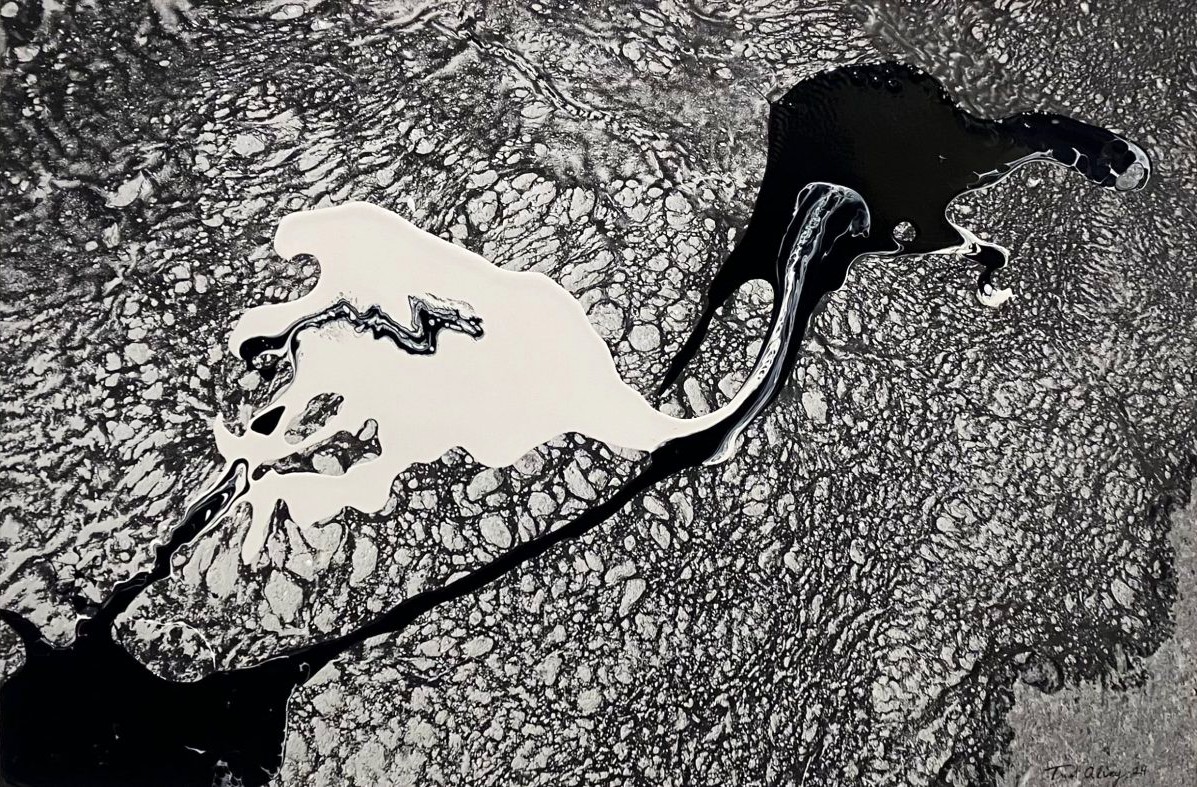
Trent Alvey, “GSL Dialogue,” 2024, altered photograph, 18×22 in.
An Ecological Reckoning: Tar Seeps of The Great Salt Lake, Bountiful Davis Art Center, Bountiful, through June 19.
DID YOU ENJOY THIS ARTICLE?
Help make more like it possible.
VENMO us a donation at artistsofutah

Or use PayPal to MAKE A DONATION.
15 Bytes is published by Artists of Utah, a 501 (c) 3 tax-exempt nonprofit.

Genevieve Vahl is a writer, farmer and artist from Milwaukee, Wisconsin. Her writing focuses on how art and community intersect, how to bring access to food and covering climate solutions around the Salt Lake Valley. She also writes poetry, binds artist books, makes paper and runs cyanotype prints from film.
Categories: Exhibition Reviews | Visual Arts