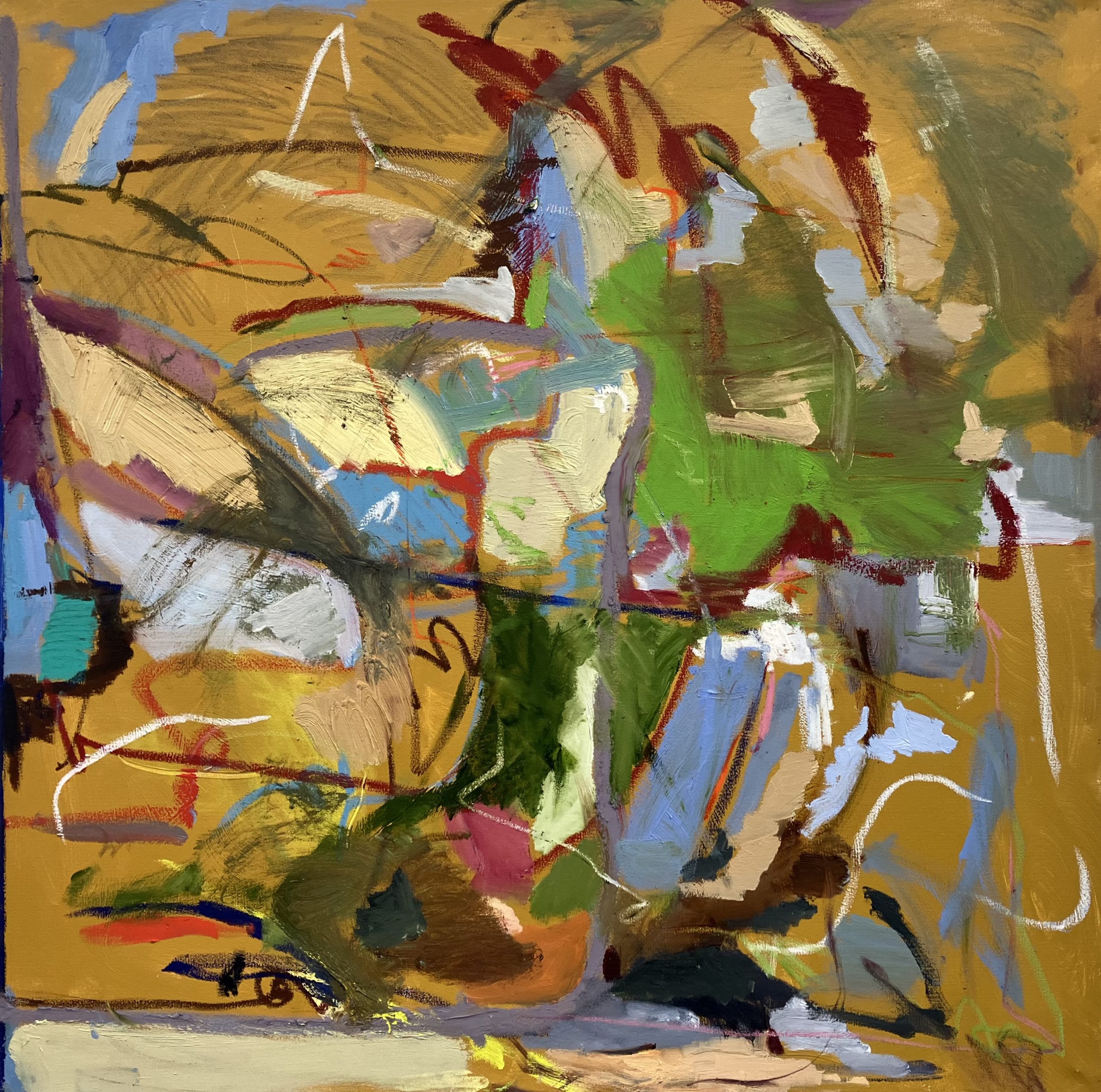
Nina Miller, “Briefly, Swiftly, Softly”
In the midst of our rapidly evolving, instant-gratification society with constant distractions, I believe we’ve lost our way. —Nina Miller
These days, when so much public commentary is clearly calculated to avoid offending our litigious oligarchs, we may well find ourselves searching the national conversation for evidence such as Nina Miller’s, here, of awareness of what is so fatally lacking in our culture. What she expresses is a rare awareness that it is actually possible not only to discern the truth, but to speak it; that objective facts do exist, and that we ignore them at risk to us and to future generations. The “distractions” Miller refers to are just one of the ways self-interested parties, be they the undeservedly powerful or the obscenely wealthy, distract the majority public from connecting the world’s increasingly uninhabitable weather to unsurvivable government policies. Of course a good painting won’t take the place of an effective measles vaccine, but it can hang on the wall of a space where conscientious citizens gather to stave off the mental paralysis that serves the already self-serving, as they labor to destroy the public pursuit of progress while building future sanctuaries for themselves in the remoter parts of Greenland they are busy stealing.
Unfortunately, it’s not easy to point to specifics in Miller’s energetic, and emotionally stimulating abstractions that make these important points. However, what is visually present is the evidence of a healthy cerebral mechanism, one that appreciates a whole world, rather than one divided into exclusive categories. In a work like “For You,” the artist shows us what might be read as a kind of urban landscape, in which figures are implied but not overdetermined. It is also one that is absolutely humming along without hostile presences or lurking threats. Miller has explained, as explicitly as she can, how such images emerge from a process that she experiences, recognizes, and encourages in herself.
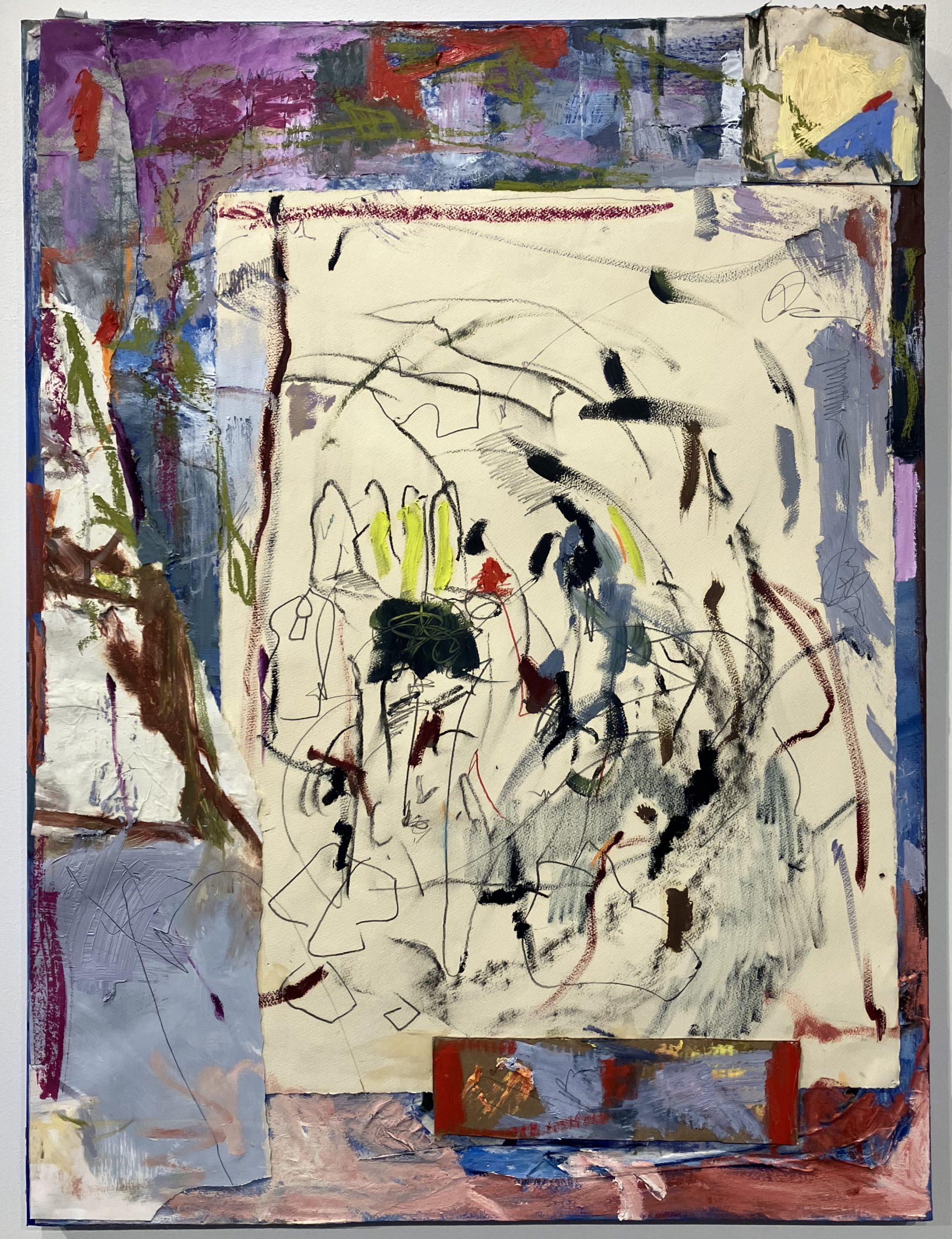
Nina Miller, “All That Remains”
Of course crazy people believe in the things they think, but their self-regard is both the only proof supporting their ideas, and provides ample warning that danger lies ahead of them. By comparison, in the forms and colors she assembles, Miller’s cerebral paths lead her to generate actual, physical evidence of where her impulses came from, how she proceeded, and where we’ve ended up for now by following her. The pleasure to be had from contemplating these original combinations of richly layered, suggestive gestures that seem rooted in healthy, enthusiastic mental processes and habits of mind argue that hers is a mental space worthy of a visit.
Once there, of course, any perceived, conventional content is probably going to depend on the viewer’s sympathetic response. It’s not difficult for someone with a creative imagination to find familiar elements here that can be visited consciously or as in a dream. Many viewers complete the history of a realistic scene in their minds, or propose how it might turn out. Portraits call to mind evidence of character in the sitter. While lacking such specifics, her abstracts contain the seeds of far more original and personal possibilities.
Try spending a few moments with “All That Remains.” I’ve been scolded for suggesting what such a painting might represent, but all I desire is to convince readers that they are fully capable not only of an emotional response, but of a more complete and more personally satisfying one as well. Here we might see the empty easel of the artist, after she has completed a work we won’t be shown—which doesn’t mean we can’t see that one in the same way as we see this one: with the aid of imagination . We might notice how the white rectangle, though in some way it resembles a hole in the image, something missing, has been formed in a way that allows it to come forward, to seem rather to be in front of what surrounds it. Why does the bottom so resemble a floor? Perhaps because we all share the habits of mind that allow us to almost instantly interpret such visual data into a useful image of where we are.
-
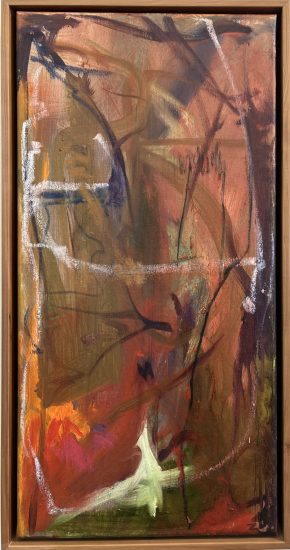
- “The Fires Within”
-
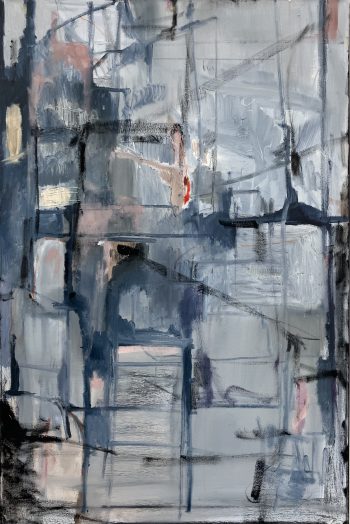
- “For You”
There is much said these days about memory … about art as a vehicle like a journal in which we strive to immortalize what has happened. Some of these painted memories are quite specific, but this one offers the pleasure of the activity without the limiting burden of another person’s content. And finally, and it shouldn’t be necessary to say it, this experience, however a given viewer chooses to connect with it, connects itself in turn with other possibilities. Like an unbound scrap of fabric, the frayed edges so exquisitely permitted by the originating mind are readily recognized by another. Many artists have selfishly declined to admit that this or that viewer’s associations with the work are valid, but in her statement Miller goes to great length listing pairs of possible references: inner and outer worlds, nature and her practice, order and chaos, the tangible and the ethereal are only a few of them. And she suggests that in her art, as may be true for most of us in life, she finds herself “in between” the rarely reached extremes.
And maybe that’s the best thing about art. Just when we begin to feel our space and time cannot be more fragmented, more alienating, more likely to turn us from those who love being alive to those who fill their surroundings with anger and resentment, along comes Nina Miller to say yes, we are not wrong to find much to share with pleasure and gratitude, and something more outgoing than a simple response to what we are here in the library to see. The artist holds that in her thoughts, too: For me, the intricate yet straightforward act of creating allows me to return to simplicity and be fully present. There are those who understand the word “abstraction” to signal absence, but in these paintings by Nina Miller, it’s all about presence.
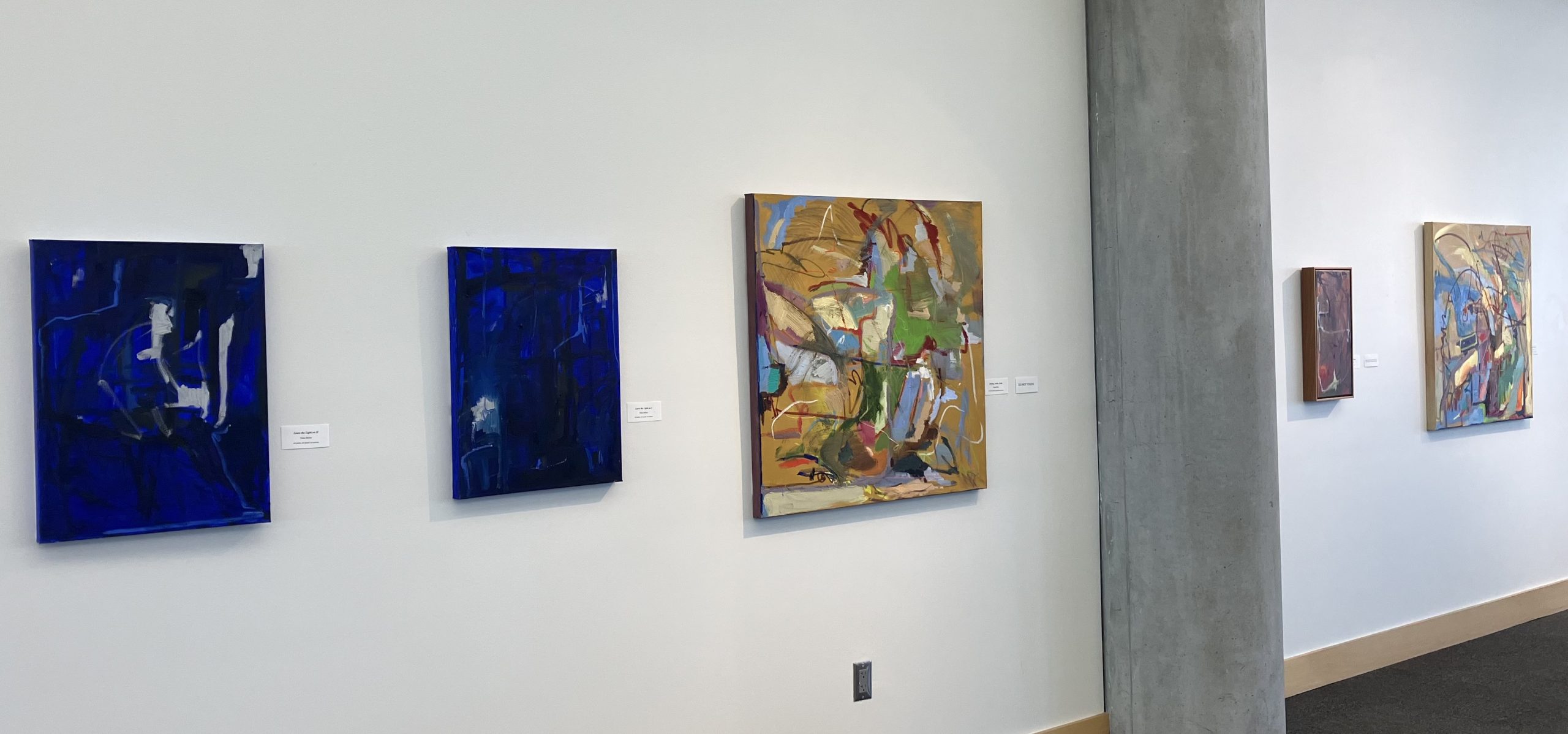
Exhibition view of Nina Miller’s “The In Between” at The Gallery at Library Square in Salt Lake City.
The In Between, Gallery at Library Square, Salt Lake City, through June 12.
DID YOU ENJOY THIS ARTICLE?
Help make more like it possible.
VENMO us a donation at artistsofutah

Or use PayPal to MAKE A DONATION.
15 Bytes is published by Artists of Utah, a 501 (c) 3 tax-exempt nonprofit.

Geoff Wichert objects to the term critic. He would rather be thought of as a advocate on behalf of those he writes about.
Categories: Exhibition Reviews | Visual Arts