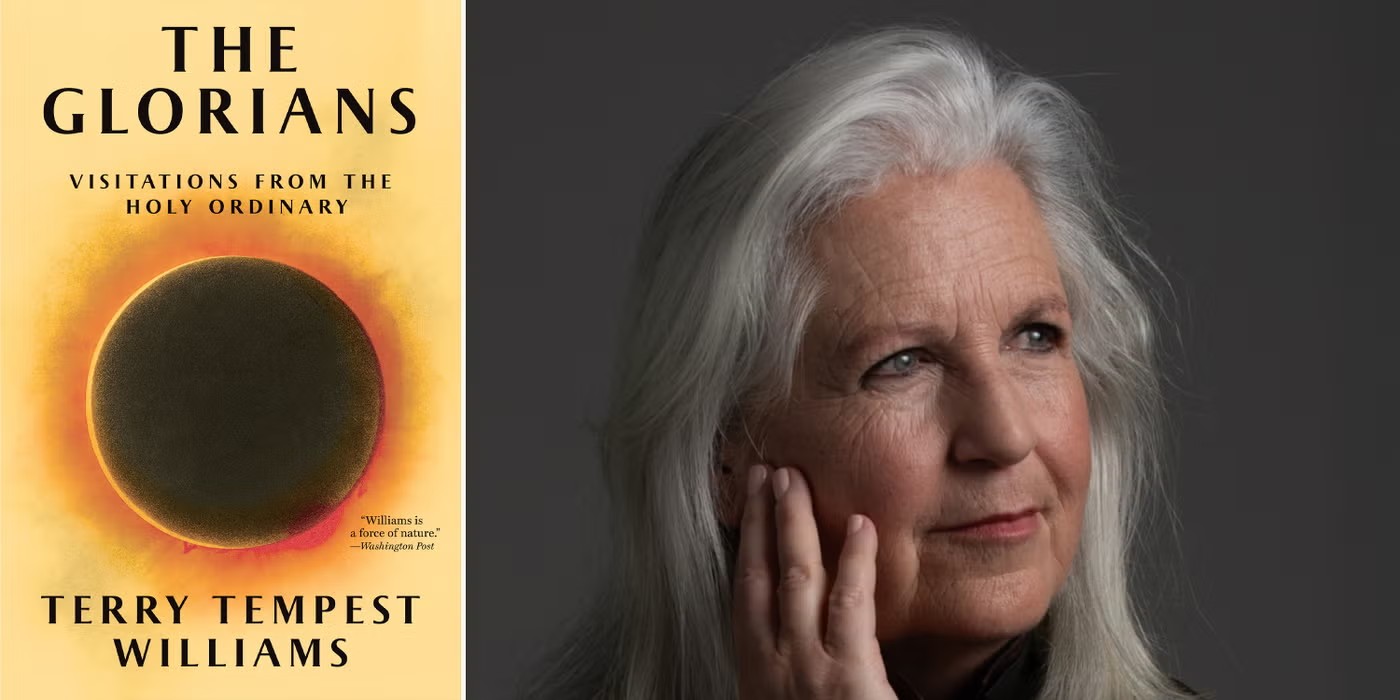
Just a few chapters into the book I realized I was spending more time annotating and thinking about what I had read rather than actually reading words. I believe it’s a good thing. Thinking. Especially if you’re thinking about words written by Terry Tempest Williams.
“I hear my grandmother telling me to focus on the ‘golden thread’ that shows us the ‘through line’ that weaves the world back together. Where is this golden thread now?”
Words thread into sentences. Sentences weave into story. Story builds understanding. Understanding creates action. Action promotes change. Change is essential.
With her latest book, The Glorians: Visitations from the Holy Ordinary, Williams is persistent in her commitment to showing how essential changes can come from our attention, as stewards of the Earth, to the small things. These small things are ethereal. They are soft as a feather, hard as stone. They are, perhaps, in broad definition, everything, if given the right, if given the grace, to coexist in our plane of being.
What is a Glorian?
Williams has made a pledge that came to her in a dream: “Your vow is to create the Epic Documentation of the Glorians.” Throughout the book, which chronicles, roughly, her experiences during the COVID-19 pandemic, she attempts to document and also define what a Glorian is. Ultimately, the truth is simple. Glorians are “the holy ordinary.”
“The ant carrying the coyote blossom across the desert is a Glorian.”
Williams moves between worlds: her desert home in Castle Valley and Harvard Divinity School where she is writer-in-residence. These two worlds inform and shape the book. At home, where during the pandemic she has sheltered and maintained distance from the outer world, it is a time of sacred suspension, an opportunity to dwell wholly in the interiority of place. When in-person learning resumes as the pandemic ebbs, she is reluctant to leave her home but is drawn to the academic stimuluses of the campus.
“It was hard to leave the desert…How to clean myself up for Cambridge? …I will arrive as a tumbleweed with tanned appendages and callouses so thick on the soles of my feet, I don’t need shoes. Reluctantly, I pull on my black cowboy boots, black pants, and a black sweater and leave Utah.”
Williams has many loves on campus with her colleagues and the students who all mix in the realm of higher learning. One particular love, however, is nonhuman. A two-centuries old red oak tree in the Commons of the Divinity School.
“Some people hug trees. I talked to this one. Every day, I would sit with the tree and a book, or with binoculars in hand when I watched birds and ate my sandwich.”
The “Divinity Tree” becomes a symbol of our earth in microcosm, a precarious focal point as the tree’s future becomes uncertain with a proposed building renovation. Supporters argue for it to be spared from the development, that it be allowed to live not only for its historic role—Emerson may have enjoyed the shade of its canopy—but also for its own terms as a sentient being that brings humans and all manner of creatures together as a community:
“…blue jays, cardinals, black-capped chickadees and titmice; house finches, flickers, downy and hairy woodpeckers, creepers and nuthatches also present, moving up and down the trunk. A pair of Cooper hawks nest in the Divinity Tree; sometimes, a red-tailed hawk perches on outer branches looking for prey, most likely cottontails running across the lawn; and dozens of gray squirrels, amusing to watch, run up and down and across the intricate network of branches, large and small. One night, when working late, I open my window and listened to a screech owl.”
The Divinity Tree is just one part of Williams’ earth, our Earth, that is exposed to demise, to extinction. Throughout the book vulnerable locations abound, but Williams primarily focuses on Utah, her home—Great Salt Lake, the La Sal Mountain range, the ever-changing arroyos and floodplains of her treasured Castle Valley. Williams lovingly appeals to the reader that these places threatened by drought, by flood, by fire, are most defenseless against the incomparable ignorance of humans. We’re not listening. We’re not seeing. We’re not changing.
Williams states: “The only force I know that carries this much velocity and power within us to change is love, a fierce love that is a force field of action—like the one witnessed as a flashing of water in the desert in drought.”
And what of the Glorians? What of love?
I finished reading the book, closed it, and put it down, my sticky notes furling from between the pages like a strange flower, some petals crumpled, fading, others fresh, all like coyote blossoms held aloft by ants in the desert. Williams encourages the reader’s own documentation of encounters with the Glorians. It does not have to be epic. Though it most certainly will be if curated in the spirit of wonder. My own new and modest documentation manifests daily. And it is my responsibility to pay attention to and nurture the relationship with love. If not me, then who?
The Glorians of Terry Tempest Williams’ Epic Documentation begin with the river and all that dwell on its surface and beneath the current. In the sky above. It is the way of time. A felix culpa flourish on an anniversary tunic. The horizon. Black rainbows. A staple stitching a beloved’s heart back into being. Nymphs. Sage. A Glorian is a tree. They are all the trees, living and dead but still alive. Tadpoles and butterflies, horny toads and black widows, dewdrops, penumbras and the umbra. Bare as the syntax of a child. Extraordinary as breath. “The holy ordinary.”
“A Glorian meets you in amazement. A Glorian jolts you from an unconscious state of mind to a conscious place of mind. A Glorian is where fear and awe join hands.”
The Glorians
Terry Tempest Williams
Grove Press
March, 2026
320 pp.
DID YOU ENJOY THIS ARTICLE?
Help make more like it possible.
VENMO us a donation at artistsofutah

Or use PayPal to MAKE A DONATION.
15 Bytes is published by Artists of Utah, a 501 (c) 3 tax-exempt nonprofit.

Larry Menlove’s short fiction and essays are published in numerous venues. His debut novel, Rush, will be available in November from Shotgun Honey Books.
Categories: Book Reviews | Literary Arts