Installation view of Polarized America at UVU’s Gallery on 6th, where a field of objects—flags, reliquaries, altered books, and sculptural assemblages—maps the varied terrain of contemporary division.
The most commanding work at Polarized America, in the Gallery on 6th at Utah Valley University, might be Kristina Lenzi’s “Pantsuit Pattern.” Essentially an actual American flag hung on a back wall, its brilliant red, white, and blue make it strikingly visible from throughout the room, while the way it fulfills the exhibition’s theme is just as unmistakable. Pinned to the flag’s fabric are the overlaid parts of a sewing pattern for a pantssuit: the assigned uniform whereby a woman seeking or holding office in the United States telegraphs her ambivalent gender. As Lenzi has assembled the piece, it looks as though one could just cut it out and stitch it right up to make a version of the sort of garment that, while technically illegal, entertainers have often worn to connect with their audiences on patriotic, rather than more conventional grounds. In this way, their claims of loyalty have proven more palatable than those of most of the women who have attempted a more direct approach to leadership: those who ran for office rather than donning the suit to stand behind their husbands. This fact Lenzi further suggests through the translucent, almost ghost-like quality of the pattern tissue. In such ways the artist, who is probably best known for her performances, has sought to raise questions while not offending either strongly opinionated side with this finely balanced, yet colorful example that dates back to the early days of the culture-wide polarization that this exhibition addresses.
Once upon a time, college educators could assume that one of the perks of their hard work would be a sabbatical, or period of paid leave, for travel and study every seven years. Today, as the assault on education by various interest groups continues, the beleaguered sabbatical has ceased to be an automatic reward and instead has become a competitive and hard-sought privilege. Adam Larsen is the meticulous creator of flawless prints and assemblage sculptures that look like they might have left some unlikely factory years—even decades ago—yet display no wear or sign of time’s passage whatsoever. He is also the longest-serving member of Snow College’s Department of Visual Arts. In order to qualify him for a sabbatical, his petition had to include specific plans for how he would spend the time, which could not be exclusively focused on himself. The plan for Polarized America was part of that proposal.
In addition to inviting artists who live and work in Sanpete County, Larsen traveled throughout Utah seeking out artists, such as Lenzi, to fill out his vision for the exhibition. Approximately 18 of them contributed about 40 works, which were shown in Ephraim, in Snow College’s art gallery. Yet it’s no secret that while that gallery is a splendid place to view art, and Larsen is a gifted curator, the remote location puts limits on attendance. So after a few substitutions for works that either couldn’t travel or wouldn’t work properly in the new space, most of the original exhibition was then moved to UVU, with the backing of the Art and Design Department chair, Jason Lanegan, who is also a participant in Polarized America.

Jason Lanegan’s “Disconnect”
No two artists in Polarized America, or for that matter in central Utah or the Wasatch Front, approach the making of art in quite the same way, but there are some strong sympathies among them that are visible here. Lanegan was probably the first local artist to focus on the making of what he calls reliquaries, into which he places memoir-like reminders of the events of his life and those of his family. In the Middle Ages, all sorts of familiar, sacred objects such as crucifixes and holy books were crafted, often from gold or other precious materials, often ornamented with semi-precious stones or glass versions, which were considered equally valuable for the purpose, and were made to hold such talismans as relics of the saints.
Lanegan approaches this tradition directly, in particular in his more recent works by making model buildings that both invoke the important places in his memory and hold objects connected to them. Rather than paint them, he may use evocative materials, like the sheet metal exterior of the school in “Disconnect,” his major piece here. It recalls his own education as well as those of his father and his son, while it critiques the way schooling has changed, using visual cues to words like “evolving,” “shifting,” “resentment,” and “exclusion.” In works not shown here, he has laminated on paper sewing patterns, like the one used by Lenzi, that may invoke the deliberate intentions that characterize both what is built around and by us, and the often unstated goals that help determine their final forms.
Several of the works here also share the use of found and altered books, or their parts, to freely suggest connections to references potentially as unlimited as those of the original books. Larsen placed “A History of Our Country,” on which someone had scrawled “Handle With Care,” under a glass dome and on a pedestal, as if to remind viewers that protecting valuable items and ideas can become a way of making them inaccessible. Nakita Shelley sliced up the text of one contentious speech and mixed the resulting noodles with a woman’s hair to produce an “entangled book” that “confronts the violence embedded in language and rhetoric by materializing the act … of eating one’s words.”

Nakita Shelley, “Eat Your Words,” transforms a political speech into tangled strips mixed with human hair, a visceral meditation on language, consumption, and harm.

Adam Larsen, “House Divided,” combines a vintage book and mechanical viewing device, extending the act of reading into a mediated, almost surveilled encounter.
While discussing the importance of an open mind and the potential for art in personal research and exploration, Lanegan added that “Good art should never be the period at the end of a sentence.” One of several artists who clearly understand the importance of starting their works in the real world in order to connect with nature is UVU professor Nancy Steele-Makasci. For “We The People,” she cut a book into the classic, body-doubling shape of a coffin, then set it atop a small cabinet that, when opened, disgorges a book-like, pleated cascade of silhouetted bodies. This universal leveling is surely one reply to the appeal of polarization, while elsewhere she shows two books seen at Finch Lane: one with its cover screwed down, the other wrapped in uncounted yards of yarn.
Another cascade takes the form of “On Tyranny,” Frank McEntire’s bandolier belt of pro and con comments on the very timely subject of authoritarianism. Perhaps because of his tendency to show rather than tell, McEntire’s humor can be missed, though that is not so likely in “East Wing,” in which the face and posture of our never-contented president are eerily echoed by the suggested remains of the title structure. While “Ballot Box” is inappropriately stuffed, like it had been mistaken for a mailbox, with campaign literature that orders compliance from voters on the ironic promise of freedom, “Co-opted Corpus,” his collaboration with Larsen, makes the anguished face of one crucified figure express new depths of suffering updated to apply to our present day.
-
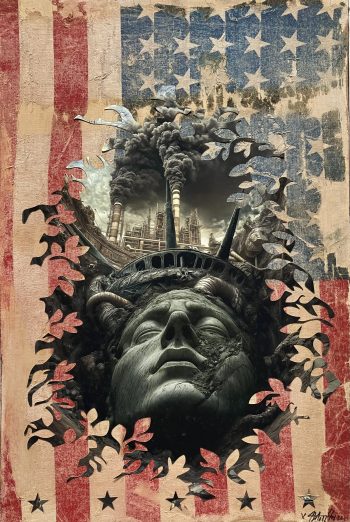
- Vincent Mattina, “Art of the Steal”
-
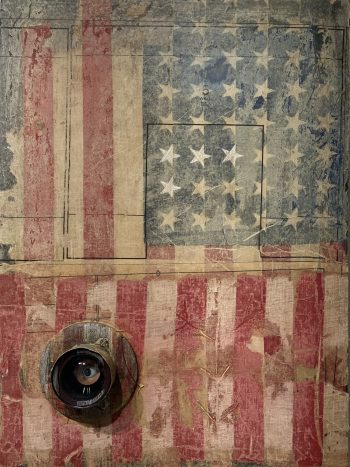
- Vincent Mattina, “Different Kind of Truth”
Vincent Mattina’s “Art of the Steal” rhymes the familiar title to connect his image of the passive and crumbling face of Liberty to the nuclear-looking, industrial pollution rising like a mushroom cloud above. Here the floral interface between the central scene and the aged flag around it suggests a potential healing if traditional values can only choke off the upstart weeds.
Some of the works here are so subtle or complex it would take more space than is available to describe or account for them. Others are perfectly clear on their own. Some, like Larsen’s “Bringing Back the Hits,” address very specific issues, like drugs in this case. Others possess a poetic indirection that makes them open to individual reading. We’ll depart the gallery as we came in, with another unanticipated collage—as if anything here could be thought predictable. Kim Gordon’s “Innocent Bystanders” presents a future war as an extension of today’s version, which seems largely to have been created as an entertainment at best, a distraction for sure. Through clever design, the artist has placed those of us watching from the gallery among the spectators in the extravaganza. Some subtly inverted text suggests that in this not particularly remote time, oil will still play a “now you see it, now you don’t” role in the political economics of war. What was once a matter of necessity has become the subject of the same manipulation that sells our newly reimagined cleaning supplies. Just check out Abe Kimball’s “American Cleanser” and be reassured.

Adam Larsen, “This Land Was Made for You and Me,” juxtaposes a vintage U.S. map with small figurative elements, suggesting both plurality and containment within national boundaries.
DID YOU ENJOY THIS ARTICLE?
Help make more like it possible.
VENMO us a donation at artistsofutah

Or use PayPal to MAKE A DONATION.
15 Bytes is published by Artists of Utah, a 501 (c) 3 tax-exempt nonprofit.

Categories: Exhibition Reviews | Visual Arts