Installation view of “Make Movement Visible” at the BYU Museum of Art. Image by Gina Cavallo.
Mimi Chen Ting believed movement could be made visible. In paintings filled with looping lines, rhythmic geometries, and figures that seem to pulse across the canvas, the artist transformed dance, migration, memory, and music into visual form. In a downstairs gallery at the BYU Museum of Art, Make Movement Visible introduces many Utah audiences to the late Chinese American painter whose work bridged performance and painting over decades of artistic practice.
The late artist’s family worked with BYU MOA’s curator, Miri Kim, to bring these masterful paintings to the museum. Born in Shanghai and raised in Hong Kong, Ting left Hong Kong in 1965 for San Francisco at the age of 18. She came to the U.S. on an F-1 nonimmigrant student visa, enrolling at San Francisco College for Women and then San Jose State University. She came just as the Immigration and Nationality Act of 1965 abolished discriminatory quotas that had historically targeted Chinese immigrants. “I found a connection to her in this,” shares Miri Kim. “My parents came here on the same type of student visa.” The curator further notes in one didactic panel, “As a Chinese American artist, Ting understood that movement (in all senses of the word) was never neutral. Themes of migration, diaspora, memory, intergenerational relations, creative community, and hard-won solitude came to define her art.”
Ting’s big, boldly colored blends of figure and form are more than just visually appealing. The title of the exhibition—”Make Movement Visible”—reflects the “guiding imperative” and goals of all the artist’s work and it creates a gallery filled with undeniably vibrant movement. It references all types of movement—the artist’s hand in the painting process, social movements, visual and compositional movement, musical movements, dance, and performance. “The title comes from a quote from Mimi Chen Ting from 1977,” states Kim. The artist’s quote leads the introductory panel: “Make movement visible and harness it within casings called lines, thereby forming shapes.”
-
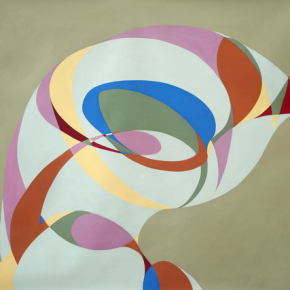
- “Gaga,” 2020
-
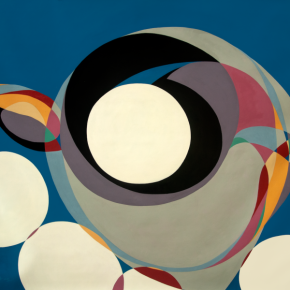
- “Stepping Out On Blue,” 2020
-
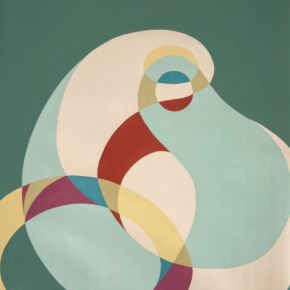
- “Devotion,” 2021
As hard as it might seem to recreate movement on a two-dimensional surface, Ting does just that, and does it with grace and beauty and the quietude of someone fully engaged in the feeling of movement within the body. Ting trained in ballet when she was in China and dance remained a part of her life and work until her death in 2022. That body awareness, as well as the deep connection to the forms that dance movements create, clearly informed her work. It was also the direct focus of many of her paintings.
“Basically, I see no division between painting and performance, except in the tools—the body for performance, art materials for painting—and manner of execution….I see my performance work as complementary to my two-dimensional work, a way of bringing three-dimensionality and real time into the equation.”
-Mimi Chen Ting
In works such as a 2005 video performance titled “Tender Tides,” and the painting “Stepping Out On Blue,” from 2020, Ting made visible both the delicate and the active moments of a body in dance. The painting’s forms create patterns of tension and rhythm as if recording a dancer’s path across a stage. Shapes come together, delicately touching as hands do in the dance. Colors flow and repeat. The piece nearly reaches the point of hearing a heartbeat. Of note with all her work, but particularly visible in this piece, the artist drew everything freehand—without using tools, she creates perfect circles and precision geometries, emphasizing once again the movement of her own hand.
Several works merge the body movement of dance with the concepts of musical movements, particularly in a wall of five works that have been masterfully installed to emphasize a line pattern that flows from one piece to another. On the left is a figure with arms in alternating curves (“Falling Waters”) that starts the flow with a blue (water) line coming from the index finger of her left hand (note the perfect circle the dancer’s middle finger and thumb make). From there, a similar pattern line visually connects to the next painting’s rope, held by a dancer with her back to us and her right hand flared in what we like to refer to as jazz hands. Then it goes on to a yellow band that crosses behind what appears to be a piano keyboard, encircled by a white ring or ribbon. The fourth piece picks up that same band but in white this time. In front of that white band hang abstracted fabric or possibly body forms that are also encircled by a black and gray patterned rope or string form. The final piece ends with a thinner white band carried over onto a black, white, and gray painting of pure movement. Two varying shades of gray sit behind and around a black box that is in turn the background for two intertwining, undulating lines—one gray and one white. The entire installation feels like a musical performance.

Exhibition view of five works where the artist’s interest in line as movement flows across five pieces. Image by Gina Cavallo.
Other paintings in the exhibition reference landscapes. Ting spent many years in the 1980s in Taos, New Mexico, where she experimented with pastels on textured paper. “Taos gives me clarity and simplicity of vision. Everywhere I look, I see changing relations of shapes, forms, and colors….” she said. In “Windows on Taos 1 – 6,” Ting has pared down her imagery to strikingly simple forms that somehow convey the majesty of the northern New Mexican landscape. But even in this more stark work, her mastery of movement brings forth the feeling of the wind as you traverse the high desert. Just below these pieces, the family and curator have deftly shared some personal archival materials such as the family photo album, her passport, and two letters to Martina R. Norelli, the curator at the National Museum of American Art from the mid-1980s. These personal windows into Ting’s life are a joyous addition that helps to bring the artist’s voice and experiences into the exhibition.

Mimi Chen Ting, “Windows on Taos 1 – 6,” ca. 1989, pastel on paper with case below of archival materials, courtesy of the Ting Family Living Trust. Image by Gina Cavallo.
That personal touch underlies the entire show. The exhibition is about a painter, but also about a woman, and specifically an Asian American woman whose life experiences spanned the transformational years from post-WWII America through the Civil Rights era and other social movements of the 1960s, embodying forms of immigration essential to the development of this country, and pulling us fully into the 21st century. Mimi Chen Ting’s life and work may not have been at the forefront of the art world most of her life, but her work provides a glimpse into the experiences of so many who came to this country to find their voice and share their talents. It also shows us how an artist can depict physical movement and its array of effects on the two-dimensional media of canvas and paper. Mimi Chen Ting’s life and work form the kind of captivatingly vibrant story that makes us stop and think about how important movement is to a full life experience.
Mimi Chen Ting: Make Movement Visible, BYU Museum of Art, Provo, through Oct. 10.
DID YOU ENJOY THIS ARTICLE?
Help make more like it possible.
VENMO us a donation at artistsofutah

Or use PayPal to MAKE A DONATION.
15 Bytes is published by Artists of Utah, a 501 (c) 3 tax-exempt nonprofit.
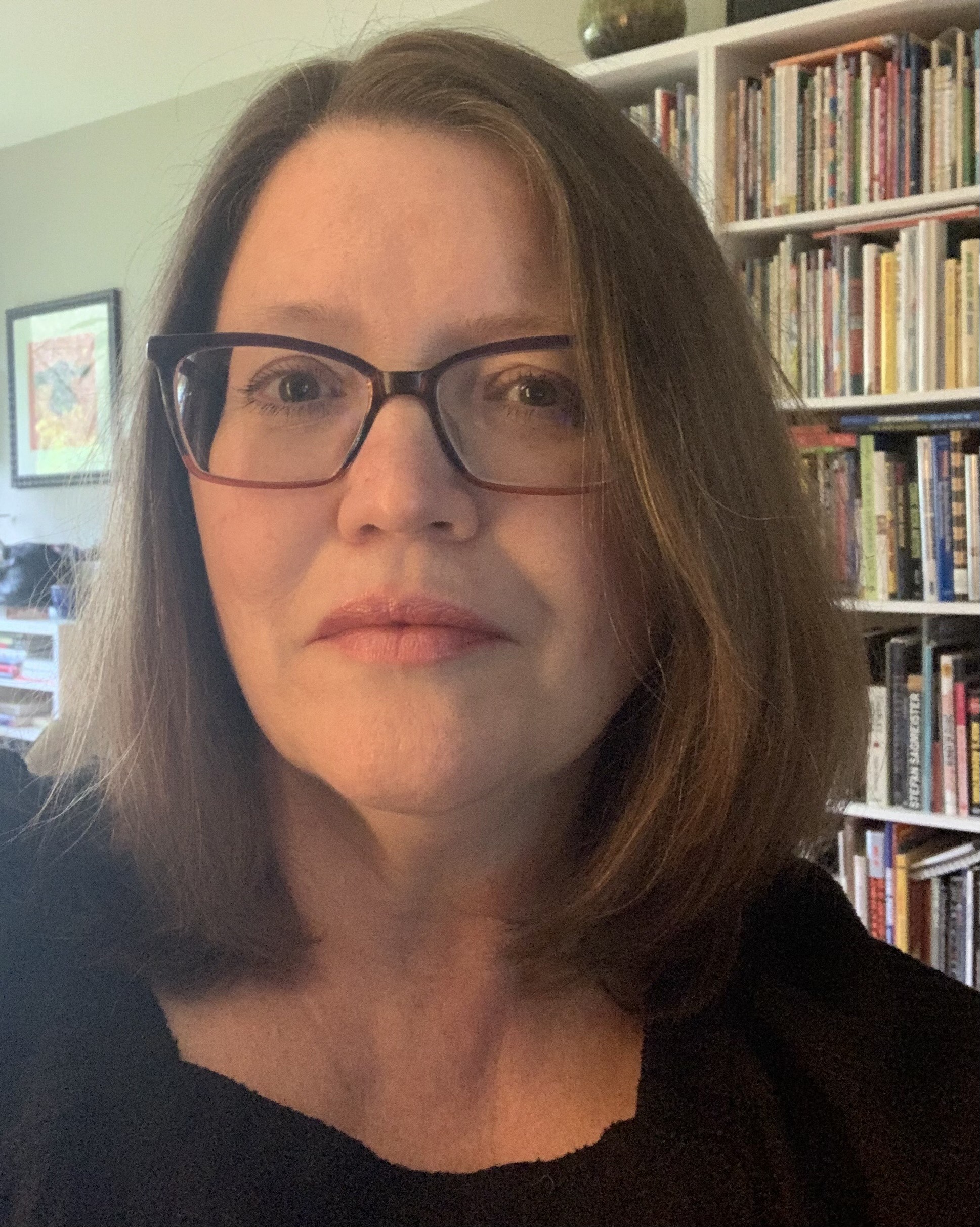
Gina Cavallo has been a curator, registrar, and executive director in museums for over 35 years. She spent many years as an art critic for publications in Phoenix. She began her career at the Phoenix Art Museum and the Heard Museum, was a founding curator at the Scottsdale Museum of Contemporary Art, spent two terms managing exhibitions at the Virginia Museum of Fine Arts, and was the Executive Director at the Mission Inn Foundation & Museum in Riverside, California. Her current role is Director of Development for Taproot Theatre Company in Seattle where she also serves as the curator of the Kendall Center Exhibition Series. She moved to Orem in 2024 with her husband, a theatre faculty member at UVU.
Categories: Exhibition Reviews | Visual Arts