

The Nora Eccles Harrison Museum of Art’s new deputy director Jeff Lambson demonstrates NEHMA’s visible storage system, where paintings can be accessed for study and research.
When curator Jeff Lambson first arrived in Utah in 2007 to become the first curator of contemporary art at Brigham Young University’s Museum of Art, it felt like a moment. Contemporary art in the state was gaining momentum, and institutions that had not always been in conversation with one another suddenly seemed to be part of a shared project. “It was exciting,” he says. “There was this moment … it felt like we were still a small community, but we’d gotten big enough, and there was starting to be enough people and enough money. It felt like something could happen.”
Now Lambson has returned to Utah in a new role, as deputy director and contemporary curator at the Nora Eccles Harrison Museum of Art at Utah State University. He has come back to a different art landscape: one with bigger institutions, more developed programming, and a larger population, but also one that, in his telling, has lost some of the intimacy and interconnectedness that once made it feel possible for a few people to help shift the culture. At NEHMA, he is stepping into that changed landscape at a moment of expansion, helping shape not only exhibitions but the museum’s next phase of growth.
Museum work has defined much of Lambson’s adult life. After studying Art History and Curatorial Studies at Brigham Young University, his first “real, real job,” as he puts it, was at the Hirshhorn Museum in Washington, D.C. His second day there was September 11, 2001. Six years later, he and his wife, Ann, who has also spent her career in museums, came west. He joined the BYU Museum of Art as its first contemporary art curator.
The position itself was new. “[Museum director] Campbell Gray really wanted to have contemporary art,” Lambson says. “There wasn’t. I had no budget, so Campbell said, ‘Okay, let’s—profits from the gift shop—we’ll put that towards contemporary art.”
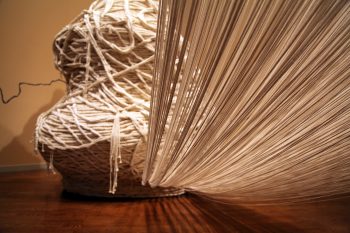
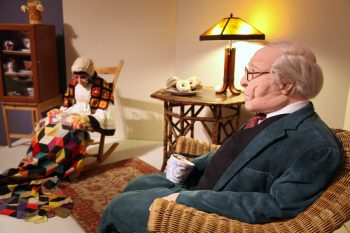
Work to Do, curated by Lambson for BYU in 2013, featured Pam Bowman’s large rope sculpture and an installation by soft sculpture pioneer Jann Haworth.
Even so, Lambson helped make BYU an unlikely contemporary destination. What mattered to him was not only bringing notable artists to Utah, but placing Utah artists in conversation with a broader art world. “The thing I loved is we were bringing in international big-name artists and showing lots of Utah artists too, to say, look, the art that’s being made here stands up on the wall,” he says. “You don’t know the difference. You put an Oliver Herring next to an Adam Bateman, side by side. They’re both really strong. They’re both really part of this conversation, and what we’re making is just as good as what’s being made in New York and LA and all over the world.”
That ambition coincided with a period Lambson still remembers vividly. He names contemporaries at other institutions, recalls the sense of regular contact between museums, and describes a statewide community that was small enough to be collaborative. “We were all kind of working together and collaborating,” he says. “If something big was happening, we sort of collaborated around it.” That sense of shared momentum extended to audiences as well. “For the first time, people were coming down from Salt Lake to BYU,” he says. “All of a sudden we’re getting coverage for the shows that we’re doing.”
After eight years at BYU, Lambson left Utah for Colorado, where Ann took a position at the Denver Art Museum. He continued curatorial and administrative work there, including at the Denver Botanic Gardens and the University of Colorado Denver. The move was, he says, “bittersweet.” “We didn’t want to leave,” he says. “We felt like we’d done everything that we could do at BYU. Had a big impact.”
Colorado offered a different scale of arts support, and that comparison has shaped the way Lambson now sees Utah. Denver’s institutions are larger, and public support for arts and culture is stronger and more systematized. But Colorado also gave him distance from Utah, and from there he watched both parallels and differences emerge. He stayed connected to artists here, brought Utah artists into exhibitions there, and noticed both how much Utah had grown and how its internal dynamics had shifted. “In some ways, we lost some of that momentum between the big museums in Utah,” he says. “There was a connectedness between the institutions, and we met regularly, shared shows with each other.” Then he pauses and offers a caveat: “But that might have been because you were so small you could still afford to do it. Now everyone’s too busy.”
Still, he does not describe Utah’s present art scene as diminished. If anything, he sees it as bigger, stronger, and more professionally developed. “There are more serious artists making good art now than there were 10 years ago,” he says. “The question is, does it have the infrastructure for it, and how are they supported?” That question, seems to be one of the central questions of his career.

The Wanlass Center for Art Education and Research, located just south of the Nora Eccles Harrison Museum of Art at Utah State University, expands NEHMA’s capacity for teaching, storage, and public access.
-
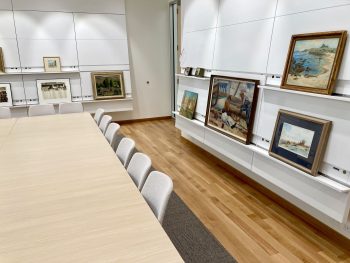
- Paintings from NEHMA’s collection line the walls of a study room, where works can be viewed outside of formal exhibitions.
-
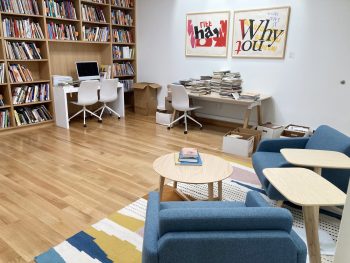
- The Wanlass Center includes a research library, offering books and study space for students and visitors.
-
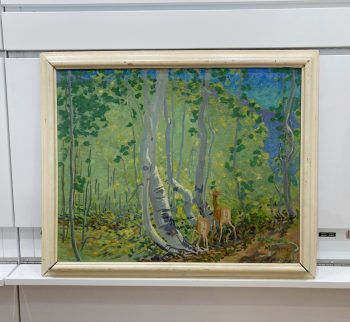
- A painting by Mabel Frazer has been brought out of storage for a class.
-
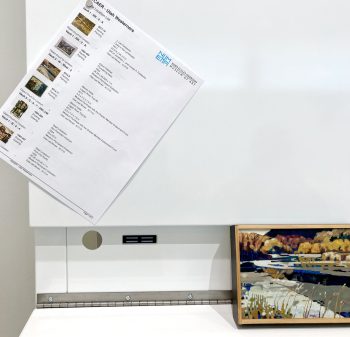
- A checklist of works from NEHMA’s Utah Westerners collection rests above a painting.
At NEHMA, Lambson’s new position reflects his concern with infrastructure. His role as deputy director is new. It comes along with the recently opened Wanlass Center for Art Education and Research, a new building that does more than add square footage. Lambson describes the building in terms of access, not architecture. The Wanlass Center houses visible storage, education space, and study areas that allow faculty, students, and community groups to engage the collection directly. “This is actually not exhibitions,” he says while walking through the space. “It’s art storage and education space.” The distinction matters. For Lambson, the building represents a shift in how a university museum can serve its public.
A large portion of the museum’s attendance, he notes, comes through K–12 programming. The new space allows those educational efforts to happen more effectively, but it also broadens what research access can look like. Faculty can ask to see works tied to a specific classroom topic, and museum staff can pull pieces from storage for a temporary study installation. “Any class from any background will work with [the museum],” he says. “They’ll tell Danielle [Stewart, Curator and Head of Academic Initiatives], my class topic is ‘this interesting topic,’ and she’ll say, okay, give me some time, and I will pull together works just for your class.” It is, he suggests, something unusual for a museum to be able to do at this level. “You could never do this at another museum,” he says.
The new building also addresses a practical reality: the museum’s collection has grown dramatically. Lambson says the collection began with around 500 objects and now numbers around 6,000. In just the last two years, he estimates, around 1,000 pieces have been added. “We ran out of space,” he says simply. But he also sees the expansion as an opportunity to make the collection more active, more visible, and more useful. “We have one of the best funk art collections in the country,” he says, pointing to strengths in California conceptual and postwar work. But he also wants to deepen the museum’s relationship to artists working closer to home. “We are collecting Utah,” he says. Then, more emphatically: “I want to start collecting artists—Utah artists—who are in Utah too.”

Visitors engage with works in NEHMA’s visible storage gallery, where the collection remains on view beyond curated exhibitions. Photo by Bruce Damonte.
That commitment feels consistent with the values Lambson articulated during his BYU years. Then as now, he is interested in placing local artists in larger conversations without losing sight of place. He talks about upcoming contemporary projects at NEHMA, including a Mike Whiting sculpture show and an installation by Colorado artist Nicole Banowetz, but he also mentions a developing exhibition that would bring together Utah and Colorado artists around questions of water and the desert. The challenge, he says, is to find an angle that avoids reheating a familiar topic. “That show’s been done to death,” he says. “So what is a unique contribution we can make?”
That question could apply more broadly to Lambson’s return to Utah. He is not coming back to the same state he left. The cities are denser. Institutions are larger. Museums have expanded. “You come to Sugar House, and all the buildings are six stories tall,” he says, laughing at the obviousness of the change. But he is also returning with a longer view, one that lets him measure growth not only in new buildings or bigger staffs, but in how a cultural community imagines itself.
If there is a through-line in his career, it may be this belief that art scenes do not simply happen on their own. They are built—through exhibitions, through collecting, through teaching, through infrastructure, through persistent advocacy, and through institutions willing to place local work in serious conversation with the wider world. At BYU, Lambson helped make that case in one way. At NEHMA, with a new role and a new building, he now has the chance to help make it again in another.

The founder of Artists of Utah and editor of its online magazine, 15 Bytes, Shawn Rossiter has undergraduate degrees in English, French and Italian Literature and studied Comparative Literature in graduate school before pursuing a career in art.
Categories: Art Professional Spotlight | Visual Arts







I had a dicey encounter with Jeff Lambson when he first arrived in Utah . . . anyone who misspells his own name is not to be trusted in my estimation. But thank you, Shawn, for reintroducing him. Any curator who includes a Jann Haworth soft figure in a show is a hero in my book. Welcome, “Jeff,” and since NEHMA is one of my favorite venues, I hope we’ll soon have a chance to make some of those connections you remember so fondly.
Utah is so lucky to have Jeff Lambson back! Katie has organized such a dynamite team at NEHMA. Excited to see what they continue to do and accomplish!