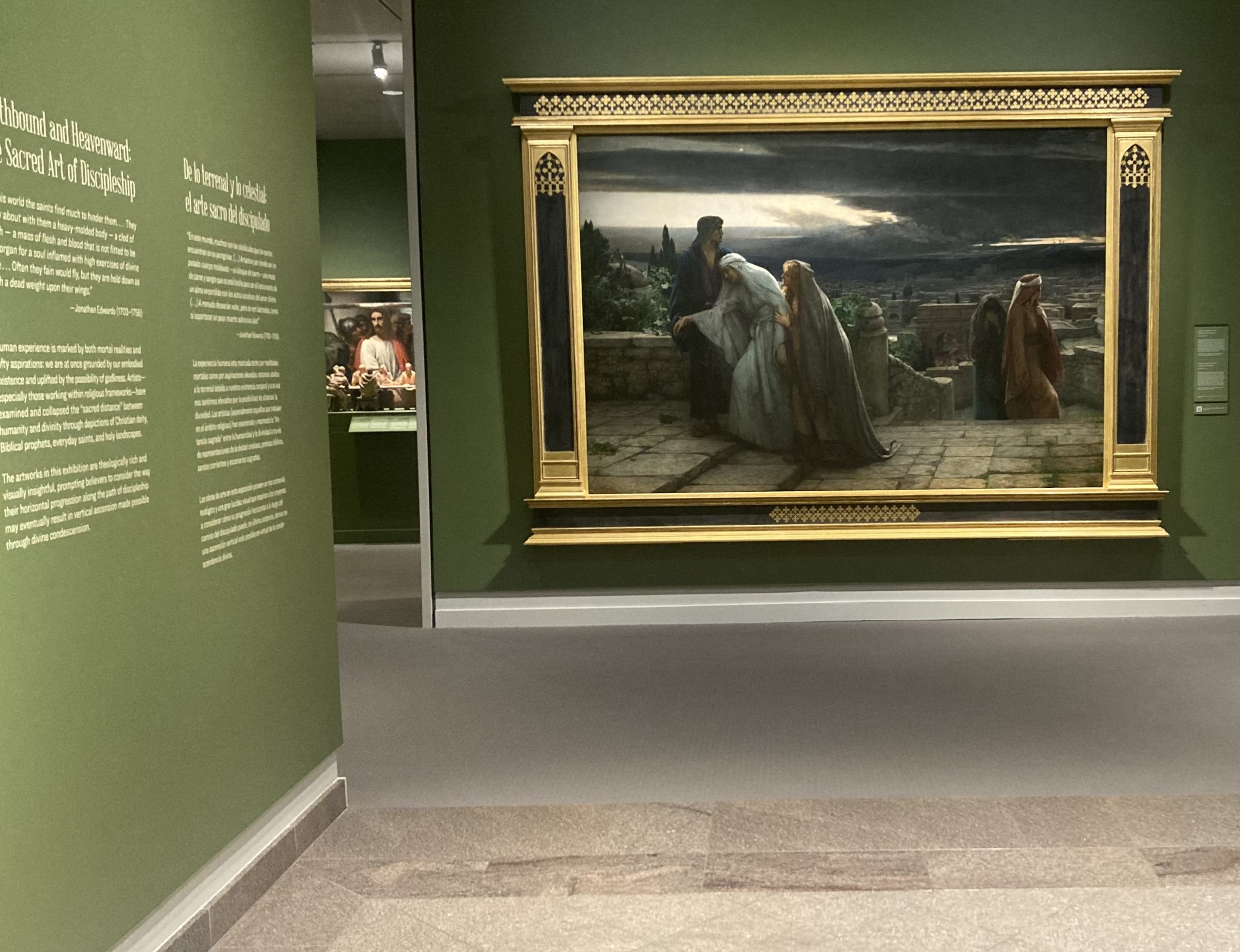
Herbert Schmalz’s “The Return from Calvary” at the entrance to BYU Museum of Art’s exhibition Earthbound and Heavenward.
For an exhibition of Christian art, there are surprisingly few images of the main character. The first painting you encounter in Earthbound and Heavenward is Herbert Schmalz’s “The Return from Calvary”—a large, theatrically lit academic canvas that anchors the exhibition’s entrance. It depicts a group of four women and one man making their way across the streets of Jerusalem under a sky gone black. The crucifixion has just happened, somewhere offstage, this group of disciples, among them the mother Mary and the beloved disciple, is harried, carrying the weight of the moment on their backs. It is a painting set at a moment of maximum absence, and it turns out to be an appropriate thesis statement for what follows.
Earthbound and Heavenward, drawn from the BYU Museum of Art’s permanent collection and supplemented by new works from living artists, spans five centuries of Christian imagery. What’s striking is how consistently the show declines to make Christ its subject. He appears in some works, is implied in others, and is absent from many entirely. But even when he’s present, the exhibition keeps redirecting attention toward the people around him: the disciples, the witnesses, the crowd. Across its galleries, the exhibition moves loosely through several modes of Christian art-making, each arriving at a similar idea by different means.
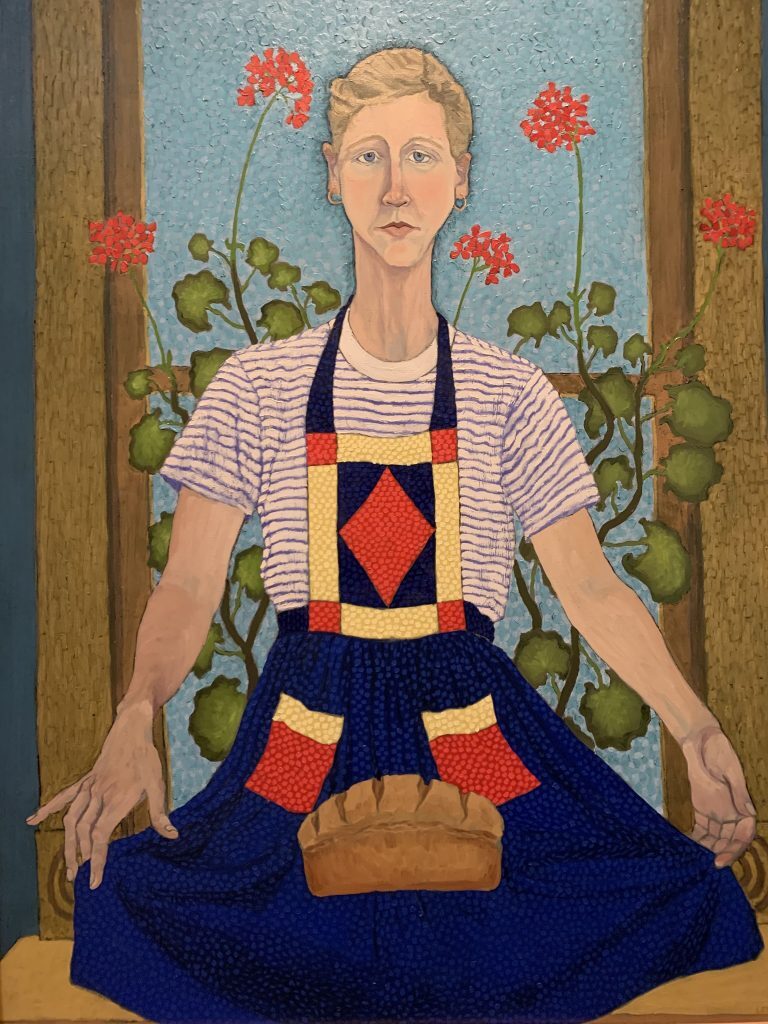
Lee Udall Bennion, “Daily Bread”
Early Christian images took the form of the icon—the frontal pose, the flattened space, the gold ground. The viewer’s traditional role before an icon is veneration, a one-way gaze upward toward what the image makes present: God, Mary, a saint. Lee Udall Bennion’s “Daily Bread” works within this register while redirecting it. Her self-portrait is frontal, symmetrical, arms open, framed by wooden posts like a triptych panel, the flanking geraniums standing in where columns or angels might bracket a saint. The pointillist surface shimmers with luminosity. And yet the subject is no divine being or sainted figure, but unmistakably a contemporary woman in a striped shirt, holding a dense, homely loaf of bread. This is not transfigured bread, but daily bread. The icon mode traditionally asks what is holy. Bennion’s answer is concrete: this woman, this labor, this daily act of making something and giving it away.
The long tradition of biblical narration that runs from Renaissance altarpieces through 19th-century academic painting forms a core of the show’s historical holdings. The best of these works do something more than illustrate scripture: they implicate the viewer in it. Ary Scheffer’s “The Denial of Peter” (1855) is the clearest example. Christ is present in the painting—haloed, luminous, occupying the right half of the canvas—but the scene turns on Peter. He stands on the left in the act of denial, his body already contracting inward, hands clasped, beginning to turn away. That hunched, folding posture is a precise depiction of moral failure—not dramatic villainy but the small, frightened, very human act of pretending you don’t know someone when knowing them costs something. The story is less about the denied than the denier.
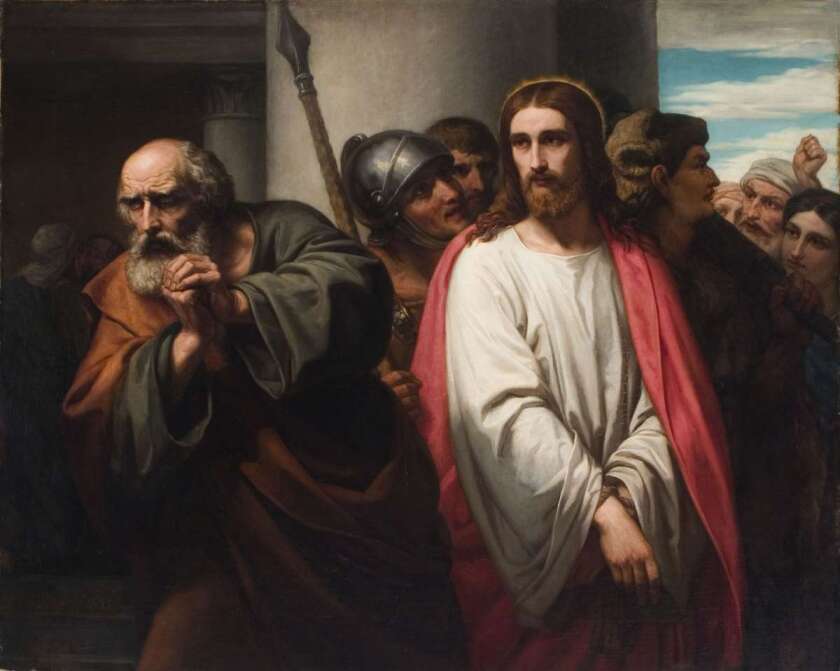
Ary Scheffer (1795-1858), The Denial of Peter, 1855, oil on canvas, 52 x 73 inches.
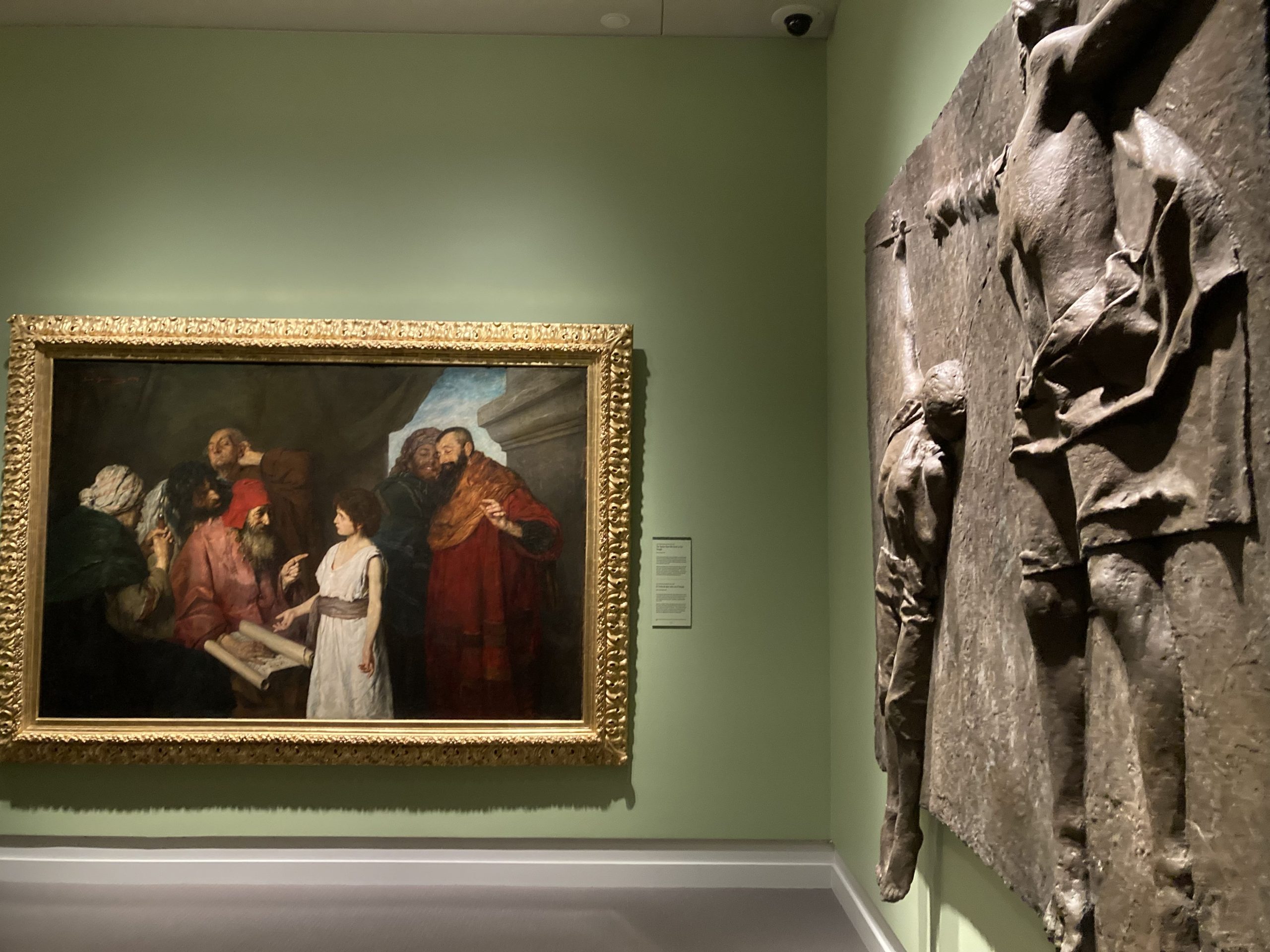
Installation view of Earthbound and Heavenward.
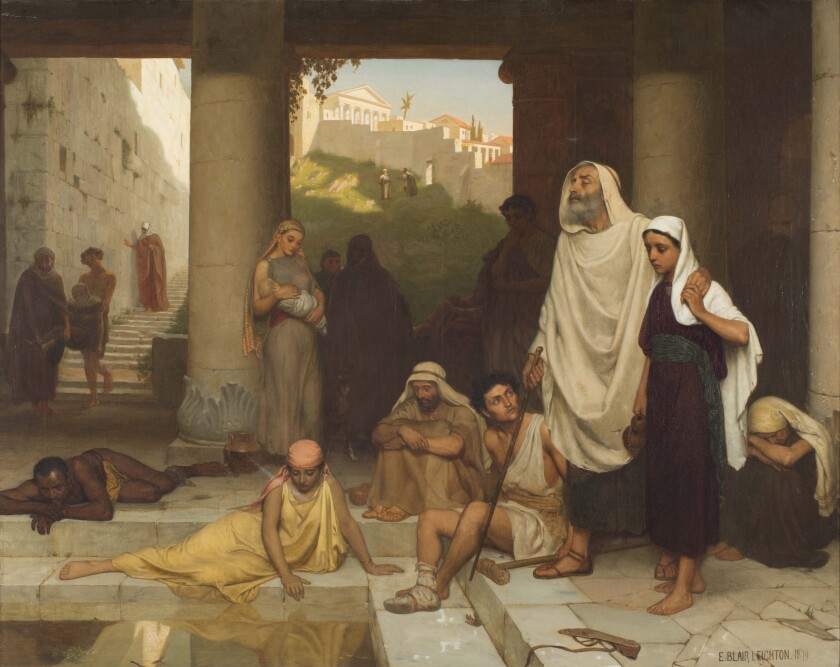
Edmund Blair Leighton (1852-1922), ‘The Blind Man at the Pool of Siloam’, 1879, oil on canvas, 102.2 × 127.8 cm.
A large canvas depicting the Pool of Siloam works differently, but to related effect. The setting is recognizable: a columned portico, a prostrate figure, attendants gathered around. But Jesus, from the Biblical narrative, is absent. What the painting shows is the next act—the body not yet healed, the bystanders who must help, the ambiguous period before the miracle arrives. For many believers, that waiting room is where most of the spiritual life actually takes place. Viewers who know their scripture will feel the charge of what’s missing from the frame; those who don’t will encounter something equally complete—a scene of human suffering and communal uncertainty, held in suspension.
The contemporary works push further still, abandoning the figure almost entirely. Emilia Wing’s “Nazareth” depicts neither Christ nor his followers but the ground he covered—an aerial view rendered in oil and gold leaf, holiness figured as something that soaks into place rather than radiates from a person. Elise Wehle’s “Through a Corridor of Laurel” goes further: a gothic arch rendered in geometric gold tracery, overgrown with pressed ferns and laurel, no figure anywhere. The ecclesiastical form is still legible—you recognize the cathedral shape immediately—but it has been overtaken by living, perishable plant matter. Stone built to last; ferns that won’t. The viewer stands at the threshold, the corridor open before them, the walking of it their own to do.
These are different centuries, different artistic modes, but a shared idea. The exhibition does not ask the viewer to look upward toward Christ, but inward, to themselves. The exhibition’s title holds this condition without resolving it—earthbound and heavenward at once, not ascending, not arrived, caught in the stretch between. The Isaiah epigraph the curators chose reinforces this: lift up your eyes to the heavens, and look upon the earth beneath.
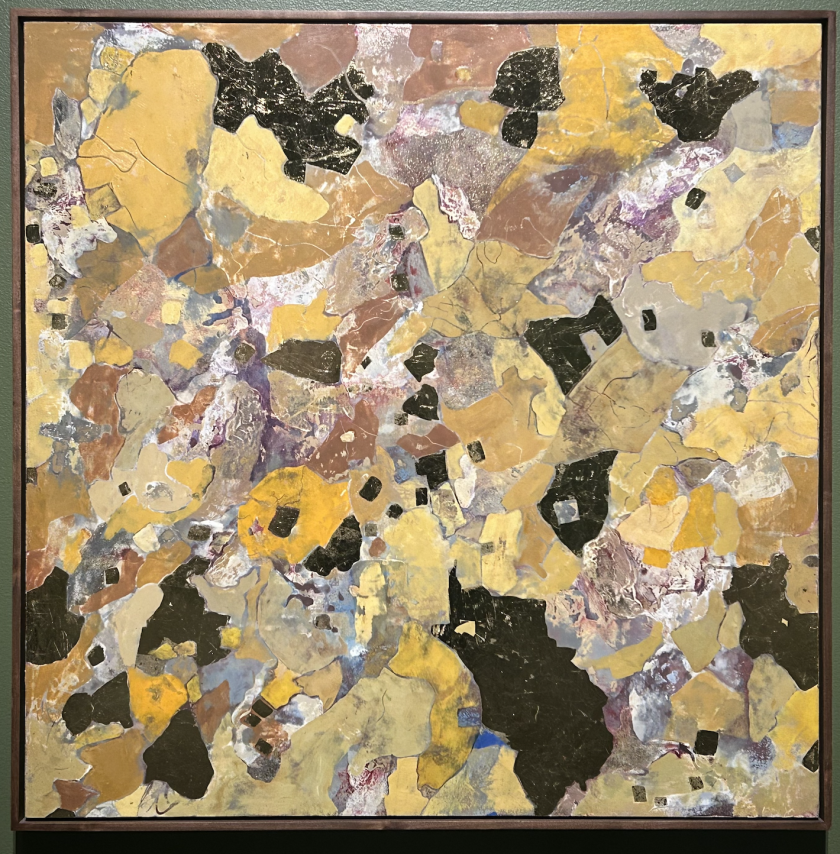
Emilia Wing’s “Nazareth”
Earthbound and Heavenward, BYU Museum of Art, Provo, through Sep. 30, 2028.
DID YOU ENJOY THIS ARTICLE?
Help make more like it possible.
VENMO us a donation at artistsofutah

Or use PayPal to MAKE A DONATION.
15 Bytes is published by Artists of Utah, a 501 (c) 3 tax-exempt nonprofit.

The founder of Artists of Utah and editor of its online magazine, 15 Bytes, Shawn Rossiter has undergraduate degrees in English, French and Italian Literature and studied Comparative Literature in graduate school before pursuing a career in art.
Categories: Exhibition Reviews | Visual Arts