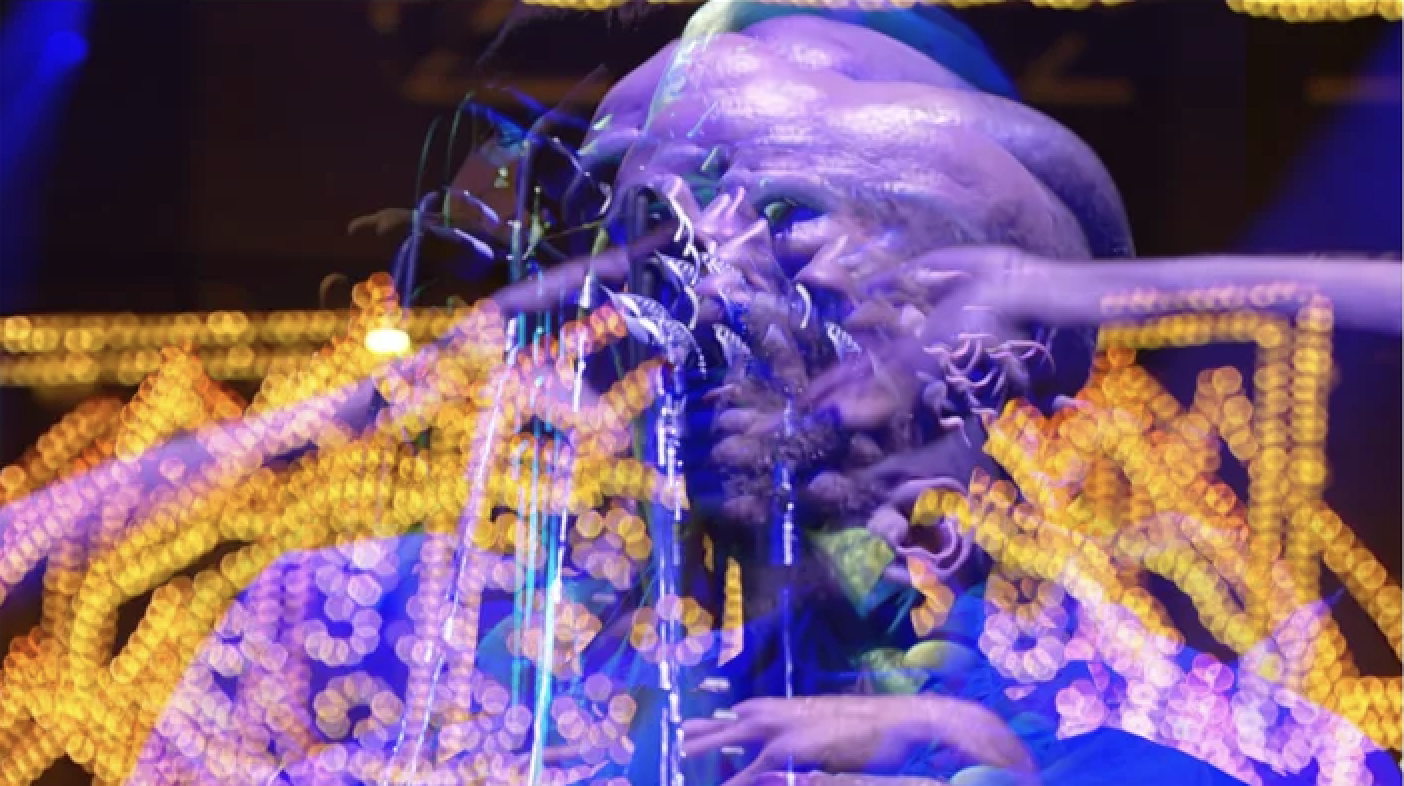
John Bell, “Crush with eyEliner,” 2025, digital print, 24” x 18.75”
There’s an assumption widely made that, by definition, a portrait must have an essential relationship with the identity of its subject. It discloses the identity of the individual whose portrait it purports to be. Yet there is nothing necessary about that connection, especially in the subtle and powerful manner of thought we call art, and examined closer, it soon becomes apparent that not only is that not always true, but it may only be so in a minority of situations. A portrait titled “The Dancer” is no less a portrait for being of an activity, rather than an individual practitioner.
Impetus for this thought comes from Salt Lake City artist John Bell, who has invented a really fine demonstration of the alternative. That is to say, he has in his gallery 24 large, elaborately constructed photographic images, each of which portrays some human angle, attribute, or behavior as if—though this is not how they come about—a high-speed, multi-frame film of one or more persons had been frozen into a single image. Bell rightly regards the technique that produces them as a form of painting; one utilizing a digital camera and a computer to augment the artist’s hand, eye, and skill. In fact, he dismisses most common distinctions between the “data” detected by scientists and that which becomes apparent to an artist. Collectively titled “Anxiety is the Dizziness of Freedom,” a definition Bell took from the work of the 19th-century Danish philosopher and theologian Søren Kierkegaard, the photos were first shown at the Al Filo Del Agua in Mexico. Now they are available to the Utah audience at his gallery, ONE Modern Art, recently reopened in an industrial building a block from the West Temple offramp of Interstate 80.
There are always several things, often conflicting conditions, going on at once in an exhibition. For instance, in addition to all that is happening in the art on display, there’s the connection—or the disconnect—between the works being shown and the space they’re shown in. For Bell, that’s ostensibly a major challenge: ONE Modern Art is a single, industrial space, with cinderblock walls and a concrete floor. Within this relatively vast room is the show we’re there to see, plus at least one other artist’s work, and often more, on display. But it’s also the studio workshop and the archive of recent pieces that haven’t left yet or are between outings. There’s the customary living room area, with comfy seating for visitors and a layout table. Except for a small office at one end, all this is open all the time. In most galleries, such an arrangement would not be workable, but here it’s part of the way ONE Modern Art lives up to its name. Not just the art, but the whole, domestic reality of art’s productive life is part of the scene.
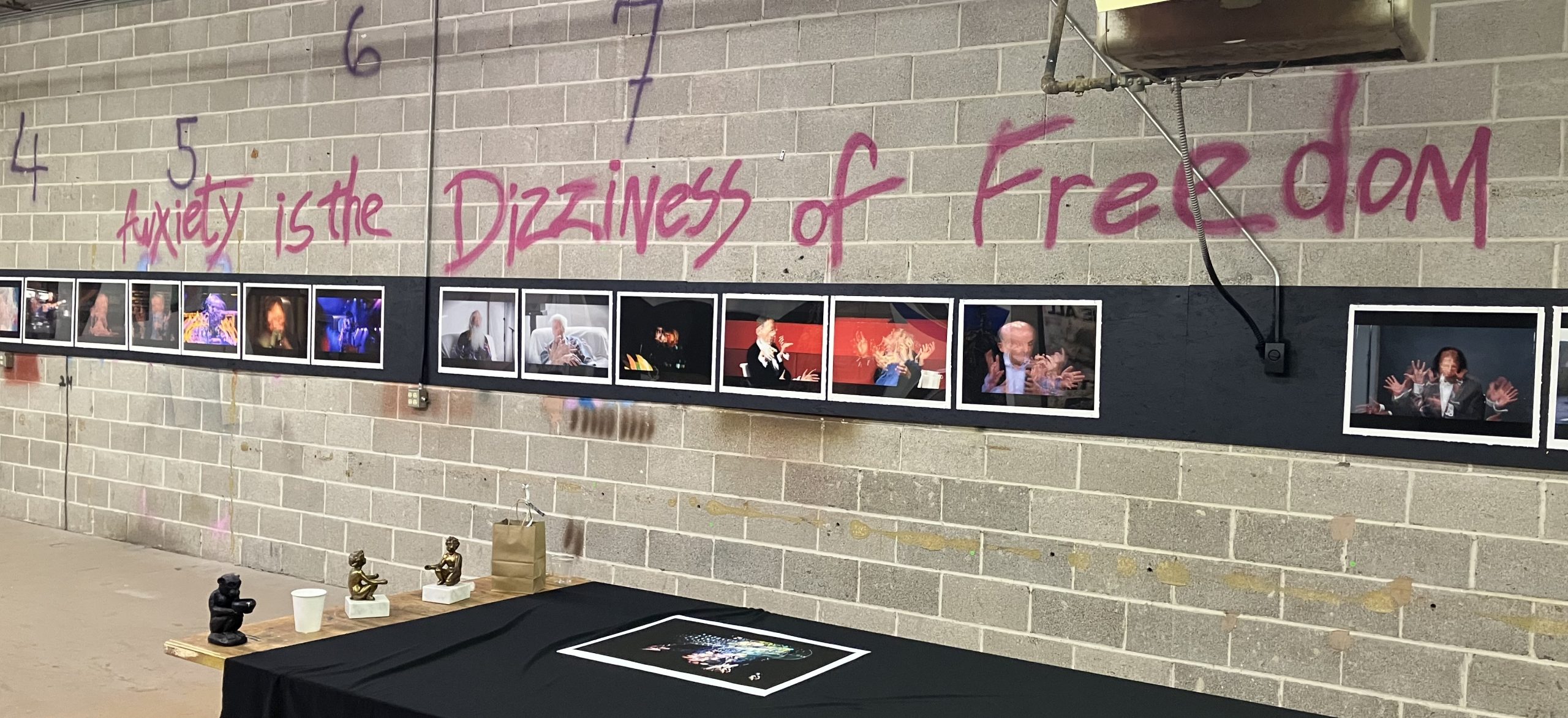
Installation view of Anxiety is the Dizziness of Freedom at ONE Modern Art. Image. by Geoff Wichert.
Frank McEntire, who has shown at One Modern and almost everywhere else, and has personally introduced many of us to John Bell, speaks with particular knowledge and emphasis about how Bell adroitly overcomes this challenge. In the case of Anxiety, he has created 24 large photographs that he shows unframed, in four sets of six, each under a pane of glass. Normally they might be seen spread around the walls of a gallery like so many independent objects, with a variety of spacings and even some interruptions, all in the assumption that viewers will identify them according to their individual levels of interest. What Bell has done, however, is to locate a broad, black ribbon along one wall, on which the 24 photos are mounted in a continuous sequence. Although there are interruptions on the wall, as there are in almost any situation where a gallery is used for shows that vary considerably in the numbers and needs of the works, it is readily possible not only to see the entire collection, but to see how it is comprises four sets of six photos. While a few works that were steps in the process have been mounted apart from the black banner, from anywhere in the gallery it is clear that this black band with its 24 pictures constitutes a single exposition.
What waits to be witnessed behind those 24 panes of glass may not on first sight be so easy to identify. They initially present as what might be called “high speed” abstractions: in other words, scenes in which so much is going on that, not unlike a cartoon scene of something happening very fast, what is visible is a blur of sometimes identifiable parts amidst a lot of visually noisy, yet promising fragments. They may be very close to pure abstractions. More often than not, even in the midst of all this, elements become identifiable: a face, hands, a guitar. In some portraits, as they are arguably best labeled, the subject is identifiable. In one particularly poignant scene, the prolific “Indian-born, British and American novelist” (as Wikipedia describes him) Salman Rushdie is clearly seen. More on that later.
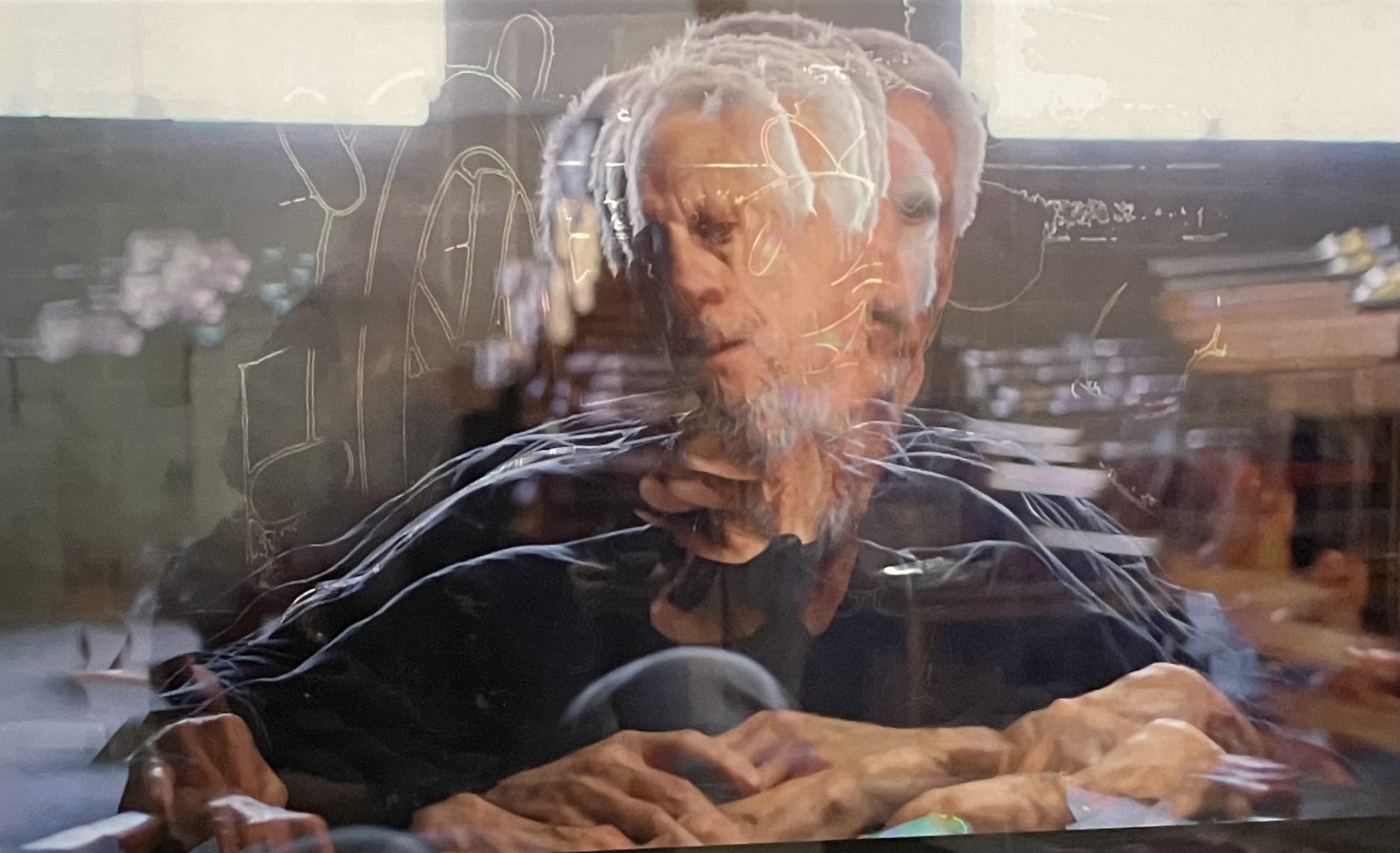
The surface of the print reflects the surrounding space of ONE Modern Art, merging viewer and environment into the work. Image by Geoff Wichert.
One of the challenges art faces in the present age is the necessity of protecting it from its audience. Having to view an inherently challenging near-abstraction, which is how these photographs might accurately be described, is not made easier by the necessary presence of reflective glass. That said, it could be argued that in this case, the choice of glazing tends, and was probably intended, to bring the environment into the image in much the same way a shadow might, except in a way more appropriate to contemporary experience. The reflections of static objects around the room, beside and behind the viewer, not to mention the viewer’s own reflected image and those of other viewers, breaks down the conventional separation of what’s behind the glass with those in front of it, and somewhat unifies the two environments. In any case, the artist has provided at least one unglazed example—at the opening it lay on a table nearby—in order that viewers could compare the pictures as exhibited with their natural state.
To that end, it’s worth noting that, where some artists insist on playing the sphinx, Bell is eager to explain his accomplishment. Where an audience member could easily shrug off the implications of these unique images, perhaps thinking they are similar enough to other examples of staccato, or strobe-like processes, Bell wants their workings to be understood by viewers so they can be seen accurately. They are not, for instance, simple sequential frames from a film. Rather, they have been selected by him from the hundreds or thousands that even a short video sequence might contain. Take for example that image of Salman Rushdie: as Bell selected and “stacked” the dozens of frames that he wanted, it became apparent that while one of the author’s eyes was clear, the other seemed to disappear. Imagine Bell’s shock when, a few months after the final version was complete, Rushdie was attacked on stage by a knife-wielding, would-be assassin, whose inept assault failed to kill him, but cost him the very eye that seems missing in Bell’s portrait.
Some of John Bell’s design choices are less mysterious than the Rushdie image, but worth noting. In a traditional motion picture, there are 24 frames shown per second to produce the illusion of motion. To emphasize this number, Bell selected 24 individual images to overlay in each of his 24 photos. It may well be that in years to come, when cultural historians look back over the early years of the 21st century, one of art’s most salient features from that time will be a concern with the multitude of media through which our view of reality has been processed and delivered to us. Consider that so much of the critique of our social and political processes we encounter daily largely blames our problems on the increasing distortion created, sometimes deliberately but often seemingly unavoidably, by the very nature and function of our technologies. If so, the interaction between John Bell’s subject matter and the methods he uses to explore it may be among the more useful and revealing approaches in today’s art. While he does credit individuals who are seen, if not often identified or identifiable, in these portraits, the impact of the way they are “painted” and ultimately shown may say far more without any necessity of knowing who they were.
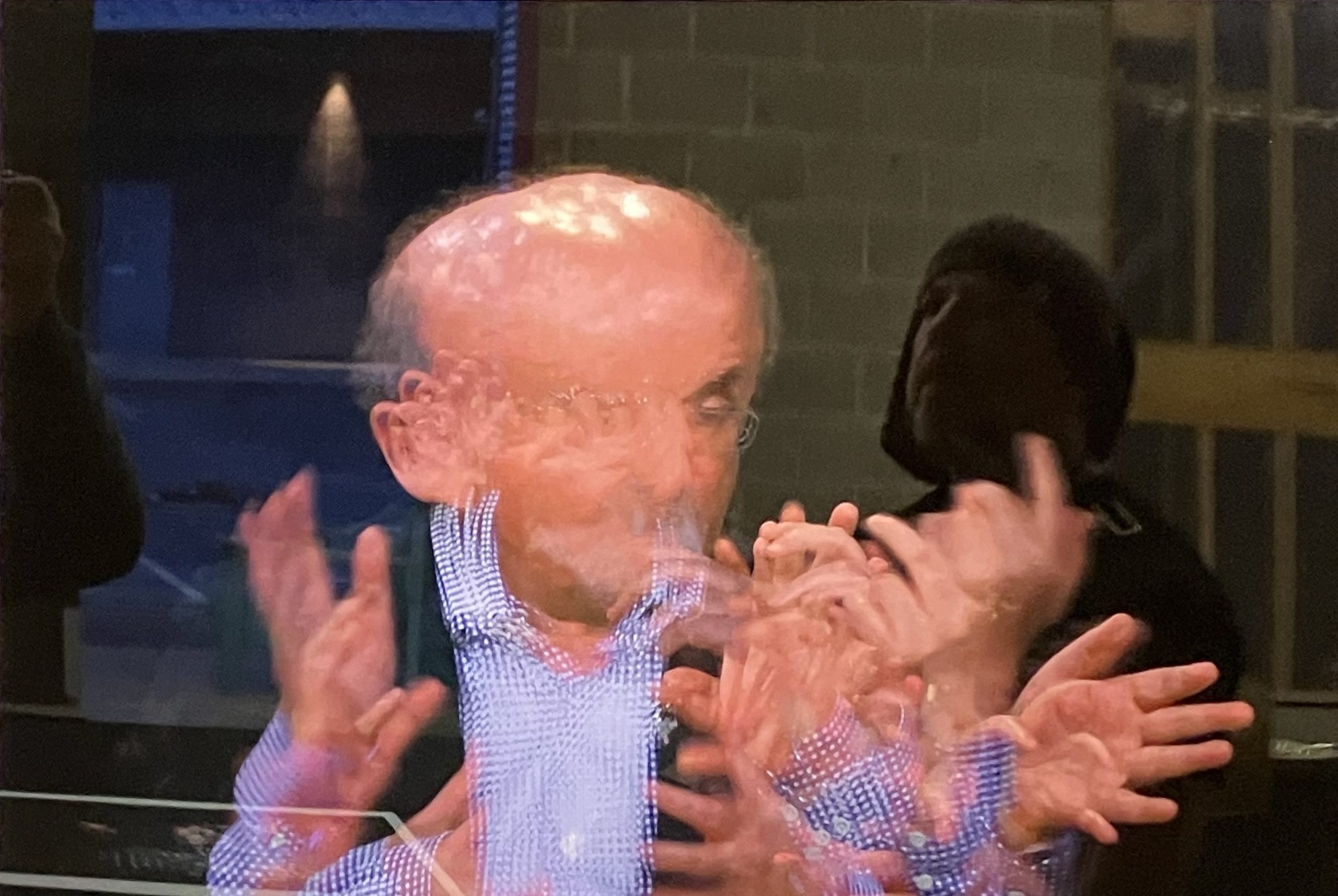
John Bell’s multi-frame portrait of author Salman Rushdie, whose duplicated gestures and shifting features evoke both vitality and vulnerability within the larger theme of freedom and identity. Bell can be seen reflected in the right portion of the image. Image by Geoff Wichert.
Anxiety is the Dizziness of Freedom, ONE Modern Art, Salt Lake City, through November 30.

Geoff Wichert objects to the term critic. He would rather be thought of as a advocate on behalf of those he writes about.
Categories: Exhibition Reviews | Visual Arts








Bravo, Shawn Rossiter! Beautifully assembled from artworks difficult to photograph and text adroitly paired with them. I must add that my closing evaluation of John Bell’s visual summation of our predicament chimes in a most timely fashion with your introductory lament pointing out how the digital world has grown too big, complex, and fragile for us to take for granted any longer.
These are so cool!!!!
Bravo Geoff!! A well written and thought out discourse on John’s work. You have done it once again.